
Start with the outcome, not the feature list
Write the result in ordinary language: you want to keep daily speaking alive through busy and low-energy days. A useful app, tutor, or routine should make that result more likely. Everything else is secondary until the core speaking loop works.
For a learner motivated by consistency, the fastest useful test is doing a full roleplay on good days and a one-minute replay on hard days. It includes a purpose, a listener, and a next action. Those elements reveal whether you can respond, not just recognize correct Japanese.
| Japanese | Romaji | Meaning |
|---|---|---|
| 小さな練習を続けます。 | Chiisana renshū o tsuzukemasu. | I keep up small practice sessions. |
Diagnose the real bottleneck
The likely trap is making every streak day require a full lesson. Notice where the attempt actually slows: understanding the reply, finding a word, selecting the right register, building the sentence, or recovering after a misunderstanding.
Name one bottleneck before opening another lesson. A listening problem needs shorter replayable audio; a retrieval problem needs timed output; a register problem needs contrasting examples; and a confidence problem needs smaller successful repetitions.
Run a fair fifteen-minute test
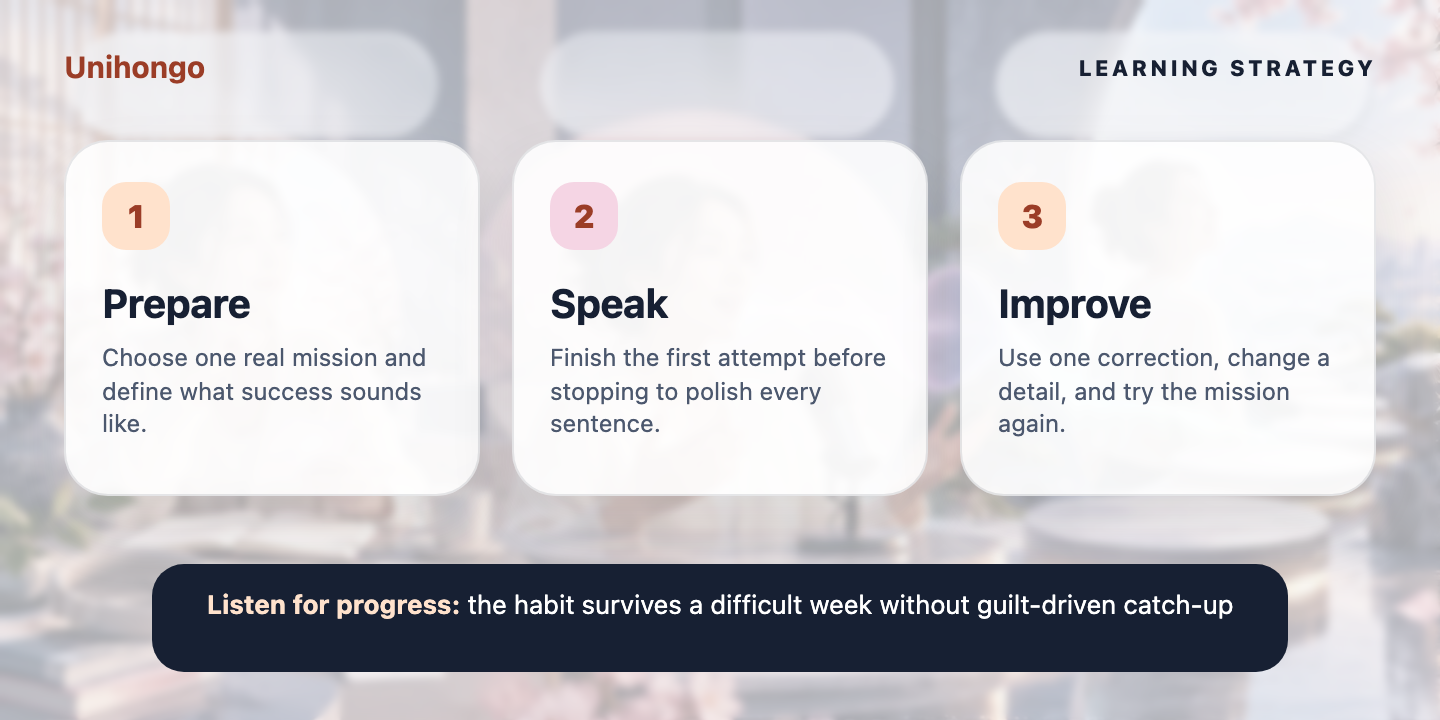
Use this method: define a normal session, a minimum viable session, and a deliberate rest rule. Keep the first run complete even when it is imperfect, because an unfinished sample cannot show whether the whole conversation works.
Then repeat doing a full roleplay on good days and a one-minute replay on hard days with one changed number, reason, person, or constraint. If the second attempt collapses when a detail changes, the first version was probably memorized rather than flexible.
- Two minutes: choose the mission and success condition
- Seven minutes: complete the first conversation without editing
- Three minutes: review one meaning correction and one naturalness correction
- Three minutes: replay with one detail changed
Measure progress you can hear
The proof signal for this goal is the habit survives a difficult week without guilt-driven catch-up. Record the date, mission, one bottleneck, and what improved on the replay. That is enough data to guide the next session.
Do not compare today's spontaneous answer with a polished model answer. Compare like with like: the same task, similar preparation, and a similar time limit. Monthly recordings reveal changes that daily confidence often hides.
Decide whether paid practice earns a place
A subscription should remove a real constraint. For a learner motivated by consistency, useful paid value might be longer conversations, more relevant missions, deeper feedback, saved progress, or the freedom to repeat at the time practice actually fits.
Use the free experience to test whether you return, speak, review, and replay. Upgrade only when a plan would help you keep daily speaking alive through busy and low-energy days more consistently. Check current pricing, limits, renewal terms, privacy choices, and cancellation details on the product page before paying.
Try the mission in Unihongo
Open a session with one sentence about the goal, then attempt doing a full roleplay on good days and a one-minute replay on hard days. Ask the AI Sensei to keep the exchange moving, request clarification when needed, and finish with a concise summary of the most useful correction.
Replay immediately with a changed detail and listen for the habit survives a difficult week without guilt-driven catch-up. If that loop feels useful enough to repeat during an ordinary week, compare the available Unihongo plans and choose the smallest option that removes your actual practice limit.