

Three instruction forms and when to use them
Japanese has several ways to tell someone what to do, and the written instruction forms are more limited than the spoken ones. The first is the dictionary form: tamanegi o kiru, cut the onion. This is the impersonal voice of recipe sites, manuals and signs. It reads as a description of what happens rather than a command. The second is the polite masu form: tamanegi o kirimasu. It reads as a friendly narrator walking beside you, and is common in recipes written for beginners and in videos.
The third is the request form, -te kudasai: tamanegi o kitte kudasai. This addresses a person, so it fits notes to a colleague and messages to a friend, where the softer -te ne or -te mite ne, try doing, is also natural. Rarer forms include the -koto ending, sanpun matsu koto, which reads like a rule. The bare imperative, kire, and the -nasai form belong to parents and emergencies, not written instructions.
| Japanese | Romaji | Meaning |
|---|---|---|
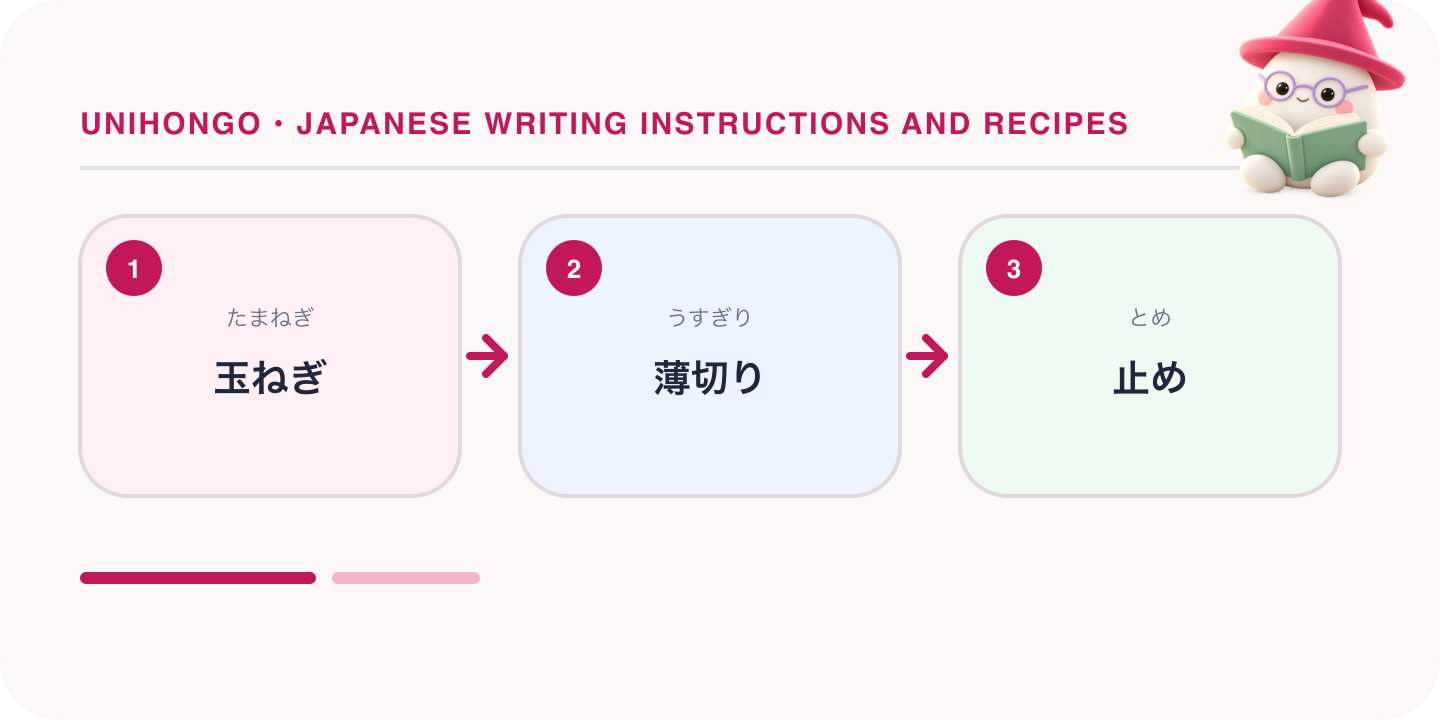
| 玉ねぎを薄切りにする。 | Tamanegi o usugiri ni suru. | Slice the onion thinly. (dictionary form) |
| 玉ねぎを薄切りにします。 | Tamanegi o usugiri ni shimasu. | Slice the onion thinly. (polite form) |
| 玉ねぎを薄切りにしてください。 | Tamanegi o usugiri ni shite kudasai. | Please slice the onion thinly. (request form) |
| 火を止めてね。 | Hi o tomete ne. | Turn off the heat, okay? (casual, to a friend) |
| 三分ほど待つこと。 | Sanpun hodo matsu koto. | Wait about three minutes. (rule style) |
| 電源を入れる前に、蓋を閉める。 | Dengen o ireru mae ni, futa o shimeru. | Close the lid before switching on the power. |
Sequencing words and connectors
The order of steps is carried by a small set of words placed at the start of a sentence. Mazu, first, opens the process, and hajime ni does the same job. Tsugi ni, next, is the everyday middle step. Sore kara, and then, joins two steps of equal weight. Sono ato, after that, and sono aida ni, meanwhile, help when two things happen in parallel. Saigo ni, finally, closes.
Inside a step, connectors handle dependence. The -te form chains actions in order: kitte, itameru, cut and fry. The -tara form means once something is done: iro ga kawattara, once the colour changes. Made means until: yawarakaku naru made, until soft. Nagara means while: mazenagara, while stirring. These four cover almost every recipe and how-to note. Numbered steps often drop the sequencing words, but mazu and saigo ni still help in prose instructions.
| Japanese | Romaji | Meaning |
|---|---|---|
| まず、米を研いで三十分水に浸す。 | Mazu, kome o toide sanjuppun mizu ni hitasu. | First, wash the rice and soak it in water for thirty minutes. |
| 次に、鍋にだしを入れて火にかける。 | Tsugi ni, nabe ni dashi o irete hi ni kakeru. | Next, put the dashi in a pan and heat it. |
| 沸騰したら、弱火にする。 | Futtō shitara, yowabi ni suru. | Once it boils, reduce to a low heat. |
| その間に、豆腐を一口大に切る。 | Sono aida ni, tōfu o hitokuchidai ni kiru. | Meanwhile, cut the tofu into bite-sized pieces. |
| 柔らかくなるまで煮る。 | Yawarakaku naru made niru. | Simmer until soft. |
| 最後に、ねぎを散らして完成。 | Saigo ni, negi o chirashite kansei. | Finally, scatter the spring onion and it's done. |
| 混ぜながら少しずつ加える。 | Mazenagara sukoshi zutsu kuwaeru. | Add a little at a time while stirring. |
Quantities, temperatures and times
Amounts come before the verb and after the ingredient: shōyu o ōsaji ippai kuwaeru, add one tablespoon of soy sauce. Ōsaji is a tablespoon and kosaji a teaspoon, counted with hai: ippai, nihai, sanbai. Cups are kappu, and Japanese recipes usually mean a 200 ml cup. Weight is guramu, and small quantities are shōshō, a pinch, or tekiryō, as needed. Whole items use ordinary counters: tamago ikko, one egg; ninjin ippon, one carrot; tōfu itchō, one block of tofu.
Heat levels are tsuyobi, chūbi and yowabi: strong, medium and low. Oven temperatures use do: hyaku hachijū do, 180 degrees. Times use fun and byō with the verbs niru, simmer; yaku, bake or grill; and itameru, stir-fry. Approximate times take hodo or kurai after the number, and a range is written with a tilde, san-gofun, three to five minutes. For servings, write the number of people with bun: futari-bun, for two.
| Expression | Reading | Meaning |
|---|---|---|
| 大さじ一杯 | ōsaji ippai | one tablespoon |
| 小さじ二分の一 | kosaji nibun no ichi | half a teaspoon |
| 一カップ | ichi kappu | one cup (usually 200 ml) |
| 二百グラム | nihyaku guramu | 200 grams |
| 少々 | shōshō | a pinch |
| 適量 | tekiryō | as much as needed |
| 一丁 | itchō | one block (of tofu) |
| 二人分 | futari-bun | serves two |
| 強火・中火・弱火 | tsuyobi, chūbi, yowabi | high, medium, low heat |
| 百八十度 | hyaku hachijū do | 180 degrees |
| 五分ほど | gofun hodo | about five minutes |
| 一晩 | hitoban | overnight |
An ingredient list, zairyō, is written with the ingredient on the left and the amount on the right, one per line, with the number of servings in the heading. Seasoning that goes in together is often grouped under the letter A with a bracket, and the step then says A o kuwaeru, add A.
A full model recipe: miso soup with tofu and wakame
Here is a complete recipe in the dictionary form used on recipe sites. It has a title, a servings line, an ingredient list and six numbered steps. The amounts are ordinary home proportions; the point is the language.
| Japanese | Romaji | Meaning |
|---|---|---|
| 豆腐とわかめの味噌汁(二人分) | Tōfu to wakame no misoshiru (futari-bun) | Miso soup with tofu and wakame (serves two) |
| 材料:だし汁 400ml、豆腐 半丁、乾燥わかめ 大さじ一、味噌 大さじ一と二分の一、小ねぎ 適量 | Zairyō: dashijiru yonhyaku miririttoru, tōfu hanchō, kansō wakame ōsaji ichi, miso ōsaji ichi to nibun no ichi, konegi tekiryō | Ingredients: 400 ml dashi, half a block of tofu, 1 tbsp dried wakame, 1.5 tbsp miso, spring onion as needed |
| 一、豆腐を一センチ角に切る。 | Ichi, tōfu o issenchi-kaku ni kiru. | 1. Cut the tofu into one-centimetre cubes. |
| 二、乾燥わかめを水で戻し、水気を切る。 | Ni, kansō wakame o mizu de modoshi, mizuke o kiru. | 2. Rehydrate the dried wakame in water and drain it. |
| 三、鍋にだし汁を入れて中火にかけ、沸騰したら豆腐とわかめを加える。 | San, nabe ni dashijiru o irete chūbi ni kake, futtō shitara tōfu to wakame o kuwaeru. | 3. Put the dashi in a pan over medium heat; once it boils, add the tofu and wakame. |
| 四、一分ほど煮たら、火を止める。 | Yon, ippun hodo nitara, hi o tomeru. | 4. After simmering for about a minute, turn off the heat. |
| 五、味噌を溶き入れ、再び温める。沸騰させないこと。 | Go, miso o tokiire, futatabi atatameru. Futtō sasenai koto. | 5. Dissolve in the miso and warm it again. Do not let it boil. |
| 六、器に盛り、小ねぎを散らす。 | Roku, utsuwa ni mori, konegi o chirasu. | 6. Serve in bowls and scatter the spring onion. |
A how-to note for a colleague
Office instructions follow the same logic with a politer surface. Use the masu form or -te kudasai, and open with one line saying what the note is for. Number the steps, one action each, and put anything that can go wrong in brackets or after a note marker such as chūi, caution. Close with your name and how to contact you if something is unclear. Here is a note for a colleague covering the weekly sales report.
| Japanese | Romaji | Meaning |
|---|---|---|
| 週次売上レポートの作成手順 | Shūji uriage repōto no sakusei tejun | Steps for preparing the weekly sales report |
| 一、毎週月曜の午前中に、共有フォルダの売上データを開いてください。 | Ichi, maishū getsuyō no gozenchū ni, kyōyū foruda no uriage dēta o hiraite kudasai. | 1. Every Monday morning, open the sales data in the shared folder. |
| 二、先週分の数字をテンプレートに貼り付けます。 | Ni, senshū-bun no sūji o tenpurēto ni haritsukemasu. | 2. Paste last week's figures into the template. |
| 三、合計が自動で計算されるので、赤字になっていないか確認してください。 | San, gōkei ga jidō de keisan sareru node, akaji ni natte inai ka kakunin shite kudasai. | 3. The total is calculated automatically, so check that nothing shows in red. |
| 四、PDFに保存して、部長にメールで送ります。 | Yon, PDF ni hozon shite, buchō ni mēru de okurimasu. | 4. Save as PDF and email it to the department head. |
| 注意:ファイル名は日付を先に書いてください。 | Chūi: fairu-mei wa hizuke o saki ni kaite kudasai. | Note: write the date first in the file name. |
| 不明な点があれば、田中まで連絡してください。 | Fumei na ten ga areba, Tanaka made renraku shite kudasai. | If anything is unclear, please contact Tanaka. |
Sentence patterns to reuse
Most steps fit one of these frames. Combine them and you can write instructions for anything from a curry to a coffee machine.
- Mazu, X o Y suru: first, do Y to X
- Tsugi ni, X ni Y o irete Z suru: next, put Y into X and do Z
- X shitara, Y suru: once X has happened, do Y
- X naru made Y suru: do Y until X
- X nagara Y suru: do Y while X
- X o Y hodo Z suru: do Z to X for about Y (time)
- Saigo ni, X shite kansei: finally, do X and it's finished
- X shinai koto / X shinaide kudasai: do not do X
- Fumei na ten ga areba, X made: if unclear, contact X
Cooking and instruction verbs
The verbs below cover the great majority of steps in home recipes and office notes. Learn the dictionary form and the masu form together.
| Verb | Reading | Meaning |
|---|---|---|
| 切る | kiru | to cut |
| 刻む | kizamu | to chop finely |
| 混ぜる | mazeru | to mix, stir |
| 加える | kuwaeru | to add |
| 炒める | itameru | to stir-fry |
| 煮る | niru | to simmer, boil in liquid |
| 焼く | yaku | to grill, bake, fry |
| 茹でる | yuderu | to boil (in water) |
| 蒸す | musu | to steam |
| 溶く | toku | to dissolve, beat (eggs) |
| 盛る | moru | to serve, dish up |
| 確認する | kakunin suru | to check |
| 保存する | hozon suru | to save (a file) |
| 送る | okuru | to send |
Yaku is broad: it covers grilling fish, baking bread and frying an egg. If the method matters, add the tool: furaipan de yaku, fry in a pan; ōbun de yaku, bake in an oven.
Mistakes that make steps unclear
The first mistake is mixing forms, which readers experience as a change in voice. The second is putting two or three actions in one step joined by long -te chains; readers lose track of which one they are on. The third is leaving out amounts and times, or putting them after the verb the English way: kuwaeru shōyu ōsaji ippai is not Japanese word order. The amount goes before the verb.
The fourth is using the bare imperative or -nasai in a note to a colleague, which reads as scolding. The fifth is forgetting the reader's knowledge: a friend who has never cooked Japanese food needs dashi explained, and a colleague new to the team needs to know where the shared folder is. Finally, check the counters: ōsaji ippai, not ōsaji ichi-ko, and ninjin ippon, not ninjin ikko.
| Japanese | Romaji | Meaning |
|---|---|---|
| 玉ねぎを切って、炒めて、水を入れて、煮て、味噌を入れる。 | Tamanegi o kitte, itamete, mizu o irete, nite, miso o ireru. | Cut the onion, fry, add water, simmer, add miso. (too many actions in one step) |
| 玉ねぎを切って炒める。水を加えて煮る。 | Tamanegi o kitte itameru. Mizu o kuwaete niru. | Cut and fry the onion. Add water and simmer. (split into two steps) |
| 醤油を入れろ。 | Shōyu o irero. | Put in the soy sauce! (bare imperative: not for written instructions) |
| 醤油を大さじ一杯加える。 | Shōyu o ōsaji ippai kuwaeru. | Add one tablespoon of soy sauce. (amount before the verb) |