
Motivation is a design problem
When a routine collapses, the honest question is not whether you wanted it enough. It is which part of the design asked for more than an ordinary day can supply. A ninety-minute evening session assumes an evening with ninety free minutes and enough energy to concentrate; most weeks do not contain five of those. The routine was not too weak, it was too expensive.
Treat every failure as a design fault with a specific repair. Too long becomes shorter. Too vague becomes a named drill. Invisible becomes measured. Isolated becomes social. This reframing matters because it is actionable: you cannot decide to feel more motivated tomorrow, but you can decide that tomorrow's session is five minutes and starts after you brush your teeth.
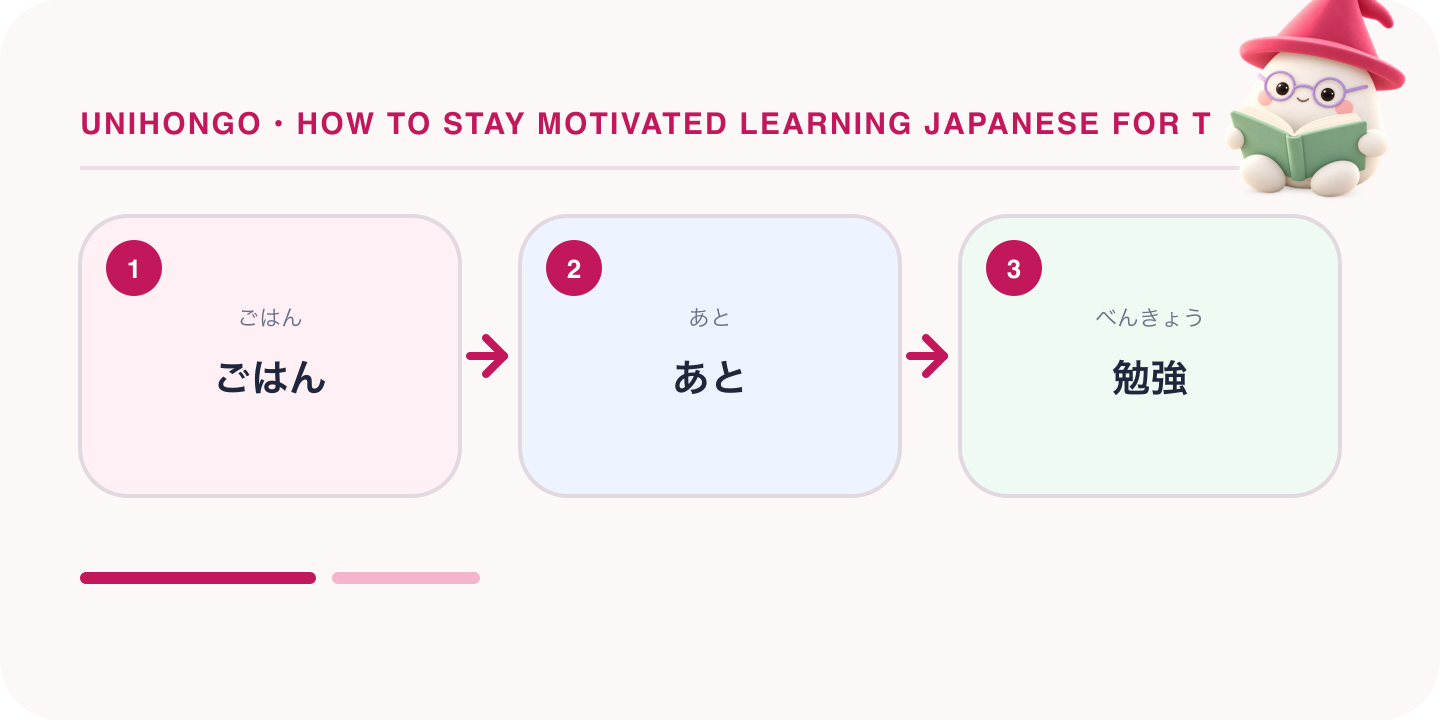
Where motivation actually breaks, and the structural fix
| Failure | What it looks like | Structural fix |
|---|---|---|
| Session too long | You skip entirely on busy days rather than doing less | Set a five-minute floor that always counts as done |
| No trigger | You study when you remember, which is rarely | Attach it to an existing daily action, same time, same place |
| Progress invisible | Months in, you feel identical to last month | Monthly recording, can-do list and a growing word bank |
| No audience | Nobody would notice if you stopped | One weekly conversation with a person or a scheduled session |
| No deadline | Someday fluency, no order of priorities | A dated trip, exam or call that decides what you study first |
| Streak broke | One missed day becomes a missed month | Restart at the minimum the same day; never double to compensate |
| Boring material | You avoid opening the book without deciding to quit | Swap the content, keep the schedule and the drill |
| Vague plan | You spend the session choosing what to do | Decide tonight's drill before you close the app tonight |
| All input, no output | You understand more but feel no more capable | Every session ends with something said aloud |
| All-or-nothing standards | A session with mistakes feels like a wasted one | Count sentences attempted, not sentences perfect |
Read the third column as a checklist rather than advice. Most learners need only two or three of these repairs, and they are usually the floor, the trigger, and a way to see progress. Fix those and the routine survives the weeks when you feel nothing about Japanese at all.
Shrink the session until it survives a bad day
Your minimum session should be embarrassingly small: five minutes, one drill, no setup. Its purpose is not to teach you much, it is to keep the identity of someone who studies Japanese intact through an awful week. The cost of a missed day is not the lost five minutes, it is that the next day's decision becomes optional again.
Define the floor as a specific action, not a duration you have to fill. Say ten sentences aloud. Review the due cards and nothing else. Play one round of a word game. On good days you will overshoot naturally, because starting is the expensive part and you will already have started.
- Write your floor as one sentence: five minutes, one named drill, one place.
- Keep the materials open or one tap away so setup costs nothing.
- Never raise the floor because you had a good week; raise your normal session instead.
- On a bad day, do the floor and stop deliberately, so it stays cheap next time.
Tie practice to something you already do
A habit needs a trigger, and a mood is a poor trigger. Anchor Japanese to an action that already happens without your deciding: after the kettle boils, after you sit on the train, after you close your laptop for the day. The anchor should be reliable and daily, and the practice should start within a minute of it so nothing intervenes.
Anchoring also removes the daily choice of what to study, which is where a surprising amount of time disappears while you scroll between options. Decide tonight what tomorrow's five minutes will contain, write it in one line, and choose it while you are not yet tired. A decision made in advance costs nothing to obey, and it turns the session into an action rather than a small planning meeting with yourself.
| Japanese | Romaji | Meaning |
|---|---|---|
| 朝ごはんのあとで、日本語を勉強します。 | Asagohan no ato de, nihongo o benkyō shimasu. | After breakfast, I study Japanese. |
| 電車の中で、単語を復習します。 | Densha no naka de, tango o fukushū shimasu. | On the train, I review vocabulary. |
| 寝る前に、五分だけ話します。 | Neru mae ni, gofun dake hanashimasu. | Before bed, I speak for just five minutes. |
| 毎日つづけることが大事です。 | Mainichi tsuzukeru koto ga daiji desu. | Continuing every day is what matters. |
The middle stage, where progress stops being visible
In the first months, progress announces itself. You could not read hiragana and now you can; you could not ask for the bill and now you can. Later the gains are wider and thinner: a slightly better ear, a few more grammar patterns available under pressure, less hesitation before a sentence. None of that shows up as an event, so it feels like nothing is happening, and that feeling is the most common reason people stop.
The answer is not more effort. It is measurement that is sensitive enough to catch small change. Three tools do this well: a recording you can compare across months, a can-do list written in the first person, and a word bank of items you have actually used in speech rather than merely met.
- Record ninety seconds on the same prompt on the first of every month and keep every file.
- Keep a can-do list: I can book a table by phone, I can explain why I am late.
- Log words the first time you use one in a real conversation, not when you learn it.
- Save one session report or correction list a month and reread last month's before you study.
- Every eight weeks, redo an old lesson's speaking task and notice how much less it costs you.
The comparison is the point. A recording from twelve weeks ago is more persuasive than any streak, because it is your own voice being slower and less certain than it is now, and you cannot argue with it.
Narrate your progress in Japanese
These are self-talk sentences: things you say about your own learning, aloud, in Japanese. They serve two purposes at once. They rehearse tense, adverbs and duration expressions you need anyway, and they make your progress something you can hear rather than something you have to believe. Say three of them at the end of every session, changing the numbers and verbs to match the truth of that day.
| Japanese | Romaji | Meaning |
|---|---|---|
| 今日は十五分、日本語を話しました。 | Kyō wa jūgo-fun, nihongo o hanashimashita. | Today I spoke Japanese for fifteen minutes. |
| 先週より、少し楽になりました。 | Senshū yori, sukoshi raku ni narimashita. | It has become a little easier than last week. |
| 新しい言葉を三つ使いました。 | Atarashii kotoba o mittsu tsukaimashita. | I used three new words. |
| まだ完璧じゃありませんが、伝わりました。 | Mada kanpeki ja arimasen ga, tsutawarimashita. | It is not perfect yet, but I got my meaning across. |
| 昨日は疲れていたので、五分だけにしました。 | Kinō wa tsukarete ita node, gofun dake ni shimashita. | I was tired yesterday, so I did only five minutes. |
| 三日休みましたが、今日また始めました。 | Mikka yasumimashita ga, kyō mata hajimemashita. | I took three days off, but I started again today. |
| 来月、電話で予約してみます。 | Raigetsu, denwa de yoyaku shite mimasu. | Next month I will try booking by phone. |
| 少しずつ、聞き取れるようになってきました。 | Sukoshi zutsu, kikitoreru yō ni natte kimashita. | Bit by bit, I have started being able to catch what people say. |
| 半年前は、これが言えませんでした。 | Hantoshi mae wa, kore ga iemasen deshita. | Six months ago I could not say this. |
| 今日はうまく話せませんでしたが、明日もやります。 | Kyō wa umaku hanasemasen deshita ga, ashita mo yarimasu. | I did not speak well today, but I will do it again tomorrow. |
Add a person, a booking and a dated reason
Solo study has no cost for skipping. Anything that creates a small external expectation changes that: a weekly call with a friend who is also learning, a language exchange partner, a class, or simply a session in your calendar with a time on it. Accountability does not have to be heavy, and it works better when the commitment is to a person or a time than to a private intention.
Be honest about what each option gives you. A person notices when you disappear and will ask, which is the strongest form; a scheduled AI session never asks but is always available and never full, which is the most reliable form. Most learners do well with one of each: a person weekly, a scheduled practice daily.
| Japanese | Romaji | Meaning |
|---|---|---|
| 今週も練習しましょう。 | Konshū mo renshū shimashō. | Let us practise again this week. |
| 毎週金曜日はどうですか? | Maishū kin-yōbi wa dō desu ka? | How about every Friday? |
| 三十分だけ話しませんか? | Sanjuppun dake hanashimasen ka? | Shall we talk for just thirty minutes? |
| 間違いがあったら、直してください。 | Machigai ga attara, naoshite kudasai. | If I make mistakes, please correct me. |
| 今日は日本語だけで話しましょう。 | Kyō wa nihongo dake de hanashimashō. | Let us speak only in Japanese today. |
| 四月に日本へ行きます。 | Shigatsu ni Nihon e ikimasu. | I am going to Japan in April. |
| 七月に試験を受けます。 | Shichigatsu ni shiken o ukemasu. | I am taking the exam in July. |
| それまでに、自己紹介を練習します。 | Sore made ni, jiko shōkai o renshū shimasu. | By then, I will practise my self-introduction. |
| 旅行で使う表現を先に覚えます。 | Ryokō de tsukau hyōgen o saki ni oboemasu. | I will learn the expressions I will use while travelling first. |
The last four lines belong to the second half of this fix. Open-ended goals give you no way to decide what to study this week, while a dated event does: a trip in April, an exam in July, a colleague visiting in six weeks. Choose one that exists whether or not you feel motivated, then write the three situations you want to handle and build backwards from them.
Recovering from a broken streak
You will miss days. The damage is done not by the missed day but by the story you attach to it, usually that you are the kind of person who does not follow through. That story predicts a second missed day, which confirms it. Break the sequence quickly and the missed day costs you almost nothing.
The rule is simple: restart the same day at the minimum, and never make up lost time. Doubling tomorrow's session is a punishment, and punishing a habit makes it less likely to happen. Return, do five minutes, and let the routine resume at its normal size the day after.
| Japanese | Romaji | Meaning |
|---|---|---|
| しばらく休んでいましたが、また始めます。 | Shibaraku yasunde imashita ga, mata hajimemasu. | I had been resting for a while, but I am starting again. |
| 今日は五分だけでいいです。 | Kyō wa gofun dake de ii desu. | Five minutes is enough for today. |
| 続けることが目標です。 | Tsuzukeru koto ga mokuhyō desu. | My goal is to keep going. |
- Miss a day: do the five-minute floor today, not a longer session tomorrow.
- Miss a week: reread your can-do list, then do the floor. Do not restart the course.
- Miss a month: play one game round or say ten sentences, and rebuild from the floor upward.
- Write down what made you stop; usually it was a session that had grown too long.
Choose material you would consume anyway
Boredom is a design fault too. If you dislike the drama, the podcast or the textbook theme, you will find reasons not to open it and you will call that a motivation problem. Swap the content and keep the schedule. Your anchor, floor and drill can all stay the same while the material changes completely.
The one requirement is that the material must lead somewhere you can speak. Enjoyable input alone builds recognition and stalls there, so end every enjoyable session with two sentences said aloud about what you just watched or read. That single step converts entertainment into practice without making it feel like homework.
| Japanese | Romaji | Meaning |
|---|---|---|
| このドラマが好きなので、毎日見ています。 | Kono dorama ga suki na node, mainichi mite imasu. | I like this drama, so I watch it every day. |
| 今日のポッドキャストは、料理の話でした。 | Kyō no poddokyasuto wa, ryōri no hanashi deshita. | Today's podcast was about cooking. |
| 半分ぐらい分かりました。 | Hanbun gurai wakarimashita. | I understood about half of it. |
| 面白かったので、もう一度聞きます。 | Omoshirokatta node, mō ichido kikimasu. | It was interesting, so I will listen once more. |
What games and short sessions honestly do
Short game rounds are excellent at one job and poor at another. They keep the habit alive on days when nothing else will happen, and they drill recognition speed for vocabulary and kana efficiently, which is real work. What they do not do is build the ability to produce a sentence under the pressure of a live conversation, because the answer is always on screen somewhere.
Use them deliberately rather than instead. A round of a vocabulary or listening game is a legitimate floor day. On a normal day it is the warm-up, and the session still ends with speech: a roleplay, a recording, or your three self-talk sentences. Judge the tool by what it protects, and do not let it stand in for the part that is uncomfortable.
- Floor day: one game round counts as done, and the streak survives.
- Normal day: game as warm-up, then five to ten minutes of speaking.
- Weekly: one longer conversation where you cannot see any answers.
- Monthly: the ninety-second recording, compared with the previous one.
A routine that runs without enthusiasm
Put the pieces together into something small enough to survive. One anchor, one floor, one weekly conversation, one monthly measurement, and one dated reason. That is the whole system, and none of it requires you to feel keen on a given morning. Enthusiasm still arrives, but it becomes a bonus that makes a session longer rather than the thing that decides whether it happens.
- Anchor: after a fixed daily action, same place every day.
- Floor: five minutes, one named drill, no setup.
- Output: every session ends with something said aloud.
- Weekly: one conversation with a person or a scheduled speaking session.
- Monthly: re-record the same prompt and update the can-do list.
- Dated reason: one real event that decides your priorities.
Review the design, not your character, whenever it stops working. Ask which of the six lines broke, repair that one, and start again today at the floor. A routine you can rebuild in five minutes is one you will still be running next year.