
What ninety days can honestly give you
By the end of this plan you should be able to read both kana without pausing, introduce yourself and ask a stranger three follow-up questions, order food, buy a ticket, describe your day in the past and present, and repair a conversation when you do not understand. That is a genuine beginner level and it is enough to survive a trip and to enjoy a lesson without translating everything first.
What you will not have is comfortable reading, natural speed listening, or the vocabulary for opinions on abstract topics. Beginners who expect those things at the ninety-day mark usually conclude they have failed when they have simply reached the normal end of the first stage. The plan below is designed so that the thing you gain is production: sentences you can produce under time pressure, out loud, without a script.
The thirteen-week map
| Week | Focus | Can-do checkpoint |
|---|---|---|
| 1 | Hiragana plus ten greeting and courtesy phrases | Read any hiragana word aloud in under three seconds |
| 2 | Katakana plus forty more survival phrases | Say fifty phrases from memory without reading |
| 3 | Desu sentences, particles wa and no, self-introduction | Introduce yourself for thirty seconds unscripted |
| 4 | Masu verbs, particles o, ni, de, time expressions | Describe your daily routine in six sentences |
| 5 | Past tense, negatives, i- and na-adjectives | Describe last weekend in six sentences |
| 6 | Question words, numbers, counters, prices | Ask five questions and understand the answers |
| 7 | Cafes and restaurants, te-form requests | Order a meal and change one thing about it |
| 8 | Shops, stations, directions, ticket machines | Buy a ticket and ask how to reach a place |
| 9 | Small talk, weather, hobbies, work | Keep a three-minute conversation going |
| 10 | Repair strategies and polite refusals | Recover from not understanding three times |
| 11 | Review of every grammar point in one week | Explain your week using four tenses |
| 12 | Fluency drills on your weakest situations | Repeat a roleplay with no pauses over three seconds |
| 13 | Self-test and the plan for the next ninety days | Hold a ten-minute conversation and read the report |
Print this table and tick each checkpoint out loud, not in your head. A checkpoint you cannot perform on demand has not been reached, and repeating a week is cheaper than carrying a gap into the next phase.
Weeks 1 and 2: kana and the first fifty phrases
Learn hiragana in week one and katakana in week two, using recognition drills rather than handwriting. The goal is reading speed, not neat strokes. In parallel, memorise fifty phrases that cover greeting, thanking, apologising, asking for something, and admitting you do not understand. These fifty do not require grammar, so they give you real speech while the grammar is still weeks away.
The single most useful group is the repair set: the lines that keep a conversation alive when you have lost the thread. Beginners who learn these in week one recover from confusion instead of freezing, and that changes what every later conversation feels like. Say each one aloud twenty times until it comes out as one unit rather than assembled words.
| Japanese | Romaji | Meaning |
|---|---|---|
| おはようございます。 | Ohayō gozaimasu. | Good morning. |
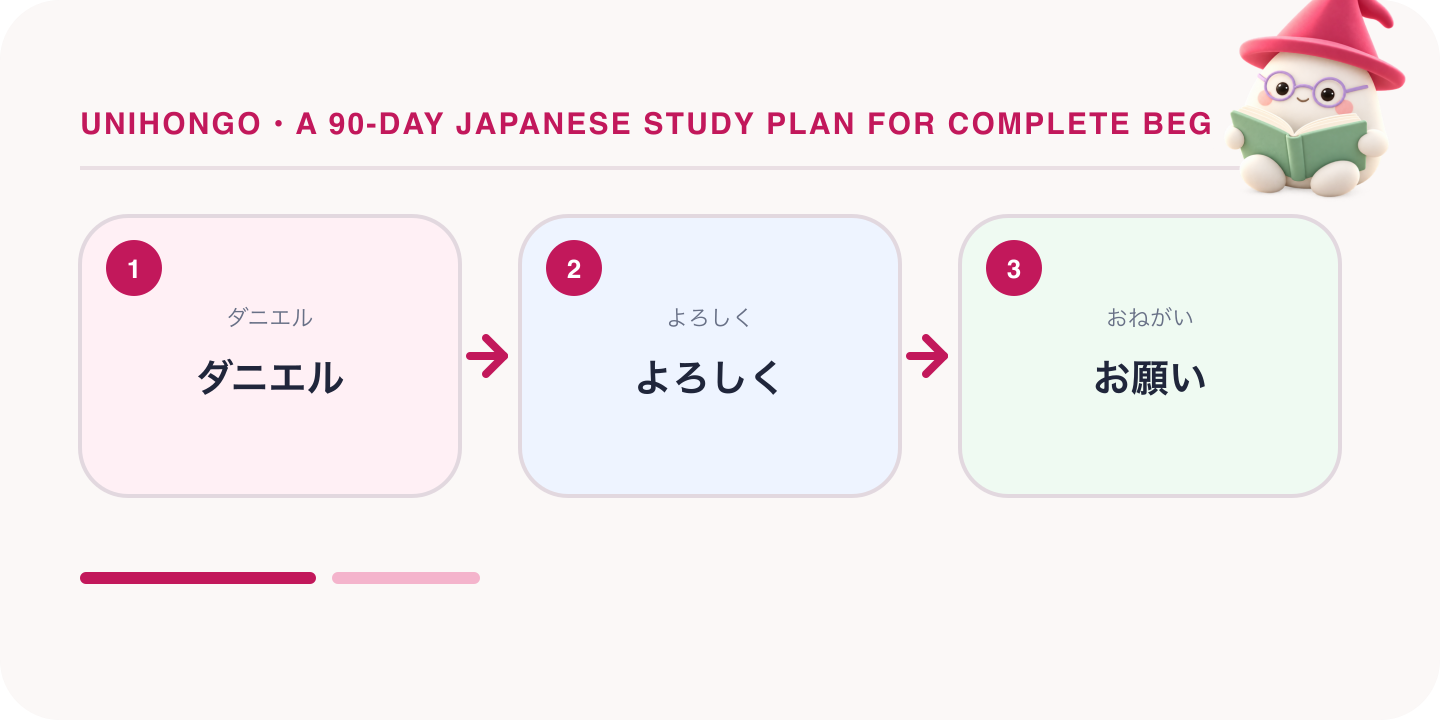
| はじめまして。ダニエルです。 | Hajimemashite. Danieru desu. | Nice to meet you. I am Daniel. |
| よろしくお願いします。 | Yoroshiku onegai shimasu. | I look forward to working with you. |
| ありがとうございます。 | Arigatō gozaimasu. | Thank you. |
| すみません。 | Sumimasen. | Excuse me. / Sorry. |
| これをください。 | Kore o kudasai. | This one, please. |
| 分かりません。 | Wakarimasen. | I do not understand. |
| もう一度お願いします。 | Mō ichido onegai shimasu. | Once more, please. |
| ゆっくり話してください。 | Yukkuri hanashite kudasai. | Please speak slowly. |
| 日本語が少し話せます。 | Nihongo ga sukoshi hanasemasu. | I can speak a little Japanese. |
Weeks 3 to 6: core grammar and three hundred words
This phase is the engine of the plan. You cover the noun sentence with desu, the polite masu verb form, past and negative endings, both adjective types, the core particles, and question words. That is a small syllabus, and it is enough to say most ordinary things about your life. The rule for the phase is that no grammar point counts as learned until you have said five original sentences with it out loud.
Vocabulary runs alongside at five to eight new words a day, chosen from your own life rather than a frequency list: your job, your commute, your food, your family. A word you will actually use gets retrieved often, and retrieval is what fixes it. Words that only appear in exercises quietly disappear. By the end of week six you should have roughly three hundred words that live in sentences.
| Japanese | Romaji | Meaning |
|---|---|---|
| 私はエンジニアです。 | Watashi wa enjinia desu. | I am an engineer. |
| 毎朝コーヒーを飲みます。 | Maiasa kōhī o nomimasu. | I drink coffee every morning. |
| 七時に会社へ行きます。 | Shichi-ji ni kaisha e ikimasu. | I go to the office at seven. |
| 昨日は映画を見ました。 | Kinō wa eiga o mimashita. | I watched a film yesterday. |
| 今日はあまり忙しくないです。 | Kyō wa amari isogashikunai desu. | I am not very busy today. |
| この店は静かで、きれいです。 | Kono mise wa shizuka de, kirei desu. | This shop is quiet and clean. |
| 駅はどこですか? | Eki wa doko desu ka? | Where is the station? |
| それはいくらですか? | Sore wa ikura desu ka? | How much is that? |
| 日本語を勉強しています。 | Nihongo o benkyō shite imasu. | I am studying Japanese. |
| 時間がありませんでした。 | Jikan ga arimasen deshita. | I did not have time. |
If a particle keeps escaping you, do not open a new grammar chapter to fix it. Take one noun and cycle it through the particles aloud, as the particles guide on this blog suggests, then move on. Phase two rewards breadth of use, not depth of explanation.
Weeks 7 to 10: situations and roleplay
Now the plan changes shape. Instead of learning a structure and finding sentences for it, you take a situation and find the structures it needs. Each week owns one setting: the cafe, the shop and station, small talk, then repair and refusal. Run the same scene four or five times across the week, changing one variable each time, so the second half of the week is about speed rather than discovery.
Record what the other person says as carefully as what you say. Beginners rehearse their own lines and are then stopped by a staff member's ordinary reply. Learn the two or three responses each situation actually produces, including the ones that mean no, and you will stop losing conversations at the second turn.
| Japanese | Romaji | Meaning |
|---|---|---|
| すみません、メニューをお願いします。 | Sumimasen, menyū o onegai shimasu. | Excuse me, the menu please. |
| こちらのセットにします。 | Kochira no setto ni shimasu. | I will have this set. |
| かしこまりました。少々お待ちください。 | Kashikomarimashita. Shōshō omachi kudasai. | Certainly. One moment, please. |
| 新宿までいくらですか? | Shinjuku made ikura desu ka? | How much is it to Shinjuku? |
| この電車は東京駅に止まりますか? | Kono densha wa Tōkyō-eki ni tomarimasu ka? | Does this train stop at Tokyo Station? |
| 荷物を預かってもらえますか? | Nimotsu o azukatte moraemasu ka? | Could you look after my luggage? |
| 写真を撮ってもいいですか? | Shashin o totte mo ii desu ka? | May I take a photo? |
| 申し訳ありませんが、今日はできません。 | Mōshiwake arimasen ga, kyō wa dekimasen. | I am sorry, but I cannot today. |
| すみません、今の言葉の意味は何ですか? | Sumimasen, ima no kotoba no imi wa nan desu ka? | Sorry, what does the word you just said mean? |
| 英語のメニューはありますか? | Eigo no menyū wa arimasu ka? | Do you have an English menu? |
Weeks 11 to 13: consolidation and the self-test
The last phase adds almost nothing new. Week eleven revisits every grammar point in a single pass, week twelve drills your two weakest situations until the pauses shrink, and week thirteen is the test. The test is simple: a ten-minute conversation covering your background, your last weekend, your plans, and one unfamiliar topic the other person chooses. Record it and listen back once.
Score it on three things only. Did you finish your sentences, or trail off into English? Did you repair breakdowns instead of stopping? Were your past and negative endings mostly correct? A pass on those three means the foundation is sound and the next ninety days can move to longer input and te-form chains. A fail on one of them tells you exactly which week to repeat.
| Japanese | Romaji | Meaning |
|---|---|---|
| 週末は何をしましたか? | Shūmatsu wa nani o shimashita ka? | What did you do at the weekend? |
| 土曜日は家族と公園に行きました。 | Doyōbi wa kazoku to kōen ni ikimashita. | On Saturday I went to the park with my family. |
| 日本語を勉強し始めて三か月です。 | Nihongo o benkyō shihajimete san-kagetsu desu. | It has been three months since I started studying Japanese. |
| 最初はひらがなも読めませんでした。 | Saisho wa hiragana mo yomemasen deshita. | At first I could not even read hiragana. |
| 今は簡単な会話ができます。 | Ima wa kantan na kaiwa ga dekimasu. | Now I can have a simple conversation. |
| 来週から新しい目標を決めます。 | Raishū kara atarashii mokuhyō o kimemasu. | From next week I will set a new goal. |
The daily thirty-minute split
| Phase | Input and reading | Vocabulary | Speaking |
|---|---|---|---|
| Weeks 1 to 2 | 10 min kana recognition | 5 min phrase review | 15 min saying the phrases aloud |
| Weeks 3 to 6 | 10 min grammar point | 8 min new and review words | 12 min original sentences aloud |
| Weeks 7 to 10 | 5 min situation vocabulary | 5 min review | 20 min roleplay and repair drills |
| Weeks 11 to 13 | 5 min weak-point review | 5 min review | 20 min free conversation |
Notice that the speaking block never drops below twelve minutes and grows as the plan goes on. That is deliberate. Study time that never becomes speech produces a learner who understands the answer and cannot give it, which is the most common outcome of self-study and the hardest to fix later.
Keep the split in that order too. Input first while you are fresh, vocabulary second, speaking last, so the session ends with the skill you most want to feel confident about. Ending on a struggle you resolved is what makes tomorrow's session easier to start.
What to skip in the first ninety days
- Kanji handwriting drills. Recognise the kanji you meet on signs, but leave stroke practice to a later phase.
- Rare grammar such as passive causatives and heavy conditional contrasts. They appear in textbooks early and in speech late.
- Textbook completionism. Skipping exercises you can already do is not cheating; finishing every page is not the goal.
- Buying more resources. One grammar source, one word list of your own, and one speaking partner is a complete kit.
- Perfect pitch accent on every word. Aim for correct vowel length and rhythm first, since those change meaning more often.
- Long passive listening with no comprehension. Background audio feels productive and teaches almost nothing at this level.
Each of these is worth doing eventually. The point of a ninety-day plan is sequencing, and every hour spent on a later-stage skill is an hour not spent on the production ability that makes the whole thing feel real.
Adapting the plan to fifteen or sixty minutes
At fifteen minutes a day, keep the same thirteen phases but stretch them to twenty weeks, and protect the speaking block above everything else. Cut input to five minutes, drop new vocabulary to three words a day, and spend the remaining time talking. A short session that ends in speech beats a longer one that ends in a reading exercise.
At sixty minutes, do not simply double every block. Keep the thirty-minute core exactly as written and add a second session later in the day: fifteen minutes of listening to material slightly above your level, and fifteen minutes repeating the day's roleplay from memory. Splitting the hour into two sittings spaces the retrieval and holds attention better than one long block.
- Fifteen minutes: 5 input, 3 vocabulary, 7 speaking, and stretch each phase by roughly half.
- Thirty minutes: the split in the table above, unchanged, thirteen weeks.
- Sixty minutes: the thirty-minute core in the morning, plus fifteen minutes of listening and fifteen of recall at night.
- Any length: never let the speaking share fall below a third of the session.
Narrating your own progress in Japanese
One quiet trick doubles the value of the plan. At the end of each session, say two or three sentences in Japanese about what you just did. The sentences are simple, they recycle the past tense and time expressions constantly, and they turn the log you would otherwise write in English into speaking practice. After a month these become the easiest sentences you own.
| Japanese | Romaji | Meaning |
|---|---|---|
| 今日は三十分練習しました。 | Kyō wa sanjuppun renshū shimashita. | I practised for thirty minutes today. |
| 新しい単語を六つ覚えました。 | Atarashii tango o muttsu oboemashita. | I learned six new words. |
| 昨日より少し上手になりました。 | Kinō yori sukoshi jōzu ni narimashita. | I have become a little better than yesterday. |
| 今週の目標は五十語です。 | Konshū no mokuhyō wa gojū-go desu. | This week's goal is fifty words. |
| 間違えても、続けます。 | Machigaete mo, tsuzukemasu. | Even if I make mistakes, I will keep going. |
| 三日休みましたが、また始めます。 | Mikka yasumimashita ga, mata hajimemasu. | I took three days off, but I am starting again. |
| 毎日少しずつやります。 | Mainichi sukoshi zutsu yarimasu. | I do a little every day. |
| 来月は旅行で日本語を使います。 | Raigetsu wa ryokō de Nihongo o tsukaimasu. | Next month I will use Japanese on a trip. |
When you fall behind
Assume you will miss days. The plan is built so that a missed day costs nothing and a missed week costs two catch-up days of review. What actually breaks a plan is the decision to restart from week one after a gap, because it puts you back in kana drills you already passed and makes the whole thing feel like a treadmill.
If motivation is the problem rather than time, shrink the session rather than skipping it. Five minutes of saying yesterday's phrases aloud keeps the habit alive and, more importantly, keeps your mouth used to the sounds. The learners who reach day ninety are rarely the ones with the most free time; they are the ones whose worst day is still five minutes long.