
What points, streaks and timers genuinely do
The first thing a game does is lower the cost of starting. Opening a textbook is a decision; tapping a game that promises a ninety-second round is barely one. Since most missed study days are lost at the moment of starting rather than in the middle of a session, that is a real gain, and it is the strongest argument for keeping games in your week.
The second thing is frequency of retrieval. A round of a vocabulary runner asks you to recall thirty or forty words in a minute, each under mild pressure, and recall spaced across days is what memory keeps, while re-reading is what it drops. A game is simply the least painful way anyone has found to make that retrieval happen every day.
The third is visible progress. Language learning feels flat for months, and a level, a tower, or a personal best gives you evidence that something moved. That feedback is not learning, but it keeps you in the chair long enough for the learning to happen.
What they do badly
A score rewards whatever is cheapest to score. In most games that is recognition: the word appears, you pick it from three choices, points. Production, where you recall a word from nothing and say it correctly, is expensive to check, so it is rarely scored, so it is rarely practised. Learners then arrive in a conversation with a large recognition vocabulary and almost nothing they can say, and blame themselves rather than the scoring.
A streak changes your goal. Once the number is large, the sessions inside it get shorter and easier, because the point of a session becomes keeping the streak alive rather than learning anything. A timer does something similar: under the clock you steer toward words you already know and avoid the deck that would slow you down, which is the deck you should be playing.
- Recognition scores inflate faster than speaking ability, so a high score can hide a learner who cannot open their mouth.
- Streak protection favours the shortest possible session at the latest possible time of day.
- Timers push you toward familiar decks and away from the level you are supposed to be reaching.
- Leaderboards reward playing time rather than learning, and playing time is easy to fake with easy decks.
- Nothing in a game notices that you have never once used a word in a sentence.
Every mechanic has a benefit and a trap
| Mechanic | What it does well | The trap | How to keep it honest |
|---|---|---|---|
| Points | Instant feedback on each answer | Rewards recognition because it is easiest to score | Count sentences said aloud, not points |
| Streaks | Gets you to start every day | Sessions shrink to protect the number | Set a minimum content for a day to count |
| Timers | Forces fast retrieval | Makes you avoid hard decks | Play the harder deck untimed first, then timed |
| Levels and decks | Gives a clear next step | Staying on a comfortable level | Move up when a round has two misses or fewer |
| Towers and combos | Makes accuracy feel rewarding | Guessing to keep a run alive | Say the word before you tap it |
| Multiple choice gates | Quick, low-friction rounds | Eliminating options instead of knowing | Add a recall direction and a listening game |
| Flip-to-reveal cards | Trains genuine recall | Flipping before you have really tried | Say the answer aloud before every flip |
| Pronunciation quests | The only mechanic that trains speech | Clearing a word you mumbled | Clear it only when you would say it to a person |
Real Japanese versus a game skin over multiple choice
The difference is easy to test. In a game that contains real Japanese, the Japanese is the puzzle: you read a customer's order and pick the right plate, you hear a word and choose its meaning without seeing it, you put chunks into the order a sentence actually takes. In a game skin, the puzzle is something else, such as timing a jump or matching colours, and the Japanese is decoration that could be swapped for any other language without changing the play.
Ask three questions of any game. Does getting the Japanese wrong lose the round, or only the theme? Does the game ever require you to produce, whether by recalling a word before seeing it, ordering a sentence, or saying it aloud? And does the content come from a deck you can inspect and adjust, so that it can match your level and your own words? Yes to all three and the game is doing real work.
- The Japanese must be the obstacle, not the wallpaper.
- At least one mode should demand recall or speech rather than recognition.
- You should be able to see and change the deck, including loading your own words.
- A round should fit the time you actually have, so that stopping is easy and starting is easier.
Mix the directions so recognition cannot hide
The cheapest fix for a recognition-heavy routine is to play every deck in both directions. Seeing the Japanese and picking the meaning is reading; seeing the meaning and picking the Japanese is recall. A learner who only plays the first direction will read menus and freeze at the counter. A game such as Vocabulary Dash lets you choose which way the gates run, and the rule is to alternate rounds rather than choosing your favourite.
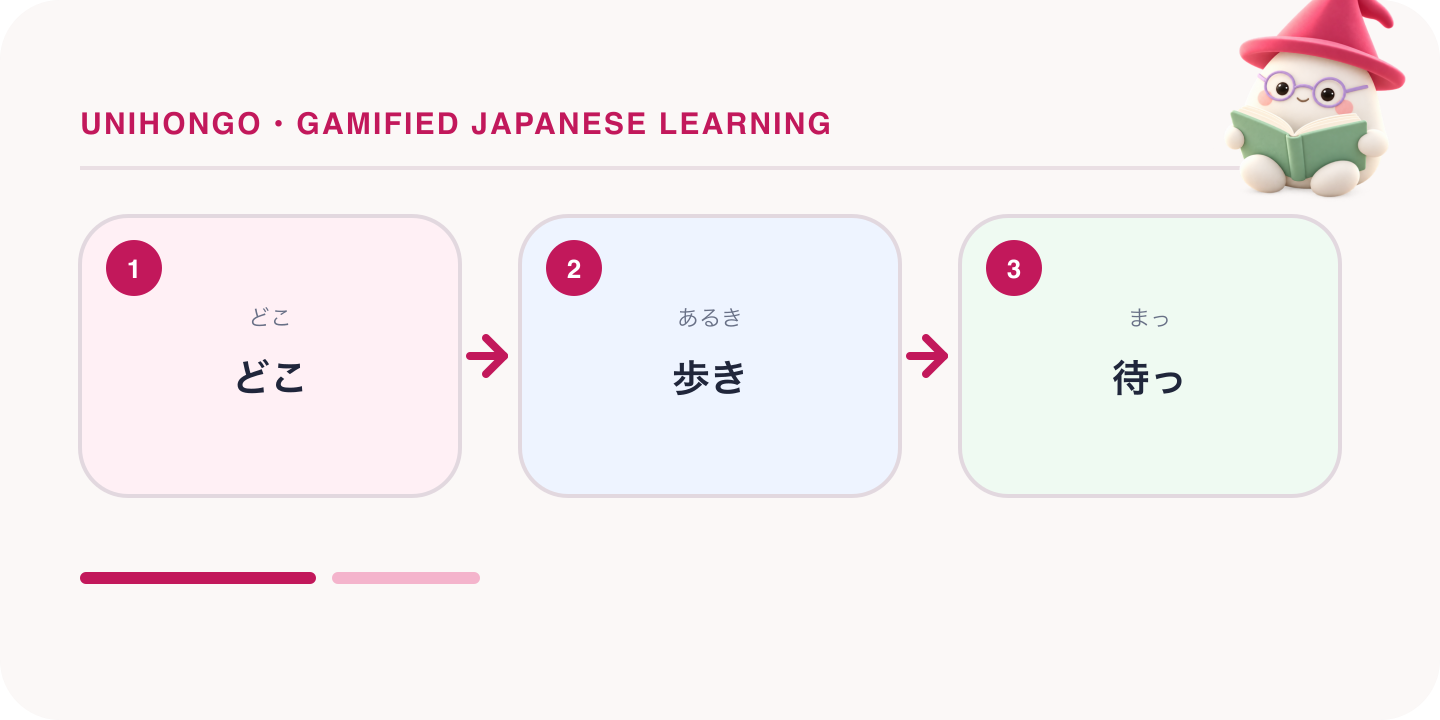
Then take a word out of the game and use it three times. A word that only lives in a gate is not yours yet; a word you have said in three sentences with different particles and verbs around it is. These lines take the word eki, station, through three real jobs.
| Japanese | Romaji | Meaning |
|---|---|---|
| 駅はどこですか? | Eki wa doko desu ka? | Where is the station? |
| 駅まで歩きます。 | Eki made arukimasu. | I walk to the station. |
| 駅の前で待っています。 | Eki no mae de matte imasu. | I am waiting in front of the station. |
| 昨日、新しい靴を買いました。 | Kinō, atarashii kutsu o kaimashita. | I bought new shoes yesterday. |
| この靴は少し小さいです。 | Kono kutsu wa sukoshi chiisai desu. | These shoes are a little small. |
| 靴を脱いでください。 | Kutsu o nuide kudasai. | Please take off your shoes. |
Add listening and speaking games
Most game mechanics are visual, so a routine built only from runners and towers never trains the ear or the mouth. Two kinds of game repair that. A listening game plays the word before showing anything, so you cannot lean on the spelling; Listen & Pick works this way, and the first rounds are humbling because words you read easily turn out to be unfamiliar as sounds. A pronunciation quest such as Say It! reverses the direction: you listen, say the word aloud, then reveal the reading and decide honestly whether it was good enough to clear.
Use the pronunciation game for the pairs that trip listeners, where a long vowel or a doubled consonant changes the meaning. Saying both members of a pair back to back, and clearing neither until they sound different, is the closest a game gets to real speech practice.
| Japanese | Romaji | Meaning |
|---|---|---|
| 病院はあそこです。 | Byōin wa asoko desu. | The hospital is over there. |
| 美容院に行きます。 | Biyōin ni ikimasu. | I am going to the hair salon. |
| おじいさんは元気です。 | Ojiisan wa genki desu. | My grandfather is well. |
| おじさんは東京にいます。 | Ojisan wa Tōkyō ni imasu. | My uncle is in Tokyo. |
| 切手を三枚ください。 | Kitte o san-mai kudasai. | Three stamps, please. |
| 来てください。 | Kite kudasai. | Please come. |
Byōin and biyōin, ojiisan and ojisan, kitte and kite: each pair differs by one length, and a visual game cannot tell whether you hear or say that length. Only a listening round and a spoken round can, which is why a routine needs at least one of each.
Where games sit in the day
The honest place for a game is around speaking, not instead of it. A short round before a conversation wakes up the words you are about to need, and a short round afterwards catches the words you fumbled while they are still fresh. On Unihongo the live session with the AI Sensei is the main event, and the arcade is the warm-up and cool-down on either side of it, with session words turning into flashcards when you are signed in so the two halves share a vocabulary.
The block below is a workable twenty-five minutes. It is deliberately lopsided: the speaking is the longest part, and the games are short enough that skipping them on a busy day costs little. If you only have ten minutes, keep the live speaking and the closing sentence and drop both games.
| Japanese | Romaji | Meaning |
|---|---|---|
| 今日はゲームで天気の言葉を練習しました。 | Kyō wa gēmu de tenki no kotoba o renshū shimashita. | Today I practised weather words in a game. |
| 今日は晴れですが、少し寒いです。 | Kyō wa hare desu ga, sukoshi samui desu. | It is sunny today but a little cold. |
| 明日の天気はどうですか? | Ashita no tenki wa dō desu ka? | What is the weather like tomorrow? (Sensei) |
| 明日は雨だと思います。 | Ashita wa ame da to omoimasu. | I think it will rain tomorrow. |
| ゲームで間違えた言葉は「曇り」です。 | Gēmu de machigaeta kotoba wa "kumori" desu. | The word I got wrong in the game was kumori. |
| 「曇り」を使って、一文言ってみましょう。 | "Kumori" o tsukatte, ichibun itte mimashō. | Let's try one sentence using kumori. (Sensei) |
| 今朝は曇りでした。 | Kesa wa kumori deshita. | It was cloudy this morning. |
| Block | Minutes | What you do |
|---|---|---|
| Warm-up game | Five | One round of a runner or stacker on the deck you will need, both directions |
| Warm-up sentence | Two | Say two sentences using words from the round |
| Live speaking | Twelve | A conversation or roleplay mission with the AI Sensei |
| Cool-down game | Four | Listen & Pick or Say It! on the words you fumbled |
| Closing sentence | Two | One spoken sentence per fumbled word, said to the Sensei |
A warm-up sentence is short and factual, and it hands the teacher something to ask about. Here is a warm-up after a round on weather words, with the replies it tends to draw.
End every session with a spoken sentence
This is the single rule that keeps gamification honest. Whatever you played, the session is not over until you have said at least one full sentence using a word from it, out loud, to someone or something that can answer. It converts the day's recognition into production, it exposes the words you can pick but not pronounce, and it gives the streak a content it has to contain.
With the AI Sensei the closing step takes two or three minutes. Report what you learned, name the hardest word, use it in a sentence, and answer one question about it. The session report afterwards shows the corrections, and those corrected words become tomorrow's cool-down deck, so the loop closes on its own.
| Japanese | Romaji | Meaning |
|---|---|---|
| 今日は五つの新しい言葉を覚えました。 | Kyō wa itsutsu no atarashii kotoba o oboemashita. | I learned five new words today. |
| 一番難しかった言葉は「約束」です。 | Ichiban muzukashikatta kotoba wa "yakusoku" desu. | The hardest word was yakusoku. |
| 「約束」を使って文を言います。 | "Yakusoku" o tsukatte bun o iimasu. | I will say a sentence using yakusoku. |
| 明日、友達と約束があります。 | Ashita, tomodachi to yakusoku ga arimasu. | I have plans with a friend tomorrow. |
| 何時に会いますか? | Nanji ni aimasu ka? | What time are you meeting? (Sensei) |
| 六時に駅で会います。 | Roku-ji ni eki de aimasu. | We are meeting at the station at six. |
| 「約束」の発音はとても自然です。 | "Yakusoku" no hatsuon wa totemo shizen desu. | Your pronunciation of yakusoku is very natural. (Sensei) |
| この言葉の使い方が分かりません。 | Kono kotoba no tsukaikata ga wakarimasen. | I do not understand how to use this word. |
| 例えば、「電車に間に合いました」と言います。 | Tatoeba, "densha ni maniaimashita" to iimasu. | For example, you say densha ni maniaimashita. (Sensei) |
| もう一度言ってもいいですか? | Mō ichido itte mo ii desu ka? | May I say it once more? |
| 今日はここまでにします。 | Kyō wa koko made ni shimasu. | I will stop here for today. |
| お疲れ様でした。また明日。 | Otsukaresama deshita. Mata ashita. | Good work. See you tomorrow. (Sensei) |
Signs your gamification has gone wrong
- Your streak is long but you cannot remember what yesterday's session contained.
- You choose the deck by how fast you can clear it rather than by what you need.
- Your recognition score is high and your last real conversation was weeks ago.
- You have never played a listening or speaking mode because they feel slower.
- You feel anxious about breaking the streak and nothing about not speaking.
- You would rather replay a cleared level than open the roleplay that scares you.