
The register between chat and keigo
Learners usually own two written registers: the clipped casual style of a messaging app and the fixed formulas of business Japanese. The personal email lives between them. It uses desu and masu from the first line to the last, because email is a slightly formal medium even between friends, but it does not use the business frame; nobody writes osewa ni natte orimasu to a friend's mother. The warmth comes from content: remembering something they said, asking after a child's cold, naming the meal they cooked.
The people who get this email are a specific group: a friend you address politely, a former teacher or host family, a colleague you also see socially, an acquaintance from a class or club, or a friend's parents. With a close friend you would normally message instead, and if you do email, plain forms are fine. The business email guide on this blog covers work correspondence, and almost nothing in it transfers here except the habit of one topic per email.
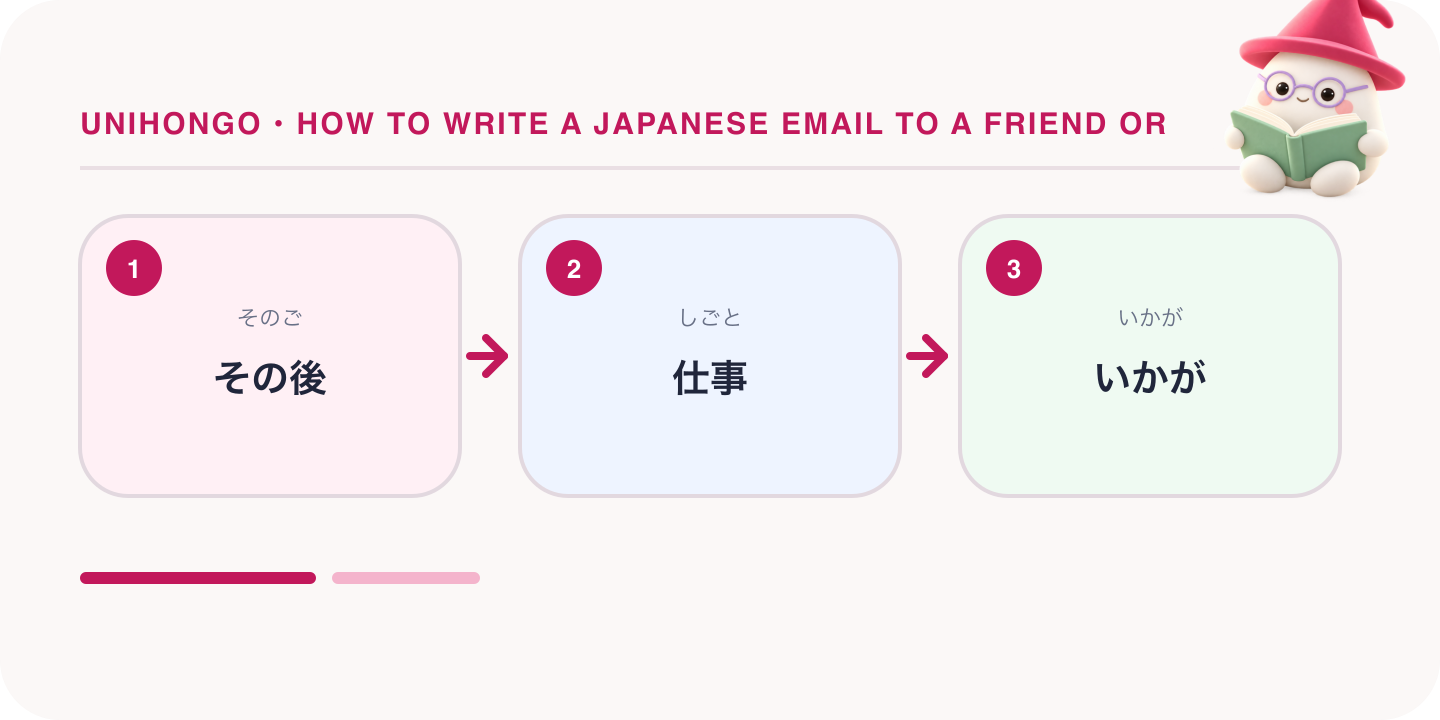
The five-move skeleton
Every personal email in Japanese can be built from five moves. First, a greeting matched to how long it has been since you were last in touch. Second, one line about the other person, a question or a remembered detail, before you talk about yourself. Third, your news or the purpose of the email, in a short paragraph. Fourth, a closing wish about their health, the season or a next meeting. Fifth, your name, on its own line. The moves are short; a whole email is often eight lines.
The second move is the one learners skip, and it is what separates a letter from a notice. It signals that you thought about the reader before you started typing. Keep it specific and answerable. Vague lines such as ogenki desu ka on their own are fine as a greeting but weak as this move; ask about the thing they mentioned last time.
| Japanese | Romaji | Meaning |
|---|---|---|
| その後、お仕事はいかがですか? | Sono go, oshigoto wa ikaga desu ka? | How has work been since then? |
| お引っ越しは無事に終わりましたか? | Ohikkoshi wa buji ni owarimashita ka? | Did the move go smoothly? |
| 新しい生活には慣れましたか? | Atarashii seikatsu ni wa naremashita ka? | Have you settled into your new life? |
A greeting matched to how long it has been
The opening line tells the reader how long the gap has been, and choosing the wrong one feels odd, like saying long time no see to someone you met yesterday. Within a couple of weeks of meeting, konnichiwa plus your name, or senjitsu wa arigatō gozaimashita if they did something for you, is right. After a month or more, ohisashiburi desu is friendly and gobusata shite imasu slightly more formal and apologetic, suited to someone older. A first email to an acquaintance opens with an apology for the suddenness and a reminder of where you met.
| Japanese | Romaji | Meaning |
|---|---|---|
| こんにちは。田中です。 | Konnichiwa. Tanaka desu. | Hello, it's Tanaka. (recent contact) |
| 先日はありがとうございました。 | Senjitsu wa arigatō gozaimashita. | Thank you for the other day. (within a couple of weeks) |
| お久しぶりです。お元気ですか? | Ohisashiburi desu. Ogenki desu ka? | It's been a while. How are you? (friendly, a month or more) |
| ご無沙汰しています。お変わりありませんか? | Gobusata shite imasu. Okawari arimasen ka? | It has been a long time. I hope all is well. (more formal, someone older) |
| 突然のメールで失礼します。先月の料理教室でご一緒した田中です。 | Totsuzen no mēru de shitsurei shimasu. Sengetsu no ryōri kyōshitsu de goissho shita Tanaka desu. | Excuse the sudden email. This is Tanaka from the cooking class last month. |
Seasonal openers in one sentence
Business letters open with fixed seasonal phrases; personal emails open with one natural sentence about the weather where you are, usually ending in ne so the reader can agree. It sits after the greeting and before the line about the other person, and in a quick reply it can be dropped entirely. Pick the line that matches the month you are writing in, and adjust it if you live in a region where the season arrives earlier or later. The seasonal greetings guide covers the events themselves; here you only need the sentence.
| Japanese | Romaji | Meaning |
|---|---|---|
| 桜がきれいな季節になりましたね。 | Sakura ga kirei na kisetsu ni narimashita ne. | The cherry blossom season is here. (spring) |
| 梅雨に入って、蒸し暑い日が続いていますね。 | Tsuyu ni haitte, mushiatsui hi ga tsuzuite imasu ne. | The rainy season has begun and it has been muggy. (June) |
| 毎日暑いですが、お変わりありませんか? | Mainichi atsui desu ga, okawari arimasen ka? | It is hot every day; I hope you are keeping well. (summer) |
| 朝晩が涼しくなってきましたね。 | Asaban ga suzushiku natte kimashita ne. | The mornings and evenings are getting cooler. (autumn) |
| 寒い日が続いていますが、風邪などひいていませんか? | Samui hi ga tsuzuite imasu ga, kaze nado hiite imasen ka? | It has been cold; I hope you have not caught a cold. (winter) |
| 年末でお忙しいことと思います。 | Nenmatsu de oisogashii koto to omoimasu. | I imagine you are busy with the year end. (December) |
Asking a favour by email
Email is a kind medium for a favour because the reader can decline without facing you. The Japanese shape is a signal that a request is coming, jitsu wa onegai ga atte, then the request in the itadakemasen ka form with a condition attached, moshi gotsugō ga yokereba, then an explicit exit, muzukashikereba enryo naku itte kudasai. The exit is not optional politeness; it is what makes a yes genuine, because the reader knows a no was available.
Keep the favour concrete: what, when, how long, and what you will do in return or how you will make it easy. A vague tetsudatte kudasai asks the reader to guess the size of the commitment, and most people answer vagueness with a polite delay. Expect a reply that either accepts with a small condition or declines with a reason and mata no kikai ni; both are complete answers, and neither needs chasing.
| Japanese | Romaji | Meaning |
|---|---|---|
| 実は、お願いがあってメールしました。 | Jitsu wa, onegai ga atte mēru shimashita. | Actually, I am emailing because I have a favour to ask. |
| もしご都合がよければ、来月の引っ越しを手伝っていただけませんか? | Moshi gotsugō ga yokereba, raigetsu no hikkoshi o tetsudatte itadakemasen ka? | If it suits you, could you possibly help with my move next month? |
| 午前中の二時間ほどで終わる予定です。 | Gozenchū no nijikan hodo de owaru yotei desu. | It should take about two hours in the morning. |
| 難しければ、遠慮なく言ってください。 | Muzukashikereba, enryo naku itte kudasai. | If it is difficult, please do not hesitate to say so. |
Replying to an invitation
An invitation by email deserves a reply within a day or two even if you are not yet sure, because the host is counting places. Accept with thanks for the invitation, a clear yes, and a practical question, which shows you are really coming. Decline with sekkaku, the word that acknowledges the effort behind the invitation, a short reason or none, zannen desu, and a request to be invited again. The invitations guide on this blog covers the spoken version; in writing the same moves simply become full sentences.
| Japanese | Romaji | Meaning |
|---|---|---|
| お誘いありがとうございます。ぜひ参加させてください。 | Osasoi arigatō gozaimasu. Zehi sanka sasete kudasai. | Thank you for the invitation. I would love to come. |
| 当日は何か持っていくものはありますか? | Tōjitsu wa nanika motte iku mono wa arimasu ka? | Is there anything I should bring on the day? |
| せっかくお誘いいただいたのに、その日は都合がつかず、残念です。 | Sekkaku osasoi itadaita noni, sono hi wa tsugō ga tsukazu, zannen desu. | It is a shame, but I cannot make that day despite your kind invitation. |
| また次の機会にぜひ誘ってください。 | Mata tsugi no kikai ni zehi sasotte kudasai. | Please do invite me again next time. |
Thanking someone after a visit
A short thank-you email the day after a meal or a stay is commonly expected from a guest, and it is one of the easiest emails to write well because the content is already there. Name the occasion, name one specific thing you enjoyed, send regards to anyone else in the household, and offer a next meeting. The specific detail is what makes it land: oryōri ga oishikatta desu is polite, but naming the gyōza tells them you remember. Send it within a day or two; a week later it needs an apology attached.
| Japanese | Romaji | Meaning |
|---|---|---|
| 昨日はお招きいただき、ありがとうございました。 | Kinō wa omaneki itadaki, arigatō gozaimashita. | Thank you for having me yesterday. |
| お料理がとてもおいしくて、つい食べすぎてしまいました。 | Oryōri ga totemo oishikute, tsui tabesugite shimaimashita. | The food was so good I ate far too much. |
| ご家族の皆さんにもよろしくお伝えください。 | Gokazoku no minasan ni mo yoroshiku otsutae kudasai. | Please give my regards to your family. |
| 今度はぜひうちにも遊びに来てください。 | Kondo wa zehi uchi ni mo asobi ni kite kudasai. | Next time, please come to ours. |
Sending photos and attachments
Photos after an outing are a natural reason to email rather than message, especially with older recipients or when there are many files. Say in the body what you attached and roughly how many, warn if the files are large or split across emails, and invite them to say if anything will not open. If a photo shows other people, it is considerate to mention that you have not shared it elsewhere. A reply about photos can be one warm line; you are not obliged to comment on each one.
| Japanese | Romaji | Meaning |
|---|---|---|
| 先日の写真を何枚か添付します。 | Senjitsu no shashin o nanmai ka tenpu shimasu. | I am attaching a few photos from the other day. |
| 容量が大きいので、二回に分けて送ります。 | Yōryō ga ōkii node, nikai ni wakete okurimasu. | The files are large, so I will send them in two emails. |
| 開けなかったら教えてください。 | Akenakattara oshiete kudasai. | Let me know if you cannot open them. |
Openers, closers and sign-offs by distance
| Relationship | Opener | Closer | Sign-off |
|---|---|---|---|
| Close friend | 元気? genki? | じゃあ、またね。 jā, mata ne. | First name or nickname |
| Friend you address politely | こんにちは。お元気ですか? konnichiwa. ogenki desu ka? | それでは、また連絡しますね。 sore dewa, mata renraku shimasu ne. | Given name or family name, no title |
| Acquaintance or friend's parents | ご無沙汰しています。 gobusata shite imasu. | お体に気をつけてお過ごしください。 okarada ni ki o tsukete osugoshi kudasai. | Full name |
| Former teacher or host family | 先生、お元気でいらっしゃいますか? sensei, ogenki de irasshaimasu ka? | くれぐれもお体を大切に。 kureguremo okarada o taisetsu ni. | Full name, sometimes with where you met |
Two things move as distance grows. The opener adds humility, from genki to gobusata shite imasu to the respectful irasshaimasu ka. The closer shifts from a plan to meet again to a wish for their health, and the sign-off grows from a nickname to a full name. Japanese emails do not add a separate best regards line; the closing wish is the regards, and the name comes straight after it. Leaving the name off is the commonest learner slip, because chat apps never need it.
A full model email, line by line
This email goes to a colleague's family who hosted you for dinner last week. It thanks them, attaches photos, shares a piece of news, asks after a child, and offers a return invitation, in eleven lines. Notice the order of moves, the single seasonal line at the close rather than the open, and the full name at the end. Copy the skeleton and swap the details for your own.
| Japanese | Romaji | Meaning |
|---|---|---|
| 件名:先日はありがとうございました(田中) | Kenmei: Senjitsu wa arigatō gozaimashita (Tanaka) | Subject: Thank you for the other day (Tanaka) |
| 佐藤さん | Satō-san | Dear Sato |
| こんにちは。田中です。 | Konnichiwa. Tanaka desu. | Hello, it's Tanaka. |
| 先週はお宅にお招きいただき、本当にありがとうございました。 | Senshū wa otaku ni omaneki itadaki, hontō ni arigatō gozaimashita. | Thank you so much for having me at your home last week. |
| 手作りの餃子、今でも思い出します。 | Tezukuri no gyōza, ima demo omoidashimasu. | I still think about the homemade gyoza. |
| その後、お子さんの風邪はよくなりましたか? | Sono go, okosan no kaze wa yoku narimashita ka? | Has your child's cold got better since then? |
| あの日撮った写真を添付します。 | Ano hi totta shashin o tenpu shimasu. | I am attaching the photos I took that day. |
| 私は来月から新しい仕事が始まるので、少しばたばたしています。 | Watashi wa raigetsu kara atarashii shigoto ga hajimaru node, sukoshi batabata shite imasu. | My new job starts next month, so things are a little hectic. |
| 落ち着いたら、今度はこちらでご飯でもいかがですか? | Ochitsuitara, kondo wa kochira de gohan demo ikaga desu ka? | Once things settle, how about a meal over this way next time? |
| 暑い日が続きますので、お体に気をつけてください。 | Atsui hi ga tsuzukimasu node, okarada ni ki o tsukete kudasai. | It has been hot, so please take care of yourself. |
| 田中 花子 | Tanaka Hanako | Hanako Tanaka |
Saying it aloud when you next meet
An email to someone you see in person is half of a conversation, and the other half happens at the next meeting. They will thank you for it, you will refer to what you wrote, and someone will mention the photos. Learners who write good emails often freeze here because the vocabulary is the same but the medium has changed. These are the spoken lines around a personal email, from asking for an address to apologising for a slow reply; say them at conversational speed, not reading pace.
| Japanese | Romaji | Meaning |
|---|---|---|
| メールアドレス、教えてもらえますか? | Mēru adoresu, oshiete moraemasu ka? | Could you give me your email address? |
| 詳しいことは、あとでメールしますね。 | Kuwashii koto wa, ato de mēru shimasu ne. | I'll email you the details later. |
| メール、届きましたか? | Mēru, todokimashita ka? | Did my email arrive? |
| メール、ありがとうございました。うれしかったです。 | Mēru, arigatō gozaimashita. Ureshikatta desu. | Thank you for your email. It made me happy. |
| メールにも書きましたが、来月引っ越します。 | Mēru ni mo kakimashita ga, raigetsu hikkoshimasu. | As I wrote in my email, I'm moving next month. |
| 写真、見てくれましたか? | Shashin, mite kuremashita ka? | Did you get a chance to look at the photos? |
| 添付が開けなかったみたいで、もう一度送りますね。 | Tenpu ga akenakatta mitai de, mō ichido okurimasu ne. | It seems the attachment wouldn't open, so I'll send it again. |
| お返事が遅くなって、すみませんでした。 | Ohenji ga osoku natte, sumimasen deshita. | Sorry my reply was so late. |
| 例の件、メールで送っておきました。 | Rei no ken, mēru de okutte okimashita. | I've emailed you about that matter. |
| では、メールお待ちしています。 | Dewa, mēru omachi shite imasu. | I'll look forward to your email, then. |