
The head start: Sino-Vietnamese words you already know
Both Vietnamese and Japanese borrowed a large layer of vocabulary from classical Chinese, and both kept those borrowed words for abstract, formal, and technical meaning. That is why a Sino-Vietnamese word such as quốc gia and a Sino-Japanese word such as kokka share the same two characters and the same meaning, even though their sounds have drifted apart over many centuries. Many learners find that once they see the mapping, new kango words feel like half-remembered Vietnamese rather than random syllables, and the most abstract vocabulary in a textbook becomes the easiest to retain.
The pairs below are recognisable rather than identical. Say each Vietnamese word, then the Japanese, and listen for the consonant that survived: the initial of học and gaku, the final n of chuẩn and jun, the kh of khách and the k of kyaku. Treat the Vietnamese word as a memory hook for the Japanese meaning, never as a pronunciation guide, because the vowels and tones will mislead you every time.
| Japanese | Romaji | Meaning |
|---|---|---|
| 私は大学の学生です。 | Watashi wa daigaku no gakusei desu. | I am a university student. |
| 準備はできましたか? | Junbi wa dekimashita ka? | Are you ready? |
| 時間がありません。 | Jikan ga arimasen. | There is no time. |
| 安全に注意してください。 | Anzen ni chūi shite kudasai. | Please pay attention to safety. |
| 結果はどうでしたか? | Kekka wa dō deshita ka? | How was the result? |
| Vietnamese | Japanese | Kanji | Meaning |
|---|---|---|---|
| quốc gia | kokka | 国家 | nation, state |
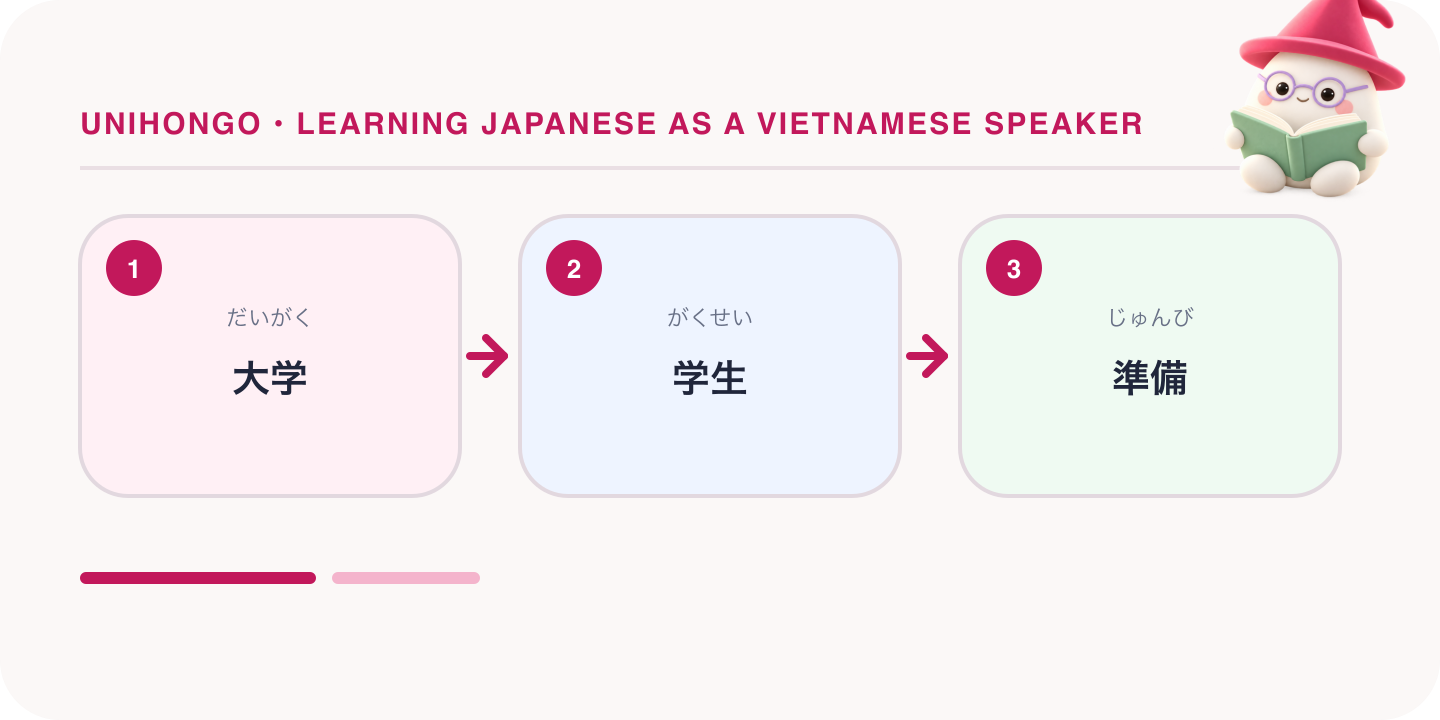
| học sinh | gakusei | 学生 | student |
| chuẩn bị | junbi | 準備 | preparation |
| điện thoại | denwa | 電話 | telephone |
| thời gian | jikan | 時間 | time |
| đại học | daigaku | 大学 | university |
| kết hôn | kekkon | 結婚 | marriage |
| ý kiến | iken | 意見 | opinion |
| an toàn | anzen | 安全 | safety |
| văn hóa | bunka | 文化 | culture |
| kinh tế | keizai | 経済 | economy |
| chú ý | chūi | 注意 | attention, caution |
| thế giới | sekai | 世界 | world |
| xã hội | shakai | 社会 | society |
| tự nhiên | shizen | 自然 | nature |
| bệnh viện | byōin | 病院 | hospital |
| kết quả | kekka | 結果 | result |
| vấn đề | mondai | 問題 | problem, question |
| đồng ý | dōi | 同意 | agreement |
| sinh hoạt | seikatsu | 生活 | daily life |
| quốc tế | kokusai | 国際 | international |
| đặc biệt | tokubetsu | 特別 | special |
| tự do | jiyū | 自由 | freedom |
| khách | kyaku | 客 | guest, customer |
One caution before you trust the hooks completely: học sinh covers school pupils in Vietnamese, while gakusei in Japanese most often means a university student and seito is the usual word for a pupil. Small drifts of this kind are common, so check the Japanese meaning once before you rely on it. Then put the words into sentences straight away, because a cognate you have only recognised is not yet a word you can say.
Cognates that changed their meaning
Some pairs share their characters but not their meaning, because the two languages developed the borrowed word in different directions. Others simply have no Japanese partner, because Japanese chose a different compound for the same idea. These are worth learning early, since a confident wrong guess is harder to fix than a blank. The table gives the Vietnamese word, the Japanese word that shares its characters, and what it actually means in Japanese.
| Japanese | Romaji | Meaning |
|---|---|---|
| 大丈夫ですか? | Daijōbu desu ka? | Are you all right? |
| はい、大丈夫です。 | Hai, daijōbu desu. | Yes, I am fine. |
| 毎日日本語を勉強しています。 | Mainichi Nihongo o benkyō shite imasu. | I study Japanese every day. |
| 会社で働いています。 | Kaisha de hataraite imasu. | I work at a company. |
| 医者に行きました。 | Isha ni ikimashita. | I went to the doctor. |
| Vietnamese | Japanese | Kanji | What it means in Japanese |
|---|---|---|---|
| bác sĩ (doctor) | hakase | 博士 | holder of a doctorate; a medical doctor is isha 医者 |
| đại trượng phu (a great man) | daijōbu | 大丈夫 | fine, all right, no problem |
| miễn cưỡng (reluctantly) | benkyō | 勉強 | study |
| tiên sinh (old-fashioned Mr) | sensei | 先生 | teacher, doctor, or master |
| khốn nạn (a strong insult) | konnan | 困難 | difficulty, plain and neutral |
| nhân viên (employee) | jin'in | 人員 | headcount; an employee is shain 社員 |
| công phu (elaborate, painstaking) | kufū | 工夫 | ingenuity, a clever idea |
| công ty (company) | kaisha, not kōshi | 会社 | company |
| thư viện (library) | toshokan, not shoin | 図書館 | library |
From SVO to SOV: particles replace word order
Vietnamese tells the listener who did what to whom by position. Tôi uống cà phê puts the drinker, the drinking, and the coffee in that order, and moving them changes the meaning. Japanese moves the verb to the end and labels each chunk with a particle instead: watashi wa kōhī o nomimasu. Because the labels do the work, the chunks before the verb can shift for emphasis without confusing anyone. Many Vietnamese learners find the hard part is not the new order but trusting the particle enough to let the verb wait.
Two other reversals matter. Vietnamese puts the describing word after the noun, as in nhà đẹp and sách của tôi; Japanese puts it before, as in kirei na ie and watashi no hon. Prepositions such as ở, đến and với become particles that follow their noun: ở Hà Nội becomes Hanoi de, đến Tokyo becomes Tōkyō ni or Tōkyō e. Say the noun first, then its label, every time, and the order fixes itself within weeks. The particles guide on this blog explains each marker in detail.
| Japanese | Romaji | Meaning |
|---|---|---|
| 私はコーヒーを飲みます。 | Watashi wa kōhī o nomimasu. | I drink coffee. |
| 友達と映画を見ました。 | Tomodachi to eiga o mimashita. | I watched a film with a friend. |
| ハノイに住んでいます。 | Hanoi ni sunde imasu. | I live in Hanoi. |
| ハノイで日本語を勉強しました。 | Hanoi de Nihongo o benkyō shimashita. | I studied Japanese in Hanoi. |
| 来年、東京へ行きます。 | Rainen, Tōkyō e ikimasu. | I am going to Tokyo next year. |
| これは私の本です。 | Kore wa watashi no hon desu. | This is my book. |
| きれいな家ですね。 | Kirei na ie desu ne. | What a lovely house. |
The traps Vietnamese sets
Every first language predicts a set of mistakes, and the useful thing about knowing yours is that you can listen for them. The table lists the habits that Vietnamese speakers most often carry into Japanese, what each one does to the sentence, and the fix. The sections that follow take the sound habits one at a time, because those are the ones that change meaning rather than merely sounding foreign.
| Vietnamese habit | What it does in Japanese | Fix |
|---|---|---|
| A tone contour on every syllable | Words sound choppy and the one real pitch drop gets lost | Hold one level pitch and allow one drop per word |
| No short-long vowel contrast | obāsan becomes obasan and kōkō becomes koko | Hold long vowels for two full beats |
| Unreleased final stops | The small tsu loses its silent beat, so kitte sounds like kite | Count the closure as a beat of its own |
| No syllable begins with ts | tsukue becomes sukue or chukue | Start from the t and release into s |
| Closed syllables are normal | Loanwords lose their last vowel, so beddo becomes bed | Voice the final vowel, even lightly |
| Tense shown by optional markers | Past events described with present-tense verbs | Conjugate every verb; tense is not optional |
| Politeness carried by pronouns | Over-use of watashi and anata | Drop pronouns and carry politeness in desu and masu |
| Modifier follows the noun | Sách của tôi copied as hon no watashi | Owner first, then no, then the thing owned |
Tones versus pitch accent
Vietnamese gives every syllable its own tone, and that tone is part of the word. Japanese does not. It has pitch accent: a word is spoken on a mostly level pitch and, in the Tokyo standard, has at most one place where the pitch drops. The drop can separate words, as in ame for rain and ame for sweets, but most of the time a level pitch with the drop roughly in the right place is understood, and a wrong drop sounds regional rather than wrong.
The habit to watch is adding a contour to each mora as if it were a Vietnamese syllable, so that arigatō gozaimasu rises and falls five times. Japanese listeners hear that as emphatic or agitated. Practise saying whole phrases on one level pitch first, almost like a monotone, then add the single drop where your dictionary marks it. Many Vietnamese learners find the monotone stage strange for a week and natural after that.
| Japanese | Romaji | Meaning |
|---|---|---|
| 雨が降っています。 | Ame ga futte imasu. | It is raining. (ame drops after the a) |
| 飴をなめています。 | Ame o namete imasu. | I am sucking a sweet. (ame rises on me) |
| 橋を渡ります。 | Hashi o watarimasu. | I cross the bridge. (hashi rises to shi) |
| 箸を使います。 | Hashi o tsukaimasu. | I use chopsticks. (hashi drops after ha) |
| ありがとうございます。 | Arigatō gozaimasu. | Thank you. (one gentle drop, no contours) |
| おはようございます。 | Ohayō gozaimasu. | Good morning. |
| すみません、もう一度お願いします。 | Sumimasen, mō ichido onegai shimasu. | Sorry, once more please. |
Long vowels and the small tsu
Vietnamese has a rich vowel system but, for most vowels, no contrast between a short and a long version; ă and a, or â and ơ, are separate qualities rather than lengths. Japanese counts length as a whole extra beat, and the beat changes the word. Obasan is an aunt and obāsan is a grandmother; koko is here and kōkō is high school. Hold the long vowel for two full beats without sliding its quality, and count on your fingers while you practise if it helps.
The small tsu is a silent beat before a consonant. Vietnamese final stops such as the t in một are unreleased, which helps you hear the closure, but Vietnamese does not hold that closure as a beat of its own, so kitte tends to come out as kite and katta as kata. Hold your tongue in position for a count of one, then release into the next consonant. The pairs below only differ in that beat.
| Japanese | Romaji | Meaning |
|---|---|---|
| おばさんは元気です。 | Obasan wa genki desu. | My aunt is well. |
| おばあさんは元気です。 | Obāsan wa genki desu. | My grandmother is well. |
| ここは高校です。 | Koko wa kōkō desu. | This is a high school. |
| おじいさんとおじさん | Ojīsan to ojisan | grandfather and uncle |
| 切手を買いました。 | Kitte o kaimashita. | I bought a stamp. |
| 来てください。 | Kite kudasai. | Please come. |
| 肩が痛いです。 | Kata ga itai desu. | My shoulder hurts. |
| 買ったばかりです。 | Katta bakari desu. | I just bought it. |
| ちょっと待ってください。 | Chotto matte kudasai. | Please wait a moment. |
The moraic n, tsu and su, and clipped endings
The Japanese n written ん takes a full beat of its own. Vietnamese gives you n, ng and nh as finals, which is a genuine head start for the sound itself, because ん before k and g sounds like ng and before m, b and p sounds like m. The trap is length: a Vietnamese final n closes the syllable quickly, so sen and onsen come out a beat short. Give ん the same time as any other mora, and before a vowel keep it separate, so kin'en for no smoking does not collapse into kinen for commemoration.
Tsu is a t released into an s. Vietnamese has no syllable beginning with ts, so many learners produce su or chu instead, and tsukue turns into sukue. Start with the tongue in the t position and let the air escape into s. Finally, Vietnamese syllables end comfortably in consonants, so loanwords such as beddo and kēki lose their last vowel and become bed and kēk. Voice that final vowel even if it is light; without it, Japanese listeners often miss the word entirely.
| Japanese | Romaji | Meaning |
|---|---|---|
| 温泉に行きたいです。 | Onsen ni ikitai desu. | I want to go to a hot spring. |
| 日本語は簡単ではありません。 | Nihongo wa kantan de wa arimasen. | Japanese is not easy. |
| この本は千円です。 | Kono hon wa sen-en desu. | This book is one thousand yen. |
| ここは禁煙です。 | Koko wa kin'en desu. | This is a no-smoking area. |
| 記念写真を撮りましょう。 | Kinen shashin o torimashō. | Let's take a commemorative photo. |
| 机の上に鍵があります。 | Tsukue no ue ni kagi ga arimasu. | The key is on the desk. |
| 寿司とお茶をください。 | Sushi to ocha o kudasai. | Sushi and tea, please. |
| 靴を脱いでください。 | Kutsu o nuide kudasai. | Please take off your shoes. |
| ベッドとテーブルを買いました。 | Beddo to tēburu o kaimashita. | I bought a bed and a table. |
| カットをお願いします。 | Katto o onegai shimasu. | A haircut, please. |
Politeness lives in the verb, not the pronoun
In Vietnamese, politeness begins with the pronoun. Choosing em, anh, chị, cô, bác or cháu tells the listener your relative age and status before you say anything else, and dạ and ạ soften the edges. Japanese works the other way round. Pronouns are mostly omitted, and the politeness sits in the verb ending: ikimasu rather than iku, desu rather than da, and at a higher level the honorific verbs of keigo. Many Vietnamese learners keep reaching for a pronoun to show respect, and the one they reach for is anata, which to a manager or a teacher sounds blunt rather than respectful.
The safer habit is to use the person's name with san, or a title such as sensei or buchō, and to drop watashi once the topic is clear. Your instinct for choosing the right level for each person is exactly the instinct Japanese rewards; you simply move it from the noun to the end of the sentence. Dạ and vâng map well onto hai, and hai, sō desu is the everyday equivalent of dạ, đúng rồi ạ. The honorifics post and the polite-versus-casual post on this blog go further.
| Japanese | Romaji | Meaning |
|---|---|---|
| 田中さんは明日来ますか? | Tanaka-san wa ashita kimasu ka? | Are you coming tomorrow, Mr Tanaka? (name, not anata) |
| 先生、質問があります。 | Sensei, shitsumon ga arimasu. | Teacher, I have a question. |
| はい、そうです。 | Hai, sō desu. | Yes, that is right. |
| 部長、少しよろしいでしょうか。 | Buchō, sukoshi yoroshii deshō ka. | Manager, do you have a moment? |
| 明日は休みます。 | Ashita wa yasumimasu. | I will be off tomorrow. (polite, no pronoun) |
| 明日は休む。 | Ashita wa yasumu. | I am off tomorrow. (casual, friends only) |
| お名前は何ですか? | O-namae wa nan desu ka? | What is your name? |
Introducing yourself as a Vietnamese speaker
These are the lines you will say in your first conversations, and they are also good test pieces, because they contain the sounds above: the long vowels in Betonamu and Hōchimin, the moraic n in san-kagetsu and hatsuon, and the small tsu in yukkuri. A Japanese speaker will usually reply with a compliment, such as Nihongo ga o-jōzu desu ne, and the natural answer is ieie, madamada desu, which means not at all, still a long way to go.
| Japanese | Romaji | Meaning |
|---|---|---|
| ベトナムから来ました。 | Betonamu kara kimashita. | I am from Vietnam. |
| ベトナム人です。 | Betonamujin desu. | I am Vietnamese. |
| 母語はベトナム語です。 | Bogo wa Betonamugo desu. | My first language is Vietnamese. |
| ホーチミン市に住んでいました。 | Hōchimin-shi ni sunde imashita. | I used to live in Ho Chi Minh City. |
| 日本語を三か月勉強しています。 | Nihongo o san-kagetsu benkyō shite imasu. | I have been studying Japanese for three months. |
| この言葉はベトナム語と似ています。 | Kono kotoba wa Betonamugo to nite imasu. | This word is similar to Vietnamese. |
| 発音を直してください。 | Hatsuon o naoshite kudasai. | Please correct my pronunciation. |
| もう少しゆっくり話してください。 | Mō sukoshi yukkuri hanashite kudasai. | Please speak a little more slowly. |
| いえいえ、まだまだです。 | Ieie, madamada desu. | Not at all, I still have a long way to go. |
Your first month of speaking
The cognate advantage tempts Vietnamese learners into reading early and speaking late, because a page of kango feels comfortable long before a conversation does. Reverse that. Spend the first month building the sound habits while they are still soft, and let the vocabulary head start show up in what you say rather than in what you recognise. Each week below adds one habit and keeps the previous ones running.
| Japanese | Romaji | Meaning |
|---|---|---|
| 今日は何を練習しましょうか。 | Kyō wa nani o renshū shimashō ka. | What shall we practise today? |
| 発音は大丈夫でしたか? | Hatsuon wa daijōbu deshita ka? | Was my pronunciation all right? |
| もう一度言ってみます。 | Mō ichido itte mimasu. | I will try saying it once more. |
- Week one: say every new word on a level pitch, twice, with long vowels counted on your fingers; learn the self-introduction lines above and use them with anyone who will listen.
- Week two: build ten sentences a day in noun-particle order, saying the noun before you choose the particle, and put the verb last every time even when the sentence feels unfinished.
- Week three: run the minimal pairs for length and the small tsu each morning, then have a three-minute conversation in which every verb is conjugated for tense, with no đã or sẽ shortcuts.
- Week four: hold a five-minute conversation with no anata and no unnecessary watashi, carrying politeness only in desu and masu, and ask your partner to stop you when a tone contour creeps in.
- Every day: read the cognate table aloud once, Japanese only, so the words you already understand become words you can produce at speed.
By the end of the month the goal is not fluency but a clean base: level pitch, full-length vowels and consonants, the verb at the end, and politeness in the ending rather than the pronoun. Every kango word you recognise after that lands on a foundation that can carry it into speech, which is exactly where the Vietnamese head start pays off.