
The head start: register, vowel length, and particles at the end
Thai has already trained you in three things Japanese depends on. First, you choose your words by relationship. Whether you say phom or chan, khun or than, and whether you close the sentence with khrap or kha, depends on who is listening, and that is exactly the judgement Japanese asks for when it chooses between desu and da. Second, Thai contrasts short and long vowels, as in pat and paat, so the difference between obasan and obāsan is one your ear already hears. Third, Thai puts its question marker at the end of the sentence, so a Japanese ka after the verb feels normal rather than backwards.
The table sets these habits against their Japanese partners. None of them is an exact match, and the sections that follow explain where each one breaks down, but many Thai learners find that the first weeks of Japanese feel less foreign than they expected because so much of the shape is familiar. The lines below use every one of these habits at once.
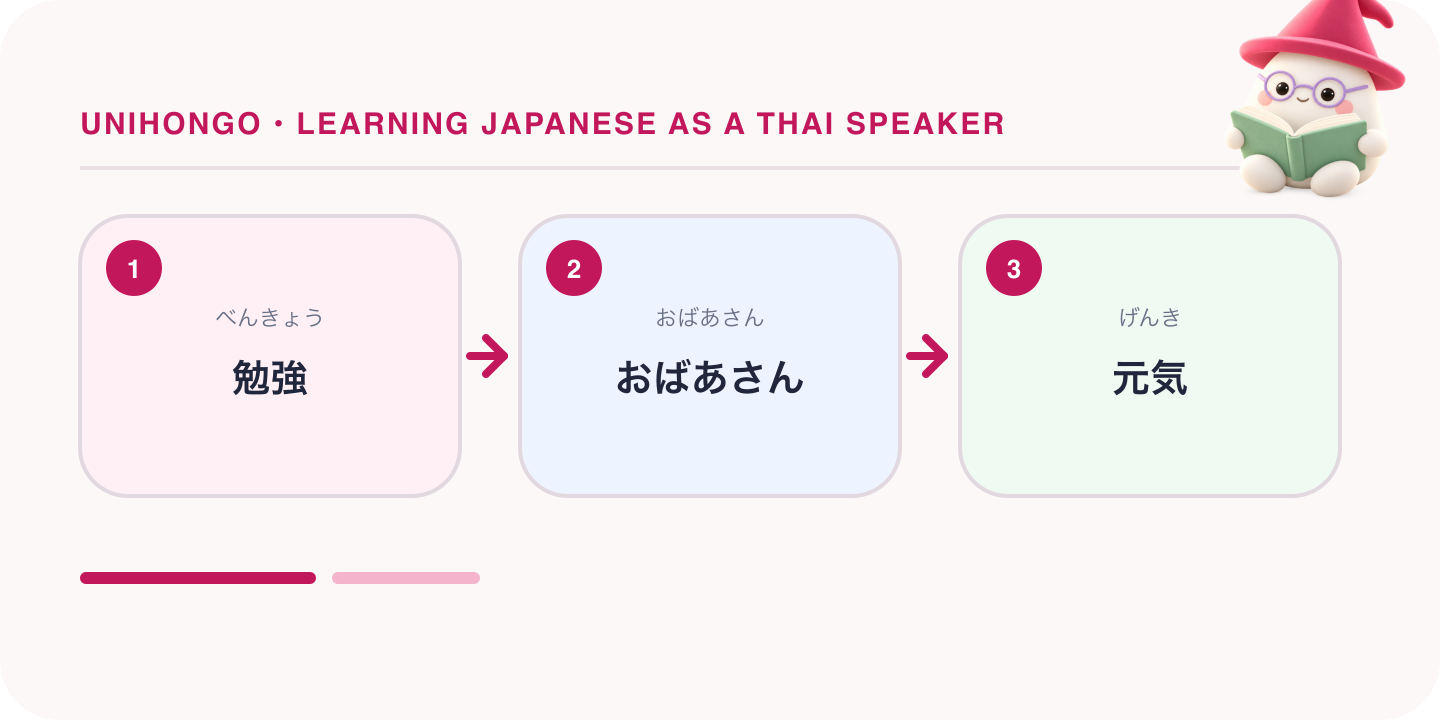
| Japanese | Romaji | Meaning |
|---|---|---|
| 日本語を勉強していますか? | Nihongo o benkyō shite imasu ka? | Are you studying Japanese? |
| はい、勉強しています。 | Hai, benkyō shite imasu. | Yes, I am. |
| おばあさんは元気です。 | Obāsan wa genki desu. | My grandmother is well. |
| いい天気ですね。 | Ii tenki desu ne. | Lovely weather, isn't it. |
| そうですね。 | Sō desu ne. | Yes, it is. |
| Thai habit | Japanese partner | What carries over |
|---|---|---|
| Sentence-final ครับ khrap and ค่ะ kha | Sentence-final desu and masu | Politeness is added at the end of the sentence |
| Short and long vowels, ปัด pat and ปาด paat | Short and long vowels, obasan and obāsan | Length changes the word |
| Question particle ไหม mai at the end | Question particle ka at the end | Questions keep the statement order |
| Softener นะ na | Softener ne | Seeking agreement with a final particle |
| Pronouns chosen by relationship | Verb endings chosen by relationship | The judgement is the same; the place it lives moves |
| Script written without spaces | Script written without spaces | Reading in chunks rather than words |
Khrap and kha become desu and masu
The closest thing Japanese has to khrap and kha is the polite ending. Ikimasu rather than iku, desu rather than da, and at a higher level the humble and honorific verbs of keigo, do the job that your final particle and your pronoun choice do together in Thai. The difference is that the Japanese marker is not an extra word you can add or leave off; it is the form of the verb itself. Every sentence you say in the polite style ends in masu or desu, and every sentence in the casual style ends in the plain form, so the choice is made once and then runs through everything.
The pronoun side does not transfer. Thai shows respect by choosing khun, than, or a kin term, but Japanese shows respect by leaving the pronoun out and using the listener's name with san, or a title such as sensei or buchō. Many Thai learners reach for anata because it is glossed as khun, and to a manager or a teacher it sounds blunt rather than polite. Drop watashi once the topic is clear, drop anata almost always, and let the ending carry the politeness. The honorifics post and the polite-versus-casual post on this blog go deeper.
| Japanese | Romaji | Meaning |
|---|---|---|
| 田中さんは明日来ますか? | Tanaka-san wa ashita kimasu ka? | Are you coming tomorrow, Mr Tanaka? (name, not anata) |
| 先生、質問があります。 | Sensei, shitsumon ga arimasu. | Teacher, I have a question. |
| はい、そうです。 | Hai, sō desu. | Yes, that is right. |
| 今日は暑いですね。 | Kyō wa atsui desu ne. | It is hot today, isn't it. |
| 明日は休みます。 | Ashita wa yasumimasu. | I will be off tomorrow. (polite, no pronoun) |
| 明日は休む。 | Ashita wa yasumu. | I am off tomorrow. (casual, friends only) |
| お名前は何ですか? | O-namae wa nan desu ka? | What is your name? |
| 少々お待ちください。 | Shōshō omachi kudasai. | Please wait a moment. |
The traps Thai sets
Every first language predicts a set of mistakes, and the useful thing about knowing yours is that you can listen for them. The table lists the habits that Thai speakers most often carry into Japanese, what each one does to the sentence, and the fix. The sound habits get their own sections below, because those are the ones that change meaning rather than merely sounding foreign.
| Thai habit | What it does in Japanese | Fix |
|---|---|---|
| A tone on every syllable | Words sound choppy and the one real pitch drop is lost | Hold one level pitch and allow one drop per word |
| Unreleased final stops and quick final n | kitte sounds like kite and onsen loses a beat | Count the closure or the n as a beat of its own |
| Aspiration separates words | ta and tha both become Japanese ta, which is fine, but g is produced as k | Ignore aspiration; practise voiced g, d, b, z |
| No voiced g | gakusei becomes kakusei, ginkō becomes kinkō | Feel the voicing start before the consonant |
| No ts at the start of a syllable | tsukue becomes sukue or chukue | Start from the t and release into s |
| No sh or z | shitsurei becomes chitsurei, zenzen becomes senzen | Practise shi and zu in minimal pairs |
| r often relaxes to l | Harmless in Japanese, but an English-style r is not | Use a light single tap for every Japanese r |
| Tense shown by optional helper words | Past events told in present-tense verbs | Conjugate every verb; tense is not optional |
| Modifier follows the noun | หนังสือของผม copied as hon no watashi | Owner first, then no, then the thing owned |
Tones versus pitch accent
Thai gives every syllable a tone, and the tone is part of the word. Japanese does not. It has pitch accent: a word is spoken on a mostly level pitch and, in the Tokyo standard, has at most one place where the pitch drops. The drop can separate words, as in ame for rain and ame for sweets, but a wrong drop usually sounds regional rather than wrong, and a level pitch with the drop roughly in the right place is understood everywhere.
The habit to watch is giving each mora a contour of its own, so that arigatō gozaimasu rises and falls five times. Japanese listeners hear that as emphatic or agitated. Practise saying whole phrases on one level pitch, almost like a monotone, and then add the single drop where your dictionary marks it. Your ear is a real advantage here, because it already hears pitch on words; the work is in the mouth, not the ear.
| Japanese | Romaji | Meaning |
|---|---|---|
| 雨が降っています。 | Ame ga futte imasu. | It is raining. (ame drops after the a) |
| 飴が好きです。 | Ame ga suki desu. | I like sweets. (ame rises on me) |
| 橋を渡ります。 | Hashi o watarimasu. | I cross the bridge. (hashi rises to shi) |
| 箸をください。 | Hashi o kudasai. | Chopsticks, please. (hashi drops after ha) |
| ありがとうございます。 | Arigatō gozaimasu. | Thank you. (one gentle drop, no contours) |
| おはようございます。 | Ohayō gozaimasu. | Good morning. |
| すみません、もう一度お願いします。 | Sumimasen, mō ichido onegai shimasu. | Sorry, once more please. |
Final consonants: the moraic n and the small tsu
Thai syllables end in unreleased stops and in m, n and ng, and none of those finals takes any extra time. Japanese has two finals that do. The n written ん is a whole mora, so onsen has four beats, not three, and before a vowel it stays separate, so kin'en for no smoking does not collapse into kinen for commemoration. Your Thai ng before k and g and m before b and p are a genuine head start for the quality of the sound; the fix is only the length.
The small tsu is a silent beat before a consonant. A Thai speaker can already close the mouth for an unreleased t or k, which helps, but Thai never holds that closure as a beat and then releases it into the next syllable. Kitte tends to come out as kite and katta as kata, which are different words. Hold your tongue in position for a count of one, then release. The pairs below differ only in that beat.
| Japanese | Romaji | Meaning |
|---|---|---|
| 温泉に行きたいです。 | Onsen ni ikitai desu. | I want to go to a hot spring. |
| 千円です。 | Sen-en desu. | It is one thousand yen. |
| ここは禁煙です。 | Koko wa kin'en desu. | This is a no-smoking area. |
| 記念写真を撮りましょう。 | Kinen shashin o torimashō. | Let's take a commemorative photo. |
| 簡単ですね。 | Kantan desu ne. | That is easy, isn't it. |
| 切手を三枚ください。 | Kitte o san-mai kudasai. | Three stamps, please. |
| 来てください。 | Kite kudasai. | Please come. |
| ちょっと待ってください。 | Chotto matte kudasai. | Please wait a moment. |
| 買ったばかりです。 | Katta bakari desu. | I just bought it. |
| 肩が痛いです。 | Kata ga itai desu. | My shoulder hurts. |
R and l, tsu and su, shi and chi
Thai has both r and l, and in relaxed speech r often turns into l. Japanese has one sound, a light tap of the tongue against the ridge behind the teeth, that sits between the two. Many Thai learners find the tap easy because it is close to a quick Thai r, and a relaxed l is understood without trouble; the sound to avoid is a heavy English-style r with the tongue pulled back. Say ryōri and raishū with the tongue tip touching briefly and the lips relaxed.
Two consonants have no Thai partner. Tsu is a t released into an s, and since no Thai syllable begins with ts, it tends to become su or chu, turning tsukue into sukue. Start with the tongue in the t position and let the air escape into s. Shi and z are the other gap: Thai has s and ch but nothing between them and nothing voiced, so shitsurei often comes out as chitsurei and zenzen as senzen. Keep shi soft and hissing rather than popped, and let z buzz.
| Japanese | Romaji | Meaning |
|---|---|---|
| 来週の日曜日に会いましょう。 | Raishū no nichiyōbi ni aimashō. | Let's meet next Sunday. |
| 料理が好きです。 | Ryōri ga suki desu. | I like cooking. |
| 机の上に本があります。 | Tsukue no ue ni hon ga arimasu. | There is a book on the desk. |
| 靴を脱いでください。 | Kutsu o nuide kudasai. | Please take off your shoes. |
| 一つください。 | Hitotsu kudasai. | One, please. |
| 失礼します。 | Shitsurei shimasu. | Excuse me. |
| 写真を撮ってもいいですか? | Shashin o totte mo ii desu ka? | May I take a photo? |
| 全然分かりません。 | Zenzen wakarimasen. | I do not understand at all. |
Aspiration does not matter, voicing does
Thai separates words by the puff of air after a stop: ป p and พ ph, ต t and ท th, ก k and ค kh are different letters and different sounds. Japanese has no such contrast. Whether your ka has a puff of air or not, it is the same word, so you can stop worrying about it entirely. What Japanese does contrast is voicing. Ka and ga, ta and da, pa and ba are different words, and the vocal cords have to start vibrating before the consonant, not after it.
Thai has a voiced b and a voiced d, so ba and da are usually fine. It has no voiced g, and that is where many Thai learners slip: gakusei becomes kakusei, and ginkō becomes kinkō. Put a hand on your throat, say ga, and feel the buzz begin before the g is released. Then run the pairs below. Notice that in every pair the Thai instinct will hear the unaspirated ก, and the Japanese word needs a buzzing g instead.
| Japanese | Romaji | Meaning |
|---|---|---|
| 学生です。 | Gakusei desu. | I am a student. |
| 銀行はどこですか? | Ginkō wa doko desu ka? | Where is the bank? |
| 金曜日に行きます。 | Kin'yōbi ni ikimasu. | I will go on Friday. |
| 電気を消してください。 | Denki o keshite kudasai. | Please turn off the light. |
| 天気がいいですね。 | Tenki ga ii desu ne. | The weather is nice, isn't it. |
| パンを買います。 | Pan o kaimasu. | I buy bread. |
| 晩ご飯を食べました。 | Bangohan o tabemashita. | I ate dinner. |
From SVO to SOV: particles replace position
Thai tells the listener who did what by position. Phom duem kafae puts the drinker, the drinking and the coffee in that order, and moving them changes the meaning. Japanese moves the verb to the end and labels each chunk with a particle instead: watashi wa kōhī o nomimasu. Because the labels do the work, the chunks before the verb can shift for emphasis without confusing anyone. Many Thai learners find the hard part is not the new order but trusting the particle enough to let the verb wait.
Two other reversals matter. Thai puts the describing word after the noun, as in baan yai and nangsue khong phom; Japanese puts it before, as in ōkii ie and watashi no hon. Prepositions such as thi, kap and jak become particles that follow their noun: thi Bangkok becomes Bankoku de or Bankoku ni, kap phuean becomes tomodachi to. Say the noun first, then its label, every time, and the order settles within weeks. The particles guide on this blog explains each marker.
| Japanese | Romaji | Meaning |
|---|---|---|
| 私はコーヒーを飲みます。 | Watashi wa kōhī o nomimasu. | I drink coffee. |
| バンコクに住んでいます。 | Bankoku ni sunde imasu. | I live in Bangkok. |
| バンコクで日本語を勉強しました。 | Bankoku de Nihongo o benkyō shimashita. | I studied Japanese in Bangkok. |
| 友達と映画を見ました。 | Tomodachi to eiga o mimashita. | I watched a film with a friend. |
| これは私の本です。 | Kore wa watashi no hon desu. | This is my book. |
| 大きい家ですね。 | Ōkii ie desu ne. | What a big house. |
| 来年、日本へ行きます。 | Rainen, Nihon e ikimasu. | I am going to Japan next year. |
Verbs change shape where Thai adds a word
A Thai verb never changes. Time and aspect come from helper words placed around it: ja for the future, laeo for a completed action, kamlang for something in progress, mai for a negative. Japanese folds all of that into the ending of the verb itself, and the ending is not optional. A past event told with a present-tense verb is one of the most common mistakes Thai learners make, simply because in Thai the marker can be left out when the context is clear.
The good news is that the polite endings are regular. Learn them on one verb, taberu, and you can apply the pattern to the whole ichidan class at once, and the godan class follows a small set of rules. The table maps each Thai helper to the ending that replaces it, and the sentences below run the same verb through every row. The verb conjugation post on this blog covers the full system.
| Japanese | Romaji | Meaning |
|---|---|---|
| 毎朝ご飯を食べます。 | Maiasa gohan o tabemasu. | I eat rice every morning. |
| 昨日、寿司を食べました。 | Kinō, sushi o tabemashita. | I ate sushi yesterday. |
| 今、昼ご飯を食べています。 | Ima, hirugohan o tabete imasu. | I am eating lunch now. |
| 肉は食べません。 | Niku wa tabemasen. | I do not eat meat. |
| 朝ご飯を食べませんでした。 | Asagohan o tabemasen deshita. | I did not eat breakfast. |
| タイ料理が食べたいです。 | Tai ryōri ga tabetai desu. | I want to eat Thai food. |
| 納豆を食べたことがありますか? | Nattō o tabeta koto ga arimasu ka? | Have you ever eaten natto? |
| Thai helper | Job | Japanese ending | Example |
|---|---|---|---|
| จะ ja | Future or intention | -masu | 食べます tabemasu |
| แล้ว laeo | Completed | -mashita | 食べました tabemashita |
| กำลัง kamlang | In progress | -te imasu | 食べています tabete imasu |
| ไม่ mai | Negative | -masen | 食べません tabemasen |
| ไม่ได้ mai dai | Did not | -masen deshita | 食べませんでした tabemasen deshita |
| อยาก yak | Want to | -tai desu | 食べたいです tabetai desu |
| เคย khoei | Have ever | -ta koto ga arimasu | 食べたことがあります tabeta koto ga arimasu |
Kanji on top of two kana scripts
Thai gives you one script with dozens of consonant letters, vowel marks that sit above, below and around them, and no spaces between words. That is a real preparation for Japanese, because you already read in chunks and already handle marks that change a base letter. Hiragana and katakana are learnable in a couple of weeks for most Thai learners, and the diacritics that turn ka into ga will feel like a familiar idea.
Kanji is the part with no Thai equivalent, and it is the largest single time cost in the language. Unlike learners with a Chinese-character background, you start from zero, so pace it. Learn the kana first and completely, read your early sentences in kana with kanji only for words you already say, and let kanji follow speech rather than lead it. A word you can say, hear, and use is much easier to attach a character to than a character you are trying to pronounce.
- Learn hiragana fully before katakana, and katakana before any kanji, writing each row by hand once a day for a week.
- Read Japanese without spaces from the start, the way you read Thai, and let particles mark where one chunk ends.
- Attach kanji only to words you already say aloud, ten a week, always inside a sentence rather than as an isolated character.
- Use the dakuten marks that turn ka into ga and ta into da as a daily voicing drill, saying both forms of every row.
- Keep a note of every kana word you can say but cannot yet read in kanji; that list is your kanji queue, in order of usefulness.
Your first month of speaking
The familiar shape of Japanese politeness tempts many Thai learners into reading and grammar early and speaking late. Reverse that. Spend the first month building the sound habits while they are still soft, and let the register instinct show up in what you say rather than in what you recognise. Each week adds one habit and keeps the previous ones running, and the lines below are the ones you will say in your first real conversations.
| Japanese | Romaji | Meaning |
|---|---|---|
| タイから来ました。 | Tai kara kimashita. | I am from Thailand. |
| タイ人です。 | Taijin desu. | I am Thai. |
| 母語はタイ語です。 | Bogo wa Taigo desu. | My first language is Thai. |
| 日本語を一か月勉強しています。 | Nihongo o ikkagetsu benkyō shite imasu. | I have been studying Japanese for one month. |
| 発音を直してください。 | Hatsuon o naoshite kudasai. | Please correct my pronunciation. |
| もう少しゆっくり話してください。 | Mō sukoshi yukkuri hanashite kudasai. | Please speak a little more slowly. |
| もう一度言ってみます。 | Mō ichido itte mimasu. | I will try saying it once more. |
- Week one: say every new word on a level pitch, twice, with the moraic n and the small tsu counted on your fingers; learn the self-introduction lines below and use them with anyone who will listen.
- Week two: build ten sentences a day in noun-particle order, saying the noun before you choose the particle, and putting the verb last every time even when the sentence feels unfinished.
- Week three: run the voicing pairs each morning with a hand on your throat, then hold a three-minute conversation in which every verb is conjugated for tense, with no ja or laeo shortcuts in your head.
- Week four: hold a five-minute conversation with no anata and no unnecessary watashi, carrying politeness only in desu and masu, and ask your partner to stop you when a tone contour creeps in.
- Every day: read one section of phrases from this post aloud, Japanese only, so the sounds you can hear become sounds you can produce at speed.
By the end of the month the goal is not fluency but a clean base: level pitch, a full beat on every n and small tsu, a voiced g, the verb at the end, and politeness in the ending rather than the pronoun. Everything the Thai register instinct already knows about choosing words for the listener lands on that base, which is exactly where the head start pays off.