

Practice N3-Style Text Grammar With Mocchi AI

Text-grammar practice asks you to use the relationship between sentences, not just recognize a form beside a blank. Ask Mocchi for a short N3-style passage and explain how the surrounding ideas support the choice before reading the answer explanation.

Mocchi checks the relationship between neighboring Japanese sentences before choosing a text-grammar option
What you need to know

Practice N3-Style Text Grammar With Mocchi AI

A connector may fit one sentence grammatically and still misrepresent the relationship to the previous one. The paragraph might need a reason, a contrast, or a reference to earlier content. Read enough context to decide which relationship is intended. Mocchi can provide original practice and compare tempting options, while your explanation shows whether the decision came from meaning or from matching a familiar translation to a single word.

Read both sides of the blank.

Name the relationship in plain language.

Check grammatical fit and passage meaning separately.

Use a new passage after reviewing the clue.

Read the neighboring ideas before selecting a form

Look at what the text has established and what the next sentence adds. Ask whether the new idea follows from a reason, contrasts with an expectation, or refers to something already mentioned. Tell Mocchi that relationship before discussing grammar labels. This makes the answer depend on the passage rather than on which option you most recently studied.

Keep the first task short enough that you can hold the context in mind. If many unknown words interrupt the passage, ask for a clearer version while preserving the same relationship. The goal is to inspect the text-grammar decision, not to combine every possible reading obstacle in one question.

Compare a reason with a contrast in context

雨が降っています。だから、家にいます presents staying home as following from the rain. 雨が降っています。でも、出かけます presents going out despite that situation. Ask Mocchi what relationship each sequence expresses, then try another pair. Do not choose a connector only because both sentences mention the same weather.
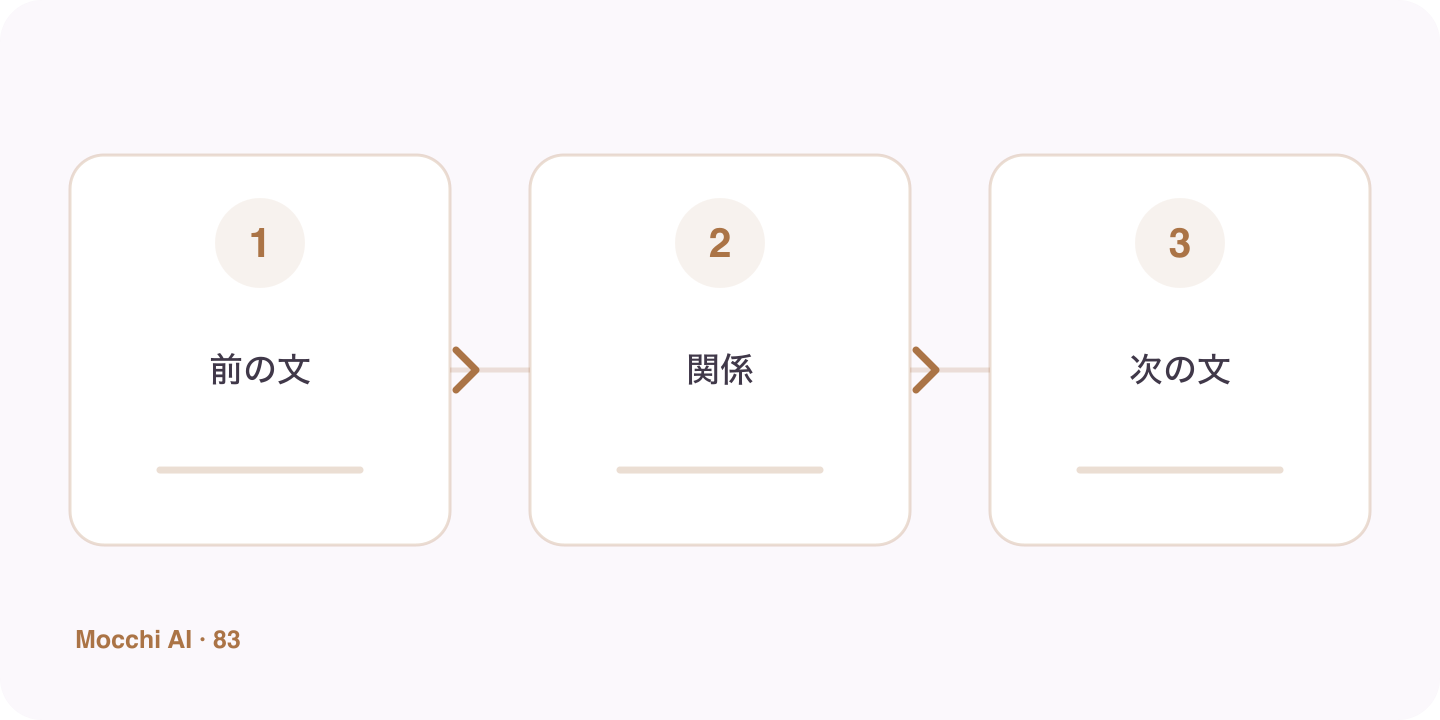
The earlier statement and following idea provide evidence for a connector or grammatical choice
A text-grammar choice belongs to the flow of the passage, not only the sentence containing the blank.
JapaneseRomajiMeaning
雨が降っています。だから、家にいます。Ame ga futte imasu. Dakara, ie ni imasu.It is raining. Therefore, I am at home.
雨が降っています。でも、出かけます。Ame ga futte imasu. Demo, dekakemasu.It is raining. But I am going out.

Separate local structure from passage logic

First check whether the form can fit the surrounding construction. Then ask whether it expresses the intended relationship between the ideas. Both matter. A practice review that explains only the form's conjugation may leave the actual reading error untouched, so ask Mocchi to identify which part of the passage rules a tempting choice out.

Use the wrong option to clarify the intended meaning

Explain what the passage would claim if the alternative were chosen. Would it reverse a reason, add an unexpected contrast, or point to the wrong earlier idea? Comparing the resulting meaning helps you see why the option was attractive and where it fails. This is more useful than memorizing that the correct answer was a particular letter.

Return with a fresh mixed task

After a focused explanation, try a new passage where the relationship is not announced in advance. Keep the vocabulary appropriate and state the clue before checking. Mocchi can use repeated misses to guide review, while official samples help you understand the actual examination format. Treat the generated set as learning evidence and keep practice results separate from official certification or pass predictions.

Key points

A practical way to improve

Ask Mocchi for a short text-grammar task around your current level. Read the passage, state how the neighboring ideas relate, and choose an option. After feedback, explain why another plausible-looking option changes the relationship. Try a fresh passage with different vocabulary and identify the same kind of evidence before opening the model explanation.

  1. 1

    Choose one clear goal

    Focus each session on a situation or skill you can actually use.

  2. 2

    Practice actively

    Say complete answers aloud instead of only reading or recognizing Japanese.

  3. 3

    Review and repeat

    Keep useful corrections and revisit the same skill until it feels natural.

FAQ

Frequently asked questions

Can an option be grammatical but wrong for the passage?

Yes. A form may fit locally while expressing a cause, contrast, or reference that the surrounding ideas do not support. Check the whole relationship as well as the sentence structure.

Should I translate every connector into one fixed word?

A gloss can help you begin, but it does not capture every context or construction. Explain the actual relationship and compare complete examples before treating options as interchangeable.

How do I review a repeated text-grammar mistake?

Name the relationship you missed and request a short fresh passage that makes it visible. Then mix in other familiar relationships so the task requires a real choice rather than repeating one announced pattern.

Read the connection around the blank

Use Mocchi to practice a passage-level decision instead of recognizing grammar in isolation.