

Edit Japanese Particles With Mocchi Without Losing Meaning

When checking particles in your Japanese writing, explain the event you intended before asking Mocchi to edit the sentence. Map the place, people, and action, then judge whether the correction preserves those roles rather than merely producing a grammatical new message.

Mocchi traces a Japanese draft's place, person, and action before checking its particles
What you need to know

Edit Japanese Particles With Mocchi Without Losing Meaning

A particle error can make a sentence ambiguous or express a relationship you did not intend. If the tutor guesses your meaning incorrectly, a smooth rewrite can hide the mismatch. Start with a short draft and a plain statement of the intended event. Ask which role each noun has, then revise the particle that represents that relationship. This turns editing into a reusable decision rather than an answer you can only copy in one sentence.

State the event you meant to describe.

Identify each noun's role in that event.

Check the verb and particles together.

Apply the correction to a new sentence.

Make the intended event explicit

Write a short description of the meaning you want: someone waits for a friend at the station, a book is on a desk, or a person goes to a library. Give Mocchi that intention alongside the draft. This is especially useful when an error makes several interpretations possible. The task is to express your event accurately, not to find any fluent sentence containing the same nouns.

Keep the first editing example short. If several clauses and unfamiliar verbs are involved, simplify the event and check its core relationship. You can add the surrounding detail again after the central sentence is clear.

Read the place and object around the verb

駅で友達を待ちます describes waiting for a friend at the station. The station is where the activity happens, and the friend is the person being waited for in this construction. Ask Mocchi to explain those roles and compare them with a sentence about going to the station. The place word remains familiar while its relationship to the event changes.
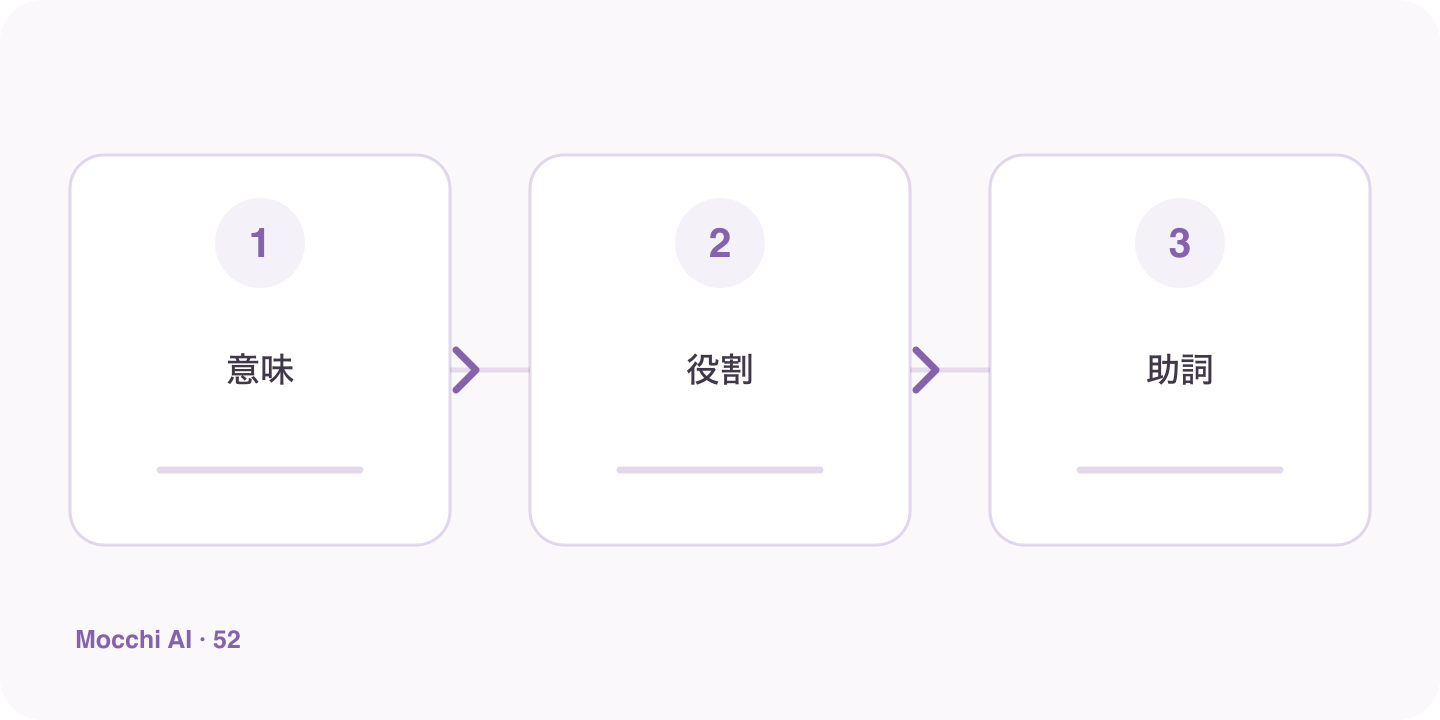
The intended event is mapped to participant roles and then to a revised sentence
An editing decision should preserve the intended event rather than repair a sentence by changing what it says.
JapaneseRomajiMeaning
駅で友達を待ちます。Eki de tomodachi o machimasu.I wait for a friend at the station.
駅に行きます。Eki ni ikimasu.I go to the station.

Ask for a reason that survives another example

A useful correction explains what the particle represents in the sentence. Ask Mocchi to name that relationship in plain language, then apply it to a changed activity. If the explanation only says that one phrase sounds natural, request a clearer contrast. You need a reason you can test, not a claim that the same noun always takes the same particle.

Separate particle work from optional rewriting

A tutor may also improve vocabulary, politeness, or sentence flow. Ask it to keep those suggestions separate from the particle correction so you can identify the target decision. Too many simultaneous changes make it difficult to tell what fixed the original problem and may remove the chance to revise your own sentence.

Review the role you repeatedly confuse

If several edits involve action locations, make that the next short practice target. If the problem occurs only with an unfamiliar verb, learn its construction in a complete phrase. Tell Mocchi what the repeated issue looks like and ask for a fresh sentence before reviewing the old correction. This gives personalized feedback a concrete learning consequence instead of leaving the same error scattered across many polished drafts.

Key points

A practical way to improve

Choose a short sentence from your own or an invented message. Tell Mocchi who acts, what the action is, and where it happens. Ask for a particle check that keeps that event intact. Explain the most important change, then write another sentence with a different place or person. If the rewrite changes the event, clarify your intention before accepting the wording.

  1. 1

    Choose one clear goal

    Focus each session on a situation or skill you can actually use.

  2. 2

    Practice actively

    Say complete answers aloud instead of only reading or recognizing Japanese.

  3. 3

    Review and repeat

    Keep useful corrections and revisit the same skill until it feels natural.

FAQ

Frequently asked questions

Can a particle correction change the meaning?

Yes. A different particle can present a different relationship between the noun and event. Explain your intention and check the revised meaning instead of assuming that every grammatical rewrite says the same thing.

Should I check every particle with a fixed English preposition?

No. English prepositions do not map one-to-one onto Japanese particles. Identify the Japanese sentence relationship and the verb's construction rather than translating each small word independently.

What if the tutor cannot tell what I meant?

Provide a short explanation or an invented scenario showing the intended roles. A clarification question is more useful than accepting a confident guess that repairs the sentence by changing the event.

Edit the relationship, not only the symbol

Use Mocchi to connect a particle correction to the event you actually want to express.