
Why news is the most learnable hard reading
News looks intimidating because of the kanji density, but it is the most repetitive prose a learner can find. Every article about a delayed train is assembled from the same twenty words. Every weather story recycles the same verbs and the same warning phrases. A novel rewards range, and punishes you for lacking it. News rewards return visits, so your second week is measurably easier than your first because the material barely changes shape.
News also arrives already half understood. If you read a story about a typhoon on the day the typhoon hits, you know what a typhoon story says before you decode a single character. That background knowledge does the work a dictionary would otherwise have to do. The same event is often covered in a short broadcast summary, a simplified edition, and a long analysis piece, which lets you pick your difficulty without losing the story.
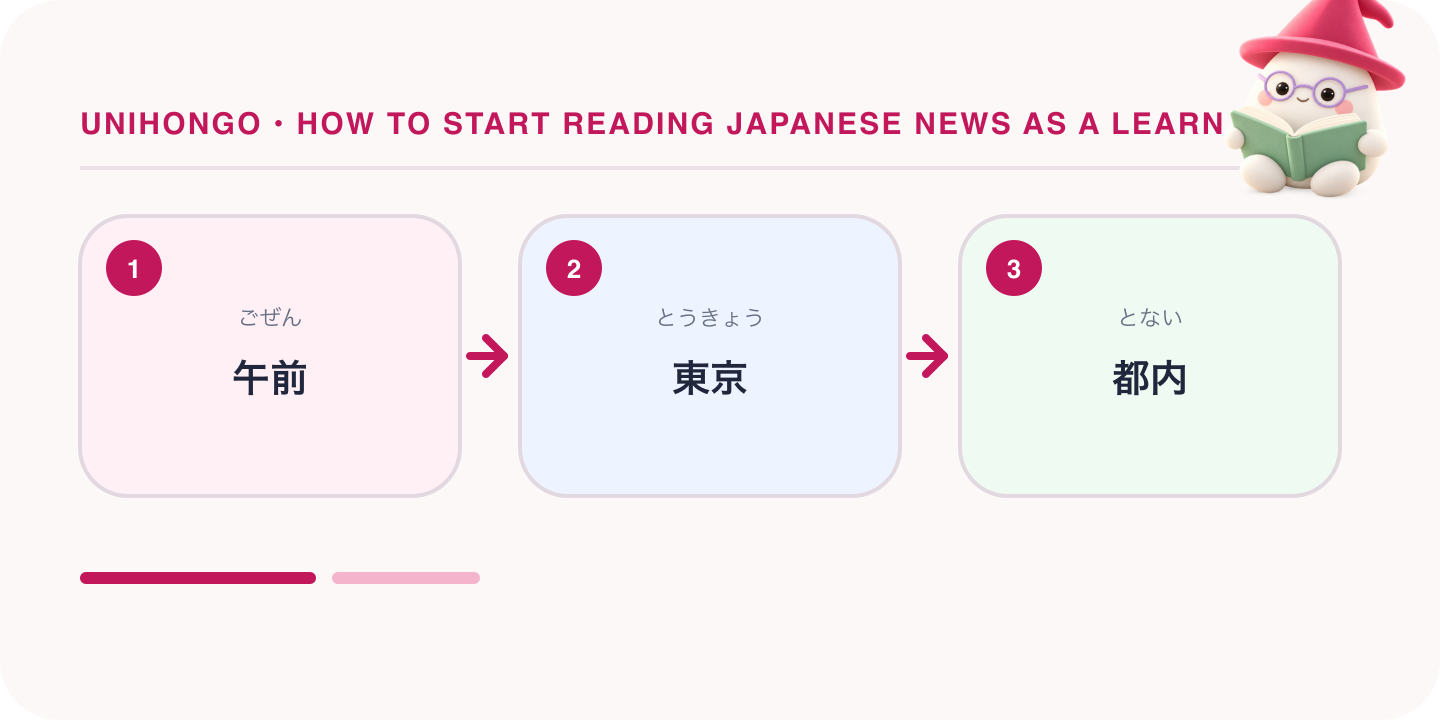
Read the first sentence and stop
Japanese news follows the inverted pyramid. The opening sentence packs when, where, who, and what into one clause chain, and everything after it adds background, official comments, and consequences. That structure gives you permission to stop early. A legitimate reading session can be one sentence long, and you will still know the story. Finishing the article is optional; understanding the lead is the target you should actually set.
Notice how the lead is built. Date and time come first, often with a bare date and no particle. The place follows with で or に. Then the event arrives as a verb in the て form, chaining into the consequence. Once you can see those joints, long leads stop looking like walls and start looking like three short sentences that a writer glued together to save space.
| Japanese | Romaji | Meaning |
|---|---|---|
| 五日午前、東京都内の駅で電車が止まり、多くの利用者に影響が出ました。 | Itsuka gozen, Tōkyō tonai no eki de densha ga tomari, ōku no riyōsha ni eikyō ga demashita. | On the morning of the fifth, trains stopped at a station in Tokyo, affecting many passengers. |
| 警察によりますと、けが人はいないということです。 | Keisatsu ni yorimasu to, keganin wa inai to iu koto desu. | According to police, there were no injuries. |
| 鉄道会社が詳しい原因を調べています。 | Tetsudō-gaisha ga kuwashii gen'in o shirabete imasu. | The railway company is investigating the detailed cause. |
Those three sentences are a complete news story in miniature: the event, the attributed detail, and the open question. Almost every incident report you meet uses that shape, so learning it once pays out every time you open a news app.
How a headline is compressed
A headline is a full sentence with the grammar squeezed out. Particles disappear, the copula disappears, a comma often does the job of は or に, and a noun such as 決定 or 開業 carries the verb meaning without する attached. Expanding a headline back into a normal sentence is one of the best five-minute exercises available, because it forces you to supply exactly the grammar you are trying to learn.
| Convention | Example headline | Full sentence | Meaning |
|---|---|---|---|
| Particles dropped | 首相、来月訪米 | 首相が来月アメリカを訪問します。 | The prime minister will visit the US next month |
| Comma marks the topic | 東京、大雨警報 | 東京に大雨警報が出ました。 | A heavy rain warning has been issued for Tokyo |
| Suru-noun as the verb | 県、支援を決定 | 県が支援を決定しました。 | The prefecture has decided on support measures |
| Copula dropped | 気温、平年より高め | 気温は平年より高めです。 | Temperatures are above average |
| へ for an upcoming event | 五輪へ最終調整 | 五輪へ向けて最終調整をしています。 | Final preparations are under way ahead of the Olympics |
| Tense left to context | 新駅、来年開業 | 新しい駅が来年開業します。 | A new station opens next year |
| Counter without a particle | 事故で三人けが | 事故で三人がけがをしました。 | Three people were injured in an accident |
| か for an unconfirmed report | 来月値上げか | 来月値上げされるかもしれません。 | Prices may rise next month |
| Kanji abbreviation | 日米首脳会談 | 日本とアメリカの首脳が会談します。 | The Japanese and US leaders will hold talks |
The abbreviation row is worth extra attention. Country names shrink to one character in compounds: 日 for Japan, 米 for the United States, 英 for the United Kingdom, 中 for China, 韓 for South Korea. Once you know a dozen of these, a headline that looked like code becomes readable at a glance.
The weather and transport beats
Weather and transport are the best starting beats because the sentences are short, the outcome matters to you personally, and the vocabulary is genuinely closed. A warning is 警報, an advisory is 注意報, a delay is 遅れ, a suspension is 運転見合わせ. Learn those four and you can already tell whether your train is running. Read the same two beats every morning for a fortnight and the words stop needing translation.
| Japanese | Romaji | Meaning |
|---|---|---|
| 明日は全国的に雨が降るでしょう。 | Ashita wa zenkokuteki ni ame ga furu deshō. | It will probably rain across the whole country tomorrow. |
| 関東地方に大雨警報が出ています。 | Kantō chihō ni ōame keihō ga dete imasu. | A heavy rain warning is in effect for the Kanto region. |
| 台風が九州に近づいています。 | Taifū ga Kyūshū ni chikazuite imasu. | A typhoon is approaching Kyushu. |
| 気温は平年より高くなる見込みです。 | Kion wa heinen yori takaku naru mikomi desu. | Temperatures are expected to be higher than average. |
| 外出の際は十分ご注意ください。 | Gaishutsu no sai wa jūbun go-chūi kudasai. | Please take great care when going out. |
| 人身事故の影響で電車が遅れています。 | Jinshin jiko no eikyō de densha ga okurete imasu. | Trains are delayed because of an accident involving a person. |
| 山手線は現在運転を見合わせています。 | Yamanote-sen wa genzai unten o miawasete imasu. | The Yamanote Line has currently suspended services. |
| 振替輸送を行っています。 | Furikae yusō o okonatte imasu. | Alternative transport is being provided. |
| 運転再開は午後三時ごろの見込みです。 | Unten saikai wa gogo san-ji goro no mikomi desu. | Services are expected to resume around three in the afternoon. |
| 道路が通行止めになっています。 | Dōro ga tsūkōdome ni natte imasu. | The road is closed to traffic. |
Politics, economy and incident stories
The next three beats are heavier but equally closed. Politics stories move between 検討 for considering, 発表 for announcing, and 可決 for passing a bill. Economy stories cycle through 物価, 円安, 上昇, and 影響. Incident stories run on 警察, 逮捕, 現場, 原因, and 調べています. None of these lists is long. What makes them feel hard is that they are almost never taught in beginner textbooks, so they arrive all at once.
| Japanese | Romaji | Meaning |
|---|---|---|
| 政府は新しい制度を検討しています。 | Seifu wa atarashii seido o kentō shite imasu. | The government is considering a new system. |
| 国会で法案が可決されました。 | Kokkai de hōan ga kaketsu saremashita. | The bill was passed in the Diet. |
| 記者会見で今後の方針を説明しました。 | Kisha kaiken de kongo no hōshin o setsumei shimashita. | He explained the future policy at a press conference. |
| 円安が続いています。 | En'yasu ga tsuzuite imasu. | The weak yen is continuing. |
| 物価の上昇が家計に影響を与えています。 | Bukka no jōshō ga kakei ni eikyō o ataete imasu. | Rising prices are affecting household budgets. |
| 警察は男性を逮捕しました。 | Keisatsu wa dansei o taiho shimashita. | Police arrested a man. |
| 現場の近くで火事がありました。 | Genba no chikaku de kaji ga arimashita. | There was a fire near the scene. |
| けが人はいませんでした。 | Keganin wa imasen deshita. | There were no injured people. |
| 警察が詳しい原因を調べています。 | Keisatsu ga kuwashii gen'in o shirabete imasu. | Police are investigating the detailed cause. |
Keep one page per beat in your notes and add a word only when you have met it twice. Words that appear once are noise. Words that appear in three separate stories are the ones that will still be there next month.
The written forms that dominate reporting
News Japanese leans on a handful of formal patterns that spoken Japanese uses sparingly. The passive removes the actor: a meeting is held, a plan is announced, a rule is introduced. Attribution runs through によりますと followed by ということです, which keeps the reporter at arm's length from the claim. Probability arrives as 見込み for an expectation and もよう for an appearance. Recognise these five shapes and a large share of the difficulty disappears.
You do not need to produce this register yourself. It is reading vocabulary. When you retell a story out loud, convert it: 発表されました becomes 会社が発表しました, and 求められています becomes みんなが求めています. That conversion is the single most useful exercise in this whole method, because it moves you from formal recognition to plain production.
| Japanese | Romaji | Meaning |
|---|---|---|
| 会議が開かれました。 | Kaigi ga hirakaremashita. | A meeting was held. |
| 新しい規則が来月導入されます。 | Atarashii kisoku ga raigetsu dōnyū saremasu. | A new rule will be introduced next month. |
| 計画が市によって発表されました。 | Keikaku ga shi ni yotte happyō saremashita. | The plan was announced by the city. |
| 関係者によりますと、工事は来年始まるということです。 | Kankeisha ni yorimasu to, kōji wa rainen hajimaru to iu koto desu. | According to people involved, construction will begin next year. |
| 大きな被害はなかったもようです。 | Ōkina higai wa nakatta moyō desu. | It appears that there was no major damage. |
| 早い対応が求められています。 | Hayai taiō ga motomerarete imasu. | A quick response is being called for. |
Easy-Japanese editions as a stepping stone
Several broadcasters and public bodies publish simplified news written for residents who are still learning the language. The sentences are shorter, difficult words are replaced or glossed, kanji carry furigana, and the audio is read slowly. This is not a children's version of the news. It is the same events with the compression removed, which makes it the ideal bridge between a textbook and a full article.
- Read the simplified story first, then open a standard version of the same event and see which words were swapped out.
- Use the furigana as a check, not a crutch: try the reading first, then look down at it.
- Play the slow audio once with the text, once without, and once while shadowing half a sentence behind.
- Keep a note of the plain word the simplified edition chose, because that is the word you should use when speaking.
- Move up when you can finish a simplified story in under three minutes without stopping.
A twenty-minute news session
A repeatable session beats an ambitious one. Twenty minutes, four steps, the same order every day. The point of the structure is that it ends with your voice, so the session cannot quietly become passive scrolling. If you only have ten minutes, cut the second reading rather than the speaking step.
- Two minutes: read three headlines and expand each into a full sentence out loud.
- Five minutes: read one story's lead sentence until you understand it without translating.
- Five minutes: skim the rest, marking only words that blocked a sentence and looking those up.
- Five minutes: read the lead aloud twice, once slowly for accuracy and once at natural speed.
- Three minutes: close the page and summarise the story in three plain sentences from memory.
Read one story aloud
Reading aloud is where news reading stops being a private hobby and starts affecting your speech. Formal written Japanese has long noun compounds that need to be chunked correctly, and saying them exposes gaps that silent reading hides. If 人身事故の影響で comes out as five separate words, it is not yet a unit in your head, and it will not be available when you need to explain why you were late.
Read the same short story on three consecutive days. On day one you will stumble on the compounds. On day two you will get the phrasing right but the pace will be flat. On day three you will sound like someone delivering information rather than decoding it. That third reading is the one that transfers into conversation, and skipping straight to a new article every day is why most learners never feel the improvement.
Say what you read
The final step is telling a person, because a summary spoken to yourself never gets challenged. Give the event, one detail, and your own reaction, then invite a response. These are the lines that turn a reading habit into conversation material, and they work equally well with a study partner, a colleague, or a tutor.
| Japanese | Romaji | Meaning |
|---|---|---|
| 今日のニュースを読みました。 | Kyō no nyūsu o yomimashita. | I read today's news. |
| 台風のニュースについて話したいです。 | Taifū no nyūsu ni tsuite hanashitai desu. | I would like to talk about the typhoon news. |
| 自分の言葉で説明してみます。 | Jibun no kotoba de setsumei shite mimasu. | I will try to explain it in my own words. |
| この見出しの意味が分かりません。 | Kono midashi no imi ga wakarimasen. | I do not understand what this headline means. |
| 決定はどういう意味ですか? | Kettei wa dō iu imi desu ka? | What does kettei mean? |
| このニュースについてどう思いますか? | Kono nyūsu ni tsuite dō omoimasu ka? | What do you think about this news story? |
| 私も同じニュースを読みました。 | Watashi mo onaji nyūsu o yomimashita. | I read the same story too. |
Expect a reply in the same register you used. If you ask どう思いますか in polite form, a Japanese speaker will usually answer politely and then ask you a follow-up such as 日本のニュースをよく読みますか. Have an answer ready for that, because it is the question that keeps the conversation going for another five minutes.
Mistakes that stall news reading
- Starting with political analysis instead of weather and transport, where the sentences are short and the stakes are familiar.
- Looking up every proper noun, when a place name you cannot read rarely changes the meaning of the lead.
- Translating each article into your own language, which trains translation speed rather than reading speed.
- Chasing a new article every day, so no vocabulary ever gets a second encounter.
- Reading only, then wondering why the formal vocabulary never appears in your speech.
- Judging progress by whether you finished the article rather than by whether you understood the first sentence.