
The comparison by dimension
| Dimension | Japanese | Korean |
|---|---|---|
| Time to read the script | Two weeks for both kana sets | A few days for Hangul |
| Long-term reading load | Heavy: roughly two thousand common kanji | Light: Chinese characters are rarely required |
| Sound inventory | Small and regular, five stable vowels | Larger, with more vowel contrasts |
| Hardest sounds for English speakers | Long versus short vowels, doubled consonants | Plain, aspirated and tense consonant three-way contrast |
| Sound changes across word boundaries | Few, so spelling matches speech closely | Frequent assimilation, so spelling and speech diverge |
| Word order | Verb last, particles label the rest | Verb last, particles label the rest |
| Politeness | Built into verb endings and vocabulary | Built into verb endings and vocabulary |
| Shared vocabulary layer | Chinese-derived words, on-yomi readings | Chinese-derived words, similar in shape |
| Speaking in the first month | Fast, because polite forms are formulaic | Fast, once the consonant contrasts settle |
| Listening difficulty | Speed and dropped particles | Sound changes and speed |
| Media pull | Animation, games, film, music, travel content | Drama, film, music, variety, online content |
| Work use | Strongest inside Japan and Japanese firms | Strongest inside Korea and Korean firms |
The table shows why the usual question is badly framed. Korean wins the first week decisively and Japanese wins the first month of speaking comfort, while year two looks similar in both. What differs permanently is the reading burden, which stays with Japanese learners for years and largely disappears for Korean learners.
Reading: a weekend against a fortnight and then years
Hangul is an alphabet designed to be learned, with letters grouped into syllable blocks and shapes that hint at how the mouth forms them. Most learners can decode written Korean, slowly but correctly, within a few days. That early win matters: it means the whole language becomes searchable, and vocabulary can be written down in the real script from week one.
Japanese asks more. Hiragana and katakana together take a couple of weeks of daily practice, and they are only the entry fee. Real Japanese mixes kanji into almost every sentence, most kanji have several readings selected by context, and comfortable reading is a multi-year project rather than a single push. The compensation is that kana is fully phonetic and furigana exists, so you are never completely locked out of a word.
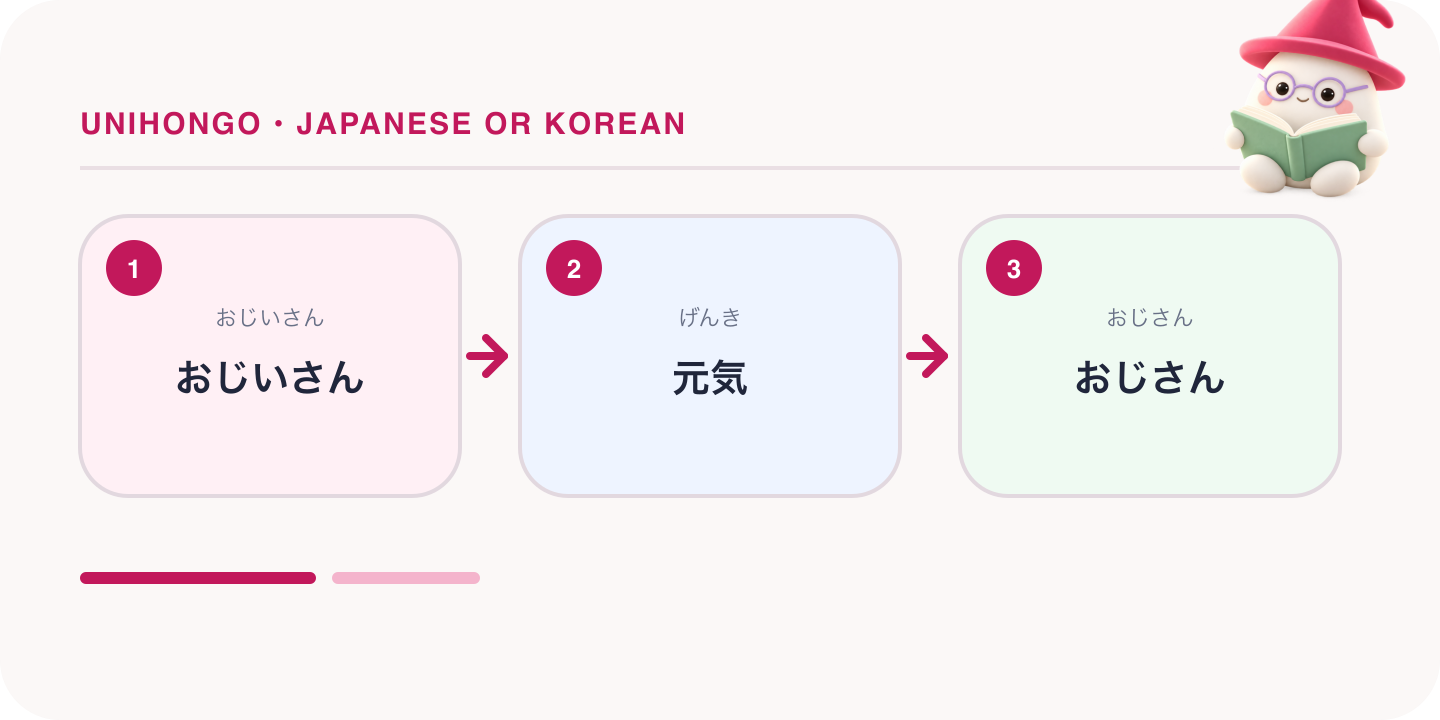
- Give kana two focused weeks and read every kana word aloud instead of transliterating it.
- Meet kanji inside words you can already say, so the reading is attached to a spoken form.
- Do not wait for reading fluency before speaking; they are separate skills on separate timelines.
- Judge kanji progress by whether you can read a menu or a train sign, not by characters seen once.
Pronunciation: where Japanese is the gentler start
Japanese sounds are few and stable. Five vowels keep their value, most syllables are a consonant plus a vowel, and a beginner who can read a word can usually say it well enough to be understood. The genuine traps are timing rather than articulation: a long vowel is held for two beats, a doubled consonant creates a short silence, and the syllabic n takes a full beat of its own.
Korean asks English speakers to hear a distinction their language does not make, splitting consonants into plain, aspirated and tense series. Many learners can produce the tense consonants long before they can reliably hear them, and Korean also changes sounds where words meet, so spelling and speech drift apart. None of this is insurmountable, but it makes the first months of Korean speech less forgiving than Japanese, which is the mirror image of the reading comparison.
| Japanese | Romaji | Meaning |
|---|---|---|
| おじいさんは元気です。 | Ojiisan wa genki desu. | My grandfather is well. |
| おじさんに会いました。 | Ojisan ni aimashita. | I met my uncle. |
| 切手をください。 | Kitte o kudasai. | A stamp, please. |
| こちらへ来てください。 | Kochira e kite kudasai. | Please come this way. |
| ビールをください。 | Bīru o kudasai. | A beer, please. |
| ビルはどこですか? | Biru wa doko desu ka? | Where is the building? |
| ちょっと待ってください。 | Chotto matte kudasai. | Please wait a moment. |
| がっこうへ行きます。 | Gakkō e ikimasu. | I go to school. |
| しんぶんを読みます。 | Shinbun o yomimasu. | I read the newspaper. |
| りょこうが好きです。 | Ryokō ga suki desu. | I like travelling. |
| ゆっくりお願いします。 | Yukkuri onegai shimasu. | Slowly, please. |
| もう一度言ってください。 | Mō ichido itte kudasai. | Please say that once more. |
The first four rows are the timing traps, arranged in pairs: a long vowel against a short one, then a doubled consonant against a single one. Say each pair back to back and record yourself. If a listener could not tell your bīru from your biru, the fix is length, not a new consonant.
What a beginner can say in the first month of Japanese
This is the practical test of a language's early kindness: how much you can genuinely say after four weeks. In Japanese, polite speech is formulaic enough that a beginner with a few dozen expressions and one verb pattern can introduce themselves, order food, ask directions and answer simple questions about their life. Expect the listener to reply faster than you would like; the two follow-up lines at the end of this list are what rescue the conversation.
| Japanese | Romaji | Meaning |
|---|---|---|
| はじめまして。よろしくお願いします。 | Hajimemashite. Yoroshiku onegai shimasu. | Nice to meet you. I look forward to knowing you. |
| 私はアンナです。イギリスから来ました。 | Watashi wa Anna desu. Igirisu kara kimashita. | I am Anna. I came from the United Kingdom. |
| 学生です。/会社員です。 | Gakusei desu. / Kaishain desu. | I am a student. / I am an office worker. |
| 日本語を勉強しています。 | Nihongo o benkyō shite imasu. | I am studying Japanese. |
| 韓国語も少し分かります。 | Kankokugo mo sukoshi wakarimasu. | I understand a little Korean as well. |
| コーヒーを一つお願いします。 | Kōhī o hitotsu onegai shimasu. | One coffee, please. |
| これはいくらですか? | Kore wa ikura desu ka? | How much is this? |
| トイレはどこですか? | Toire wa doko desu ka? | Where is the toilet? |
| 明日は何をしますか? | Ashita wa nani o shimasu ka? | What are you doing tomorrow? |
| 友達と映画を見ます。 | Tomodachi to eiga o mimasu. | I am seeing a film with a friend. |
| すみません、分かりませんでした。 | Sumimasen, wakarimasen deshita. | Sorry, I did not understand. |
| それはどういう意味ですか? | Sore wa dō iu imi desu ka? | What does that mean? |
A common reply to your introduction is 日本語が上手ですね (Nihongo ga jōzu desu ne), meaning your Japanese is good. The expected answer is not thank you but いいえ、まだまだです (Iie, madamada desu), meaning no, I still have a long way to go, which is modest and completely standard.
The shared skeleton underneath both languages
Japanese and Korean line up remarkably well in structure. Both put the verb at the end, both attach particles to nouns to mark topic, subject and object, both leave out subjects that context makes obvious, and both build politeness into verb endings rather than into word choice alone. Both also carry a large layer of Chinese-derived vocabulary, so a word learned in one often has a recognisable relative in the other.
This is why the second language is so much cheaper. A learner who already thinks in verb-final sentences does not have to rebuild that habit, and honorific levels feel like a familiar system with new endings rather than an alien concept. The similarity is structural, not lexical: you still learn the vocabulary from scratch, and the sounds transfer hardly at all.
| Japanese | Romaji | Meaning |
|---|---|---|
| 私は毎日日本語を勉強します。 | Watashi wa mainichi nihongo o benkyō shimasu. | I study Japanese every day. |
| 田中さんは先生です。 | Tanaka-san wa sensei desu. | Tanaka is a teacher. |
| これは私のかばんです。 | Kore wa watashi no kaban desu. | This is my bag. |
| 七時に起きます。 | Shichi-ji ni okimasu. | I get up at seven. |
| 電車で行きます。 | Densha de ikimasu. | I go by train. |
| 田中さんとカフェで話しました。 | Tanaka-san to kafe de hanashimashita. | I talked with Tanaka at a cafe. |
| お名前を教えていただけますか? | O-namae o oshiete itadakemasu ka? | Could you tell me your name? |
| 先生がいらっしゃいます。 | Sensei ga irasshaimasu. | The teacher is here. |
The last two rows show the honorific layer: the same idea can be said plainly or lifted with a humble or respectful verb. Both languages make that choice constantly, which is one more thing you only have to understand once.
Media, work and where the languages actually go
Media pull decides consistency, and here the two languages simply serve different tastes. Korean drama, film and popular music circulate widely with subtitles and are full of contemporary conversational speech, which suits a learner who wants to hear how people actually talk. Japanese offers animation, games, film, music and a huge amount of travel and hobby content, and animation in particular tends to be clearly enunciated, which helps beginners. Look at what you watched last month rather than at what you intend to watch.
For work, both languages are strongest inside their own country, where daily business runs in the local language and even intermediate ability changes which roles you can hold. Outside those countries, demand is patchy and sector-specific, so check with employers in your own field rather than trusting a general claim. In both cases the language pairs best with a skill you already have, rather than serving as a qualification on its own. Confirm visa, exam and course details with the relevant authority or provider, since they change.
Choose Japanese or Korean: four readers
Take the recommendation that matches your situation rather than weighing every dimension again. If two descriptions fit you, the country you plan to spend real time in wins, because daily use beats every argument about difficulty. If none fits, the last paragraph of this section gives a tiebreaker you can apply in about ten seconds.
- The reader who wants to feel progress in the first week: choose Korean. Reading real text within days is a powerful early reward, and it makes vocabulary work feel productive immediately.
- The reader who wants to speak comfortably and hates fighting with pronunciation: choose Japanese. The sound system is forgiving, polite speech is formulaic, and you will be understood while still making obvious mistakes.
- The reader whose watchlist is already dominated by one country's drama, animation or music: choose that language, without further analysis. Consistency beats every difficulty argument, and study you look forward to is study that happens.
- The reader planning to work or study abroad: choose the language of the country you will actually be in, and start with the survival lines rather than the writing system. Everything else follows from being able to handle a shop, a landlord and a colleague.
If none of these fits, choose Japanese if the writing system fascinates you and Korean if it intimidates you. That single reaction predicts more about your next two years than any comparison of grammar.
Learn one, then the other
The most efficient path for someone who wants both is sequential, not parallel. Take the first language until you can hold an unscripted ten-minute conversation and read at a basic level, then start the second. At that point the shared skeleton pays out: verb-final word order, particles and politeness levels are already habits, so you spend your effort on vocabulary and sounds rather than on rebuilding your sense of how a sentence works.
Order matters less than people think, but there is a mild argument each way. Starting with Japanese front-loads the hardest writing system while your motivation is fresh, and makes Korean feel like relief. Starting with Korean gets you reading and speaking fast, which builds the study habit before you meet kanji. Either order works; alternating from day one does not, because beginner particles and endings from the two languages blur together.
- Set the switch point by ability, not by calendar: an unscripted conversation, not six months.
- Keep the first language alive with one short speaking session a week once the second begins.
- Drill the new sounds separately from the start; pronunciation is the one area with no transfer.
- Expect to mix up politeness endings for a few weeks, and correct them out loud rather than on paper.
- Use one notebook per language so shared vocabulary is learned twice, in each language's own sound shape.
Where classes, tutors and speaking practice each fit
Be fair to the options an app does not provide. A group class gives you a schedule, a syllabus and classmates who notice when you stop appearing, which is real accountability. A private tutor sees the specific mistake you keep making and rebuilds the plan around it. A beginner textbook series sequences grammar coherently, so you are not learning at random from whatever you happened to hear. A language school abroad surrounds you with the language all day, which nothing else replicates.
What none of them give you cheaply is volume. You cannot ask a teacher to hear the same sentence twenty times, and an exchange partner will not correct your particle on every attempt. That is the gap live speaking practice with an AI Sensei fills: unlimited retries, no social cost for failing, and a session report afterwards that names the corrections. Use it between lessons rather than instead of them, and bring the corrections back to whoever is guiding your study.
| Japanese | Romaji | Meaning |
|---|---|---|
| 体験レッスンはありますか? | Taiken ressun wa arimasu ka? | Do you offer a trial lesson? |
| 初心者のクラスはありますか? | Shoshinsha no kurasu wa arimasu ka? | Do you have a beginner class? |
| 一回のレッスンは何分ですか? | Ikkai no ressun wa nan-pun desu ka? | How long is one lesson? |
| 会話の練習は多いですか? | Kaiwa no renshū wa ōi desu ka? | Is there a lot of conversation practice? |
| オンラインでも受けられますか? | Onrain de mo ukeraremasu ka? | Can I take it online as well? |
| 先生は英語が話せますか? | Sensei wa eigo ga hanasemasu ka? | Can the teacher speak English? |
| 申し込みはどうすればいいですか? | Mōshikomi wa dō sureba ii desu ka? | How do I apply? |
| 言語交換をしませんか? | Gengo kōkan o shimasen ka? | Would you like to do a language exchange? |
| 三十分ずつ話しましょう。 | Sanjuppun zutsu hanashimashō. | Let us speak for thirty minutes each. |
| 間違いを直してください。 | Machigai o naoshite kudasai. | Please correct my mistakes. |
The last three lines are the ones that make an exchange work. Agreeing on equal time and explicitly asking to be corrected turns a friendly chat into practice, because most partners will otherwise let your errors pass to keep the conversation pleasant.