
Why long sentences collapse halfway through
When a sentence runs past two lines, most learners hold the first half in memory, meet a clause they cannot place, and start again from the beginning. The second attempt fails in the same spot, and after three passes the sentence stops being language and becomes a wall. The problem is rarely vocabulary. It is that the reader has no map of where the sentence is going, so every new phrase is a surprise instead of a slot being filled.
Japanese gives you that map for free, because the sentence ends with its most informative word. The final predicate tells you whether this is a statement or a question, whether it happened or has not happened, whether the writer is certain or reporting hearsay, and how polite the register is. Read it first and the rest of the sentence becomes detail attached to a known frame rather than a series of unrelated fragments.
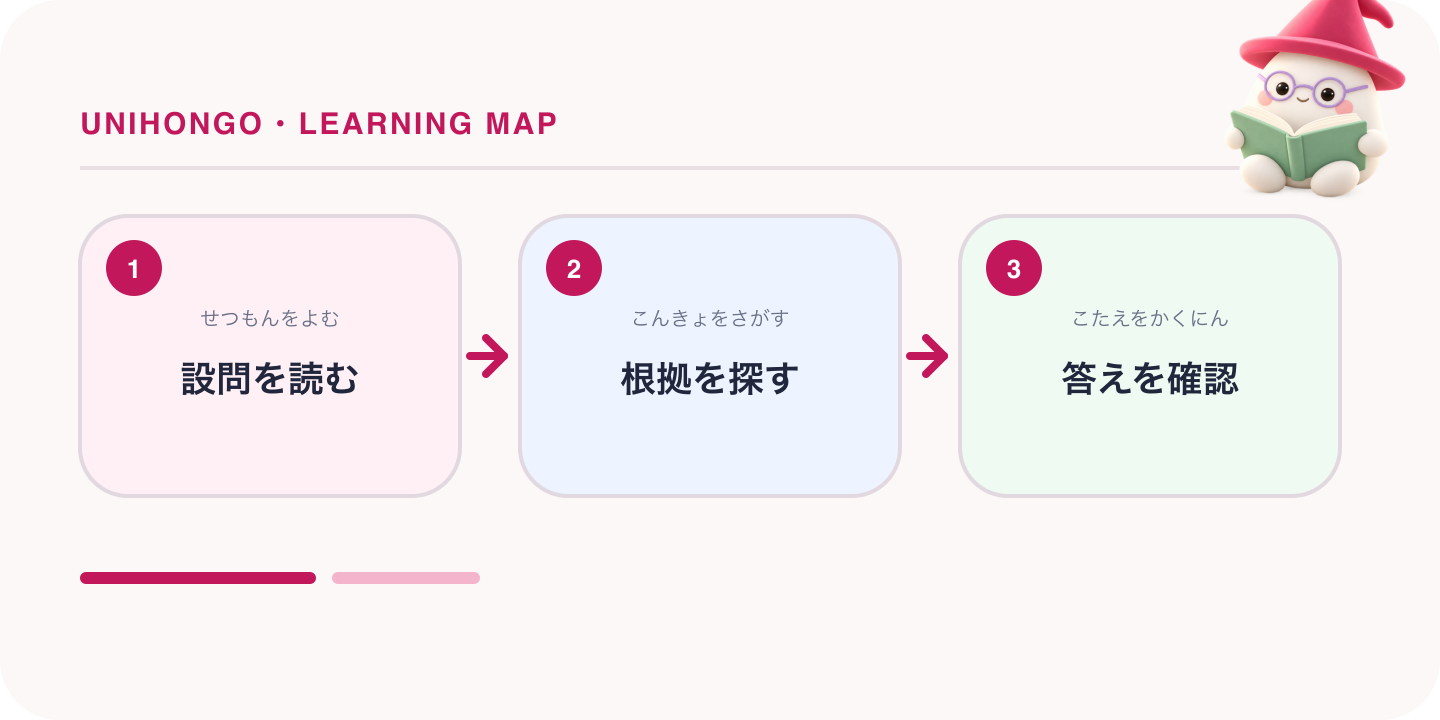
The parsing order
| Step | What you look for | Why it comes at this point |
|---|---|---|
| 1 | The final predicate before the full stop | It fixes tense, politeness and negation for the whole sentence |
| 2 | The tail attached to it | Endings such as sō desu, yō desu or kamo shiremasen change how certain the claim is |
| 3 | The phrase marked with wa | It frames everything that follows, sometimes across several clauses |
| 4 | The ga and o phrases | They give you the doer and the thing acted on |
| 5 | Any clause closing with to | Treat it as one block: a quotation, a thought or a report |
| 6 | Verbs sitting immediately before a noun | They describe that noun, so bracket them and read the noun first |
| 7 | Connectors te, shi, ga, node and kara | They show where one clause stops and the next starts |
| 8 | Whatever is still missing | A dropped subject is recovered from an earlier sentence, not from this one |
The order matters more than the speed. Beginners who follow all eight steps slowly read long sentences correctly; readers who skip to step three and guess the rest are fast and often wrong. After a few weeks the steps merge into a single sweep and you stop counting them.
One long sentence, piece by piece
Here is a sentence of the kind that appears in a company notice or a news summary. Read the whole thing once at natural speed without stopping, accept that it made little sense, and then work through the pieces below in the order the parsing table gives rather than in the order they appear on the page.
| Japanese | Romaji | Meaning |
|---|---|---|
| 昨日会議で山田さんが話していた新しいプロジェクトについて、部長はまだ何も決めていないと言っていましたが、来週までに結論を出さなければならないそうです。 | Kinō kaigi de Yamada-san ga hanashite ita atarashii purojekuto ni tsuite, buchō wa mada nani mo kimete inai to itte imashita ga, raishū made ni ketsuron o dasanakereba naranai sō desu. | The whole sentence, before it is taken apart |
| そうです。 | Sō desu. | Step 1: the tail says this is hearsay, so nothing here is the writer's own claim |
| 出さなければならない | Dasanakereba naranai | Step 1: the final predicate means must produce, and it is not negative despite the nai |
| 部長は | Buchō wa | Step 3: the department head is the topic of the middle clause |
| まだ何も決めていない | Mada nani mo kimete inai | Step 4: has not decided anything yet, the real negative in the sentence |
| と言っていました | To itte imashita | Step 5: to closes the quotation, so the whole negative clause is what was said |
| 昨日会議で | Kinō kaigi de | Step 6: at the meeting yesterday, the setting of the description that follows |
| 山田さんが話していた | Yamada-san ga hanashite ita | Step 6: a clause describing the next noun, not the main sentence |
| 新しいプロジェクトについて | Atarashii purojekuto ni tsuite | Step 6: about the new project, the noun that clause was describing |
| が、 | Ga, | Step 7: after a finished predicate this is but, not the subject particle |
| 来週までに | Raishū made ni | Step 4: by next week, the deadline attached to the final predicate |
Put together: about the new project Yamada was talking about at yesterday's meeting, the department head said that nothing had been decided yet, but apparently a conclusion has to be reached by next week. Notice that the sentence contains two different subjects, one negative, one quotation and one deadline, and that none of them are ambiguous once the pieces are labelled.
Start at the final verb
The last few syllables of a Japanese sentence do most of the grammatical work. Politeness, tense, negation, ability, obligation, permission and the writer's confidence are all stacked there in a fixed order. English spreads that information across the sentence, which is why English readers instinctively look at the front. Retraining that instinct is the single highest-value habit in Japanese reading.
| Japanese | Romaji | Meaning |
|---|---|---|
| 行きます。 | Ikimasu. | I will go. |
| 行きません。 | Ikimasen. | I will not go. |
| 行きませんでした。 | Ikimasen deshita. | I did not go. |
| 行かなかったようです。 | Ikanakatta yō desu. | It seems he did not go. |
| 行けないかもしれません。 | Ikenai kamo shiremasen. | He might not be able to go. |
| 行ったほうがいいと思います。 | Itta hō ga ii to omoimasu. | I think it would be better to go. |
Every one of those endings sits on the same verb. The difference between them is invisible until the final two or three syllables, so a reader who decides the meaning early will be wrong in five cases out of six.
Work backwards through the particles
Once you know what kind of statement you are holding, the particles hand you the roles without any guessing. Ga marks the one doing or being described, o marks what is acted on, ni marks a target or recipient, de marks the scene or the means. Because these labels travel with the phrase, a Japanese writer can move phrases around for emphasis without confusing anyone, and you can read them in any order you like.
This is why word order is a weak clue in Japanese and particles are a strong one. If you have found the verb and then found the o phrase, you already know the core of the sentence, even if six other phrases are still unread. The particle guide on this blog covers each particle's core job in more depth.
| Japanese | Romaji | Meaning |
|---|---|---|
| 田中さんが資料を作りました。 | Tanaka-san ga shiryō o tsukurimashita. | Tanaka prepared the documents. |
| 資料は田中さんが作りました。 | Shiryō wa Tanaka-san ga tsukurimashita. | As for the documents, it was Tanaka who prepared them. |
| 部長に報告書を送りました。 | Buchō ni hōkokusho o okurimashita. | I sent the report to the department head. |
| 会議室で資料を配ります。 | Kaigishitsu de shiryō o kubarimasu. | We hand out the documents in the meeting room. |
| この件については、明日話します。 | Kono ken ni tsuite wa, ashita hanashimasu. | As for this matter, we will talk tomorrow. |
Bracket the clause that describes a noun
A verb that is followed directly by a noun is not ending the sentence. It is describing that noun, and everything from the start of that clause up to the verb belongs inside the description. English marks these with who, which and that; Japanese marks them with nothing at all, which is why they are the commonest cause of a lost reader.
Two habits make them visible. First, when you meet a plain-form verb, look at the next word: if it is a noun, you are inside a modifier and should bracket back to the beginning of the clause. Second, remember that the subject inside such a clause takes ga or no, never wa, so a ga near a plain verb followed by a noun is almost always a description rather than the main subject.
| Japanese | Romaji | Meaning |
|---|---|---|
| 私が昨日買った本 | Watashi ga kinō katta hon | the book I bought yesterday |
| 駅の前に立っている人 | Eki no mae ni tatte iru hito | the person standing in front of the station |
| 日本語で書かれたメール | Nihongo de kakareta mēru | an email written in Japanese |
| 母が作ってくれた料理はとてもおいしかったです。 | Haha ga tsukutte kureta ryōri wa totemo oishikatta desu. | The food my mother made for me was very good. |
| 先週申し込んだ人だけが参加できます。 | Senshū mōshikonda hito dake ga sanka dekimasu. | Only people who applied last week can take part. |
Quoted clauses end in to
A clause that ends in to and is followed by a verb of saying, thinking, hearing or deciding is a single block, and its internal grammar belongs to the speaker being quoted rather than to the writer. This matters because such a clause is usually in plain form even in a polite sentence, and because a negative inside the quotation says nothing about the writer's own position.
| Japanese | Romaji | Meaning |
|---|---|---|
| 明日は雨が降ると思います。 | Ashita wa ame ga furu to omoimasu. | I think it will rain tomorrow. |
| 彼は行かないと言いました。 | Kare wa ikanai to iimashita. | He said he was not going. |
| 会議は三時からだと聞きました。 | Kaigi wa san-ji kara da to kikimashita. | I heard the meeting is from three. |
| 遅れるかもしれないと連絡がありました。 | Okureru kamo shirenai to renraku ga arimashita. | Word came that he might be late. |
| 来月から始めることに決まりました。 | Raigetsu kara hajimeru koto ni kimarimashita. | It has been decided that we will start from next month. |
In the second example the writer is not refusing to go. Someone else refused, and the writer is only reporting it. Learners who read the negative as the main statement invert the meaning of the whole sentence, which is why the block has to be closed off before anything is translated.
Connectors tell you where a clause stops
| Japanese | Romaji | Meaning |
|---|---|---|
| 時間がないので、先に帰ります。 | Jikan ga nai node, saki ni kaerimasu. | Since there is no time, I will leave first. |
| 安いし、近いし、よく行きます。 | Yasui shi, chikai shi, yoku ikimasu. | It is cheap and it is close, so I go often. |
| 電話しましたが、出ませんでした。 | Denwa shimashita ga, demasen deshita. | I called, but there was no answer. |
| 駅で友達に会って、一緒に食べました。 | Eki de tomodachi ni atte, issho ni tabemashita. | I met a friend at the station and we ate together. |
| この道をまっすぐ行くと、右に見えます。 | Kono michi o massugu iku to, migi ni miemasu. | If you go straight along this road, you will see it on the right. |
| Connector | What it does | Clue for the reader |
|---|---|---|
| て te | Chains actions or gives a light reason | The clause is unfinished; tense and politeness come later |
| し shi | Stacks up reasons | Expect at least one more reason, then a conclusion |
| が ga after a predicate | But, or a soft lead-in | Follows a complete predicate, unlike the subject particle after a noun |
| ので node | Because, neutral and explanatory | Cause before, result after |
| から kara after a predicate | Because, more personal and assertive | Cause before, result after |
| けれども keredomo | But, more formal than ga | Common in writing and careful speech |
| たら tara | If or when the first event happens | Sits on the past-tense stem |
| と to after a plain verb | Whenever the first happens, the second follows | Not a quotation unless a verb of saying comes later |
The two entries to watch are ga and to, because each has a second, unrelated job. After a noun, ga marks a subject; after a finished predicate, it means but. After a plain verb with a saying verb later in the sentence, to opens a quotation; after a plain verb with no such verb, it is a conditional. Checking what stands on either side settles it every time.
The traps that flip the meaning
Four patterns account for most confident misreadings. Negation arriving only at the very end is the first, and the cure is the habit already described. The second is the double negative, where nai appears twice and the sentence is in fact positive or obligatory. The third is the embedded question, where ka sits inside the sentence rather than at the end and means whether rather than turning the sentence into a question. The fourth is a subject that was named two sentences ago and never mentioned again.
| Japanese | Romaji | Meaning |
|---|---|---|
| 田中さんは来週の会議に出席しません。 | Tanaka-san wa raishū no kaigi ni shusseki shimasen. | Tanaka will not attend next week's meeting. |
| 行かなければなりません。 | Ikanakereba narimasen. | I have to go, literally it will not do if I do not go. |
| 知らないわけではありません。 | Shiranai wake de wa arimasen. | It is not that I do not know. |
| 彼が来るかどうか分かりません。 | Kare ga kuru ka dō ka wakarimasen. | I do not know whether he is coming. |
| 何時に始まるか教えてください。 | Nan-ji ni hajimaru ka oshiete kudasai. | Please tell me what time it starts. |
| 昨日、部長に会いました。とても忙しそうでした。 | Kinō, buchō ni aimashita. Totemo isogashisō deshita. | I met the department head yesterday. He looked very busy. |
In the last pair, nothing in the second sentence names the department head, and nothing rules out the writer. Japanese resolves this by leaving out what is already established, so the person who looked busy is the person just introduced. When a sentence seems to have no subject, look up the page rather than inside the sentence.
Holding the topic across the whole sentence
A phrase marked with wa can govern several clauses in a row, including clauses that have their own subjects marked with ga. Learners often attach the topic to the first verb they meet and then lose it, which makes the second half of the sentence feel as though it belongs to someone else. Keep the topic on a mental shelf until the final predicate, and check at the end whether the closing verb is still about it.
This also explains the comma after a topic. When a writer writes a noun, wa, and then a comma, they are signalling that the frame is wide and the reader should carry it for a while. Read that comma as an instruction rather than as a pause.
| Japanese | Romaji | Meaning |
|---|---|---|
| この制度は、来年から変わるそうです。 | Kono seido wa, rainen kara kawaru sō desu. | This system is apparently changing from next year. |
| 申請は、窓口ではなく、オンラインで受け付けます。 | Shinsei wa, madoguchi de wa naku, onrain de uketsukemasu. | Applications are accepted online rather than at the counter. |
| この本は、難しい言葉が多いですが、説明が丁寧です。 | Kono hon wa, muzukashii kotoba ga ōi desu ga, setsumei ga teinei desu. | This book has a lot of difficult words, but the explanations are careful. |
| 彼女は、日本に来る前は先生をしていたそうです。 | Kanojo wa, Nihon ni kuru mae wa sensei o shite ita sō desu. | Apparently she was a teacher before she came to Japan. |
A ten-minute daily parsing drill
- Choose one sentence a day that is genuinely too long for you, from a notice, an article or a novel.
- Read it once at natural speed without stopping, and accept that you understood almost nothing.
- Underline the final predicate and write its English in the margin before anything else.
- Bracket every clause that ends in a verb followed by a noun, and every clause closing with to.
- Circle each particle and write the role above it: doer, thing, target, scene.
- Say the sentence aloud in full, then say your English version aloud, then read the Japanese once more.
- Keep the sentence in a notebook and reread it a week later; a sentence you can now read at speed is proof the routine is working.