
The head start: five vowels and even syllables
Filipino has the same five vowels as Japanese, a, e, i, o and u, and it says them cleanly, without the gliding that English speakers add. Its syllables are simple and take roughly even time, so a word such as Maynila already has the steady rhythm that Japanese calls mora timing. Most Japanese consonants exist in Filipino too, and the ng you use in ngayon is exactly what the Japanese n becomes before k and g. Many Filipino learners are told early that they sound natural, and the compliment is deserved.
The table sets the Filipino sound habits against their Japanese partners. The match is close but not complete, and the sections that follow take the gaps one at a time: length, the small tsu, fu, the n, and the r. Say the self-introduction lines below first, because they use the sounds you already own, and notice how little you have to change.
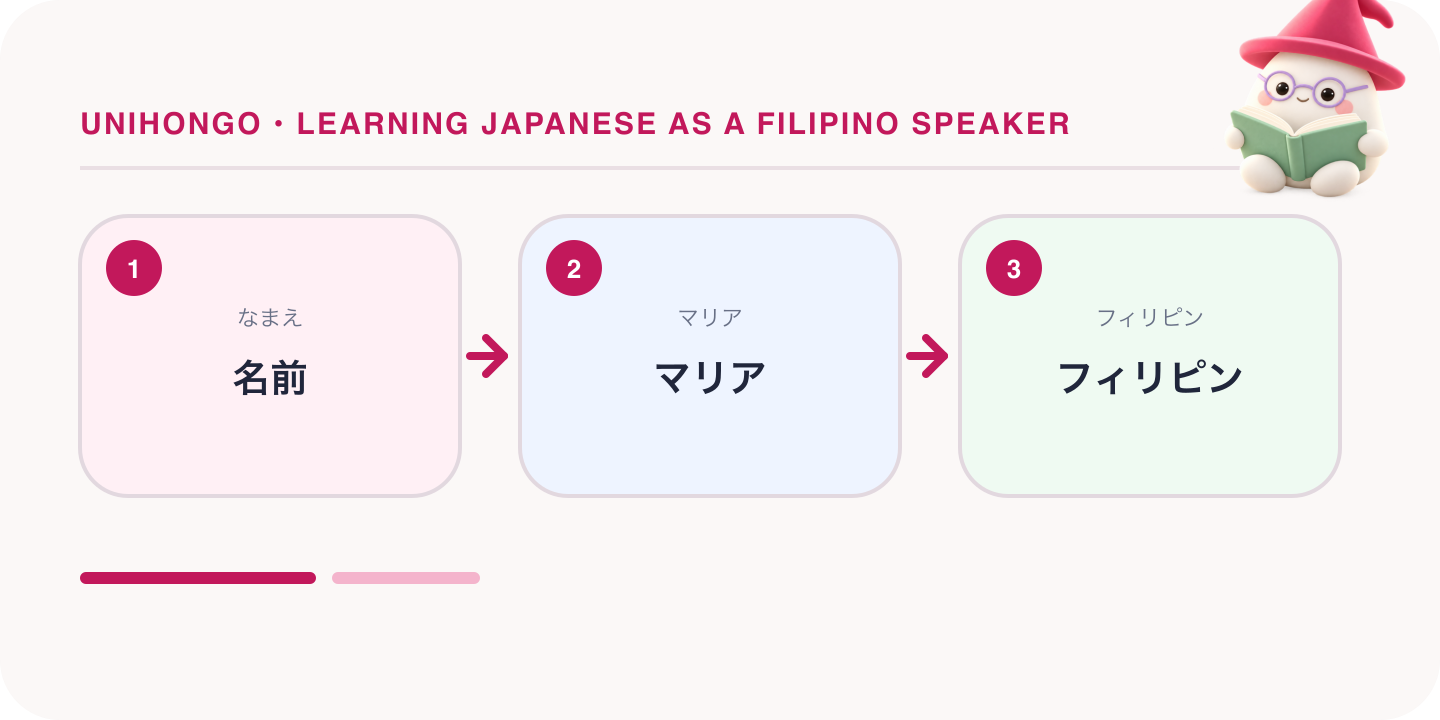
| Japanese | Romaji | Meaning |
|---|---|---|
| 名前はマリアです。 | Namae wa Maria desu. | My name is Maria. |
| フィリピンから来ました。 | Firipin kara kimashita. | I am from the Philippines. |
| マニラに住んでいました。 | Manira ni sunde imashita. | I used to live in Manila. |
| タガログ語を話します。 | Tagarogu-go o hanashimasu. | I speak Tagalog. |
| 日本語はまだ少しだけです。 | Nihongo wa mada sukoshi dake desu. | My Japanese is still only a little. |
| 毎日練習しています。 | Mainichi renshū shite imasu. | I practise every day. |
| Filipino habit | Japanese partner | What carries over |
|---|---|---|
| Five pure vowels | Five pure vowels | Vowel quality, almost unchanged |
| Even syllable timing | Mora timing | The steady rhythm, minus the extra beats |
| ng in ngayon and ang | The n before k and g | The sound is identical |
| Tapped r in araw and pera | The Japanese r | A light tap, never an English r |
| Glottal catch at the end of words | The small tsu | The idea of a silent closure, not yet its length |
| Po and opo to elders | Desu and masu | Adding politeness at the end of a sentence |
Trap one: long vowels held for a full beat
Filipino separates words by stress. Báka is a cow and baká means perhaps, and the stressed syllable is a little longer as a side effect. Japanese separates words by length itself, and the long vowel is a whole extra beat, not a stressed one. Obasan is an aunt and obāsan is a grandmother; koko is here and kōkō is high school; biru is a building and bīru is a beer. Many Filipino learners hear the difference easily and still shorten the vowel when speaking, because nothing in Filipino asks them to hold a vowel without stressing it.
The fix is to count. Give the long vowel two even beats on the same pitch and the same quality, without the rise that a stressed Filipino syllable would carry. Tap the table once per mora while you read the pairs below, so that obāsan gets four taps and obasan gets three, and keep going until the extra tap feels ordinary rather than slow.
| Japanese | Romaji | Meaning |
|---|---|---|
| おばさんは元気です。 | Obasan wa genki desu. | My aunt is well. |
| おばあさんは元気です。 | Obāsan wa genki desu. | My grandmother is well. |
| ここは高校です。 | Koko wa kōkō desu. | This is a high school. |
| おじさんとおじいさん | Ojisan to ojīsan | uncle and grandfather |
| 病院はどこですか? | Byōin wa doko desu ka? | Where is the hospital? |
| 美容院に行きます。 | Biyōin ni ikimasu. | I am going to the hair salon. |
| ビールを一杯ください。 | Bīru o ippai kudasai. | One beer, please. |
| あのビルは高いです。 | Ano biru wa takai desu. | That building is tall. |
Trap two: the small tsu and the moraic n
The small tsu is a silent beat before a consonant. Filipino has a glottal catch at the end of words such as batà, so the idea of stopping the air is familiar, but that catch is not held for a beat and it does not double the following consonant. In Japanese, kitte for stamp and kite for come differ only in that held beat, and so do katta and kata. Close the mouth in the position of the next consonant, hold for a count of one, then release.
The n written ん is the other extra beat. Filipino gives you n, m and ng at the end of syllables, so the sounds are no trouble, but a Filipino final n closes the syllable quickly. Give ん the same time as any other mora, so onsen has four beats, and before a vowel keep it separate, so kin'en for no smoking does not merge into kinen for commemoration. The pairs below only differ in these beats, and both are worth ten repetitions a day for the first fortnight.
| Japanese | Romaji | Meaning |
|---|---|---|
| 切手を買いました。 | Kitte o kaimashita. | I bought a stamp. |
| 来てください。 | Kite kudasai. | Please come. |
| ちょっと待ってください。 | Chotto matte kudasai. | Please wait a moment. |
| 学校に行きます。 | Gakkō ni ikimasu. | I go to school. |
| 雑誌を読みました。 | Zasshi o yomimashita. | I read a magazine. |
| 温泉に行きたいです。 | Onsen ni ikitai desu. | I want to go to a hot spring. |
| 簡単ですね。 | Kantan desu ne. | That is easy, isn't it. |
| ここは禁煙です。 | Koko wa kin'en desu. | This is a no-smoking area. |
| 記念写真を撮りましょう。 | Kinen shashin o torimashō. | Let's take a commemorative photo. |
Trap three: fu, hu, and the r that leans towards d
Japanese fu is not the f of English or of Spanish loanwords; it is made by blowing gently through rounded lips, closer to blowing out a candle, and it sits between f and h. Many Filipino learners either harden it to f or, following the older Tagalog habit of replacing f with p, say pu. Neither is a disaster, but Fujisan with a p sounds wrong to a Japanese ear. Keep the lips loose and the air soft. The h in ha, hi, he and ho is a plain breath, not a rasp, so hade and hare stay light.
The Japanese r is a single tap, and Filipino already makes it in araw and pera, which is a real advantage. The trap is the neighbour. In Filipino, r and d swap freely in words such as dito and rito, so the two sounds feel like one. In Japanese they are separate words: hade means flashy and hare means clear weather, sode is a sleeve and sore is that. Keep d as a firm stop against the teeth and r as a quick brush, and the pairs below will stay apart.
| Japanese | Romaji | Meaning |
|---|---|---|
| 冬は寒いです。 | Fuyu wa samui desu. | Winter is cold. |
| 富士山を見ました。 | Fujisan o mimashita. | I saw Mount Fuji. |
| 二つください。 | Futatsu kudasai. | Two, please. |
| 船で行きます。 | Fune de ikimasu. | I am going by boat. |
| 派手な服ですね。 | Hade na fuku desu ne. | Those are flashy clothes. |
| 明日は晴れです。 | Ashita wa hare desu. | Tomorrow will be clear. |
| 袖が長いです。 | Sode ga nagai desu. | The sleeves are long. |
| それは長いです。 | Sore wa nagai desu. | That is long. |
| 子供が三人います。 | Kodomo ga san-nin imasu. | I have three children. |
The traps at a glance
Every first language predicts a set of mistakes, and the useful thing about knowing yours is that you can listen for them in your own recordings. The table gathers the habits Filipino speakers most often carry into Japanese, what each one does to the sentence, and the fix. The sound habits were covered above; the grammar habits get their own sections next.
| Filipino habit | What it does in Japanese | Fix |
|---|---|---|
| Stress instead of length | obāsan becomes obasan, bīru becomes biru | Two even beats, no stress rise |
| A quick glottal catch | kitte becomes kite | Hold the closure for a full beat |
| f said as p, or a hard f | Fujisan sounds like Pujisan | Blow softly through loose lips |
| r and d treated as one sound | hare and hade blur together | Firm d against the teeth, light tap for r |
| Aspect on the verb, not tense | Habitual and future both come out as kakain-style forms | Choose past or non-past before speaking |
| Predicate first | The verb is said before the object | Object and particle first, verb last |
| Markers before the noun | ni and de placed before the place name | Noun first, then its particle |
| Kayo and po for respect | Anata used as a polite you | Use the name with san and drop the pronoun |
Verbs change for tense and politeness, not aspect
A Filipino verb tells you whether an action is completed, still going, or not yet started: kumain, kumakain, kakain. It does not, by itself, tell you whether the speaker is being polite, and the same form serves for today, yesterday and next week as long as the aspect is right. A Japanese verb does almost the opposite. It marks tense, past versus non-past, and it marks politeness, masu versus the plain form, and it leaves much of the aspect to context or to the te imasu pattern.
The mapping is rough but usable. Kumain lines up with tabemashita, kumakain with tabete imasu, and kakain with tabemasu, which also covers the habitual meaning Filipino would express differently. The non-past covers both what you will do and what you usually do, so many Filipino learners find they want a future form that is not there. Learn the polite endings on one verb and the pattern carries across the whole class. The verb conjugation post on this blog covers the full system.
| Japanese | Romaji | Meaning |
|---|---|---|
| 昨日、ご飯を食べました。 | Kinō, gohan o tabemashita. | I ate yesterday. |
| 今、ご飯を食べています。 | Ima, gohan o tabete imasu. | I am eating now. |
| 明日、友達と食べます。 | Ashita, tomodachi to tabemasu. | I will eat with a friend tomorrow. |
| 毎日、七時に起きます。 | Mainichi, shichi-ji ni okimasu. | I get up at seven every day. |
| 肉は食べません。 | Niku wa tabemasen. | I do not eat meat. |
| 昨日は働きませんでした。 | Kinō wa hatarakimasen deshita. | I did not work yesterday. |
| 日本に行きたいです。 | Nihon ni ikitai desu. | I want to go to Japan. |
| Filipino form | Aspect | Japanese form | What Japanese marks |
|---|---|---|---|
| kumain | Completed | 食べました tabemashita | Past, polite |
| kumakain | In progress | 食べています tabete imasu | Ongoing, polite |
| kakain | Not yet started | 食べます tabemasu | Non-past, polite; also habitual |
| kumakain araw-araw | Habitual | 毎日食べます mainichi tabemasu | Non-past, polite |
| hindi kumain | Completed, negative | 食べませんでした tabemasen deshita | Past negative, polite |
| hindi kakain | Not started, negative | 食べません tabemasen | Non-past negative, polite |
| gustong kumain | Desire | 食べたいです tabetai desu | Want to, polite |
Particles follow the noun and the verb goes last
Filipino usually puts the predicate first: umiinom ako ng kape leads with the drinking. Japanese puts the verb last: watashi wa kōhī o nomimasu. Everything before the verb is a labelled chunk, and the label is a particle that follows its noun, where Filipino markers such as ang, ng and sa come before theirs. Nakatira ako sa Osaka becomes Ōsaka ni sunde imasu, with the place first and its particle after it. Say the noun, then the label, and let the verb wait.
The topic marker wa has a loose parallel that is worth knowing and worth treating carefully. The ay inversion, ako ay estudyante, puts the topic first and the comment after, which is what watashi wa gakusei desu does, and ang marks the phrase the sentence is about in a way that sometimes feels like wa and sometimes like ga. The parallel is a hint, not a rule: sino ang dumating asks with ga, dare ga kimashita ka, because the person is unknown. The particles guide and the wa-versus-ga post on this blog take this further.
| Japanese | Romaji | Meaning |
|---|---|---|
| 私は看護師です。 | Watashi wa kangoshi desu. | I am a nurse. |
| 私はコーヒーを飲みます。 | Watashi wa kōhī o nomimasu. | I drink coffee. |
| 大阪に住んでいます。 | Ōsaka ni sunde imasu. | I live in Osaka. |
| 会社で働いています。 | Kaisha de hataraite imasu. | I work at a company. |
| 誰が来ましたか? | Dare ga kimashita ka? | Who came? |
| 田中さんが来ました。 | Tanaka-san ga kimashita. | Tanaka came. |
| これは私のかばんです。 | Kore wa watashi no kaban desu. | This is my bag. |
Po and opo become desu and masu
You have been adding politeness to sentences since childhood. Po and ho, opo instead of oo, kayo instead of ikaw, and kuya or ate for people slightly older, are all ways of shaping a sentence for the listener, and that judgement is exactly what Japanese asks for. The place it lives is different. Japanese politeness sits inside the verb ending, desu and masu rather than the plain form, and once you choose the polite style it runs through every sentence rather than being added to some.
The pronoun side does not carry over. Filipino shows respect by choosing kayo; Japanese shows it by leaving the pronoun out and using the listener's name with san, or a title such as sensei or buchō. Anata is not a polite you, and to a manager it sounds abrupt. The table pairs the polite Filipino phrases you already use with their Japanese partners, and the honorifics post on this blog covers the higher levels of keigo.
| Japanese | Romaji | Meaning |
|---|---|---|
| 田中さんはお元気ですか? | Tanaka-san wa o-genki desu ka? | How are you, Mr Tanaka? (name, not anata) |
| はい、元気です。 | Hai, genki desu. | Yes, I am well. |
| 先生、ありがとうございました。 | Sensei, arigatō gozaimashita. | Thank you, teacher. |
| 明日は休みます。 | Ashita wa yasumimasu. | I will be off tomorrow. (polite, no pronoun) |
| 明日は休む。 | Ashita wa yasumu. | I am off tomorrow. (casual, friends only) |
| すみません、分かりません。 | Sumimasen, wakarimasen. | Sorry, I do not understand. |
| Filipino | Japanese | Romaji |
|---|---|---|
| Magandang umaga po | おはようございます | Ohayō gozaimasu |
| Salamat po | ありがとうございます | Arigatō gozaimasu |
| Opo | はい | Hai |
| Hindi po | いいえ | Iie |
| Pasensya na po | すみません | Sumimasen |
| Kumusta po kayo? | お元気ですか? | O-genki desu ka? |
| Sige po, naiintindihan ko | はい、分かりました | Hai, wakarimashita |
| Ingat po | 気をつけて | Ki o tsukete |
| Paalam po | 失礼します | Shitsurei shimasu |
Words you already half know
Filipino and Japanese both borrowed from Portuguese and Spanish centuries ago, and a few words arrived in both: pan for bread and tabako for tobacco are the same word in Manila and in Tokyo, and the Japanese botan for button sits close to butones. The larger shared layer is English. Most Filipino speakers use English daily, and Japanese has thousands of English loanwords written in katakana, so konpyūtā, kōhī and miruku are recognisable at once.
The trap is that every loanword has been reshaped to Japanese sounds and rhythm. Milk becomes miruku with three even beats, coffee becomes kōhī with two long vowels, and computer stretches to konpyūtā. Say the katakana form as a Japanese word, counting every mora, and never as the English word with a Japanese accent, or the listener will miss it.
| Japanese | Romaji | Meaning |
|---|---|---|
| パンを買いました。 | Pan o kaimashita. | I bought bread. |
| たばこは吸いません。 | Tabako wa suimasen. | I do not smoke. |
| ボタンを押してください。 | Botan o oshite kudasai. | Please press the button. |
| コンピューターを使います。 | Konpyūtā o tsukaimasu. | I use a computer. |
Workplace phrases to prioritise
Many Filipino learners study Japanese because a job in Japan is the goal, in care work, engineering, hospitality, shipbuilding, or an office. If that is you, the lines you need first are not the textbook's chapter on hobbies but the fixed phrases that open and close every working day. Japanese colleagues use them constantly, and saying them cleanly does more for your standing in the first week than any grammar point.
Three matter most. Otsukaresama desu acknowledges a colleague's effort and works as a greeting during the day and a farewell at the end of it. Osaki ni shitsurei shimasu is what you say when you leave before others. Yoroshiku onegai shimasu closes a request or an introduction and has no clean English or Filipino equivalent; use it whenever you are asking someone to work with you. The workplace greetings post on this blog gives the full set; these are the ones to say from day one.
| Japanese | Romaji | Meaning |
|---|---|---|
| おはようございます。 | Ohayō gozaimasu. | Good morning. (used at any hour at the start of a shift) |
| お疲れ様です。 | Otsukaresama desu. | Thank you for your work. |
| お先に失礼します。 | Osaki ni shitsurei shimasu. | Excuse me for leaving before you. |
| よろしくお願いします。 | Yoroshiku onegai shimasu. | Please treat me well. / I look forward to working with you. |
| 確認してもいいですか? | Kakunin shite mo ii desu ka? | May I check something? |
| 分かりました。すぐやります。 | Wakarimashita. Sugu yarimasu. | Understood. I will do it right away. |
| もう一度お願いします。 | Mō ichido onegai shimasu. | Once more, please. |
| すみません、遅れました。 | Sumimasen, okuremashita. | Sorry, I am late. |
| 佐藤さん、少しよろしいですか? | Satō-san, sukoshi yoroshii desu ka? | Mr Sato, do you have a moment? |
| 手伝いましょうか? | Tetsudaimashō ka? | Shall I help? |
| 休憩に入ります。 | Kyūkei ni hairimasu. | I am going on my break. |
Your first month of speaking
Because you sound good early, the temptation is to trust your ear and skip the drills. Many Filipino learners do, and the shortened long vowels and missing small tsu that result are hard to fix later because nobody corrects a learner who is easy to understand. Spend the first month building the beats while they are still soft, and let the grammar grow inside sentences you say rather than tables you read. Each week adds one habit and keeps the earlier ones running.
| Japanese | Romaji | Meaning |
|---|---|---|
| 今日は何を練習しましょうか。 | Kyō wa nani o renshū shimashō ka. | What shall we practise today? |
| 発音は大丈夫でしたか? | Hatsuon wa daijōbu deshita ka? | Was my pronunciation all right? |
| もう少しゆっくり話してください。 | Mō sukoshi yukkuri hanashite kudasai. | Please speak a little more slowly. |
- Week one: read the long-vowel and small-tsu pairs every morning, tapping one beat per mora, and use the self-introduction lines from the first section with anyone who will listen.
- Week two: build ten sentences a day with the verb last, saying each noun before you choose its particle, and choosing past or non-past before you say the verb.
- Week three: say the workplace greeting sequence, from ohayō gozaimasu to osaki ni shitsurei shimasu, at real speed each day, then hold a three-minute conversation in polite style with no anata.
- Week four: hold a five-minute conversation in which every long vowel and small tsu is counted, and ask your partner to stop you the moment a fu turns into pu or a d and an r swap places.
- Every day: read one phrase section aloud, Japanese only, so the sounds you already hear correctly become sounds you produce correctly at speed.
By the end of the month the goal is not fluency but a clean base: full-length vowels, a held small tsu, a soft fu, the verb at the end, and politeness carried by the ending rather than by a pronoun. The head start you bring in sound and in register then lands on a foundation that can carry it into real conversations, which is exactly where it pays off.