
The resolution in one sentence
The whole method fits in three words of Japanese: mainichi sukoshi zutsu, a little every day. Zutsu attaches to an amount and means at a time, so sukoshi zutsu is a little at a time. It is a phrase Japanese people say to each other about study, exercise and recovery alike, and it is a good first thing to be able to say about yourself.
The lines below are your opening vocabulary for talking about the goal. Say them on 1 January, and you have already done day one.
| Japanese | Romaji | Meaning |
|---|---|---|
| 毎日少しずつ。 | Mainichi sukoshi zutsu. | A little every day. |
| 今年の目標は日本語です。 | Kotoshi no mokuhyō wa Nihongo desu. | My goal this year is Japanese. |
| 三日坊主になりません。 | Mikka bōzu ni narimasen. | I won't be a three-day quitter. |
Four design rules that survive February
Think of the resolution as a product you are designing for a tired version of yourself. That person will not open a textbook at eleven at night. They might say three sentences aloud while the kettle boils. The four rules below are the difference between a resolution and a habit, and the picture cards show them in Japanese.
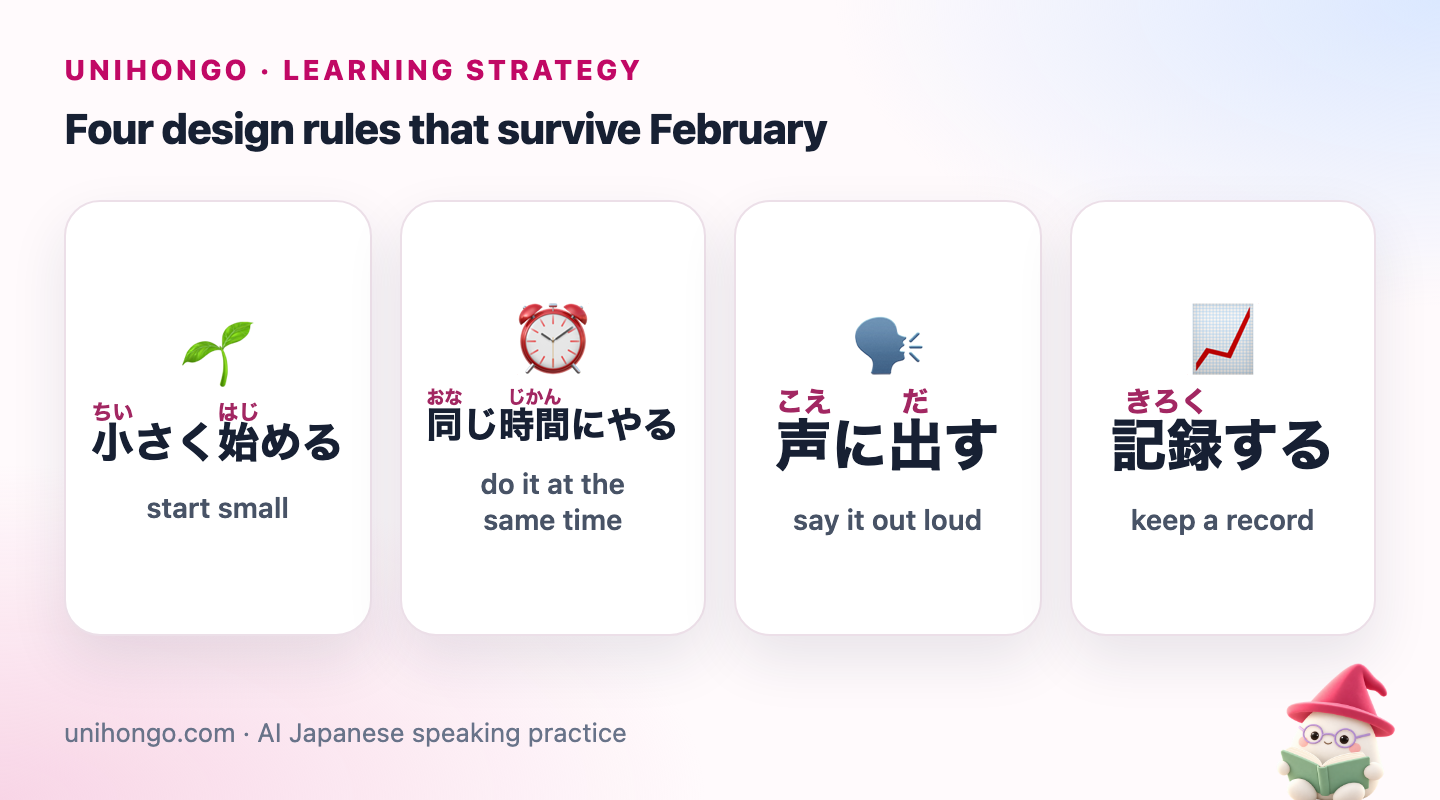
| Japanese | Romaji | Meaning |
|---|---|---|
| 小さく始める | chiisaku hajimeru | start small |
| 同じ時間にやる | onaji jikan ni yaru | do it at the same time |
| 声に出す | koe ni dasu | say it out loud |
| 記録する | kiroku suru | keep a record |
- Start small. The daily unit should be so short that skipping it feels sillier than doing it. Three minutes of speaking qualifies. You can always do more; the rule is about the minimum.
- Same time, same trigger. Attach the session to something that already happens every day: after brushing your teeth, on the train, while the coffee drips. A habit with a fixed trigger needs no decision.
- Say it out loud. Reading and tapping feel like study, but the resolution is to speak Japanese, so every session must contain your voice. Speaking is also the hardest skill to catch up on later.
- Keep a visible record. A paper calendar with a mark per day, or a folder of weekly recordings. What you can see, you protect.
The three-minute speaking ritual
Here is a ritual that takes about three minutes and works from the first day, before you know any grammar. Step one: say today's date and the weather. Step two: say one thing you will do today. Step three: say one new word from yesterday in a sentence. On day one, the sentences will be copied from here; by February, they will be your own. The ritual grows naturally: when three minutes feels easy, add a fourth step, such as describing what you can see.
| Japanese | Romaji | Meaning |
|---|---|---|
| 今日は一月一日です。 | Kyō wa ichigatsu tsuitachi desu. | Today is the first of January. |
| 今日は寒いです。 | Kyō wa samui desu. | It's cold today. |
| 今日は友達に会います。 | Kyō wa tomodachi ni aimasu. | Today I'm meeting a friend. |
| 昨日、新しい言葉を覚えました。 | Kinō, atarashii kotoba o oboemashita. | Yesterday I learned a new word. |
| 今日も日本語を練習しました。 | Kyō mo Nihongo o renshū shimashita. | Today, too, I practised Japanese. |
Measuring that keeps you honest
Chapters finished is a bad measure because it rewards rushing and hides the skill you actually want. Measure two things instead. First, days done: a mark on a calendar for every day you spoke Japanese, however briefly. Second, a thirty-second recording every Sunday on the same prompt: what did you do this week? The recordings are the real test. In the first week you will manage two sentences with long pauses; by the eighth you will complain that thirty seconds is too short.
Set a review date in your calendar now: 1 March. On that day, listen to the first recording and the latest one. The difference is the motivation for the second quarter, and it is one no app streak can give you.
| Measure | How | Why it works |
|---|---|---|
| Days done | One mark per day you spoke Japanese aloud | Protects the habit itself, not a result |
| Weekly recording | Thirty seconds every Sunday on the same question | Shows progress you can hear, in your own voice |
| Words you have used | A list of words you said in a real sentence this week | Rewards use over recognition |
| Monthly conversation | One unscripted conversation with a person or an AI partner | Tests the goal, which is talking |
When you miss a day
You will miss a day. Flu, travel, a deadline, a party. The rule that saves the resolution is simple: never miss twice in a row. One missed day is noise. Two in a row is the beginning of a new habit called not doing it. So the day after a miss, do the smallest possible version, even one sentence, and the chain is intact.
Japanese has gentle ways to talk about this that are good practice in themselves. Notice ~てしまいました for something that happened and that you regret a little, and また from, again.
| Japanese | Romaji | Meaning |
|---|---|---|
| 昨日は忙しくて、勉強できませんでした。 | Kinō wa isogashikute, benkyō dekimasen deshita. | Yesterday I was busy and couldn't study. |
| 一日休んでしまいました。 | Ichinichi yasunde shimaimashita. | I ended up skipping a day. |
| 今日からまた始めます。 | Kyō kara mata hajimemasu. | I'll start again from today. |
| 二日続けて休みません。 | Futsuka tsuzukete yasumimasen. | I won't skip two days in a row. |
| 大丈夫、続けることが大事。 | Daijōbu, tsuzukeru koto ga daiji. | Friend: It's fine, what matters is continuing. (casual) |
Talking about resolutions in Japanese
New Year is a natural time for this conversation in Japan. People ask each other about shinnen no hōfu, New Year's resolutions, or more plainly kotoshi no mokuhyō, this year's goal. There is also an old saying, ichinen no kei wa gantan ni ari, the year's plan is made on New Year's Day, which people quote half-seriously when announcing a resolution. Here is the exchange with a friend, in casual Japanese, followed by the polite version of your answer for a coworker.
| Japanese | Romaji | Meaning |
|---|---|---|
| 今年の目標は何? | Kotoshi no mokuhyō wa nani? | Friend: What's your goal this year? (casual) |
| 日本語で十分話せるようになること。 | Nihongo de juppun hanaseru yō ni naru koto. | You: To be able to talk in Japanese for ten minutes. (casual) |
| いいね。毎日やってるの? | Ii ne. Mainichi yatteru no? | Friend: Nice. Are you doing it every day? |
| うん、朝三分だけ。 | Un, asa sanpun dake. | You: Yes, just three minutes in the morning. |
| 新年の抱負は日本語を続けることです。 | Shinnen no hōfu wa Nihongo o tsuzukeru koto desu. | You: My New Year's resolution is to keep up Japanese. (polite) |
| 一年の計は元旦にあり。 | Ichinen no kei wa gantan ni ari. | The year's plan is made on New Year's Day. (saying) |
Yatteru is the casual, contracted form of yatte iru, doing. You will hear it far more often than the full form among friends.
Common mistakes with a Japanese resolution
- Buying everything on 2 January: a textbook, three apps and a tutor. Choose one main course and one speaking partner; add things only after a month of daily practice.
- Setting the goal as pass N3 or be fluent. Those are outcomes you cannot do on a Tuesday. The goal is the behaviour: speak Japanese every day.
- Studying silently. If your resolution is to speak, every session must contain speech, from day one.
- Treating a missed day as the end. The rule is never twice in a row, not never.
- Measuring by streaks in an app. A streak measures opening the app. Measure days you spoke and record yourself monthly.
- Waiting for January. If you are reading this in October or November, start the three-minute ritual today; by January it will be a habit, and the resolution becomes to keep it.