
What changes when you start later, and what does not
Starting Japanese later in life is common, and it is a real advantage in some ways. You probably know why you are learning, you can sit with a grammar explanation without giving up, and you have decades of experience to talk about. Those are the things that keep a learner going for years.
Some things can feel harder. Fast speech may be harder to follow, especially in noisy places, and memorising lists of unconnected words may feel slower than it once did. The answer is not to try harder in the same way but to study differently: learn words in sentences about your own life, review a little every day, and give your ears slower audio first.
| Japanese | Romaji | Meaning |
|---|---|---|
| 六十歳から始めました。 | Rokujussai kara hajimemashita. | I started at sixty. |
| 日本語を勉強しています。 | Nihongo o benkyō shite imasu. | I'm studying Japanese. |
| まだ初心者です。 | Mada shoshinsha desu. | I'm still a beginner. |
Introduce yourself with your own life
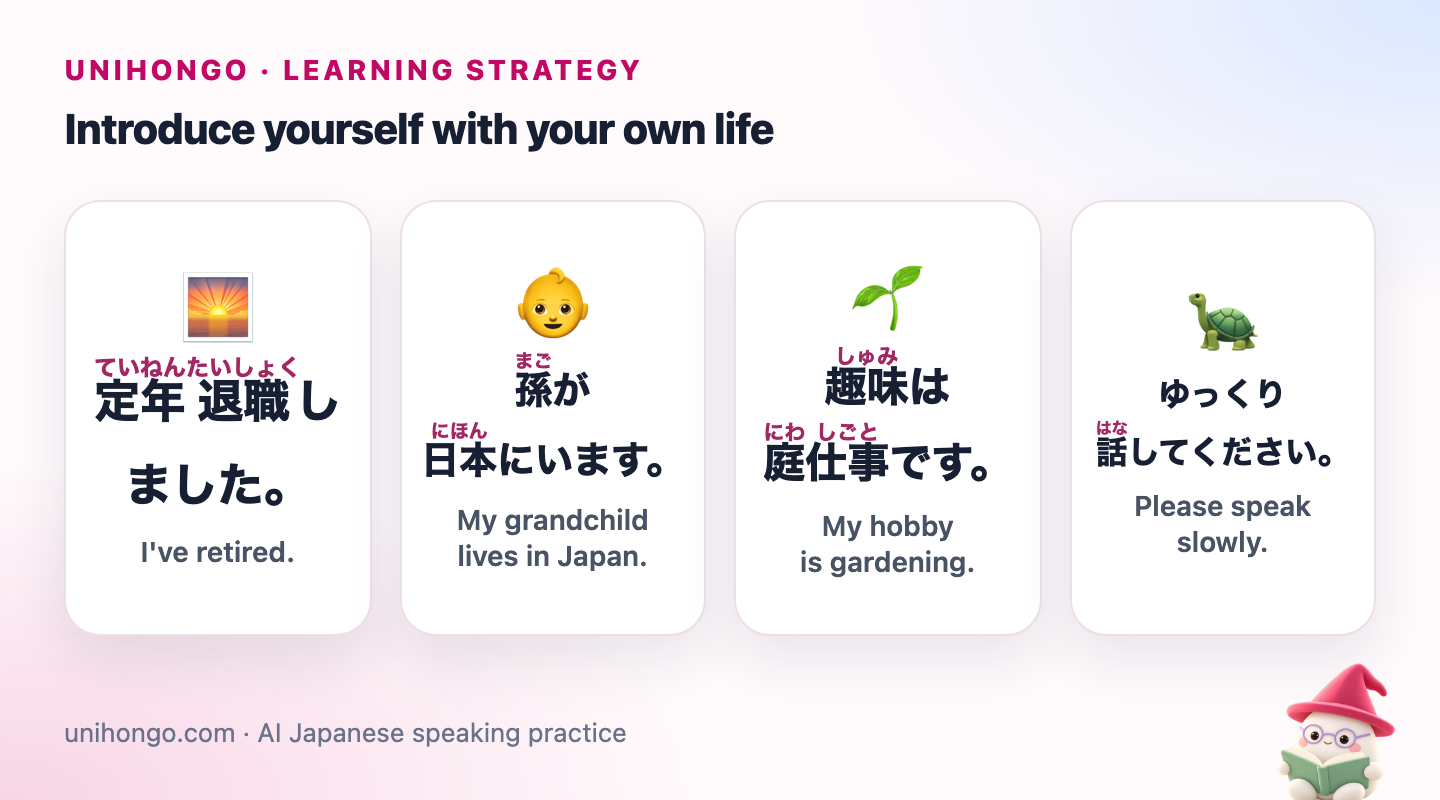
Textbook self-introductions usually assume you are a student. Yours can be much more interesting. These four lines are the start of a self-introduction that fits an older learner, and each one opens a conversation.
| Japanese | Romaji | Meaning |
|---|---|---|
| 定年退職しました。 | Teinen taishoku shimashita. | I've retired. |
| 孫が日本にいます。 | Mago ga Nihon ni imasu. | My grandchild lives in Japan. |
| 趣味は庭仕事です。 | Shumi wa niwa shigoto desu. | My hobby is gardening. |
| ゆっくり話してください。 | Yukkuri hanashite kudasai. | Please speak slowly. |
Teinen taishoku means retiring at the usual retirement age. If you stopped working for another reason, simply say shigoto o yamemashita, I stopped working. Mago means grandchild when you talk about your own; when you ask about someone else's, say omagosan.
Yukkuri hanashite kudasai is the most useful line in this post. Japanese speakers are usually happy to slow down, and they will often switch to simpler words once you ask.
Choose a goal that fits your life
A clear, personal goal does more for motivation than any study method. It also tells you what to study first and what you can safely ignore for now.
| Your goal | Study first | Can wait |
|---|---|---|
| A trip to Japan | Greetings, shopping, transport, asking for help | Kanji writing, casual slang |
| Talking with family | Family words, daily life, casual and polite forms | Business Japanese |
| A hobby such as tea or calligraphy | Hobby vocabulary, polite requests, thanks | JLPT grammar lists |
| Living in Japan | Clinic, bank, city hall, neighbours | Literary Japanese |
| Keeping the mind active | Kana, kanji you like, reading short texts | Speed and deadlines |
Write your goal down in one sentence and keep it where you study. If a lesson or app pushes you toward material that does not serve the goal, it is fine to skip it.
Talking about family and the years behind you
Family and past work are topics Japanese people of all ages enjoy asking about, and they give you plenty to say. Remember the humble and respectful pairs: use the plain words for your own family and the honorific words for someone else's. This is one of the first places where polite Japanese makes a real difference.
| Japanese | Romaji | Meaning |
|---|---|---|
| 娘が二人います。 | Musume ga futari imasu. | I have two daughters. |
| 息子さんはお元気ですか。 | Musukosan wa ogenki desu ka. | How is your son? (respectful) |
| 昔、学校の先生をしていました。 | Mukashi, gakkō no sensei o shite imashita. | I used to be a school teacher. |
| 四十年、同じ会社で働きました。 | Yonjūnen, onaji kaisha de hatarakimashita. | I worked at the same company for forty years. |
| 孫に会いに日本へ行きます。 | Mago ni ai ni Nihon e ikimasu. | I'm going to Japan to see my grandchild. |
Make memory and listening work for you
- Learn words inside sentences about your life. Niwa (garden) is easier to keep when it lives in shumi wa niwa shigoto desu.
- Study a little, often. A short session most days usually beats one long session a week.
- Review on a schedule. Spaced repetition flashcards bring words back just before you forget them; let the schedule be generous rather than rushed.
- Listen slowly first. Use slowed audio and clear voices, then move to natural speed with the same material.
- Read aloud. Saying sentences links your eyes, ears and mouth, and it helps you hear your own progress.
- Make the text big. Kana and kanji details are small, so increase font size on your phone or tablet.
Let a hobby lead the way
Many older learners come to Japanese through something they already love: gardening, photography, tea, poetry, board games or cooking. A hobby gives you a ready-made vocabulary list, a reason to read and watch things in Japanese, and an easy topic when you meet people. It also makes the language feel like part of your life rather than a school subject.
Choose one hobby and collect its key words first. Then look for simple Japanese videos, books or blogs about it; you will understand more than you expect, because you already know the subject.
| Japanese | Romaji | Meaning |
|---|---|---|
| 茶道 | sadō | the tea ceremony |
| 盆栽 | bonsai | bonsai, miniature trees |
| 囲碁 | igo | the board game go |
| 俳句 | haiku | haiku poetry |
| 写真を撮るのが好きです。 | Shashin o toru no ga suki desu. | I like taking photos. |
| 盆栽を三十年やっています。 | Bonsai o sanjūnen yatte imasu. | I've been doing bonsai for thirty years. |
A sentence like bonsai o sanjūnen yatte imasu is a gift in conversation. It tells people something real about you, and it almost always leads to a question, which is exactly the practice you want.
Classes, clubs and community
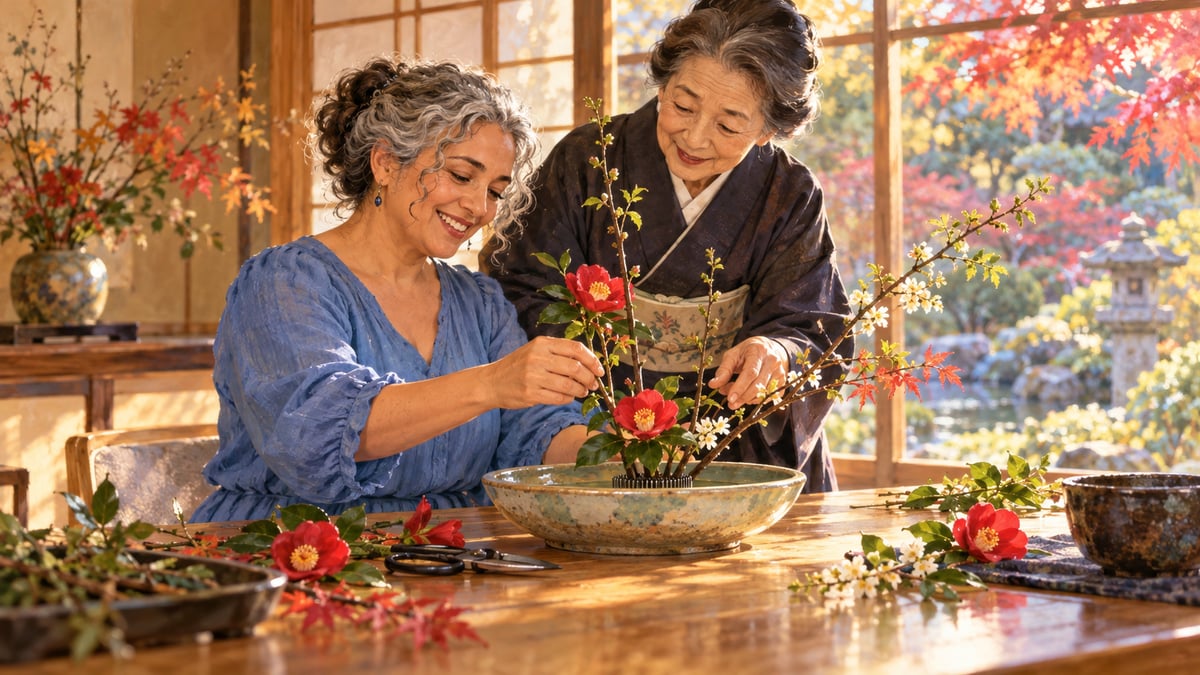
Learning with other people is motivating at any age. Outside Japan, community colleges, cultural centres and Japanese associations often run adult classes, and some offer culture classes in tea, flower arranging, calligraphy or cooking that come with plenty of Japanese. In Japan, many towns have Japanese classes for foreign residents, often run by volunteers at the local community centre; your city hall or the local international association can usually tell you where.
These classes tend to be friendly, relaxed places where people of all ages learn side by side. Here is how a first visit might go.
| Japanese | Romaji | Meaning |
|---|---|---|
| すみません、日本語教室はこちらですか。 | Sumimasen, nihongo kyōshitsu wa kochira desu ka. | You: Excuse me, is this the Japanese class? |
| はい、どうぞ。初めてですか。 | Hai, dōzo. Hajimete desu ka. | Volunteer: Yes, come in. Is it your first time? |
| はい。まだ少ししか話せません。 | Hai. Mada sukoshi shika hanasemasen. | You: Yes. I can only speak a little. |
| 大丈夫ですよ。ゆっくりやりましょう。 | Daijōbu desu yo. Yukkuri yarimashō. | Volunteer: That's fine. Let's take it slowly. |
| よろしくお願いします。 | Yoroshiku onegai shimasu. | You: I look forward to learning with you. |
Myths and mistakes to leave behind
- "I'm too old to remember new words." You may need more reviews than a teenager, but you also understand more. Keep going.
- "I must learn the way schools teach." You can skip school topics that do not fit your life and focus on your goal.
- "I should wait until I'm ready to speak." Start speaking simple sentences early; it is the fastest reward.
- "I'll embarrass myself." Japanese people are usually delighted when an older visitor tries their language.
- Comparing yourself with young learners online. Measure progress against your own goal instead.
Learn at your own pace with Mocchi
Tell Mocchi about yourself, for example: "I'm 67, retired, and I want to talk with my grandchild's family in Japan next spring." Mocchi builds a personal plan around that goal and the time you have, keeps track of what you find hard, and adjusts the plan if you ask. Use /explain on any sentence from a letter or message from family to see each word and particle broken down.
When you want to speak, AI Sensei lets you choose a teacher, such as Yamada-sensei, and ask for slower speech or polite Japanese. Afterwards you get a written session report with corrections and new words, which you can read as slowly as you like. For pronunciation, the pronunciation coach plays each line slowed down before you record yourself.