
What a rirekisho is and how it differs from a CV
A rirekisho, written 履歴書, is a personal history on a standard form. Templates are sold in stationery shops, downloaded from the web, and sometimes issued by the company itself, and while they differ in small ways, the blocks are largely the same: identity and contact details, a photo, education and work history in date order, licences and qualifications, a motivation field, and a few practical boxes such as commuting time and dependants.
Three habits separate it from a Western CV. It is a fixed template, so you do not rearrange sections or add a skills sidebar. It runs from oldest to newest, so your most recent job sits at the bottom of the history, not at the top. And it is modest in tone: history rows record facts in set phrases with no adjectives, and self-promotion is confined to the motivation and self-PR fields. Achievements, numbers and project detail belong in the companion document described at the end.
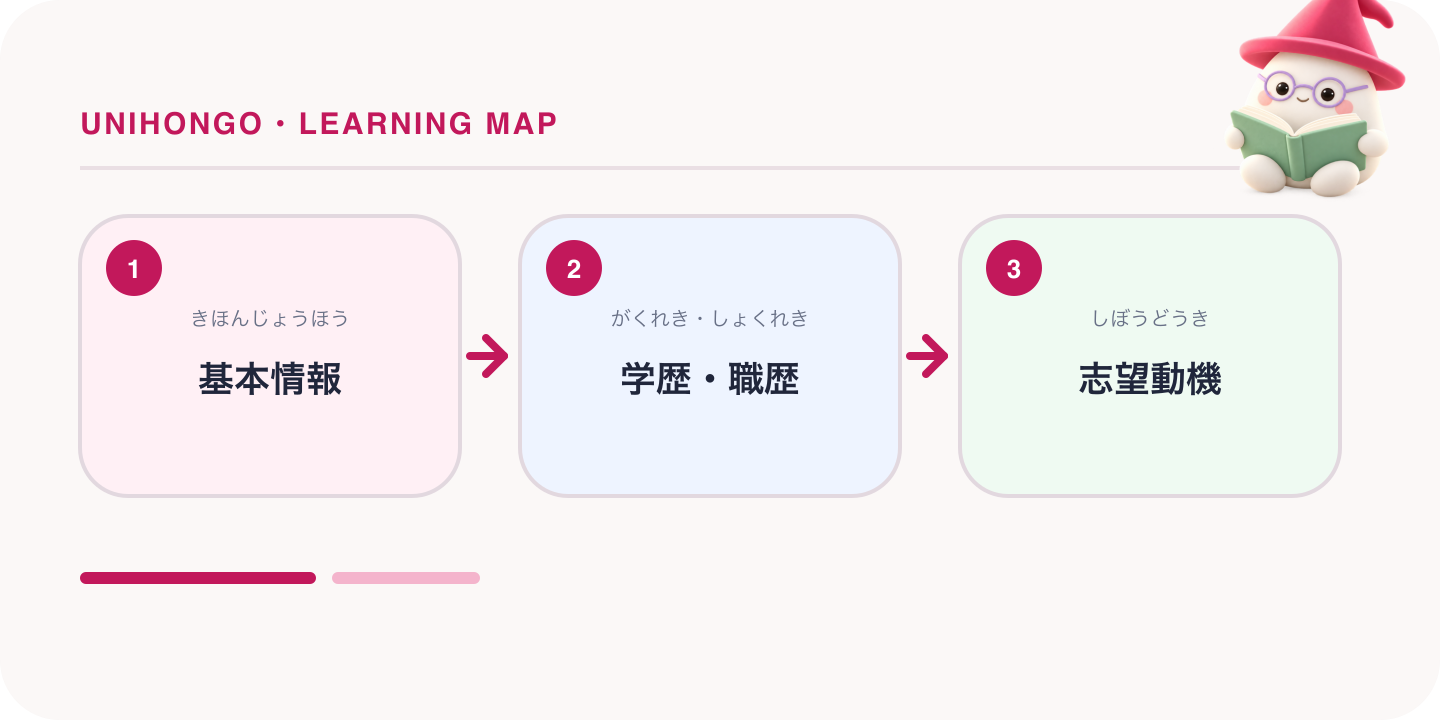
The fields at a glance
The table below lists the fields found on most templates, with the Japanese label and the format or set phrase that commonly fills each. Your form may omit some boxes or add others, such as a residence-status line on templates aimed at non-Japanese applicants. Fill every box that is printed; where you have nothing to write, use the set phrase for none in particular rather than leaving it empty.
| Field | Japanese label | Romaji | Set phrase or format |
|---|---|---|---|
| Date of writing | 年月日 現在 | Nengappi genzai | The date you submit, followed by genzai |
| Name | 氏名 | Shimei | Full name as on your residence card; furigana in the row above |
| Date of birth and age | 生年月日 | Seinengappi | Date, then man plus your age as of the date at the top |
| Photo box | 写真 | Shashin | A recent, formal head-and-shoulders photo; follow the template's size note |
| Current address | 現住所 | Genjūsho | Postal code mark, then the full address with furigana above it |
| Phone and email | 電話・メール | Denwa, mēru | One number and one address you actually check |
| Education and work history | 学歴・職歴 | Gakureki, shokureki | Year and month columns, then the set phrase for each row |
| Licences and qualifications | 免許・資格 | Menkyo, shikaku | Year and month, then the official name and shutoku or gōkaku |
| Motivation | 志望の動機 | Shibō no dōki | A short paragraph ending in shibō itashimashita |
| Self-PR, hobbies | 自己PR・趣味・特技 | Jiko PR, shumi, tokugi | Two or three plain sentences |
| Commuting time | 通勤時間 | Tsūkin jikan | Yaku plus minutes, one-way |
| Dependants | 扶養家族数(配偶者を除く) | Fuyō kazoku-sū (haigūsha o nozoku) | A number, excluding your spouse |
| Spouse | 配偶者 | Haigūsha | Circle ari or nashi |
| Requests | 本人希望記入欄 | Honnin kibō kinyūran | Kisha no kitei ni shitagaimasu unless you have a fixed constraint |
The top block: name, date, photo, address
Write your name exactly as it appears on your residence card or passport, in the same order. Non-Japanese names are commonly written in katakana, sometimes with the Roman-letter version beside them, and the furigana row above repeats the reading. Look at the printed label: ふりがな in hiragana asks for hiragana, フリガナ in katakana asks for katakana. The date at the top is the date you submit, not the date you started writing, and your age is calculated as of that date with 満 in front.
The photo box takes a recent, formal, front-facing head-and-shoulders photo against a plain background, in the clothes you would wear to the interview. Sizes and rules are printed on the template and vary, so follow the form rather than a guide. If you paste a printed photo, people commonly write their name on the back in case it comes loose. Below that, the address takes the postal code mark first, then the full address with furigana above the kanji, and a phone number and email you actually check.
| Japanese | Romaji | Meaning |
|---|---|---|
| ふりがな ぐえん みん | Furigana: guen min | Reading: Nguyen Minh (hiragana row) |
| 氏名 グエン・ミン | Shimei: Guen Min | Name: Nguyen Minh |
| 二〇二六年九月六日現在 | Nisen-nijūroku-nen ku-gatsu muika genzai | As of 6 September 2026 |
| 一九九七年五月十二日生(満二十九歳) | Sen-kyūhyaku-kyūjūnana-nen go-gatsu jūni-nichi umare (man nijūkyū-sai) | Born 12 May 1997 (age 29) |
| 現住所 〒160-0022 東京都新宿区新宿一丁目二番三号 | Genjūsho: yūbin bangō 160-0022, Tōkyō-to Shinjuku-ku Shinjuku itchōme ni-ban san-gō | Address: 160-0022, 1-2-3 Shinjuku, Shinjuku-ku, Tokyo |
Education and work history in the set format
The history block has three columns: year, month, and the event. Write the heading 学歴 centred on its own line, then one row per event, from the oldest to the newest. Most templates start from the last year of secondary school or from high school entry; ask if the listing specifies. Each school takes two rows, entry with nyūgaku and graduation with sotsugyō, and the second row may shorten the school name to dōkō, the same school, or dōdaigaku, the same university.
Leave one blank row, write 職歴 centred, and list employment the same way: nyūsha when you joined a company and taisha when you left, with a short reason. If you are still employed, the final row reads genzai ni itaru, to the present. Whether or not you have work history, the block ends with 以上 on the right, which closes the list. Write company and school names in full, including kabushiki-gaisha rather than the bracketed abbreviation, and use the official name at the time you attended.
| Japanese | Romaji | Meaning |
|---|---|---|
| 学歴 | Gakureki | Education (centred heading) |
| 二〇一二年 九月 ハノイ第一高等学校 入学 | Nisen-jūni-nen ku-gatsu Hanoi Dai-ichi Kōtō Gakkō nyūgaku | September 2012: Entered Hanoi No. 1 High School |
| 二〇一五年 六月 同校 卒業 | Nisen-jūgo-nen roku-gatsu dōkō sotsugyō | June 2015: Graduated from the same school |
| 二〇一五年 九月 ハノイ大学 外国語学部 日本語学科 入学 | Nisen-jūgo-nen ku-gatsu Hanoi Daigaku Gaikokugo-gakubu Nihongo-gakka nyūgaku | September 2015: Entered Hanoi University, Faculty of Foreign Languages, Department of Japanese |
| 二〇一九年 六月 同大学 卒業 | Nisen-jūkyū-nen roku-gatsu dōdaigaku sotsugyō | June 2019: Graduated from the same university |
| 二〇二七年 三月 同大学 卒業見込み | Nisen-nijūnana-nen san-gatsu dōdaigaku sotsugyō mikomi | March 2027: Expected to graduate from the same university |
| 職歴 | Shokureki | Work history (centred heading) |
| 二〇一九年 八月 株式会社サクラ物産 入社 | Nisen-jūkyū-nen hachi-gatsu Kabushiki-gaisha Sakura Bussan nyūsha | August 2019: Joined Sakura Bussan Co., Ltd. |
| 営業部にて海外顧客対応を担当 | Eigyō-bu nite kaigai kokyaku taiō o tantō | Handled overseas client relations in the sales department |
| 二〇二三年 三月 一身上の都合により退社 | Nisen-nijūsan-nen san-gatsu isshinjō no tsugō ni yori taisha | March 2023: Left the company for personal reasons |
| 二〇二三年 五月 株式会社ミドリ商事 入社 | Nisen-nijūsan-nen go-gatsu Kabushiki-gaisha Midori Shōji nyūsha | May 2023: Joined Midori Shoji Co., Ltd. |
| 現在に至る | Genzai ni itaru | To the present |
| 以上 | Ijō | End (right-aligned) |
A few variant phrases cover the other cases. Contract work that ended on schedule is keiyaku kikan manryō ni yori taisha, left on expiry of the contract, which reads better than a personal-reasons line. A redundancy is kaisha tsugō ni yori taisha. Leaving a course before finishing is chūto taigaku, and a student who has not yet graduated writes sotsugyō mikomi. Some people write taishoku instead of taisha; both are seen, but do not mix them within one form.
Dates: era or Western, but never both
Japanese forms commonly use the era calendar, in which the year is counted from the start of the current emperor's reign, and many templates print 年 with a space for either system. Western years are equally accepted on most forms and are easier for non-Japanese applicants to keep straight. The rule that matters is consistency: the date at the top, your birth date, every history row and every qualification row must use the same system, because a mixed form looks careless.
If you choose the era system, convert carefully. Reiwa began in May 2019, so Reiwa years are the Western year minus 2018; Heisei began in January 1989, so Heisei years are the Western year minus 1988; Shōwa began in late 1926, so Shōwa years are the Western year minus 1925. Only the first year of an era carries two names, and for a date in that year you write whichever era was in force on the actual day.
| Era | Began | Conversion | Example |
|---|---|---|---|
| 令和 Reiwa | May 2019 | Western year minus 2018 | 2026 is Reiwa 8 |
| 平成 Heisei | January 1989 | Western year minus 1988 | 2015 is Heisei 27 |
| 昭和 Shōwa | December 1926 | Western year minus 1925 | 1985 is Shōwa 60 |
On a handwritten form, numbers may be written in Arabic numerals or in kanji numerals, and both are common; typed forms nearly always use Arabic numerals. Whichever you use, the first year of an era is written gannen rather than ichi-nen, so 2019 after May would be Reiwa gannen. When in doubt, use Western years throughout and move on; the interviewer cares whether the dates are right, not which calendar you chose.
Licences and qualifications
This block follows the same year and month layout. Write the official name of the qualification in full, then shutoku for a licence you obtained or gōkaku for an exam you passed. Language qualifications go here, and for a non-Japanese applicant the JLPT level is often the line a hiring manager looks for first. List them oldest to newest, driving licences commonly first. If you have nothing yet, write toku ni nashi; if you are studying for something, one line saying so is common and welcome.
| Japanese | Romaji | Meaning |
|---|---|---|
| 免許・資格 | Menkyo, shikaku | Licences and qualifications (heading) |
| 二〇二〇年 十二月 日本語能力試験 N2 合格 | Nisen-nijū-nen jūni-gatsu Nihongo Nōryoku Shiken enu-ni gōkaku | December 2020: Passed the JLPT N2 |
| 二〇二一年 五月 普通自動車第一種運転免許 取得 | Nisen-nijūichi-nen go-gatsu futsū jidōsha dai-isshu unten menkyo shutoku | May 2021: Obtained an ordinary Class 1 driving licence |
| 二〇二二年 二月 日商簿記検定 三級 合格 | Nisen-nijūni-nen ni-gatsu Nisshō Boki Kentei san-kyū gōkaku | February 2022: Passed the Nissho Bookkeeping Test, Level 3 |
| 現在、日本語能力試験N1に向けて勉強中 | Genzai, Nihongo Nōryoku Shiken enu-ichi ni mukete benkyō-chū | Currently studying for the JLPT N1 |
| 特になし | Toku ni nashi | None in particular |
The motivation field
Shibō no dōki is the one place on the form where you argue for yourself, and it is small, commonly three to five sentences. A pattern that works: one sentence on what drew you to this company in particular, one on the experience or skill you bring, and one on what you want to do there. In writing the company is kisha; onsha is the spoken form used in the interview, and mixing them is one of the most common slips on forms from non-Japanese applicants.
Keep the register humble and the verbs in the formal polite range: shibō itashimashita, kōken shitai to kangaete orimasu. Avoid copying a template paragraph that could fit any company; hiring staff read hundreds and recognise them. If your Japanese is a selling point, say it in one plain sentence with the level attached rather than with adjectives. The self-PR and hobbies boxes, where present, take two or three short sentences in the same tone.
| Japanese | Romaji | Meaning |
|---|---|---|
| 貴社の海外展開に魅力を感じ、志望いたしました。 | Kisha no kaigai tenkai ni miryoku o kanji, shibō itashimashita. | I was drawn to your company's overseas expansion and decided to apply. |
| 前職で培った営業経験を活かし、貴社に貢献したいと考えております。 | Zenshoku de tsuchikatta eigyō keiken o ikashi, kisha ni kōken shitai to kangaete orimasu. | I hope to contribute by applying the sales experience I built in my previous role. |
| 日本語能力試験N2を取得しており、日本語での業務に支障はありません。 | Nihongo Nōryoku Shiken enu-ni o shutoku shite ori, nihongo de no gyōmu ni shishō wa arimasen. | I hold JLPT N2 and can carry out work in Japanese without difficulty. |
| ベトナム語と日本語の両方を使い、貴社と現地の橋渡しをしたいと考えております。 | Betonamugo to nihongo no ryōhō o tsukai, kisha to genchi no hashiwatashi o shitai to kangaete orimasu. | Using both Vietnamese and Japanese, I would like to be a bridge between your company and the local side. |
| 粘り強く、最後までやり遂げる性格です。 | Nebarizuyoku, saigo made yaritogeru seikaku desu. | I am persistent and see things through to the end. (self-PR) |
| 趣味は登山です。特技はベトナム語と英語です。 | Shumi wa tozan desu. Tokugi wa Betonamugo to eigo desu. | My hobby is hiking. My special skills are Vietnamese and English. |
Commuting time, dependants and the requests field
The small boxes near the bottom are practical, and they are easy to get wrong through overthinking. Commuting time is the one-way time from your current address to the workplace, written as yaku plus minutes; if you would move for the job, write that in the requests field instead. Dependants means the people you support financially, excluding your spouse, who has a separate ari or nashi box. Templates commonly also ask whether you have a duty to support your spouse, again as ari or nashi.
The requests field, honnin kibō kinyūran, is not the place for salary hopes or preferences. Most applicants write kisha no kitei ni shitagaimasu, I will follow your company's rules, and add a line only for a genuine constraint: a fixed work location, a start date tied to a notice period, or a specific role when the listing offers several. Templates for non-Japanese applicants sometimes add a residence-status line; if yours does, copy the status and expiry exactly from your residence card and confirm anything unclear with the employer.
| Japanese | Romaji | Meaning |
|---|---|---|
| 通勤時間 約四十分 | Tsūkin jikan: yaku yonjuppun | Commuting time: about forty minutes |
| 扶養家族数(配偶者を除く) 〇人 | Fuyō kazoku-sū (haigūsha o nozoku): zero-nin | Dependants (excluding spouse): none |
| 配偶者 無 | Haigūsha: nashi | Spouse: none |
| 貴社の規定に従います。 | Kisha no kitei ni shitagaimasu. | I will follow your company's rules. |
| 営業職を希望いたします。 | Eigyō-shoku o kibō itashimasu. | I wish to apply for the sales position. |
| 現職の引き継ぎのため、入社は二〇二六年十一月以降を希望いたします。 | Genshoku no hikitsugi no tame, nyūsha wa nisen-nijūroku-nen jūichi-gatsu ikō o kibō itashimasu. | Owing to handover at my current job, I would like to start from November 2026 or later. |
Mistakes non-Japanese applicants commonly make
- Reordering the history newest first, as a Western CV would; the rirekisho runs oldest to newest.
- Mixing era years and Western years, or writing an era's first year as ichi-nen instead of gannen.
- Writing onsha in the motivation field; the written form is kisha.
- Abbreviating school and company names, such as writing 高校 for 高等学校 or the bracketed form of kabushiki-gaisha.
- Leaving boxes blank instead of writing toku ni nashi, or missing the furigana rows above the name and address.
- Putting achievements, percentages and project bullet points into the history rows; those belong in the shokumu keirekisho.
- Using correction fluid or crossing out on a handwritten form; people commonly rewrite the page instead.
- Writing a name that differs in order or spelling from the residence card, which slows down every later check.
- Pasting a casual or cropped photo; the box expects a formal photo taken for the purpose.
Saying your rirekisho aloud
The shokumu keirekisho is the rirekisho's companion for mid-career applicants: a free-format career history, commonly one to two typed pages, that describes each role, your responsibilities, and concrete results, in the achievement-focused style the rirekisho deliberately avoids. Whether the listing asks for one is stated in the job posting, and the two documents should agree on every date and company name. The guide to Japanese job interview questions covers what happens once both are on the table.
Every row on your form is a question waiting to be asked, and interviewers commonly work down the history with the paper in front of them. So practise the form as speech: each row as a full sentence with a verb, each gap with a one-sentence reason, and the motivation field as a spoken paragraph rather than a recitation. The lines below are what that sounds like, with the questions you should expect in return.
| Japanese | Romaji | Meaning |
|---|---|---|
| 履歴書をお持ちしました。ご確認をお願いいたします。 | Rirekisho o omochi shimashita. Gokakunin o onegai itashimasu. | I have brought my resume. Please take a look. |
| こちらが履歴書と職務経歴書です。 | Kochira ga rirekisho to shokumu keirekisho desu. | Here are my rirekisho and my career history. |
| 履歴書を拝見しました。学歴からお願いします。 | Rirekisho o haiken shimashita. Gakureki kara onegai shimasu. | I have read your resume. Please start with your education. (interviewer) |
| 二〇一九年六月にハノイ大学を卒業しました。 | Nisen-jūkyū-nen roku-gatsu ni Hanoi Daigaku o sotsugyō shimashita. | I graduated from Hanoi University in June 2019. |
| 同年八月に株式会社サクラ物産に入社し、営業を担当しました。 | Dōnen hachi-gatsu ni Kabushiki-gaisha Sakura Bussan ni nyūsha shi, eigyō o tantō shimashita. | In August of the same year I joined Sakura Bussan and worked in sales. |
| 二〇二三年三月に一身上の都合で退職しました。 | Nisen-nijūsan-nen san-gatsu ni isshinjō no tsugō de taishoku shimashita. | I left in March 2023 for personal reasons. |
| この二か月の空白期間について教えてください。 | Kono ni-kagetsu no kūhaku kikan ni tsuite oshiete kudasai. | Please tell me about this two-month gap. (interviewer) |
| その間は日本語の勉強と転職活動をしておりました。 | Sono aida wa nihongo no benkyō to tenshoku katsudō o shite orimashita. | During that time I was studying Japanese and looking for a new position. |
| 日本語能力試験N2に合格しています。 | Nihongo Nōryoku Shiken enu-ni ni gōkaku shite imasu. | I have passed the JLPT N2. |
| 通勤時間は約四十分です。 | Tsūkin jikan wa yaku yonjuppun desu. | My commute is about forty minutes. |
| 御社を志望した理由は、海外展開に魅力を感じたからです。 | Onsha o shibō shita riyū wa, kaigai tenkai ni miryoku o kanjita kara desu. | The reason I applied to your company is that I was drawn to its overseas expansion. |
| 勤務地については、御社の規定に従います。 | Kinmuchi ni tsuite wa, onsha no kitei ni shitagaimasu. | As for work location, I will follow your company's rules. |