

Choose a challenge that produces observable language
A useful challenge asks you to do something: summarize a message, choose and explain a particle, read a word in context, or make a short request. Tell Mocchi which ability matters to your current goal. Keep the task small enough to repeat later without requiring a completely different lesson setup.
Avoid defining success only as feeling confident. Confidence is helpful, but an attempted response gives you something to inspect. You can be nervous and still make a clearer sentence than before, or feel comfortable because the task repeats an answer you already memorized.
Keep the conditions similar while changing the content
If the first challenge used a short notice with familiar vocabulary, the later one should not suddenly become a dense essay under time pressure. Change the names, details, or example while preserving the main demand. Ask Mocchi for that controlled variation. It lets you test transfer without confusing a change in task difficulty with a change in your ability.
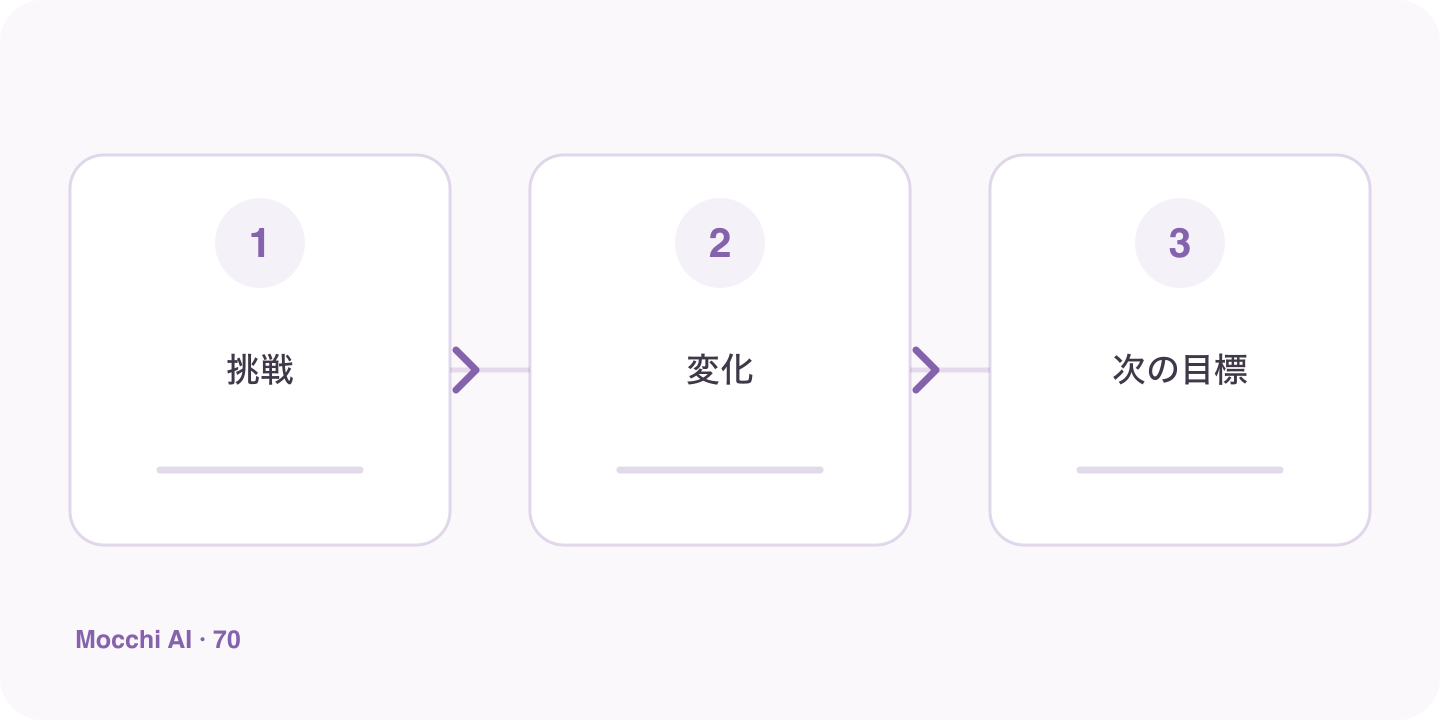
| Challenge | Useful observation |
|---|---|
| Explain a short notice | The detail and supporting phrase you found |
| Make a request | Whether the action and audience are clear |
| Choose a grammar form | The clue you used and help required |
Record the support rather than hiding it
Note whether you needed a translation, vocabulary hint, example, or complete model. These supports can make a task productive, but they affect what the result shows. A later answer with less help may be a meaningful improvement even if the wording stays simple. Ask Mocchi to discuss that change rather than assigning a broad level from one small task.
Make the challenge enjoyable without losing the target
Use a favorite topic, an invented character, or a short friendly quiz format to make the task inviting. Keep the language decision visible and manageable. If you also use Unihongo's arcade games, treat them as another practice format with their own rules and access limits, not automatic proof that every skill has improved.
Choose the next challenge from the result
Celebrate a concrete change, then identify the next small obstacle. If you understood the message but could not explain the clue, practice the explanation. If the answer was clear but required a full model, reduce the support gradually. Mocchi can help connect these observations to a personal learning routine, making progress both more encouraging and more informative than a single total of days or points.