
Where the three scripts came from
Japanese had a spoken language long before it had a written one. Writing arrived with Chinese texts, and Japanese scribes took the characters with them. That created an immediate mismatch, because Chinese characters were built for a different language, and Japanese has grammatical endings that Chinese does not. Early writers solved this partly by using characters for their meanings and partly by using them purely for their sounds, ignoring what they meant.
Those sound-only characters are the ancestors of both kana sets. Hiragana developed from flowing cursive forms of them, and katakana from small fragments taken out of them, and over the centuries each settled into a fixed set of about fifty syllable signs. The result was not designed by anyone. It is a stack of three solutions from three different periods that stayed because, together, they worked better than any of them alone.
What each script carries
| Script | What it carries | Example |
|---|---|---|
| Kanji | The meaning of content words: nouns, and the stems of verbs and adjectives | 食 in 食べます tabemasu, to eat |
| Hiragana | Grammar: particles, verb and adjective endings, and many native words | を and ます in パンを食べます pan o tabemasu |
| Katakana | Loanwords, foreign names, sound words, technical terms, and emphasis | パン pan, bread, from Portuguese |
Those are defaults rather than laws, and every one of them has exceptions a writer can use on purpose. But if you read a mixed sentence expecting kanji to be the meaning, hiragana to be the machinery, and katakana to be the flagged item, you will be right most of the time, and being right most of the time is what makes reading flow.
How the three split the work in one sentence
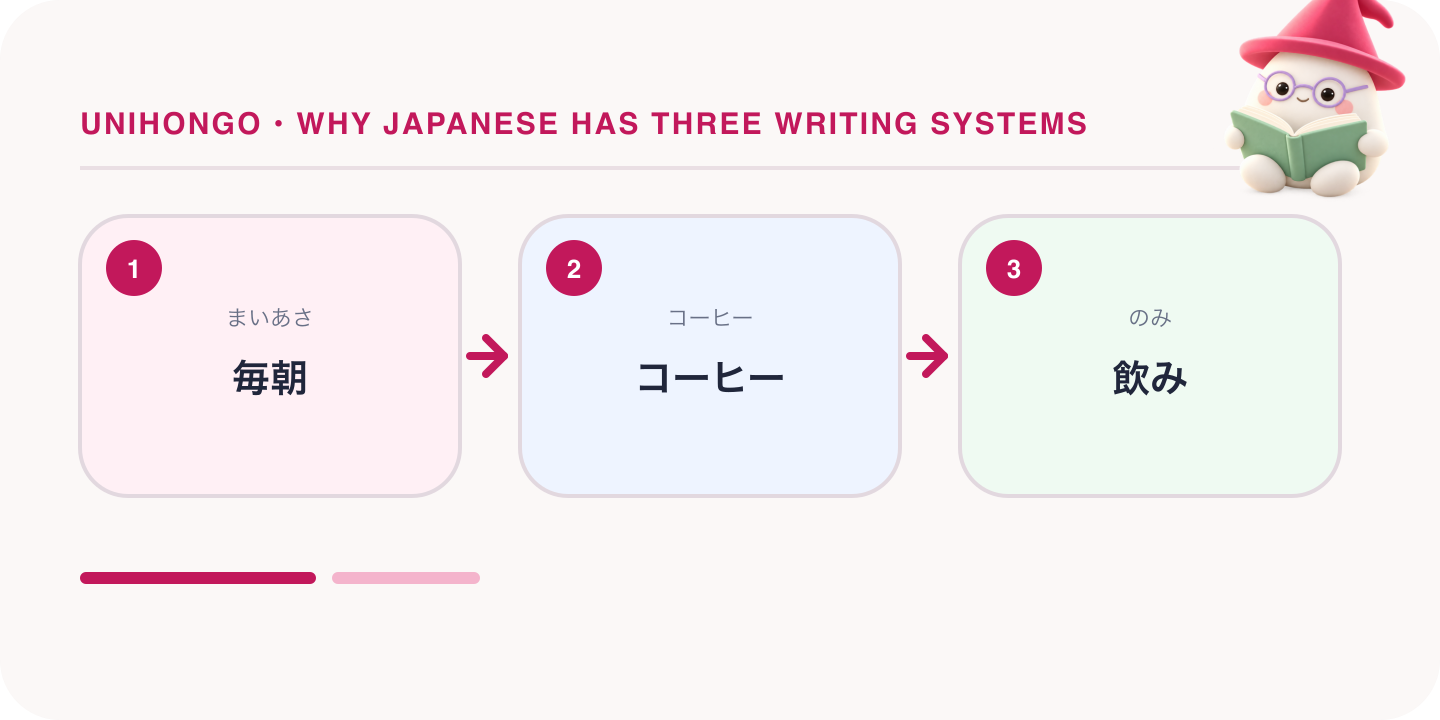
Take a single ordinary sentence and watch the handover. In 毎朝コーヒーを飲みます, the katakana block is the imported item, the kanji carry the two pieces of meaning, and the hiragana between and after them say what role each piece plays and when the action happens. Nothing is repeated: each script covers what the others do not, which is why the sentence is shorter to the eye than a kana-only version of the same words.
This is also why Japanese verbs look half written. The kanji holds the fixed meaning and the hiragana tail does the conjugating, so 食べます, 食べました, and 食べたい all share a visible stem. Once you see that pattern you can identify the tense of a verb before you have finished reading the word, which is a real reading speed advantage.
| Japanese | Romaji | Meaning |
|---|---|---|
| 毎朝コーヒーを飲みます。 | Maiasa kōhī o nomimasu. | I drink coffee every morning. |
| 昨日はパンを食べました。 | Kinō wa pan o tabemashita. | Yesterday I ate bread. |
| 明日はカレーが食べたいです。 | Ashita wa karē ga tabetai desu. | Tomorrow I want to eat curry. |
| 駅の前で友達を待ちます。 | Eki no mae de tomodachi o machimasu. | I will wait for my friend in front of the station. |
The same sentence written three ways
| Japanese | Romaji | Meaning |
|---|---|---|
| きょうはともだちとあたらしいかふぇでこーひーをのみました。 | Kyō wa tomodachi to atarashii kafe de kōhī o nomimashita. | Kana only: correct, but the eye has to find every word boundary itself. |
| 今日は友達と新しいカフェでコーヒーを飲みました。 | Kyō wa tomodachi to atarashii kafe de kōhī o nomimashita. | Standard mixed writing: the same sentence, read at a glance. |
| 本日は友人と新装開店の喫茶店にて珈琲を飲みました。 | Honjitsu wa yūjin to shinsō-kaiten no kissaten nite kōhī o nomimashita. | Heavier and more formal: same event, but it now reads like a written report. |
The first and second rows contain the same words in the same order. Only the script changed, and yet the second is far quicker to read, because the kanji blocks tell your eye where each word starts before you have decoded a single sound. The kana-only line is not wrong; it is simply doing all the work with one tool.
The third row shows the other extreme. It swaps in stiffer vocabulary, uses にて in place of で, and writes coffee with its old character spelling instead of katakana. Nothing is incorrect, but a friend receiving that in a message would find it comic. Script and word choice together set the register, and the mixed middle row is what ordinary writing looks like.
Why text without spaces still works
Japanese does not put spaces between words, which sounds impossible until you notice what the script changes are doing. A run of kanji usually begins a content word, the hiragana immediately after it usually finishes that word or marks its grammatical role, and a run of katakana is normally one imported item from start to end. Those transitions are word boundaries in disguise, and fluent readers use them the way English readers use the white gaps.
The classic demonstration is a line that becomes ambiguous the moment you remove the kanji. Written in kana alone, ここではきものをぬいでください can be cut after ここで or after ここでは, which produces two different instructions. The kanji settle it instantly, because 履物 and 着物 look nothing alike even at a glance.
| Japanese | Romaji | Meaning |
|---|---|---|
| ここで履物を脱いでください。 | Koko de hakimono o nuide kudasai. | Please take off your footwear here. |
| ここでは着物を脱いでください。 | Koko de wa kimono o nuide kudasai. | Here, please take off your kimono. |
| ここではきものをぬいでください。 | Koko de hakimono o nuide kudasai. | The same line in kana only, which can be cut either way. |
| 今日は日本語を勉強します。 | Kyō wa nihongo o benkyō shimasu. | Today I am going to study Japanese. |
| 会社の近くに新しい店ができました。 | Kaisha no chikaku ni atarashii mise ga dekimashita. | A new shop has opened near my office. |
Why dropping kanji would make Japanese harder
The usual proposal from frustrated learners is to abolish kanji and write everything in kana. The problem is homophones. Japanese has a comparatively small set of syllables, and centuries of vocabulary borrowed from Chinese produced very large families of words that sound identical and mean completely different things. In speech, context and pitch usually sort them out, and the conversation moves at a pace that allows a question. On the page there is no context yet and nobody to ask.
Kanji do that disambiguating work silently. こうえん could be a park, a lecture, or a stage performance, and the reader knows which within a fraction of a second because 公園, 講演, and 公演 look different. Take the characters away and every one of those words becomes a guess resolved later in the sentence. Reading would still be possible, but it would be slower and more error-prone, which is the opposite of what the proposal wanted.
| Japanese | Romaji | Meaning |
|---|---|---|
| 公園で待っています。 | Kōen de matte imasu. | I am waiting in the park. |
| 講演は三時からです。 | Kōen wa san-ji kara desu. | The lecture starts at three. |
| 記者に質問されました。 | Kisha ni shitsumon saremashita. | I was asked a question by a reporter. |
| 汽車の写真を撮りました。 | Kisha no shashin o torimashita. | I took a photograph of the steam train. |
| 科学の本を読んでいます。 | Kagaku no hon o yonde imasu. | I am reading a science book. |
| 化学は苦手です。 | Kagaku wa nigate desu. | I am not good at chemistry. |
| 性格が明るいですね。 | Seikaku ga akarui desu ne. | You have a cheerful personality. |
| 正確な時間を教えてください。 | Seikaku na jikan o oshiete kudasai. | Please tell me the exact time. |
| 橋を渡ってください。 | Hashi o watatte kudasai. | Please cross the bridge. |
| お箸をお願いします。 | O-hashi o onegai shimasu. | Chopsticks, please. |
Speakers do feel this in conversation too, which is why 化学 is sometimes said as bakegaku to keep it apart from 科学. That workaround exists precisely because sound alone is not always enough, and it is the clearest evidence that the characters are carrying real information rather than decorating the page.
Where a script carries tone instead of information
Once the basic division is in place, writers start breaking it deliberately, and that is where script becomes style. A word normally written in kanji can be softened by writing it in hiragana, which is why greeting cards, children's material, and small friendly shopfronts use so much kana. The same word pushed into katakana becomes emphatic, clinical, or slightly detached, which is roughly the work English does with italics and capitals.
None of this changes what the word means. It changes how the sentence sounds in the reader's head. When you meet a word in an unexpected script, the question to ask is not what does this mean but why did the writer point at it, and the answer is usually emphasis, softness, or a specialised register.
| Japanese | Romaji | Meaning |
|---|---|---|
| ここは危険です。 | Koko wa kiken desu. | It is dangerous here. (standard, on a warning sign) |
| それ、ヤバいですね。 | Sore, yabai desu ne. | That is intense. (katakana marks the slangy tone) |
| ダメですよ。 | Dame desu yo. | That is not allowed. (katakana adds firmness) |
| お名前はカタカナで書いてください。 | O-namae wa katakana de kaite kudasai. | Please write your name in katakana. (staff line at a counter) |
| スマホで写真を撮ってもいいですか。 | Sumaho de shashin o totte mo ii desu ka. | May I take a photo with my phone? |
A dedicated guide on this blog goes further into which script a given word normally takes and what a switch signals, so this post stays with the reason all three exist at once.
How to read a mixed sentence
- Scan for the kanji blocks first; they are the content, and they tell you what the sentence is about.
- Read the hiragana immediately after each block, because that is what says how the block fits in.
- Treat every katakana run as a single imported item, and read it as a whole rather than sound by sound.
- Find the end of the sentence next; the final verb or だ, です, ます carries the tense and the politeness.
- Only then go back and decode anything you skipped, now that you know the shape of the whole line.
- Read the finished sentence aloud once, because a sentence you have only decoded silently will not come back when you need to say it.
This order feels backwards at first, since beginners tend to read strictly left to right and stall at the first unknown character. Reading in blocks is closer to how the writing system is actually designed to be used, and it makes long sentences much less intimidating, because you always have a rough meaning before you start filling in the gaps.
Lines for asking about the scripts
You will meet writing you cannot place, and the fastest way through is to ask. These lines work with a colleague, a shop assistant, a teacher, or an AI Sensei, and the likely replies are printed here so the answer does not surprise you into silence.
| Japanese | Romaji | Meaning |
|---|---|---|
| これは漢字ですか、カタカナですか。 | Kore wa kanji desu ka, katakana desu ka. | Is this kanji or katakana? |
| どうしてカタカナで書くんですか。 | Dōshite katakana de kaku n desu ka. | Why is it written in katakana? |
| 外来語だからです。 | Gairaigo dakara desu. | Because it is a loanword. (likely reply) |
| ひらがなで書くと、やわらかい感じがします。 | Hiragana de kaku to, yawarakai kanji ga shimasu. | Written in hiragana, it feels softer. (likely reply) |
| 漢字で書いたほうがいいですか。 | Kanji de kaita hō ga ii desu ka. | Would it be better to write it in kanji? |
| 三つの文字を全部覚える必要がありますか。 | Mittsu no moji o zenbu oboeru hitsuyō ga arimasu ka. | Do I need to learn all three sets of characters? |
| 読み方が二つありますか。 | Yomikata ga futatsu arimasu ka. | Does it have two readings? |
| この文を声に出して読んでもいいですか。 | Kono bun o koe ni dashite yonde mo ii desu ka. | May I read this sentence out loud? |
What this means for your study plan
The three scripts are not three separate mountains. Hiragana and katakana are one project of about fifty sounds each, finishable in weeks, and everything after that is vocabulary that happens to be written in kanji. Learners who treat kanji as a fourth language they will start later usually find their reading stalls, because the words they need most are written with characters and skipping them means learning each word twice.
The practical plan is to get kana fluent quickly, then learn every new word in the script it is normally written in, from the day you meet it. That way the writing system stops being a topic you study and becomes the ordinary surface of the language. And because reading is recognition, pair it from the start with saying the sentences aloud, or the words will stay something you can identify but never produce.
- Finish hiragana first, since grammar is written in it and every sentence needs it.
- Add katakana next, and practise it on menus and product labels where loanwords cluster.
- Learn new vocabulary in its usual script rather than in romaji, so you never learn a word twice.
- Note the script whenever a writer breaks the default, and ask yourself what tone it added.
- Say every sentence you read aloud at least once, so recognition turns into something you can produce.