
Meet 音 and 楽: sound plus enjoyment
Japanese writes music as 音楽: the kanji for sound followed by the kanji for enjoyment. It is a neat little definition hidden inside a word, and it gives you two characters that you will meet constantly, together and apart.
Start with these four. The first is the full word for music. The second is the plain word for a sound. The third is the adjective for fun, and the fourth is the word for an instrument, where 楽 means music again.
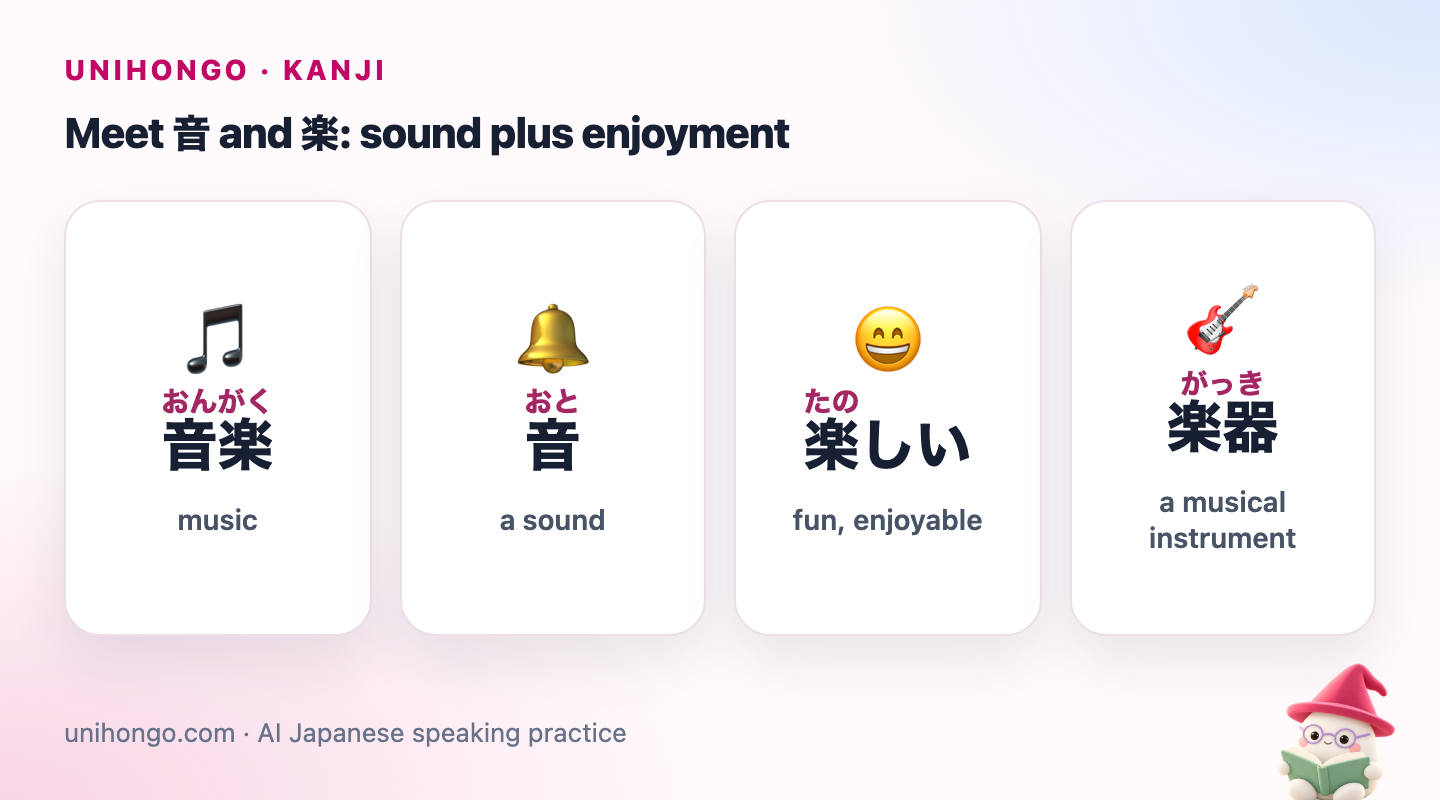
| Japanese | Romaji | Meaning |
|---|---|---|
| 音楽 | ongaku | music |
| 音 | oto | a sound |
| 楽しい | tanoshii | fun, enjoyable |
| 楽器 | gakki | a musical instrument |
Readings, strokes and the shapes inside 音 and 楽
音 has nine strokes. Its shape looks like 立 (stand) sitting on top of 日 (sun), and most learners remember it that way, even though historians trace it to a drawing related to 言, speech, with a mark in the mouth. As a building block, 音 sits inside other kanji you will meet later, such as 暗 (dark) and 意 (meaning, mind).
楽 has thirteen strokes. It has 白 (white) in the middle with a short stroke on each side, all on top of 木 (tree). The traditional form, 樂, is still seen in some names and old signs, and simplified Chinese writes it 乐, which is why music is 音乐 in mainland Chinese but 音楽 in Japanese.
| Kanji | Reading type | Reading | Example |
|---|---|---|---|
| 音 | kun'yomi | oto | 音, oto, a sound; 足音, ashioto, footsteps |
| 音 | kun'yomi | ne | 音色, neiro, tone colour; 本音, honne, true feelings |
| 音 | on'yomi | on | 音楽, ongaku; 発音, hatsuon, pronunciation |
| 音 | on'yomi (some words) | in | 母音, boin, vowel; 子音, shiin, consonant |
| 楽 | on'yomi | gaku | 音楽, ongaku; 楽器, gakki |
| 楽 | on'yomi | raku | 楽, raku, easy; 気楽, kiraku, carefree |
| 楽 | kun'yomi | tano(shii) | 楽しい, tanoshii; 楽しむ, tanoshimu |
A rule of thumb: when 音 stands alone it is oto, and when it joins another kanji it is usually on. The reading ne survives in a few beautiful words that are worth learning as wholes, especially 本音, a person's real feelings, and 音色, the particular colour or character of a sound.
Fifteen words with 音 and 楽 you will actually hear
These words come up in classrooms, apps, offices and karaoke rooms. They are grouped by kanji so you can see each reading at work. Notice how many study words use 音: if you are learning Japanese, you will see 発音 and 音読 on every worksheet.
| Japanese | Romaji | Meaning |
|---|---|---|
| 発音 | hatsuon | pronunciation |
| 音読 | ondoku | reading aloud |
| 録音 | rokuon | a recording; to record |
| 音量 | onryō | volume |
| 足音 | ashioto | footsteps |
| 物音 | monooto | a noise (from something unseen) |
| 騒音 | sōon | noise pollution |
| 音色 | neiro | tone colour, timbre |
| 本音 | honne | one's true feelings |
| 楽譜 | gakufu | sheet music |
| 楽しみ | tanoshimi | something to look forward to |
| 楽 | raku | easy, comfortable |
| 気楽 | kiraku | carefree, relaxed |
| 楽しみにしています。 | Tanoshimi ni shite imasu. | I'm looking forward to it. (polite) |
| この椅子、楽だね。 | Kono isu, raku da ne. | This chair is comfy. (casual) |
Two of these are especially useful. Tanoshimi ni shite imasu is the standard polite way to say you are looking forward to something, perfect at the end of a message to a teacher, a host or a colleague. And raku is the everyday word for easy or comfortable: shoes, chairs, jobs and routes can all be raku. Be a little careful with it about other people's work, though. Saying someone's job looks raku can sound like you think it is too easy.
Oto or koe? The sound mistake almost everyone makes
English uses sound and noise for almost anything, but Japanese splits them. 音 (oto) is a sound made by an object or by something happening: a bell, a car, the wind, a piano. 声 (koe) is a voice, the sound that comes out of a living throat, including birdsong and a dog's bark. Learners often say oto for a person speaking, and it sounds strange, a bit like saying the noise of your friend.
Music sits on both sides. An instrument makes oto, but a singer has a koe. If you compliment a guitarist, say ii oto desu ne; if you compliment a singer, say koe ga kirei desu ne.
| Japanese | Romaji | Meaning |
|---|---|---|
| ドアの音がした。 | Doa no oto ga shita. | I heard the door. |
| 鳥の声が聞こえる。 | Tori no koe ga kikoeru. | I can hear birds singing. |
| ピアノの音がきれいですね。 | Piano no oto ga kirei desu ne. | The piano sounds lovely. (polite) |
| きれいな声ですね。 | Kirei na koe desu ne. | What a beautiful voice. (polite) |
| 音を小さくしてくれる? | Oto o chiisaku shite kureru? | Can you turn it down? (casual) |
| Point | 音 (oto) | 声 (koe) |
|---|---|---|
| Basic meaning | a sound from things | a voice from people or animals |
| Examples | doors, rain, bells, instruments | talking, singing, birds, dogs |
| Loud | oto ga ōkii: the sound is loud | koe ga ōkii: someone speaks loudly |
| Music | an instrument's sound | a singer's voice |
A second trap is 音楽 itself. Japanese speakers usually say ongaku only for music in general: ongaku ga suki, I like music. For one song, use 曲 (kyoku) or 歌 (uta, a song with words). Kono ongaku ii ne is understandable, but kono kyoku ii ne sounds much more natural when a track comes on.
A short dialogue: play something for me
Here is a casual conversation between two friends at home. One has spotted a guitar in the corner. Notice how 楽 appears as both music and fun, and how 音 is used for the sound of the guitar, not for the person.
| Japanese | Romaji | Meaning |
|---|---|---|
| 何か楽器を弾くの? | Nanika gakki o hiku no? | Friend: Do you play an instrument? |
| うん、ギターを少し。 | Un, gitā o sukoshi. | You: Yeah, a little guitar. |
| どんな音楽が好き? | Donna ongaku ga suki? | Friend: What kind of music do you like? |
| 日本のシティポップをよく聴くよ。 | Nihon no shiti poppu o yoku kiku yo. | You: I often listen to Japanese city pop. |
| いいね!ちょっと弾いてみて。 | Ii ne! Chotto hiite mite. | Friend: Nice! Play something for me. |
| 音、大きすぎない? | Oto, ōkisuginai? | You: Isn't it too loud? |
| 大丈夫。いい音だね。 | Daijōbu. Ii oto da ne. | Friend: It's fine. It sounds great. |
| 楽しかった!また聴かせて。 | Tanoshikatta! Mata kikasete. | Friend: That was fun! Play for me again. |
Sayings and set phrases built on 音 and 楽
A handful of idioms with these kanji are common in conversation, and they show the reading ne in action. They are good to recognise early, and two of them are easy to use yourself.
| Japanese | Romaji | Meaning |
|---|---|---|
| 音を上げる | ne o ageru | to give up, to admit defeat |
| 本音と建前 | honne to tatemae | true feelings and public face |
| 音沙汰がない | otosata ga nai | to hear nothing from someone |
| 楽あれば苦あり | raku areba ku ari | no pleasure without pain |
| 音痴 | onchi | tone-deaf; bad at something |
| 方向音痴 | hōkō onchi | having no sense of direction |
Ne o ageru means to admit something is too hard and give up, usually in the negative as praise: kare wa zettai ni ne o agenai, he never gives up. Honne to tatemae describes the gap between what people really think and what they say in public, and it comes up often in conversations about Japanese work life, although every culture has its own version of it.
Onchi literally means bad with sound, someone who cannot sing in tune. It is a teasing word, so use it about yourself rather than others: watashi, onchi nan desu, I'm hopeless at singing, is a classic way to escape a karaoke microphone. Hōkō onchi, tone-deaf about directions, is a friendly self-description for anyone who gets lost easily.
Music tattoos and logos: 音, 楽 or 音楽?
Music is a popular theme for tattoos, band logos and studio names. The kanji look elegant, but each option sends a slightly different message to a Japanese reader.
- A lone 楽 is most likely to be read raku, easy or comfortable, or as the first kanji of fun. To many readers it says relax rather than music.
- A lone 音 means sound. It can work as a minimal, artistic design for a sound engineer or a DJ, but it will not read as music.
- 音楽 is clear and correct, but plain, the way the English word MUSIC alone might look. 音色 (neiro, the colour of a sound) or 楽しむ (tanoshimu, to enjoy) carry more feeling.
- Chinese and Japanese differ here. Simplified Chinese writes music as 音乐, with 乐 instead of 楽, and traditional Chinese uses 音樂. If you want Japanese, make sure the artist uses 楽.
- Ask a native speaker to check the characters, the stroke direction and the font or brush style. Mixed-up strokes in 楽 are a common mistake because it has so many parts.
If you plan to visit Japanese hot springs or public baths, be aware that many have rules about tattoos. Rules differ from place to place, so check and respect each one.
Look-alikes: 薬, 暗 and 意
The most common look-alike for 楽 is 薬 (kusuri, medicine). It is exactly 楽 with the grass radical 艹 on top, a reminder that many old medicines were plants. You will see 薬 on every pharmacy, so it is worth knowing the difference: grass on top means medicine, no grass means music or fun.
音 hides inside other kanji. Put 日 on its left and you get 暗 (kurai, dark). Put 心 (heart) underneath and you get 意 (i, meaning or intention), as in 意味 (imi, meaning). 章 (shō, chapter) also starts with 立 and 日 but adds a long stroke through the bottom.
| Japanese | Romaji | Meaning |
|---|---|---|
| 薬 | kusuri | medicine |
| 暗い | kurai | dark |
| 意味 | imi | meaning |
| 文章 | bunshō | a piece of writing |
- Reading 楽器 as rakuki. In music words, 楽 is gaku: gakki.
- Saying ongaku for a single song. Use kyoku or uta.
- Using oto for a person's voice. People have koe.
- Writing 楽 with the side strokes after 木. They go with 白, before the tree.
A listening-and-reading loop for 音 and 楽
Sign in and ask Mocchi: Quiz me on oto versus koe with ten everyday sounds, one at a time. Mocchi gives you a situation, such as a phone ringing or a baby crying, and you choose the word. It keeps track of the ones you get wrong and brings them back in a later /review, so the split between objects and voices settles in over a few days. Follow up with /kanji 楽 whenever the three readings blur together.
Then move from reading to listening. The pronunciation coach has drills on small tsu, so gakki, ikki and similar words get real practice with a slowed-down model, a recording of your own voice and a tip on what to fix.