
水 at a glance: four everyday words
水 means water. It began as a drawing of a stream: a central flow with smaller currents splashing on each side. On its own it is read mizu, and you will hear it many times a day, from a restaurant table to a weather report.
These four words show how 水 works in real life: the kanji itself, the polite word for drinking water, the day of the week, and the sport. The last two use the Chinese-derived reading sui.
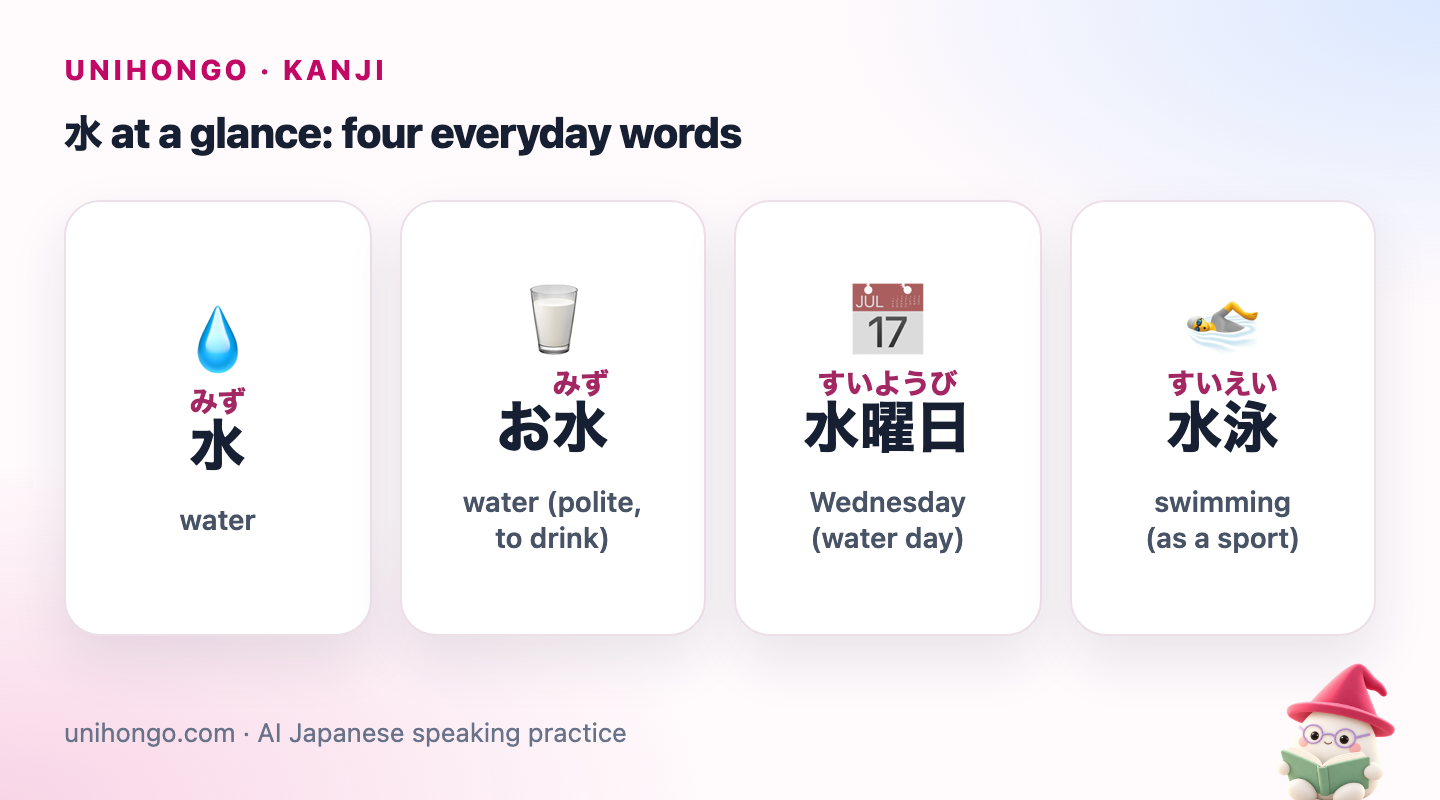
| Japanese | Romaji | Meaning |
|---|---|---|
| 水 | mizu | water |
| お水 | omizu | water (polite, to drink) |
| 水曜日 | suiyōbi | Wednesday (water day) |
| 水泳 | suiei | swimming (as a sport) |
Readings, stroke order and the shape of 水
水 has four strokes. It is a pictograph, so it is not made from smaller parts. It has one native Japanese reading and one main reading from Chinese, and the rule is simple: alone or with native words, mizu; in Chinese-style compounds, sui. After some sounds, sui becomes zui, as in 洪水 (kōzui, flood).
| Japanese | Romaji | Meaning |
|---|---|---|
| 氷 | kōri | ice |
| 永遠 | eien | eternity, forever |
| かき氷 | kakigōri | shaved ice dessert |
| Reading type | Reading | When you use it | Example |
|---|---|---|---|
| kun'yomi | mizu | alone and in native compounds | 水着, mizugi, swimsuit |
| on'yomi | sui | most two-kanji words | 水道, suidō, water supply |
| on'yomi (sound change) | zui | after some sounds | 洪水, kōzui, flood |
How to write it: begin with the long vertical stroke in the centre, ending in a small hook to the left. Next, write the left part as one stroke: a short horizontal line that turns and falls down to the left. Then write the right side: a short stroke falling to the left from the top, and finally a long stroke sweeping down to the right. Keep the centre line straight, and keep the two sides close to it, like water splashing from a stream.
Watch the dots. 氷 (kōri, ice) is 水 with an extra dot on the left; 永 (ei, eternity) is 水 with a dot on top. Writing that dot by accident changes the word, so compare the three side by side once and the difference sticks.
Fifteen everyday words with 水
These are the 水 words that come up in shops, homes, schools and the news. Notice how many are about daily life rather than nature: tap water, water bottles, swimsuits and even a polka-dot pattern.
| Japanese | Romaji | Meaning |
|---|---|---|
| こまめに水分をとってください。 | Komame ni suibun o totte kudasai. | Please drink fluids often. |
| 水色のシャツを探しています。 | Mizuiro no shatsu o sagashite imasu. | I'm looking for a light blue shirt. |
Two words are particularly useful in summer. Suibun is what health advice tells you to drink, as in suibun o totte kudasai, please drink plenty of fluids, a line you hear on the news and from coworkers during heatwaves. Mizuiro, water colour, is the Japanese name for light blue, so a mizuiro no shatsu is a pale blue shirt, not a wet one.
Mizu and oyu: cold water is not hot water
English uses one word, water, and adds hot or cold. Japanese splits it in two. Mizu is cold or room-temperature water, the water you drink or wash vegetables in. Hot water is 湯, almost always said politely as oyu. A bath is filled with oyu, a kettle boils oyu, and you pour oyu on instant noodles. Saying atsui mizu is understood but sounds unnatural, a bit like saying hot ice.
This matters at onsen too: the curtain marked ゆ, yu, is the hot water of the bath, written with the same 湯. The kanji 湯 itself has the water radical 氵 on the left, a nice reminder that it belongs to the water family.
| Japanese | Romaji | Meaning |
|---|---|---|
| お湯を沸かしてくれる? | Oyu o wakashite kureru? | Could you boil some water? (casual) |
| お風呂のお湯がぬるい。 | Ofuro no oyu ga nurui. | The bath water is lukewarm. |
| お冷をください。 | Ohiya o kudasai. | Could I have a glass of iced water? |
| Word | Temperature | Typical use |
|---|---|---|
| 水, mizu | cold or room temperature | drinking, washing, watering plants |
| お湯, oyu | hot | baths, tea, instant noodles |
| お冷, ohiya | cold | iced water served in restaurants |
| ぬるま湯, nurumayu | lukewarm | warm-ish water; also a comfortable, easy situation |
The water radical 氵 and its family
When water sits on the left of a kanji, it becomes three short strokes, 氵, called sanzui, three water. It is one of the most common radicals in the Japanese writing system, and it is a strong clue: if you see 氵 in an unknown kanji, the meaning very often involves water, liquid, the sea or washing. Learn these and you have a whole map of wet words.
| Japanese | Romaji | Meaning |
|---|---|---|
| 海 | umi | the sea |
| 池 | ike | a pond |
| 泳ぐ | oyogu | to swim |
| 洗う | arau | to wash |
| 酒 | sake | sake, alcohol |
| 涙 | namida | tears |
| 波 | nami | a wave |
| 湖 | mizuumi | a lake |
湖 (lake) is read mizuumi, literally water sea, a lovely example of how the native word builds on mizu. Water also shows its full shape inside some kanji, such as 泉 (izumi, a spring), with 水 sitting at the bottom under 白, white.
Asking for water in a restaurant
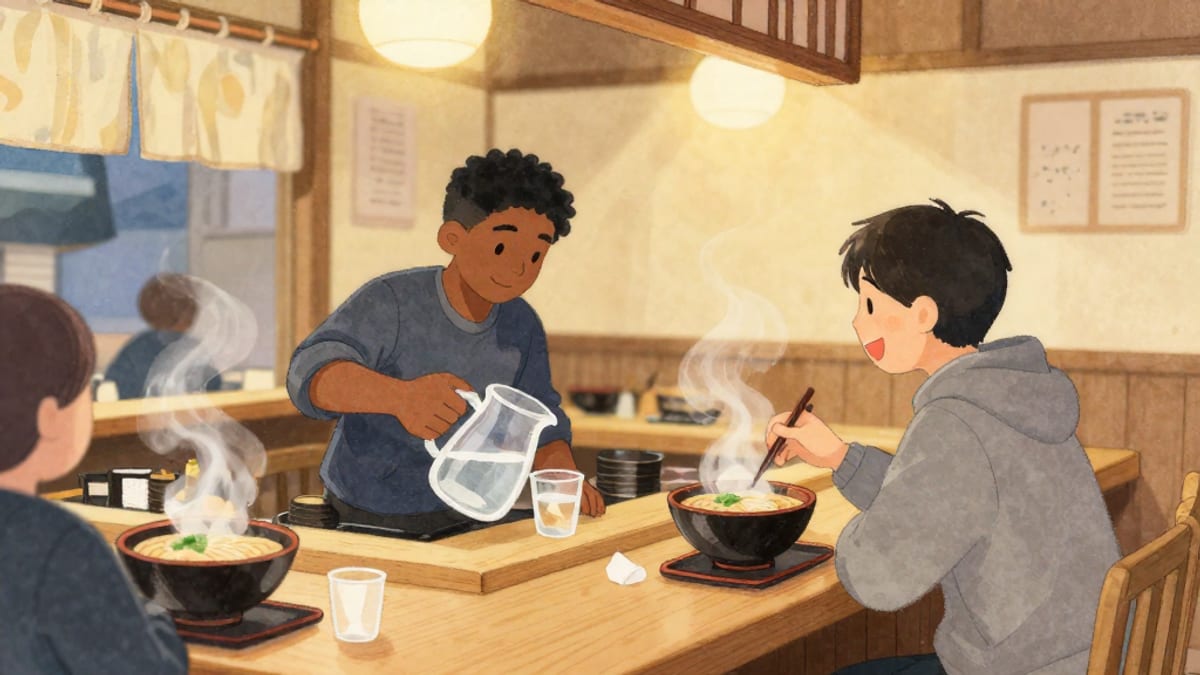
In most Japanese restaurants, water or tea is free and arrives when you sit down. In many casual places, especially ramen shops and set-meal restaurants, there is a self-service water jug or dispenser instead, and staff may say omizu wa serufu sābisu desu. If you want more, you can simply ask, and asking whether the tap water is drinkable is a normal question. In most of Japan the tap water is generally considered safe to drink, but it is still polite to ask in a home or a hotel if you are unsure.
| Japanese | Romaji | Meaning |
|---|---|---|
| すみません、お水をください。 | Sumimasen, omizu o kudasai. | You: Excuse me, could I have some water? |
| お水はセルフサービスです。 | Omizu wa serufu sābisu desu. | Staff: Water is self-service. |
| あ、わかりました。ありがとうございます。 | A, wakarimashita. Arigatō gozaimasu. | You: Oh, I see. Thank you. |
| お水のおかわりをお願いします。 | Omizu no okawari o onegai shimasu. | You: More water, please. |
| この水道水は飲めますか。 | Kono suidōsui wa nomemasu ka. | You: Can I drink this tap water? |
| はい、大丈夫ですよ。 | Hai, daijōbu desu yo. | Staff: Yes, it's fine. |
Sayings, names and set phrases with 水
Water appears in some of the most useful Japanese idioms. Mizu ni nagasu, to let it flow away in the water, means to forgive and forget, and it is often said kindly after a quarrel: mō mizu ni nagasō, let's put it behind us. Mizu o sasu, to pour water on something, means to spoil a good mood or interrupt a plan. Yakeishi ni mizu, water on a hot stone, describes help that is far too small to make a difference.
In names, 水 appears mostly in surnames such as 清水 (Shimizu, clear water) and 水野 (Mizuno, water field). For given names, families more often choose related kanji such as 泉 (Izumi, spring) or 澄 (sumu, clear), which suggest pure water with a softer look. One kanji can have several readings in names, so always check how a person reads theirs.
| Japanese | Romaji | Meaning |
|---|---|---|
| 水に流す | mizu ni nagasu | to forgive and forget |
| 水を差す | mizu o sasu | to spoil the mood |
| 水の泡 | mizu no awa | all for nothing |
| 焼け石に水 | yakeishi ni mizu | a drop in the ocean |
| 清水 | Shimizu | Shimizu (surname: clear water) |
| 泉 | Izumi | Izumi (spring) · unisex |
Water tattoos and designs: one kanji or a phrase?
Water is a calm and attractive theme for designs, associated with flow, adaptability and clarity. Here is how Japanese readers are likely to see the common choices.
- 水 on its own is clear but plain. It is also the kanji for Wednesday on every calendar, so some Japanese readers may find it a little like a label.
- A word gives more meaning: 流水 (ryūsui, flowing water) or 清流 (seiryū, a clear stream) suggest movement and freshness.
- Four-character idioms such as 明鏡止水 (meikyō shisui, a mirror-clear mind like still water) are used in Japanese to describe calm and clarity, but check that the nuance is what you want.
- Chinese and Japanese both use 水 with the same meaning. Differences appear in longer phrases and in simplified Chinese characters, so make sure your design uses the Japanese form if you want a Japanese look.
- Confirm the final design with a native speaker, including stroke shapes: one extra dot turns 水 into 氷, ice, or 永, eternity.
Turn the water radical into a Mocchi quiz
Type this to Mocchi after you sign in: Quiz me on kanji with the water radical: 海, 池, 泳, 洗, 酒, 涙, 波, 湖, one at a time. Mocchi asks for the reading or meaning, explains the ones you get wrong, and keeps a note of them so a later /review brings them back. If you want 水 in your study plan, ask Mocchi to add five minutes of sanzui kanji to this week's tasks.
- Try /kanji 湯 to see how the hot-water kanji belongs to the same family.
- Ask Mocchi to make flashcards for mizu, oyu and ohiya with /create-flashcards, picking a photo of a cold glass, a steaming kettle and an iced glass.
- Play Mocchi Flight with those cards and steer Mocchi through the right word gates.