
刀 and 剣: the two sword kanji at a glance
Think of 刀 as the object and 剣 as the idea. 刀 is the blade a samurai wore at the hip, the one you see behind glass in a museum and the word a sword shop uses. 剣 is the sword of myths and the sword as a path of training, which is why the martial art is 剣道 and its practitioners are 剣士.
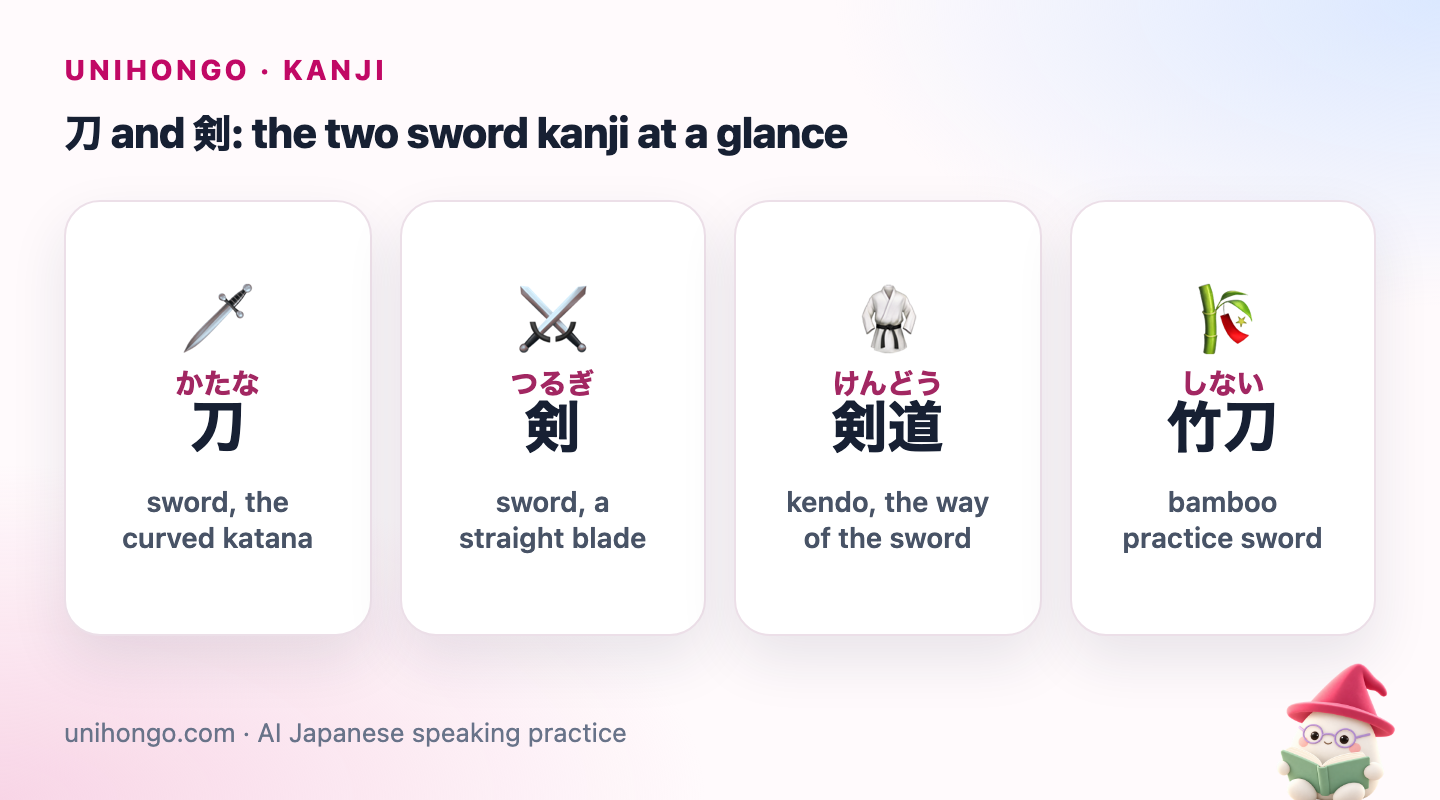
The four cards below give the core set. If you only learn four sword words in Japanese, learn these: the two kanji, the name of the art, and the bamboo sword you would actually hold in a kendo class.
| Japanese | Romaji | Meaning |
|---|---|---|
| 刀 | katana | sword, the curved katana |
| 剣 | tsurugi | sword, a straight blade |
| 剣道 | kendō | kendo, the way of the sword |
| 竹刀 | shinai | bamboo practice sword |
Readings, stroke counts and parts of 刀 and 剣
| Kanji | Strokes | On'yomi | Kun'yomi | Core meaning |
|---|---|---|---|---|
| 刀 | 2 | tō | katana | single-edged sword, blade |
| 剣 | 10 | ken | tsurugi | straight sword, swordsmanship |
刀 is a simple picture of a blade, with only two strokes. It also lives inside many other kanji as a component. Squeezed onto the right side, it becomes 刂, a radical called rittō (standing sword), which you can see in 刻 (to carve), 別 (to separate) and 前 (before). In 切 (to cut), 刀 keeps its full shape on the right. When you see 刂 on the right, think of cutting.
剣 has ten strokes. The right side is that same 刂, the cutting radical. The left side also appears, on the right, in 検 (to inspect), 険 (steep) and 験 (test), and all four kanji are read ken, so the left side is a useful sound hint. The older form of the kanji is 劍, which you may still see on old documents or in Chinese-language sources.
On its own, 刀 is read katana and 剣 is read tsurugi or, less often, ken. In compound words they switch to tō and ken: 日本刀 (nihontō) and 剣道 (kendō).
Everyday words built on 刀
Words with 刀 are concrete: they name a kind of blade, a style or the person who makes it. Several of them use the reading tō, and two have special readings that you just have to memorise: 竹刀 (shinai) and 太刀 (tachi).
| Japanese | Romaji | Meaning |
|---|---|---|
| 日本刀 | nihontō | Japanese sword |
| 木刀 | bokutō | wooden practice sword |
| 短刀 | tantō | short sword, dagger |
| 小刀 | kogatana | small knife, pocket knife |
| 太刀 | tachi | long slung sword of older times |
| 名刀 | meitō | famous, finely made sword |
| 刀鍛冶 | katanakaji | swordsmith |
| 二刀流 | nitōryū | two-sword style; doing two things |
| 刀剣 | tōken | swords and blades in general |
二刀流 is worth knowing beyond swords. It describes a famous two-sword fighting style, and today it is also used for anyone who does two demanding things at once, such as an athlete who both pitches and bats or a person with two careers. You will hear it in sports news and in everyday chat.
Everyday words built on 剣
Words with 剣 tend to be about skill, training and seriousness. 真剣 is the one you will use most often in conversation, because it has drifted far from swords: today it simply means serious or earnest.
| Japanese | Romaji | Meaning |
|---|---|---|
| 剣士 | kenshi | swordsman, swordswoman |
| 剣術 | kenjutsu | sword technique, old sword arts |
| 真剣 | shinken | a real blade; serious, earnest |
| 真剣に考えます。 | Shinken ni kangaemasu. | I'll think about it seriously. (polite) |
| 手裏剣 | shuriken | throwing star |
| 剣幕 | kenmaku | a furious look or manner |
| 諸刃の剣 | moroha no tsurugi | a double-edged sword |
諸刃の剣 works exactly like the English idiom: something that helps and harms at the same time. A strong sales tool that annoys customers is 諸刃の剣. 剣幕 appears mostly in the phrase すごい剣幕で, with a terrifying look, as in 彼はすごい剣幕で怒った, he was furious.
In names, 剣 is occasionally used for boys, read Ken or Tsurugi, while 刀 is rare. 剣 also appears in place names: Mount Tsurugi in Toyama, one of Japan's most dramatic peaks, is written 剱岳, with an old variant form of the kanji.
Kendo, iaido and the words of the dojo
If you join a kendo or iaido class in Japan, you will hear sword words in a very practical setting. Kendo practitioners fight with a 竹刀 and wear armour called 防具 (bōgu); the targets they shout as they strike are 面 (men, head), 小手 (kote, wrist) and 胴 (dō, body). Iaido, 居合道 (iaidō), is the art of drawing and cutting in one motion and is practised with a blunt practice sword or, for advanced students, a real blade.
Classes are formal. You bow when you enter and leave the dojo, bow to your partner before and after each exercise, and address the teacher as sensei. The language is mostly polite, with short shouted commands during practice.
| Japanese | Romaji | Meaning |
|---|---|---|
| 道場 | dōjō | training hall |
| 稽古 | keiko | practice, training session |
| 防具 | bōgu | kendo armour |
| 居合道 | iaidō | iaido, the art of drawing the sword |
| よろしくお願いします。 | Yoroshiku onegai shimasu. | Please train with me. (said before practice) |
| ありがとうございました。 | Arigatō gozaimashita. | Thank you for the practice. (after) |
Mini dialogue: asking about a katana at a sword museum
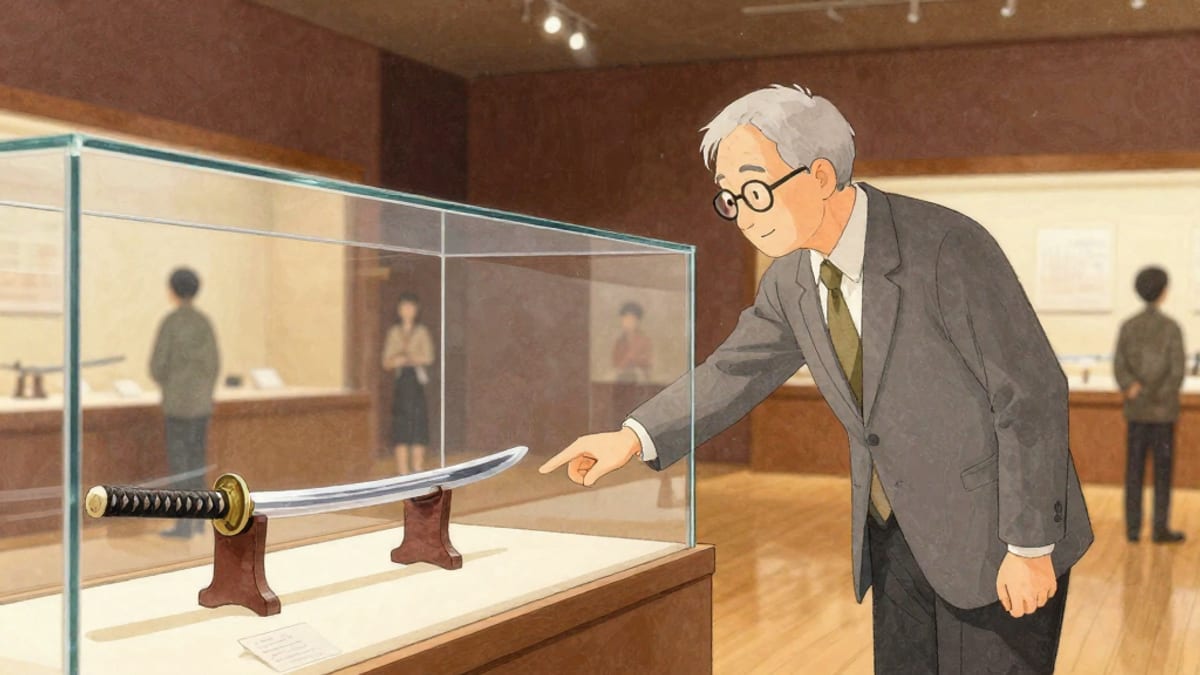
Japan has museums and castle exhibitions where you can see historical swords up close, and the guides are often happy to talk. Here is a polite exchange you could have with a guide, using both kanji naturally.
| Japanese | Romaji | Meaning |
|---|---|---|
| この刀はいつごろのものですか。 | Kono katana wa itsugoro no mono desu ka. | You: About when is this sword from? |
| 江戸時代の日本刀です。 | Edo jidai no nihontō desu. | Guide: It's a Japanese sword from the Edo period. |
| 刃の模様がきれいですね。 | Ha no moyō ga kirei desu ne. | You: The pattern on the blade is beautiful. |
| 刃文といって、刀鍛冶によって違います。 | Hamon to itte, katanakaji ni yotte chigaimasu. | Guide: It's called hamon; it differs by swordsmith. |
| 写真を撮ってもいいですか。 | Shashin o totte mo ii desu ka. | You: May I take a photo? |
| フラッシュなしならどうぞ。 | Furasshu nashi nara dōzo. | Guide: Go ahead, as long as there's no flash. |
Photo rules differ from museum to museum, so asking is always the right move. Authentic Japanese swords in shops come with a registration certificate, and Japan's Firearms and Swords Control Law, 銃刀法 (jūtōhō), strictly limits carrying blades in public, so most visitors who want a souvenir buy a replica, 模造刀 (mozōtō), and ask the shop how to ship or pack it.
刀 or 剣 as a tattoo or design
A single sword kanji looks striking, but think about how it reads. 刀 has only two strokes, and in many fonts it is close to 力 (power), so the design may be misread at a glance. 剣 is more distinctive and reads clearly as sword, with an old, heroic flavour, rather like the English word blade on a poster.
Chinese usage is different in a way that matters for designs. In Chinese, 刀 (dāo) is the everyday word for knife as well as a single-edged sword, so 刀 alone can look like knife to a Chinese reader. The Chinese straight sword is written 剑 in simplified characters and 劍 in traditional ones, not the Japanese 剣. A design copied from a Chinese site may therefore not be the Japanese form.
A full word often says more. 剣道 suits someone who practises kendo; 一刀両断 (ittō ryōdan, cutting through with one stroke) means acting decisively; 真剣 can express wholehearted seriousness. Before you print or ink anything, ask a native speaker to check the exact characters, the stroke shapes and the font.
| Japanese | Romaji | Meaning |
|---|---|---|
| 一刀両断 | ittō ryōdan | cutting through decisively, one stroke |
| 剣の道 | ken no michi | the path of the sword |
Make 刀 and 剣 stick with Mocchi
Open Mocchi and type /kanji 剣. You get the meaning, the readings ken and tsurugi and common words, and you can follow up with a real question, such as why kendo uses 剣 but the bamboo sword uses 刀. Mocchi keeps a note of which readings tripped you up, so 竹刀 and 太刀 come back in a later /review instead of slipping away.
Then ask Mocchi to make flashcards of the sword words in this post with /create-flashcards, choosing a photo for each one: a bamboo sword for 竹刀, a throwing star for 手裏剣. Send the deck to Kotoba Tank, where you hear a word and hit the right one, which is a quick way to separate tō, katana and ken by ear.
Look-alikes and how to write 刀
- 刀 vs 力 (chikara, power). In 刀, the sweeping second stroke starts at the top line and stays inside; in 力 it pokes up above the top line.
- 刀 vs 刃 (ha, blade or edge). 刃 is 刀 with one extra dot on the blade: the dot marks the cutting edge. 刃物 (hamono) means bladed tools.
- Reading 竹刀 as takegatana or chikutō. It is shinai, a special reading for the whole word.
- Using 刀 for a kitchen knife. In Japanese, a kitchen knife is 包丁 (hōchō) and a Western knife is ナイフ (naifu); 小刀 is a small craft knife.
- Saying 真剣 only about swords. In daily life it nearly always means serious: 真剣な顔, a serious face.