
What katakana practice should look like
Knowing the chart is step one. Reading katakana is a different skill: your eyes have to group symbols into a word, notice a long mark or a small ッ, and turn the whole thing into sound quickly enough to guess the meaning. That is why the drills below always use whole words.
Keep each session short and mixed. Five or ten focused minutes with several drill types beat a long session of one drill, because real katakana throws all the difficulties at you at once. And always read aloud: saying the word is what lets you recognise the English or other foreign word hidden in it.
| Japanese | Romaji | Meaning |
|---|---|---|
| カタカナ、読めた! | Katakana, yometa! | I could read the katakana! (casual) |
| コーヒー | kōhī | coffee |
| テレビ | terebi | television |
Drill 1: the four look-alikes
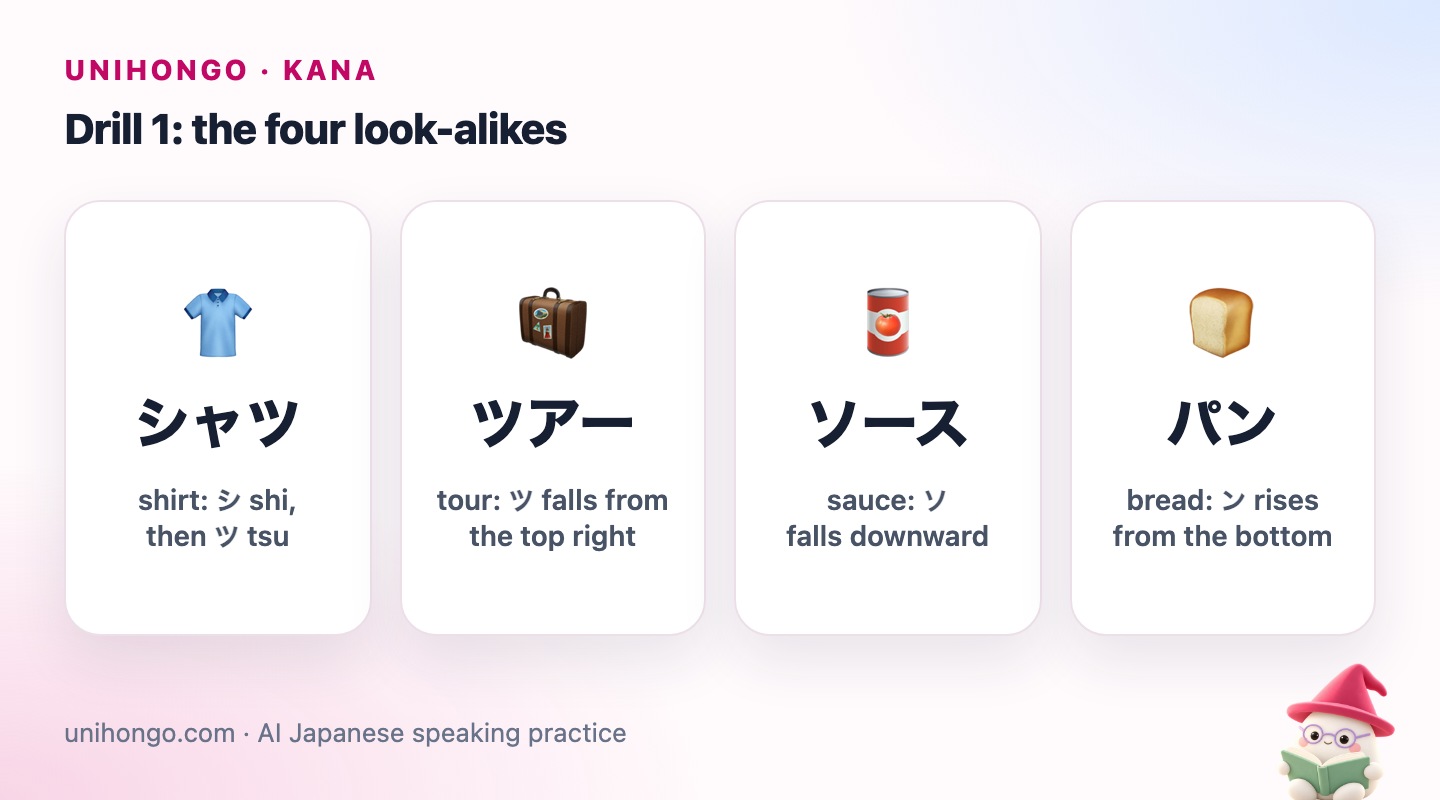
シ (shi), ツ (tsu), ソ (so) and ン (n) cause more katakana mistakes than all the other symbols together. They are easy to separate once you know one fact: the direction of the main stroke. Practise them inside words, because seeing them next to each other is the real test.
| Japanese | Romaji | Meaning |
|---|---|---|
| シャツ | shatsu | shirt: シ shi, then ツ tsu |
| ツアー | tsuā | tour: ツ falls from the top right |
| ソース | sōsu | sauce: ソ falls downward |
| パン | pan | bread: ン rises from the bottom |
The rule in one line: シ and ン are written with a final stroke that rises from the bottom left; ツ and ソ have a stroke that falls from the top right. The dots help too. In シ the short strokes are stacked on the left, while in ツ they sit side by side on top. ン and ソ each start with one short stroke: in ン it lies flatter, like a dot, while in ソ it stands more upright.
In print the shapes can look almost identical, so read the word, not only the symbol. If ソース did not make sense as sōsu, try the other reading and see which one is a real word.
Drill 2: long marks and small ッ
The long mark ー doubles the vowel before it, and a small ッ adds a short pause before the next consonant. Both count as a full beat, and both can change the meaning. Practise reading pairs where only one of these marks differs, and say each word with your fingers counting the beats.
| Japanese | Romaji | Meaning |
|---|---|---|
| ビール | bīru | beer |
| ケーキ | kēki | cake |
| カップ | kappu | cup |
| ベッド | beddo | bed |
| チケット | chiketto | ticket |
| スーパー | sūpā | supermarket |
| Word | Romaji | Meaning | Beats |
|---|---|---|---|
| ビル | biru | building | 2 |
| ビール | bīru | beer | 3 |
| カード | kādo | card | 3 |
| ベッド | beddo | bed | 3 |
| チケット | chiketto | ticket | 4 |
In vertical writing the long mark is written as a vertical line, so on a vertical menu ビール shows a short vertical stroke after ビ. It still means the same thing: hold the vowel.
Drill 3: combinations and foreign sounds
Katakana uses small ャ, ュ and ョ the same way hiragana does, as in ジュース (juice). It also has extra combinations with small ァ, ィ, ゥ, ェ and ォ for sounds that Japanese words do not use, such as ti, fa, we and di. These look scary on the chart but are logical: the big kana gives the consonant and the small kana gives the vowel.
| Japanese | Romaji | Meaning |
|---|---|---|
| ジュース | jūsu | juice |
| ティッシュ | tisshu | tissues |
| ファイル | fairu | file, folder |
| パーティー | pātī | party |
| ウェブ | webu | the web |
| メニュー | menyū | menu |
Read each one slowly in beats. ティッシュ is ti-s-shu, three beats: ティ is one beat, ッ is a pause, and シュ is one beat. ファイル is fa-i-ru. Once you know that a small kana always merges with the one before it, these words stop looking like puzzles.
Drill 4: read the room, then order a drink
Katakana is all around you if you live in Japan or shop at a Japanese store: drinks, snacks, shampoo, electronics. Pick five objects with katakana on them and read the words aloud every morning for a week. This gives you real words in real fonts, which are often harder than textbook print, and you can check your guess against the object in your hand.
Then use the words. Café drinks are almost all katakana, so ordering one is a perfect first speaking drill.

| Japanese | Romaji | Meaning |
|---|---|---|
| いらっしゃいませ。ご注文は? | Irasshaimase. Gochūmon wa? | Staff: Welcome. What would you like? |
| アイスコーヒーをください。 | Aisu kōhī o kudasai. | You: An iced coffee, please. |
| サイズはいかがなさいますか。 | Saizu wa ikaga nasaimasu ka. | Staff: What size would you like? (very polite) |
| Mサイズでお願いします。 | Emu saizu de onegai shimasu. | You: Medium, please. |
| ケーキもいかがですか。 | Kēki mo ikaga desu ka. | Staff: Would you like some cake too? |
| じゃあ、チーズケーキを一つ。 | Jā, chīzu kēki o hitotsu. | You: Then one cheesecake. |
Drill 5: speed rounds with Kana Dash
Accuracy comes first, but at some point you need speed, because menus and train screens do not wait. Short timed rounds are the easiest way to build it. Kana Dash at unihongo.com/alphabet is a 3D runner for hiragana and katakana: it is free for everyone and needs no sign-up, so you can play a round on your phone while you wait for a train.
Use it as a speed drill on top of the other four, not instead of them. A game is good at making recognition fast; it is not a substitute for reading whole words and saying them aloud. A good pattern is a quick Kana Dash round, then reading three real katakana words around you.
A one-week katakana rotation
| Day | Main drill | Extra |
|---|---|---|
| Monday | Look-alikes シ ツ ソ ン in words | Write each four times |
| Tuesday | Long marks and small ッ | Count beats on your fingers |
| Wednesday | Combinations like ティ and ファ | Read the six words aloud twice |
| Thursday | Read five objects at home | Guess the English word first |
| Friday | Kana Dash speed rounds | Note the kana you missed |
| Saturday | Café order dialogue aloud | Swap in other drinks |
| Sunday | Review the words you marked | Rest if all is easy |
Common beginner mistakes to watch for during the week: mixing up シ and ツ in print, skipping the beat of the long mark, reading small ッ as a full tsu, and reading katakana as English spelling instead of Japanese sounds. Say チーズ as chīzu, not cheese.
Let Mocchi find your weak katakana
Ask Mocchi something specific: "Give me ten katakana words that mix シ, ツ, ソ and ン, and quiz me one at a time." Mocchi keeps notes on which symbols you misread, so if ソ keeps turning into ン, your next /review session leans on exactly that pair, and the practice can become a small task in your study plan.
Between chats, a round of Kana Dash keeps the shapes fresh. And once you can read the words, ask Mocchi to turn the café words into flashcards with /create-flashcards, each with a photo you pick, so the spaced reviews bring back the ones you find hardest.