
旅 in four words: journey, trip, solo travel and inn
These four words are the core of 旅. The first two are the pair learners must tell apart; the last two are the words you will see on almost every trip in Japan.
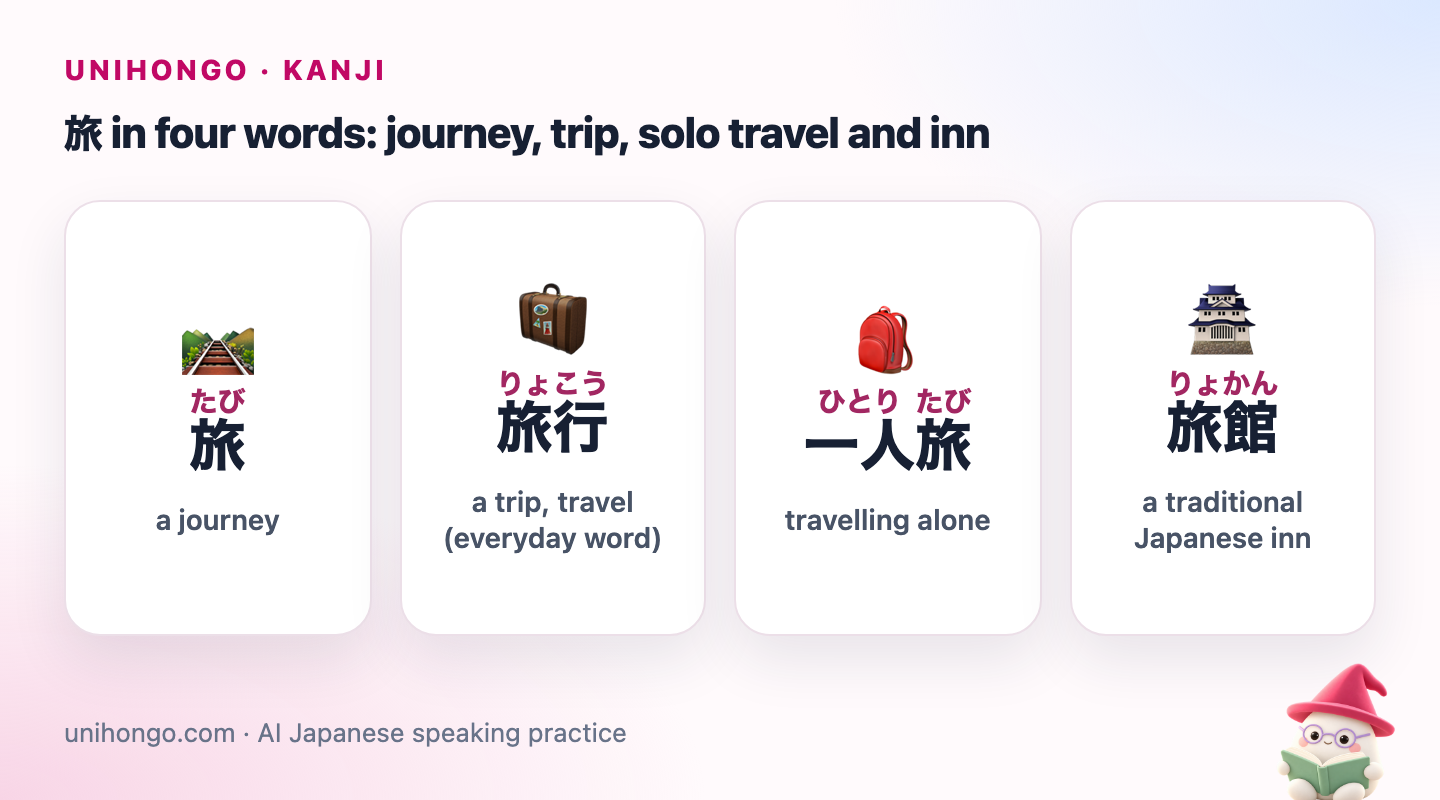
| Japanese | Romaji | Meaning |
|---|---|---|
| 旅 | tabi | a journey |
| 旅行 | ryokō | a trip, travel (everyday word) |
| 一人旅 | hitoritabi | travelling alone |
| 旅館 | ryokan | a traditional Japanese inn |
Readings, strokes and the parts of 旅
旅 has ten strokes. The left side is 方, the radical called katahen or hōhen. In old forms, the character is usually explained as people gathered under a flag, a group setting out together; the right side contains the flag and the people. Treat this as a helpful image rather than something to analyse further.
| Reading | Type | Examples |
|---|---|---|
| tabi | Kun'yomi | 旅, 一人旅, 旅人, 旅先, 船旅 |
| ryo | On'yomi | 旅行, 旅館, 旅費, 旅券, 旅客 |
| tabi- (verb) | Kun'yomi in a verb | 旅立つ (tabidatsu), to set out |
The on'yomi is ryo with a short o, so 旅行 is ryo-kō, not ryō-kō. Learners often stretch the first syllable because the second is long. The pair 旅館 and 旅行 is worth saying slowly a few times: ryokan, ryokō.
In compounds with tabi at the end, the t usually stays as it is: hitoritabi, funatabi, nagatabi for a long journey. That makes the word easy to recognise in speech.
旅 or 旅行? Choosing the right word
Both mean travel, but they live in different places. 旅行 is practical and factual: you book it, pay for it and take photos on it. 旅 is the experience: what you feel, learn and remember. The same holiday can be both, depending on how you talk about it.
| Japanese | Romaji | Meaning |
|---|---|---|
| 来月、京都へ旅行します。 | Raigetsu, Kyōto e ryokō shimasu. | I'm taking a trip to Kyoto next month. |
| 修学旅行 | shūgaku ryokō | a school trip |
| 新婚旅行 | shinkon ryokō | a honeymoon |
| 旅に出たいなあ。 | Tabi ni detai nā. | I'd love to set off on a journey. |
| 人生は旅だ。 | Jinsei wa tabi da. | Life is a journey. |
| Situation | Natural choice | Example |
|---|---|---|
| Booking, prices, plans | 旅行 | 旅行の予約, a trip booking |
| School trip, honeymoon | 旅行 | 修学旅行, 新婚旅行 |
| Feelings, adventure, life | 旅 | いい旅だった, it was a great journey |
| Titles, slogans, songs | 旅 | 旅に出よう, let's set off on a journey |
| Travel agency, insurance | 旅行 | 旅行会社, 旅行保険 |
Notice the verbs. 旅行する, ryokō suru, is the normal verb for to travel. 旅をする also exists, and 旅に出る, to set off on a journey, sounds adventurous. You would not say 旅を予約する for booking a trip; 旅行を予約する is natural.
Travel shows and posters love 旅 because it makes an ordinary trip sound special. A railway campaign might invite you on a 旅, while the booking page beside it talks about 旅行 and prices. Reading both in the same place is a good way to feel the difference: 旅 sells the dream, 旅行 handles the details.
Travel words with 旅
These compounds come up in guidebooks, at stations and in conversation with people you meet on the road. Some are formal, such as 旅券 for passport, which you mainly see on official documents; in speech people say パスポート.
| Japanese | Romaji | Meaning |
|---|---|---|
| 旅人 | tabibito | a traveller |
| 旅先 | tabisaki | a travel destination, where you are on a trip |
| 船旅 | funatabi | a voyage, a journey by ship |
| 旅立つ | tabidatsu | to set out, also to leave home for a new life |
| 旅費 | ryohi | travel expenses |
| 旅券 | ryoken | passport (formal, on documents) |
| 旅行会社 | ryokō gaisha | travel agency |
| 旅先で友達ができました。 | Tabisaki de tomodachi ga dekimashita. | I made a friend while travelling. |
| 一人旅は初めてです。 | Hitoritabi wa hajimete desu. | This is my first time travelling alone. |
Travel proverbs and how people use them
旅 appears in several well-known proverbs. 旅は道連れ世は情け says that on a journey a companion helps, and in life kindness helps; people quote it when a stranger offers to help or share the road. かわいい子には旅をさせよ, let the child you love go on a journey, means that hardship helps children grow, and parents say it when a son or daughter studies abroad. 旅の恥はかき捨て, shame on a journey is thrown away, describes people who behave badly when far from home; today it is usually quoted as criticism.
| Japanese | Romaji | Meaning |
|---|---|---|
| 旅は道連れ世は情け | Tabi wa michizure yo wa nasake. | On the road, company; in life, kindness. |
| かわいい子には旅をさせよ | Kawaii ko ni wa tabi o saseyo. | Let the child you love see the world. |
| 旅の恥はかき捨て | Tabi no haji wa kakisute. | People forget their manners when far from home. |
Arriving at a ryokan
Staying at a 旅館 is a highlight of many journeys. Staff usually greet you at the entrance, you take off your shoes, and someone may show you to your room and explain the bath times and meals. Customs vary between inns, from family-run places to large onsen hotels, so it is fine to ask. Polite, simple sentences work perfectly. The host will often use very polite keigo; you do not need to match it, and plain desu and masu forms are completely appropriate for a guest.
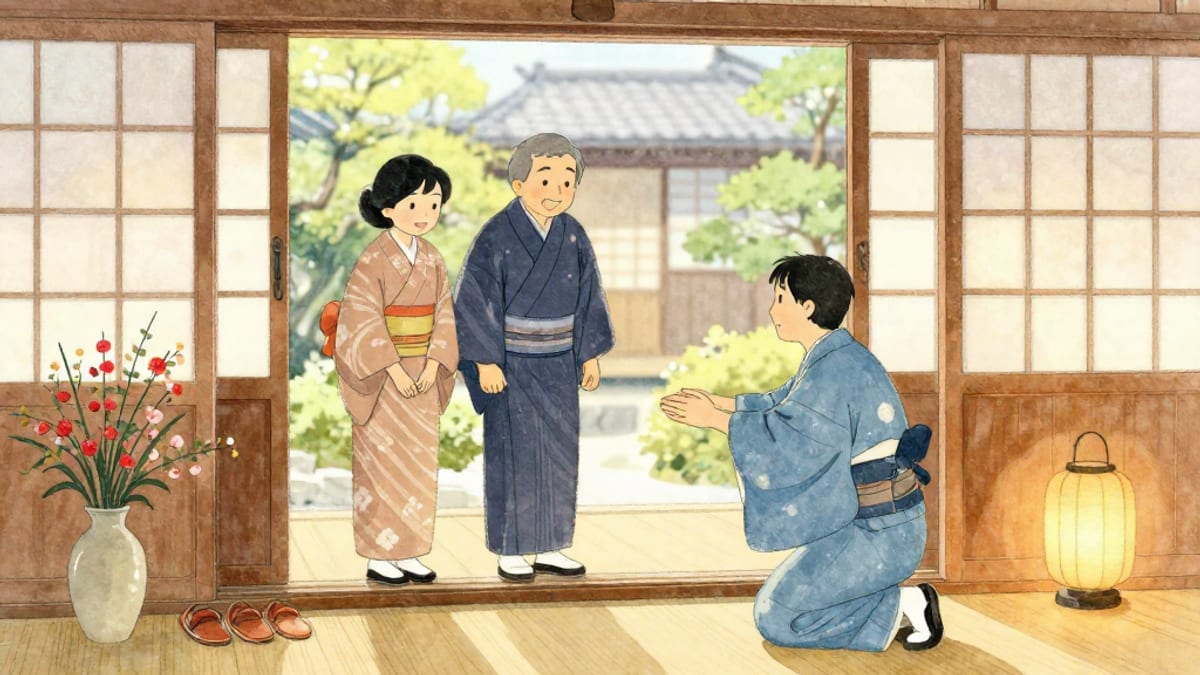
| Japanese | Romaji | Meaning |
|---|---|---|
| 予約したスミスです。 | Yoyaku shita Sumisu desu. | You: I'm Smith, I have a reservation. |
| お待ちしておりました。どうぞお上がりください。 | Omachi shite orimashita. Dōzo oagari kudasai. | Host: We've been expecting you. Please come in. |
| 夕食は何時からですか。 | Yūshoku wa nanji kara desu ka. | You: What time is dinner? |
| 六時からお部屋でご用意します。 | Rokuji kara oheya de goyōi shimasu. | Host: We'll serve it in your room from six. |
| お風呂は何時まで入れますか。 | Ofuro wa nanji made hairemasu ka. | You: Until what time can we use the bath? |
旅 vs 族 and 旗, and how to write 旅
旅 belongs to a family of kanji with the 方 radical and the flag shape: 族, family or tribe, as in 家族, kazoku, family; 旗, hata, flag; and 施, to carry out. They look alike at a glance. Check the bottom right: 旅 ends in a cluster of short strokes with a sweep to the right, 族 has 矢, arrow, and 旗 has 其.
| Japanese | Romaji | Meaning |
|---|---|---|
| 家族 | kazoku | family |
| 旗 | hata | flag |
| 家族旅行 | kazoku ryokō | a family trip (both kanji together) |
- Writing 族 in 旅行. Look for the arrow 矢 at the bottom right: that is family, not travel.
- Saying ryōkō with two long vowels. It is ryokō.
- Using 旅 for every trip in conversation. For a business trip, say 出張, shutchō.
- Quoting 旅の恥はかき捨て as advice. It describes bad manners, not a permission.
To write 旅, start with 方: the dot, the horizontal, then the stroke that turns and hooks and the left-falling stroke. On the right, write the flag shape at the top first, then the lower part, which ends with a sweep to the bottom right. The right side is the hard part; check a stroke-order chart once and copy it slowly a few times.
旅 or 旅人 on a tattoo or design
旅 is a favourite single-kanji design for travellers. In Japanese it reads as journey, with a gentle, romantic feel; in Chinese it means travel too, and in formal and military contexts it can also mean a brigade, though readers will understand your intention. 旅行 would look odd on skin, a bit like tattooing the word tourism.
If you want to describe yourself, 旅人, traveller, is a natural choice. 一期一会, ichigo ichie, treasure every meeting, is a phrase many travellers love, though it is not about travel itself. Whatever you pick, look at it in the font you will use and have a native speaker check it before inking.
Plan your journey Japanese with Mocchi and Yamada-sensei
Tell Mocchi when you leave and where you are going, for example: Build me a two-week plan for my trip to Kyoto with ryokan and train phrases. Mocchi builds the daily tasks around your level and adjusts them with /adjust-plan if your dates change. It remembers what you struggled with and picks it up again in the next session.
For the speaking part, open AI Sensei, choose Yamada-sensei and ask him to play the host at a ryokan. Check in, ask about dinner and the bath, then read the session report for the corrections.