
笑 at a glance
笑 is a common kanji taught in the fourth year of elementary school. It covers a whole range of happy faces and sounds, from a small smile to loud laughter. When you need to be precise, Japanese adds another word: 笑顔 for a smile you can see, 微笑み for a gentle one, and 爆笑 for an explosion of laughter.
The cards below show the four words to learn first.
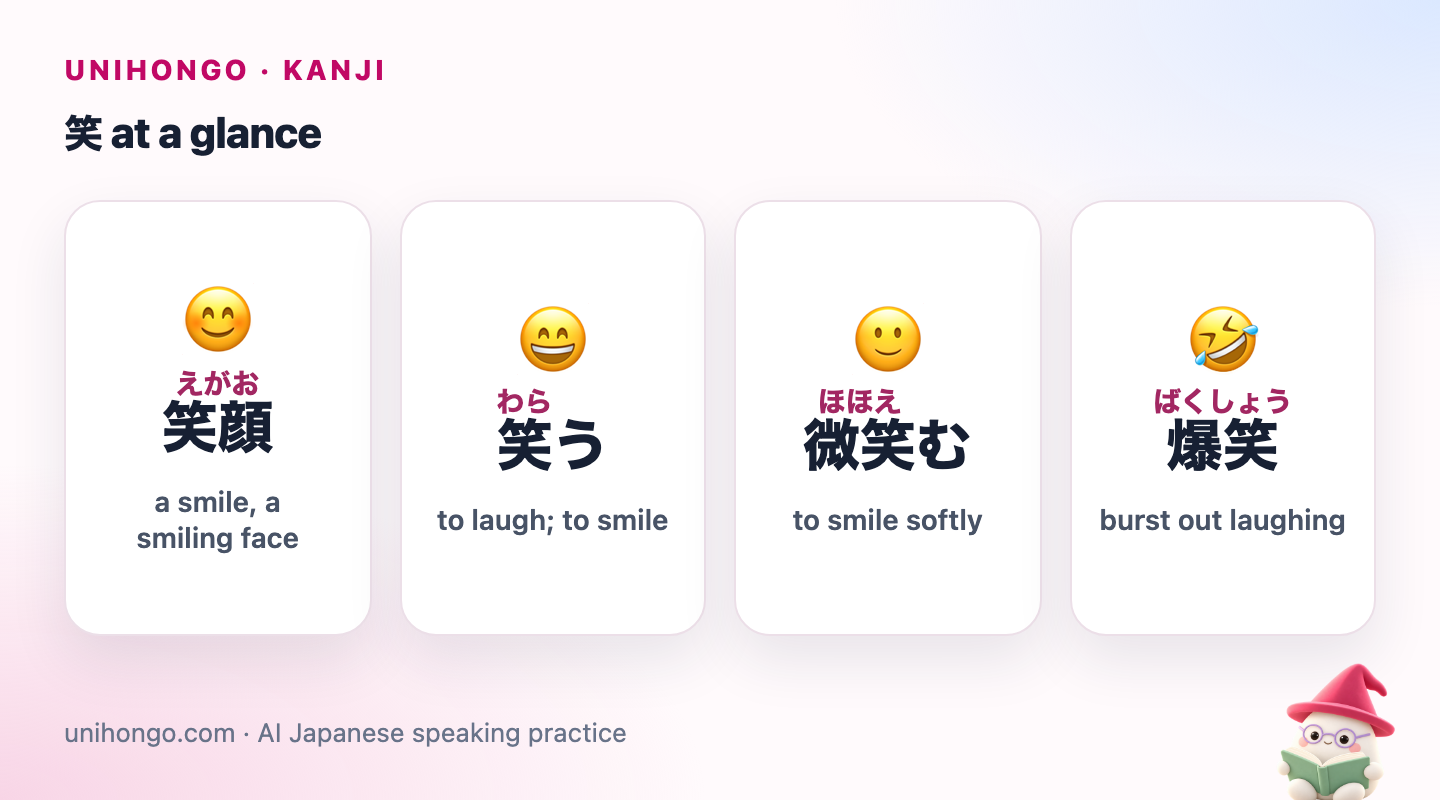
| Japanese | Romaji | Meaning |
|---|---|---|
| 笑顔 | egao | a smile, a smiling face |
| 笑う | warau | to laugh; to smile |
| 微笑む | hohoemu | to smile softly |
| 爆笑 | bakushō | burst out laughing |
If you want to say she smiled, the safest everyday choice is にっこり笑った (nikkori waratta) or simply 笑った. Adding にっこり, the sound-image of a smile, tells listeners there was no sound.
Readings, strokes and special readings
笑 has the Chinese reading shō and the native readings wara(u) and e(mu). Two of its most common words use special readings that you simply learn as whole words.
| Japanese | Romaji | Meaning |
|---|---|---|
| 笑み | emi | a smile (written style) |
| 微笑を浮かべる | bishō o ukaberu | to wear a faint smile (literary) |
| Item | Detail | Example |
|---|---|---|
| On'yomi (Chinese reading) | shō | 爆笑 (bakushō), 談笑 (danshō) |
| Kun'yomi (native readings) | wara(u), e(mu) | 笑う (warau), 笑み (emi) |
| Special readings | egao, hohoemi | 笑顔 (egao), 微笑み (hohoemi) |
| Stroke count | 10 | 竹 crown 6, bottom part 4 |
| Parts | ⺮ bamboo crown + 夭 | Origin explained in different ways |
The top of 笑 is ⺮, the bamboo radical, and the bottom is 夭. Scholars give different explanations of why laughter is written with bamboo, so it is best not to rely on any single story. A practical memory hook: the two little ⺮ shapes on top look like smiling eyes.
笑顔 is read egao, not shōgan, and 微笑み is read hohoemi, not bishōmi. These are fixed readings for the whole word. You will still see 微笑 read bishō in a few written compounds, such as 微笑を浮かべる (bishō o ukaberu, to wear a faint smile) in novels.
Everyday words with 笑
These words are common in conversation, TV and messages. Several show that Japanese uses 笑 for very different kinds of smile.
| Japanese | Romaji | Meaning |
|---|---|---|
| 笑い | warai | laughter, a laugh |
| 大笑い | ōwarai | a big laugh |
| 苦笑い | nigawarai | a wry or awkward smile |
| お笑い | owarai | comedy, comedians |
| 笑い話 | waraibanashi | a funny story |
| 談笑 | danshō | a friendly chat with laughter |
| 笑える | waraeru | funny, makes you laugh (casual) |
| 笑わせる | warawaseru | to make someone laugh |
| 笑顔で | egao de | with a smile |
| 作り笑い | tsukuriwarai | a forced smile |
| ニコニコ | nikoniko | smiling happily (no kanji) |
| にっこり | nikkori | with a sudden, warm smile (no kanji) |
苦笑い, literally bitter laughing, is the smile you give when something is awkward or a little embarrassing: your boss makes a bad joke, or you trip on the stairs in front of everyone. It is extremely common in Japanese descriptions of social situations. 作り笑い, a forced smile, is related but different: it is a smile you put on deliberately, for a photo or for a customer, without feeling it.
ニコニコ and にっこり are onomatopoeia, sound-and-image words. They are often more natural in speech than any kanji word: いつもニコニコしているね, you're always smiling.
Sayings and the 笑 in your messages
One famous proverb uses 笑, and you will see it on New Year cards and shop walls: good fortune comes to the house where people laugh.
| Japanese | Romaji | Meaning |
|---|---|---|
| 笑う門には福来る | Warau kado ni wa fuku kitaru | Fortune comes to a home full of laughter. |
| 笑ってください。 | Waratte kudasai. | Smile, please. (for a photo, polite) |
| 思わず笑っちゃった。 | Omowazu warachatta. | I couldn't help laughing. (casual) |
| 今日寝坊した(笑) | Kyō nebō shita (warai) | I overslept today lol. (message) |
In text messages and social media, many people type (笑) or just w after a sentence, the way English speakers type lol or haha. The 笑 version is slightly gentler and common among adults; ww and www are casual, and a long string of w is the internet's version of rolling on the floor. With a teacher, a boss or a customer, leave them out.
Note that 笑 alone in a message is read warai and means laughing. That is one reason a single 笑 can look like an internet joke on a T-shirt or a tattoo, which the design section discusses.
Mini dialogue: complimenting a photo
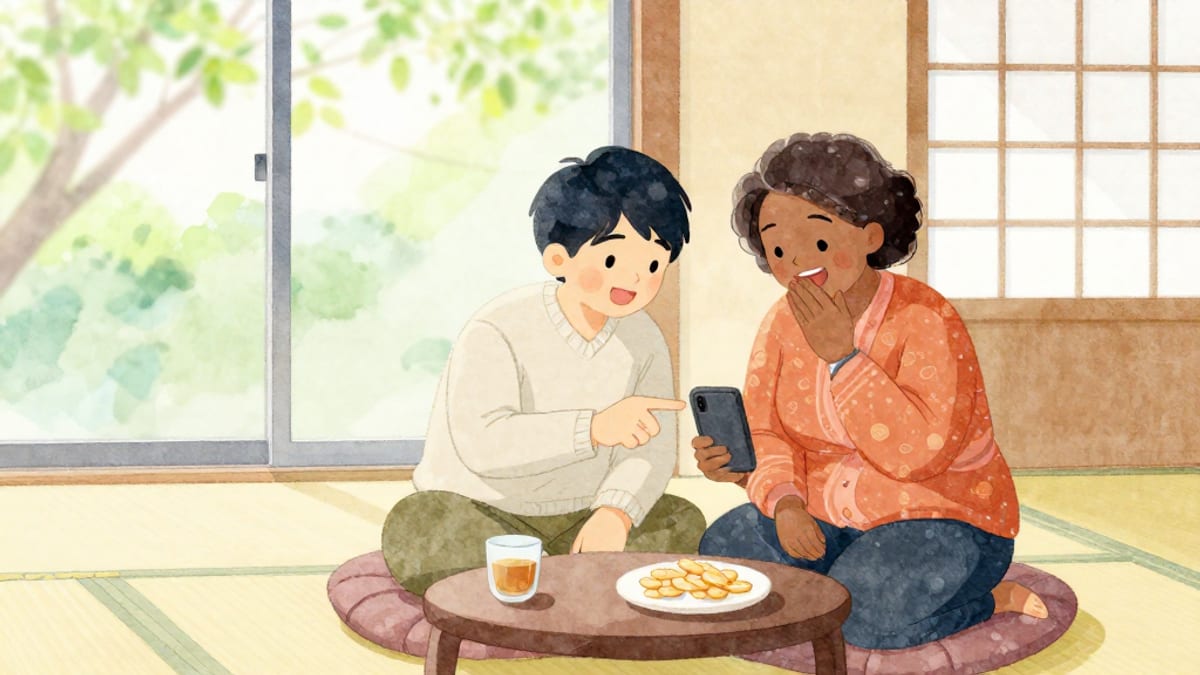
Showing photos on a phone is a common way to start a chat. Here a learner looks at a friend's family photo.
| Japanese | Romaji | Meaning |
|---|---|---|
| これ、先週の家族旅行の写真。 | Kore, senshū no kazoku ryokō no shashin. | Kenta: Here's a photo from our family trip last week. |
| わあ、みんな笑顔がすてきだね。 | Wā, minna egao ga suteki da ne. | Ada: Wow, everyone has a lovely smile. |
| これは父が転んだ直後。 | Kore wa chichi ga koronda chokugo. | Kenta: This is just after my dad fell over. |
| えっ、それで笑ってるの? | E, sore de waratteru no? | Ada: What, and he's laughing? |
| 本人が一番笑ってた。 | Honnin ga ichiban waratteta. | Kenta: He was laughing hardest of all. |
| 笑える! | Waraeru! | Ada: That's hilarious! |
Look-alike kanji, writing tips and common mistakes
笑 is often compared with 咲 (saku, to bloom), as in 桜が咲く, the cherry trees bloom. 咲 has 口, mouth, on the left. It is often said that in older Chinese writing 咲 was a variant of 笑, and that Japanese later gave it the meaning of flowers blooming. Whatever its history, the link makes a nice image: a flower opening is like a face breaking into a smile.
How to write 笑: draw the two small ⺮ shapes first, left then right, three strokes each. Then write 夭 below: the short slanted stroke at the top, the horizontal, and finally the two sweeping strokes. Keep the bamboo crown compact so that 夭 has room to spread.
| Japanese | Romaji | Meaning |
|---|---|---|
| 笑 | shō | smile, laugh |
| 咲く | saku | to bloom (look-alike) |
- Using 笑う when you mean smiled silently. Add にっこり or say 微笑んだ in writing.
- Reading 笑顔 as shōgan. It is egao.
- Saying 笑わないで to mean don't make me laugh. 笑わないで means don't laugh (at me); don't make me laugh is 笑わせないで.
- Adding (笑) to a serious apology. It undoes the apology.
笑 or 笑顔 as a tattoo or design
笑 alone is a real kanji, but for Japanese readers it carries a risk: because (笑) is the standard lol in messages, a lone 笑 on clothing or skin can look like an internet joke. It can also read as laughter in general rather than a gentle smile.
笑顔 (smile, smiling face) is a much clearer choice. It is a word many Japanese people like as a motto, often in the form 笑顔で (with a smile). The proverb 笑う門には福来る works as a longer design with a cheerful meaning, though it is long for a tattoo. The kanji 笑 is used in the same way in Chinese, but the internet use of 笑 is a Japanese habit.
Whatever you choose, ask a native speaker to check the characters, the reading and the design, and give the artist a clean, checked image.
| Japanese | Romaji | Meaning |
|---|---|---|
| 笑顔で | egao de | with a smile |
Let Mocchi help you smile in Japanese
Paste the sentence 父が転んで、みんな苦笑いした into Mocchi with /explain. Mocchi, Unihongo's study assistant, splits it into words, names each particle and pattern, and explains why 苦笑い fits better than 笑った here. Ask follow-up questions about ニコニコ and にっこり, and Mocchi remembers which smile words you mix up.
Then turn the list in this post into flashcards with /create-flashcards and play Mocchi Flight with your own deck, guiding Mocchi through the gate with the right word for each kind of smile.