
The short answer, layer by layer
Learning hiragana is not one task but several. The table gives typical ranges for a learner who practises a little every day. Some people go faster, some slower, and both are normal. What matters is moving through the layers in order and not stopping at the first one.
| Japanese | Romaji | Meaning |
|---|---|---|
| ひらがな、全部読める! | Hiragana, zenbu yomeru! | I can read all the hiragana! (casual) |
| あいうえお | aiueo | the five vowels, the first row of the chart |
| わたしは がくせいです。 | Watashi wa gakusei desu. | I am a student. |
| Layer | What you can do | Typical time with daily practice |
|---|---|---|
| Basic 46 kana | Recognise each symbol and say its sound | about one to two weeks |
| Voiced kana and small kana | Read が, ぱ, きゃ, っ and long vowels | about one to two more weeks |
| Slow word reading | Sound out short words correctly | around the first month |
| Smooth reading | Read simple sentences without spelling out each kana | a few months of regular reading |
Notice the big jump between the second and fourth rows. Knowing every symbol does not make you a fast reader, just as knowing the alphabet does not make a child read novels. The extra months are spent reading, not studying the chart.
Four layers in four words
Each layer adds one new trick to the symbols you already know. These four words show them, one per layer.
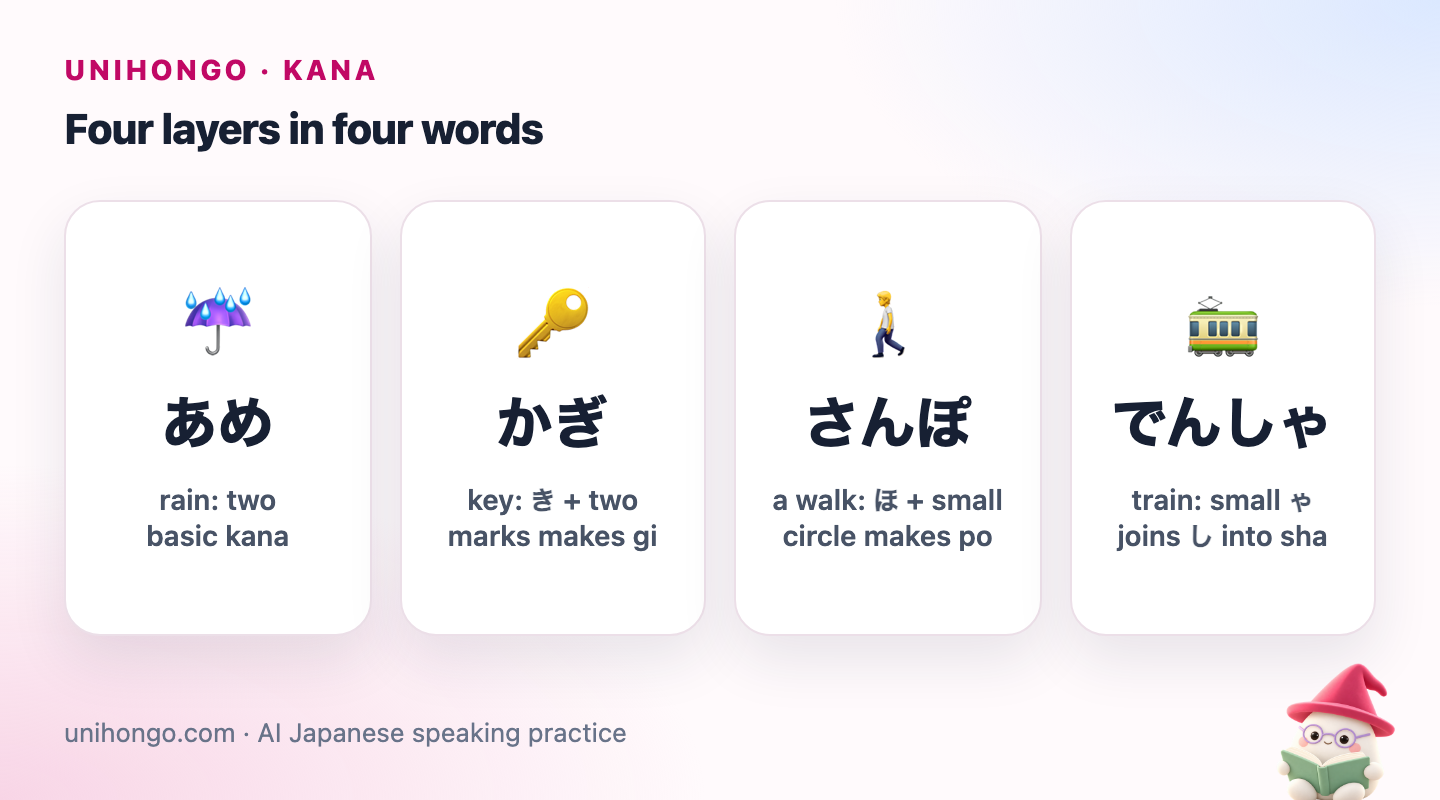
| Japanese | Romaji | Meaning |
|---|---|---|
| あめ | ame | rain: two basic kana |
| かぎ | kagi | key: き + two marks makes gi |
| さんぽ | sanpo | a walk: ほ + small circle makes po |
| でんしゃ | densha | train: small ゃ joins し into sha |
The two small marks, called dakuten, turn k into g, s into z, t into d and h into b. The small circle, handakuten, turns h into p. A small ゃ, ゅ or ょ joins the kana before it into one beat, and a small っ adds a short pause. Long vowels are written with an extra vowel kana, as in おかあさん (okāsan, mother).
Each of these is a rule, not new symbols to memorise, which is why the second layer is usually faster than the first.
What speeds you up and what slows you down
- Daily short sessions. Seeing the kana every day, even briefly, is usually faster than one long session a week.
- Mnemonics for the first pass. A picture story for each shape helps at the start; drop it once you read the kana directly.
- Reading real words early. Words like すし and ねこ give each symbol a meaning, which makes it stick.
- Mixing the order. Testing yourself in chart order hides the gaps, because you predict the next symbol.
- Slowed down by: waiting until the chart is perfect before reading anything.
- Slowed down by: romaji everywhere. If romaji is always next to the kana, your eyes read the romaji.
- Slowed down by: look-alike pairs left unpractised, such as さ and ち, ぬ and め, ね and れ, る and ろ.
Milestone tests you can try today
Instead of asking how long it should take, test where you are. Cover the romaji and read each group aloud. If a group is easy, you have that layer; if you stop on most words, spend a few more days there.
| Japanese | Romaji | Meaning |
|---|---|---|
| ねこ | neko | Test 1, basic kana: cat |
| さかな | sakana | Test 1, basic kana: fish |
| がっこう | gakkō | Test 2, marks and small っ: school |
| きっぷ | kippu | Test 2, marks and small っ: ticket |
| おちゃ | ocha | Test 2, small kana: green tea |
| びょういん | byōin | Test 2, small kana: hospital |
| えきへ いきます。 | Eki e ikimasu. | Test 3, a sentence: I'm going to the station. |
| みずを のみます。 | Mizu o nomimasu. | Test 3, a sentence: I drink water. |
Test 3 checks the particle readings that confuse almost everyone at first. When は, へ and を work as particles, they are read wa, e and o. That is why わたしは is watashi wa and えきへ is eki e. Getting this right is part of learning hiragana, not an extra.
Be careful with びょういん (byōin, hospital) and びよういん (biyōin, hair salon). The only difference is the size of one kana, and it is a classic mix-up that shows why small kana deserve their own practice time.
When someone asks if you can read hiragana
If you live in Japan or have Japanese friends, the topic comes up quickly, often when someone sees you reading a sign or a menu. It is a friendly question, and a modest answer is the natural reply. Here is how the exchange often goes.

| Japanese | Romaji | Meaning |
|---|---|---|
| ひらがな、読めるんですか。 | Hiragana, yomeru n desu ka. | Friend: You can read hiragana? |
| はい、少しだけ読めます。 | Hai, sukoshi dake yomemasu. | You: Yes, just a little. |
| すごいですね。どのくらい勉強しましたか。 | Sugoi desu ne. Dono kurai benkyō shimashita ka. | Friend: That's great. How long did you study? |
| 二週間くらいです。でも、まだ遅いです。 | Nishūkan kurai desu. Demo, mada osoi desu. | You: About two weeks. But I'm still slow. |
| カタカナはどうですか。 | Katakana wa dō desu ka. | Friend: How about katakana? |
| カタカナはこれからです。 | Katakana wa kore kara desu. | You: I'm starting katakana next. |
Mada osoi desu, I'm still slow, is a natural, modest reply. Japanese speakers tend to downplay their own skills, and a learner who does the same sounds comfortable with the culture. You can also say mada mada desu, I still have a long way to go.
After hiragana: furigana and your first kanji
Once hiragana feels comfortable, you are ready for the next step, which is reading kanji with help. Furigana are small hiragana printed next to or above a kanji to show its reading. Children's books, learner materials and many manga use them, and they are exactly where your hiragana pays off: you can read any word with furigana even before you know its kanji.
This is also why the time you spend on hiragana is never wasted. Every kanji reading you learn later is written in hiragana in dictionaries and textbooks, and every verb ending, particle and adjective ending is hiragana too. A learner who reads hiragana smoothly learns kanji faster.
| Japanese | Romaji | Meaning |
|---|---|---|
| 振り仮名 | furigana | small kana showing a kanji's reading |
| 漢字 | kanji | Chinese characters used in Japanese |
| 読み方 | yomikata | the way to read something |
| 食べます | tabemasu | I eat: a kanji with a hiragana ending |
Look at 食べます: one kanji, then hiragana for the rest. Most Japanese sentences mix scripts like this, so even advanced readers spend much of their time reading hiragana.
Common mistakes that stretch the timeline
- Studying the chart for weeks without reading a single word. Start reading words on day one.
- Reading は as ha in every position. As a particle it is wa: こんにちは is konnichiwa.
- Ignoring small kana. びょういん and びよういん are different places.
- Counting a long vowel as one beat. がっこう has four beats: ga-k-ko-u, said ga-k-ko-o.
- Keeping the mnemonic forever. Once you read あ as a without the story, let the story go.
- Comparing yourself with someone who claims to have done it in a weekend. Measure your own progress with the tests above.
Pace your hiragana with Mocchi
Tell Mocchi how much time you have and where you are, for example: "I know the basic hiragana but I'm slow with small kana. Build me a short daily practice and check each week which kana I still misread." Mocchi builds the practice into your personal plan as small daily tasks, remembers which kana you stumble on, and uses /read to give you tiny hiragana passages at your level.
For speed, add a round of Kana Dash between plan tasks. It is free for everyone with no sign-up at unihongo.com/alphabet, so it is easy to share with a friend who is starting too.