
猫 in four everyday words
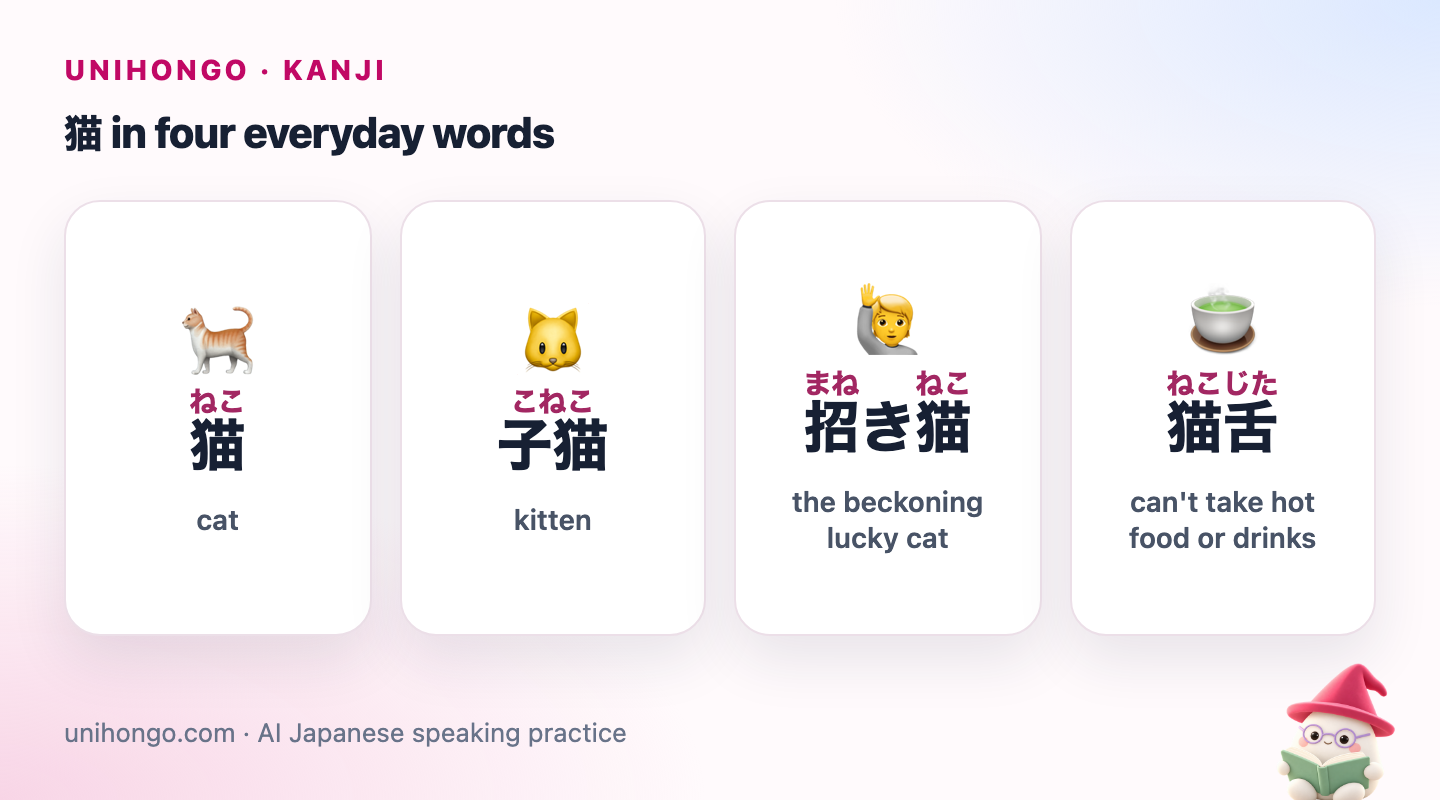
猫 is one of the first animal kanji learners want, and luckily one of the most useful. These four words cover the animal, the baby, the famous lucky figure and the phrase you will say about yourself at a hot-pot dinner.
| Japanese | Romaji | Meaning |
|---|---|---|
| 猫 | neko | cat |
| 子猫 | koneko | kitten |
| 招き猫 | maneki neko | the beckoning lucky cat |
| 猫舌 | nekojita | can't take hot food or drinks |
Readings, strokes and parts: 犭 plus 苗
猫 has eleven strokes and is on the official list of kanji for general use, so it appears freely in newspapers and signs. On the left is 犭, the animal radical, a combining form of 犬, dog. On the right is 苗, the kanji for a seedling, nae, whose on'yomi is byō. In 猫 it works as the sound part, which is why the on'yomi of 猫 is also byō. It is not a hint that cats like plants.
| Reading | Type | Example |
|---|---|---|
| neko | Kun'yomi | 猫, 子猫, 黒猫, 猫舌 |
| byō | On'yomi | 愛猫 (aibyō), a beloved cat; mostly written words |
| neko / ネコ | Kana spelling | Picture books, pet shops, science writing |
The on'yomi is rare in speech. You will mainly see it in 愛猫, aibyō, a beloved cat, used in writing and pet-food advertising, and in a few formal words. In conversation, 愛猫 is often read aineko too, and both are understood. Everywhere else, neko is the reading you need.
Cats also have their own sound word. A cat says にゃー, nyā, or にゃん, nyan, in Japanese, and you will hear these sounds in shop names, adverts and the playful speech of cat lovers. Adding にゃん to the end of a sentence is a cute, joking style, fine with close friends and in comics, but far too childish at work.
Pet owners call their cat うちの子, our child, just as dog owners do, and talk about it with the same warmth they use for family. When a Japanese friend shows you a photo of their cat, a simple かわいい! followed by a question about its name or age keeps the conversation going naturally.
Cat words: kittens, strays and cat people
Colours and patterns combine with 猫 in the most natural way: just put the colour in front. Calico cats have their own word, 三毛猫, three-fur cat. A stray is 野良猫, and a cat that lives outdoors but is cared for by a neighbourhood is called 地域猫, a community cat, in many towns.
| Japanese | Romaji | Meaning |
|---|---|---|
| 黒猫 | kuroneko | black cat |
| 三毛猫 | mikeneko | calico cat |
| 野良猫 | noraneko | stray cat |
| 地域猫 | chiiki neko | community cat, cared for by locals |
| 猫好き | nekozuki | cat lover |
| 猫派 | nekoha | a cat person (vs a dog person) |
| 猫背 | nekoze | a hunched back, round shoulders |
| 猫カフェ | neko kafe | cat café |
| 私は猫派です。 | Watashi wa nekoha desu. | I'm a cat person. |
| 猫背を直したいです。 | Nekoze o naoshitai desu. | I want to fix my posture. |
Cat idioms you will actually hear
Japanese cat idioms are lively and common. Start with these four, which are useful in everyday conversation and do not sound old-fashioned. 猫をかぶる, to wear a cat, means to hide your true personality and act sweet and quiet, often said with a laugh about someone who seems shy at first. 猫に小判, gold coins to a cat, is like pearls before swine. 猫の額, a cat's forehead, describes a tiny piece of land, often used modestly about one's own garden.
| Japanese | Romaji | Meaning |
|---|---|---|
| 猫の手も借りたい | neko no te mo karitai | so busy you'd take any help |
| 猫をかぶる | neko o kaburu | to hide your true self, act sweet |
| 猫に小判 | neko ni koban | wasted on someone who can't value it |
| 猫の額ほどの庭 | neko no hitai hodo no niwa | a tiny garden |
| 猫かわいがり | nekokawaigari | doting on someone too much |
| 今週は猫の手も借りたいくらい忙しい。 | Konshū wa neko no te mo karitai kurai isogashii. | This week I'm so busy I'd take help from anyone. (casual) |
| 彼女、最初は猫をかぶってたんだよ。 | Kanojo, saisho wa neko o kabutteta n da yo. | She was hiding her real self at first. (casual) |
猫に小判 can sound rude if you say it about a specific person's taste, because it implies they cannot appreciate something. Use it about yourself, for example when given an expensive wine you cannot judge: 私には猫に小判です, it is wasted on me. 猫をかぶる is similar: laughing about your own shyness is fine, but accusing someone else of it can sting.
A real conversation: the cat at the hot-pot table
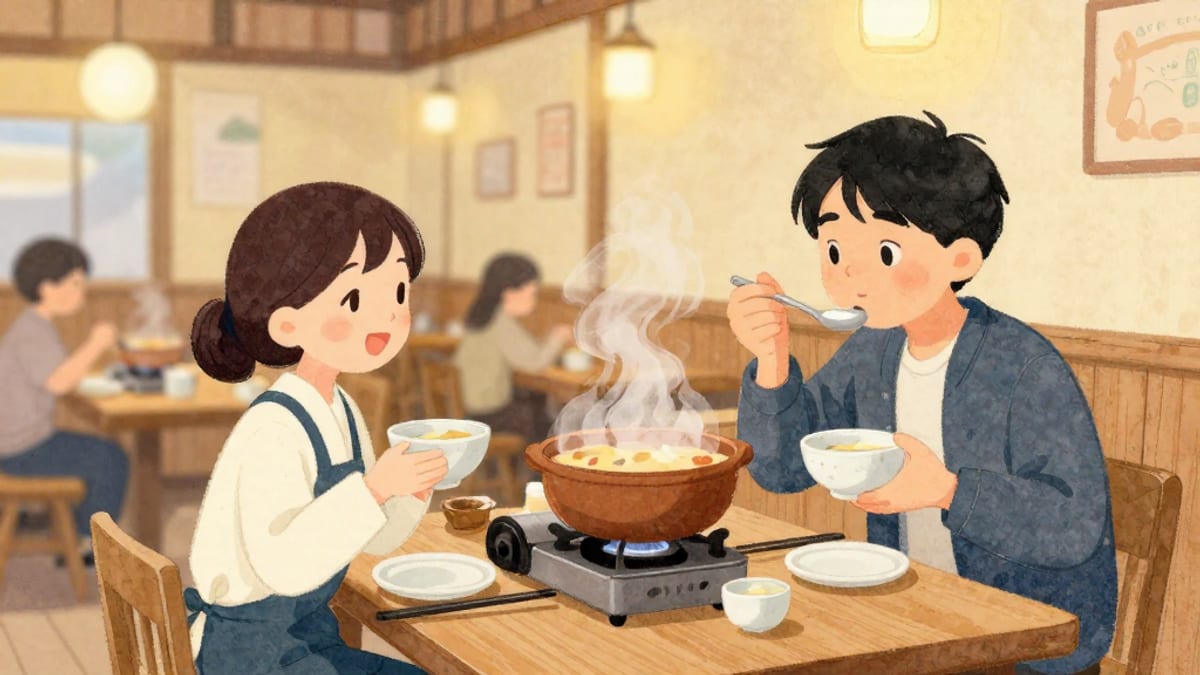
Cat words turn up in ordinary moments. Here is a short exchange at a dinner with a coworker, the kind of place where 猫舌 is the perfect word. A shop or café owner might also mention the 招き猫 on the counter: a cat raising its paw to beckon in customers or good fortune. People say the raised paw matters, and colours too, but explanations differ from shop to shop, so ask rather than lecture.
| Japanese | Romaji | Meaning |
|---|---|---|
| 熱いうちにどうぞ。 | Atsui uchi ni dōzo. | Coworker: Please, eat it while it's hot. |
| すみません、猫舌なんです。 | Sumimasen, nekojita nan desu. | You: Sorry, I can't take hot food. |
| 私もです!少し待ちましょう。 | Watashi mo desu! Sukoshi machimashō. | Coworker: Me too! Let's wait a bit. |
| 最近、仕事どうですか。 | Saikin, shigoto dō desu ka. | You: How's work these days? |
| 猫の手も借りたいくらいですよ。 | Neko no te mo karitai kurai desu yo. | Coworker: I'd take help from a cat at this point. |
猫 vs 描, and how to write the cat
The classic trap is 描, to draw or depict, as in 描く, kaku, and 描写, byōsha, description. It has the same right side, 苗, and the same on'yomi, byō. Only the left side differs: 犭, the animal, for the cat; 扌, the hand, for drawing. Think of the hand that holds the pen.
| Japanese | Romaji | Meaning |
|---|---|---|
| 描く | kaku | to draw, to paint |
| 描写 | byōsha | description, depiction |
| 苗 | nae | seedling (the sound part) |
- Writing 描 in your cat's name card. Check for the curved animal stroke on the left.
- Saying aibyō in casual chat. Neko or uchi no neko, our cat, sounds natural.
- Using 猫をかぶる as praise. It means pretending, not being cute.
- Thinking 熊猫 is a Japanese word for panda. In Japanese, say パンダ.
To write 猫, start with 犭: the short left-falling stroke, the long curved stroke that hooks up, and the second left-falling stroke. Then 苗: the three-stroke grass top, written small, and finally 田 below. Keep 田 square and slightly smaller than you expect, so the character does not look top-heavy.
猫 on a tattoo, logo or mug
A single 猫 is charming and unambiguous: it means cat in Japanese and Chinese. Cat lovers often prefer a word with more personality, though. 黒猫 says black cat, 招き猫 says good luck, and 猫好き says you love cats. A Japanese reader will smile at any of them, because cat words feel warm and playful rather than serious.
If you want the name of your own cat, remember that pet names are often in katakana, such as ミケ or タマ, and that a kanji spelling for a pet can look grand or odd. A native speaker can tell you in a minute whether your design looks natural. Ask one before anything permanent is printed or inked.
Build a cat-idiom deck with Mocchi
Type /create-flashcards cat idioms from this post to Mocchi. It makes a card for each idiom and lets you choose a photo, a busy office for 猫の手も借りたい, a steaming cup for 猫舌. Use /review-flashcards each day; the idioms you hesitate on return sooner, and Mocchi remembers them for your later quizzes.
When the deck feels easy, take it into Mocchi Flight on the games page and guide Mocchi through the gate with the right word. It is a quick, playful way to check that you recognise the idioms at speed.