
狼 at a glance: wolf, lone wolf and the kana spellings
狼 is the only common kanji for wolf, so you do not have to choose between forms as you do with the dragon. What you do have to choose is the script. Because 狼 is outside the official list of kanji for general use, newspapers and textbooks often write the animal in kana, and zoos and nature programmes use katakana, as they do for most animal names.
The kanji itself appears in novels, idioms, names of characters in games and manga, and in a handful of everyday compounds. Recognising it is useful; being able to write it by hand is a bonus. If you write a message to a friend, おおかみ in hiragana is perfectly natural and looks friendly, while 狼 looks more dramatic, like the title of a novel.
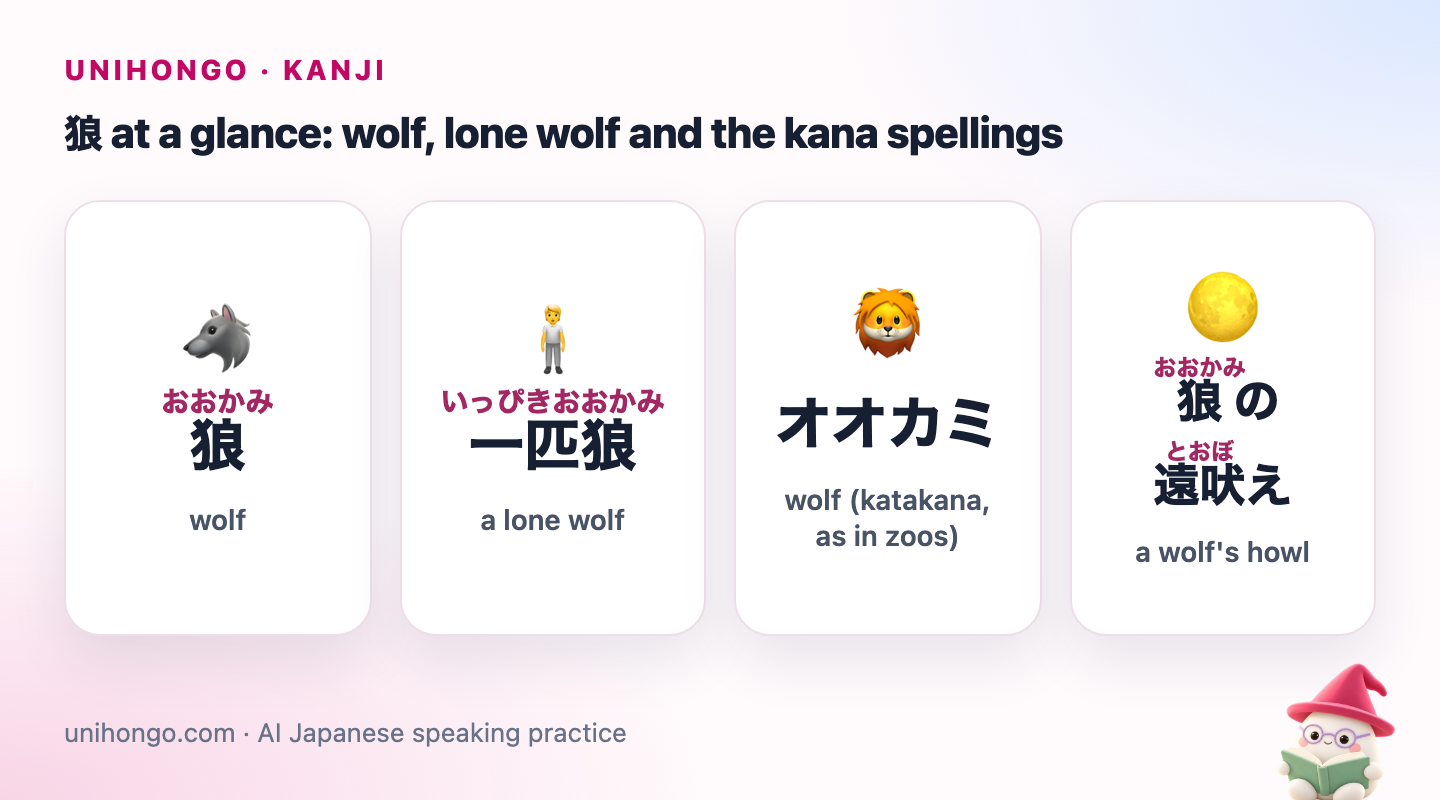
| Japanese | Romaji | Meaning |
|---|---|---|
| 狼 | ōkami | wolf |
| 一匹狼 | ippiki ōkami | a lone wolf |
| オオカミ | ōkami | wolf (katakana, as in zoos) |
| 狼の遠吠え | ōkami no tōboe | a wolf's howl |
Readings and parts: 犭 plus 良
The kun'yomi, ōkami, is the native Japanese word and is used when the kanji stands alone or in native compounds such as 狼男. The on'yomi, rō, comes from Chinese and appears in Sino-Japanese words such as 狼狽. The kanji has ten strokes.
| Part | Name | Role in 狼 |
|---|---|---|
| 犭 | kemonohen, the animal radical | Marks the meaning: an animal |
| 良 | the kanji for good, ryō | Gives the sound: rō |
| 狼 | ōkami / rō | Ten strokes in total |
This is a phono-semantic character, the most common type of kanji: one part hints at the meaning and the other at the sound. The 良 part has nothing to do with wolves being good; it simply sounded like the Chinese word for wolf. The same sound part appears in 浪, 朗 and 郎, all with the reading rō.
犭 is the combining form of 犬, dog, and appears in many animal kanji: 猫, cat; 狐, fox; 狸, tanuki; and 猿, monkey. Once you know it, a whole family of animals becomes easier to read.
Words and idioms that use 狼
The wolf in Japanese idioms is rarely a noble creature. It is the loner, the danger in the forest or the trickster of fairy tales. Two compounds are worth special attention because 狼 in them has little to do with the animal: 狼狽 means panic and confusion, and 狼煙 is a signal fire.
| Japanese | Romaji | Meaning |
|---|---|---|
| 狼男 | ōkami otoko | werewolf |
| 狼少年 | ōkami shōnen | the boy who cried wolf; a habitual liar |
| 送り狼 | okuri ōkami | a man who walks a woman home with bad intentions |
| 狼狽 | rōbai | panic, consternation (formal) |
| 狼狽える | urotaeru | to be flustered |
| 狼煙 | noroshi | a signal fire, smoke signal |
| 反撃の狼煙を上げる | hangeki no noroshi o ageru | to signal the start of a counterattack |
| あの人は一匹狼だね。 | Ano hito wa ippiki ōkami da ne. | That person's a lone wolf, isn't he? (casual) |
狼狽える is read urotaeru, a native verb that borrowed the kanji of 狼狽 for its meaning. Many native speakers simply write うろたえる. 送り狼 is old-fashioned, half-joking slang; you may hear it in dramas, but it is a sharp thing to say about a real person, so keep it in your passive vocabulary. The same goes for jokes about men being wolves, which you may hear in older songs and comedy.
狼少年 comes from the Aesop story, which Japanese children know well. Calling someone 狼少年 means people have stopped believing them because of too many false alarms.
Lone wolf in conversation: praise or criticism?
一匹狼 can describe a freelance designer who prefers to work alone, a climber who travels solo, or a colleague who never joins the team. Japanese often values cooperation, so the word can hint that someone stands apart. With a warm tone and the right context, it becomes a compliment about independence. Listen for the words around it.
| Japanese | Romaji | Meaning |
|---|---|---|
| 彼は一匹狼タイプです。 | Kare wa ippiki ōkami taipu desu. | He's the lone-wolf type. |
| 一匹狼でかっこいいね。 | Ippiki ōkami de kakkoii ne. | Going it alone, that's cool. (casual) |
| チームでは浮いているみたいです。 | Chīmu de wa uite iru mitai desu. | He seems not to fit in with the team. |
| 一人で仕事するほうが好きなんです。 | Hitori de shigoto suru hō ga suki nan desu. | I prefer to work on my own. |
Wolves at Japanese mountain shrines
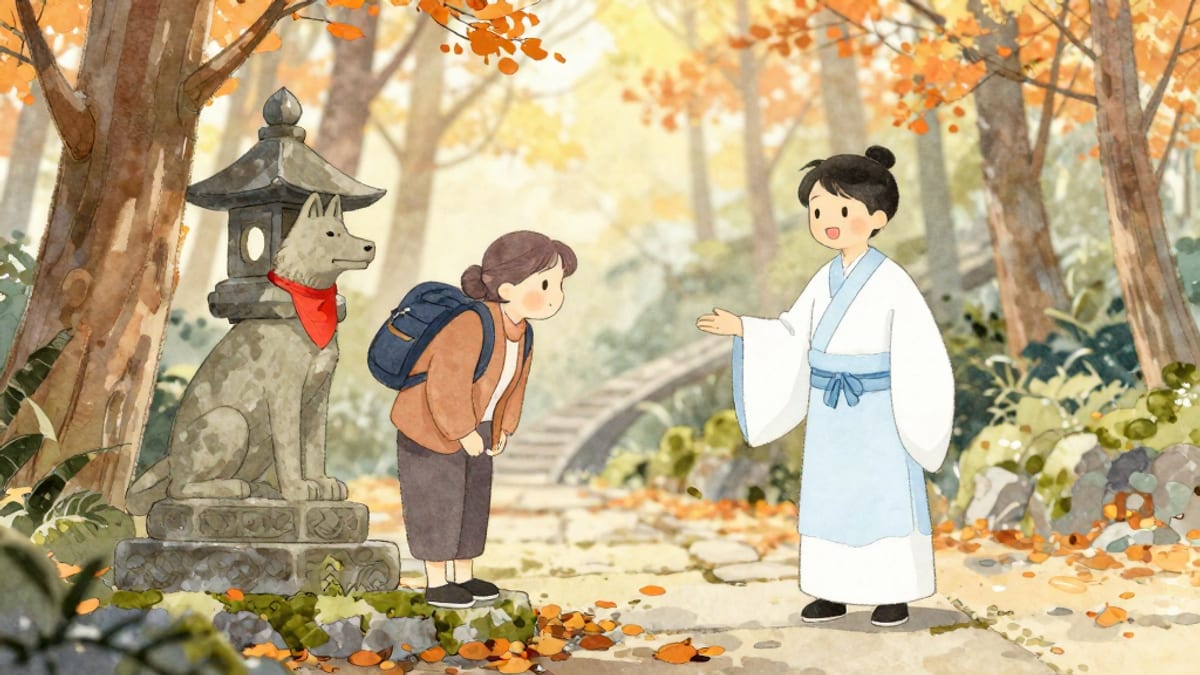
In parts of the mountains west of Tokyo, around Chichibu and Okutama, some shrines honour the wolf as a messenger and protector. Instead of the usual lion-dogs, a pair of stone wolves may guard the approach, and you can sometimes buy a charm with a wolf on it, traditionally said to protect against fire and theft. Local people may call the wolf ōkuchi no makami or oinu-sama, respectful names. Customs and stories differ from shrine to shrine, so the guide or shrine staff are the best people to ask.
| Japanese | Romaji | Meaning |
|---|---|---|
| この狛犬は狼ですか。 | Kono komainu wa ōkami desu ka. | You: Is this guardian statue a wolf? |
| はい、ここでは狼が神様の使いなんです。 | Hai, koko de wa ōkami ga kamisama no tsukai nan desu. | Staff: Yes, here the wolf is the messenger of the gods. |
| 何のお守りですか。 | Nan no omamori desu ka. | You: What is this charm for? |
| 火事や盗難から守ってくれると言われています。 | Kaji ya tōnan kara mamotte kureru to iwarete imasu. | Staff: It's said to protect against fire and theft. |
Look-alikes with 良, and how to write 狼
The sound part 良 produces a family of kanji that all read rō. Learn them together and you will stop confusing them. The radical on the left tells you which one you are looking at: water for waves, the moon for brightness, the animal for the wolf.
| Japanese | Romaji | Meaning |
|---|---|---|
| 浪人 | rōnin | a masterless samurai; a student retaking exams |
| 朗らか | hogaraka | cheerful, bright |
| 新郎 | shinrō | bridegroom |
| 良い | yoi | good (the sound part on its own) |
- Writing 浪 instead of 狼. 浪 has the water radical 氵; 狼 has the animal radical 犭.
- Reading 狼煙 as ōkami kemuri. It is a special reading: noroshi.
- Using 狼 for a person in praise without context. 一匹狼 is the safe way to say lone wolf.
- Mixing up 犭 and 扌, the hand radical. 犭 has a curved hooked stroke; 扌 has a straight vertical with a hook.
To write 狼, start with 犭: a short left-falling stroke, a long curved stroke that hooks at the bottom, then a second left-falling stroke across it. Then write 良 on the right: a dot, then the box with a horizontal inside, and finally the lower part that ends with a sweeping stroke to the bottom right. Keep 良 slightly taller than the radical.
狼 or 一匹狼 in a tattoo or logo
A single 狼 is bold and easy to read, and in both Japanese and Chinese it means wolf. If what you want to say is independence, freedom or going your own way, 一匹狼 expresses it better, because a single animal kanji only names the animal. Japanese viewers will understand 一匹狼 instantly; it is a familiar phrase.
Be careful with additions. In Chinese, 色狼 means a lecher, and in Japanese 送り狼 is a man with bad intentions, so do not add characters to 狼 just because they look nice. Ask a native speaker, and if the design is in a brush style, someone who knows calligraphy, to check it before the session. Remember also that many Japanese onsen and pools have rules about visible tattoos; check the rules of each place before you go.
Hunt down the wolf words with Mocchi
Type /explain 反撃の狼煙を上げる to Mocchi and it splits the phrase into parts, names each particle and gives the meaning, which is a good way to see why noroshi is not about wolves. Mocchi keeps track of the readings you get wrong, such as rōbai or urotaeru, and brings them back in later quizzes.
Then turn the vocabulary here into your own flashcards and play Kotoba Tank with them on the games page: you hear ōkami, rōnin or noroshi and have to hit the right word, which trains your ear as well as your eyes.