
Why print and handwriting parted ways
The kanji in your textbook are drawn by a typeface. Serif styles descend from carved and cast type, so strokes have even weight, corners are squared off and every element sits at a fixed size for legibility at small point sizes. Handwriting descends from the brush. A brush lifts, turns and reconnects, so a written character records the movement of a hand rather than a designed outline. Neither is a corruption of the other; they are two conventions that happen to represent the same characters.
This matters because textbooks train your eye on only one of them. You can read a novel comfortably and still stall on a three-word note, not because your kanji knowledge is weak but because your visual memory holds the wrong template. The repair is not more vocabulary. It is exposure to written shapes, plus a small amount of writing practice so you know from the inside which strokes a hand runs together.
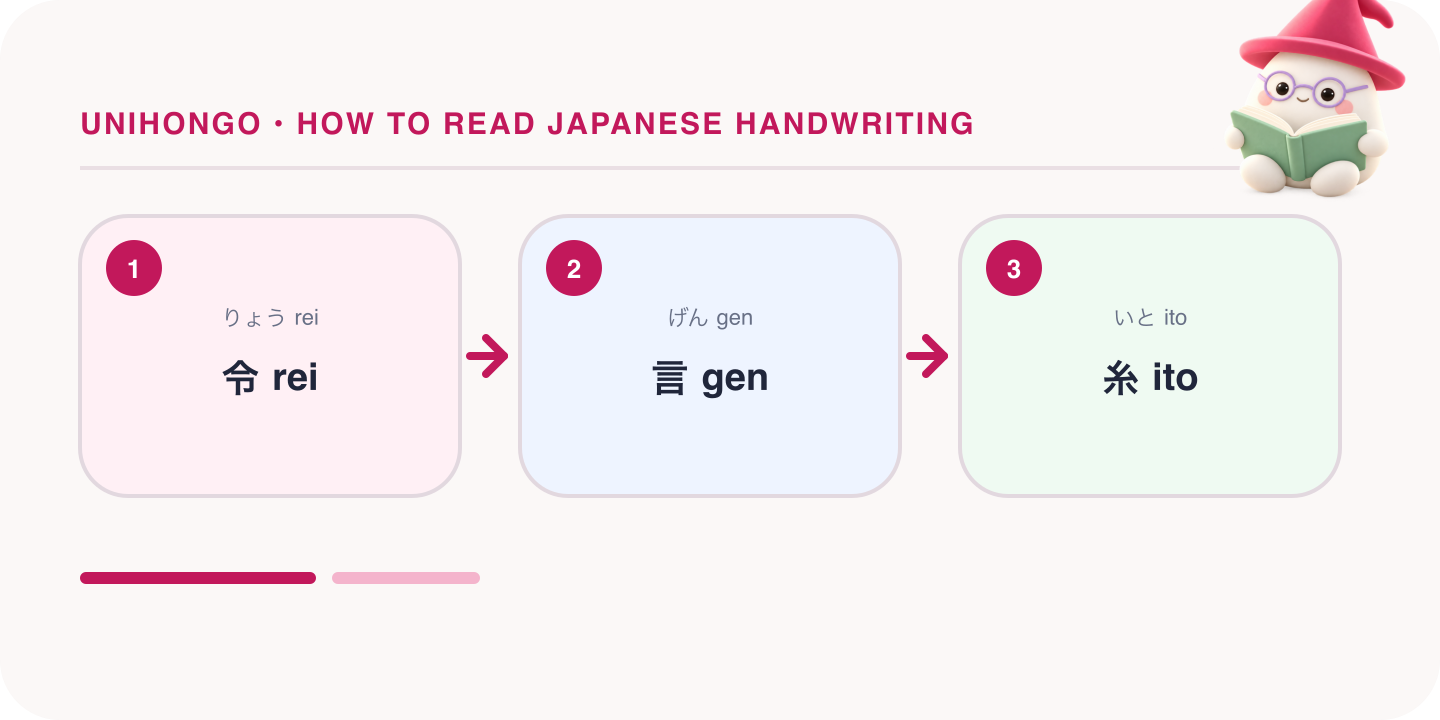
What a fast hand does to a stroke
Four things happen when someone writes quickly. Strokes that finish and start near each other get connected by a thin trailing line. Hooks and sharp corners get rounded or shortened until a right angle becomes a curve. Repeated short strokes merge into one gesture, so three dots become a single wave. And the whole character leans, because a hand moving down a page pulls shapes slightly to the right and compresses them vertically.
These changes are systematic, which is the good news. The three strokes at the bottom of a thread radical usually become a loop or a wave in the same way every time. A vertical stroke that ends in a hook usually keeps a trace of the hook even when it is barely a flick. Once you have seen a radical simplified two or three times you will recognise it everywhere, and a whole family of characters becomes readable at once.
- Connected strokes: a thin ligature runs from the end of one stroke to the start of the next.
- Shortened hooks: the hook on a vertical or on a bent stroke becomes a small upward flick.
- Merged repeats: three dots or three short strokes become one wave or one loop.
- Collapsed radicals: the speech, thread, water and fire elements each have a standard simplified gesture.
- Compression: the character narrows and leans right, and the last stroke often trails toward the next character.
Characters whose written form drifts furthest from print
| Character | In print | Written by hand | What to look for |
|---|---|---|---|
| 令 rei | A squared lower element with a horizontal and a vertical | The lower part is often written as a katakana ma shape | The roof plus a small ma below; the same happens in 冷 and 鈴 |
| 言 gen | A flat horizontal bar on top of the stack | The top stroke is a short slanted dot | A dot, then the horizontals; in fast writing the horizontals become one zigzag |
| 糸 ito | Three separate short strokes at the bottom | A single wave, or a loop above it in fast writing | A loop with a tail; common in 紙, 経, 続 |
| 心 shin | Three distinct dots around a curved stroke | One sweeping curve with dots that may merge into it | The wide curve first, then count how many dots survive |
| 女 onna | The horizontal often stops at the crossing strokes | The horizontal is drawn long and sticks out on both sides | A long bar crossing the whole character |
| 辶 shinnyō | A dot, a small bend, then a flat sweeping base | One dot and a single continuous wave underneath | The wave carries the whole element; the top dot may be tiny |
| 木 ki | A straight vertical with clean diagonals | The vertical curves and ends in a flick to the left | A hooked foot and diagonals that may join the vertical |
| 四 shi | A neat box with two upright legs inside | The inner legs bend inwards and may touch the base | Box outline first, then whatever is left inside |
| 者 sha | No dot in the modern printed form | Some writers add a small dot on the right shoulder | Treat an extra dot as decoration, not a different character |
| 雨 ame | Four separate dots inside the frame | Two quick strokes or a dashed line inside the frame | The frame and vertical stay stable; the dots do not |
| 門 mon | Two symmetrical uprights with clear crossbars | Each side collapses to a vertical with a wiggle | Two tall shapes with a gap down the middle |
Read this table as a set of habits rather than rules, because every writer applies them differently and some people write almost like print. What it gives you is a prediction: when a shape is not what you expected, check whether one of these standard simplifications explains the difference before you decide you do not know the character.
Semi-cursive and cursive in daily life
Everyday handwriting is essentially block style with a few connections, which is why a colleague's note is usually readable once your eye adjusts. Semi-cursive goes further: strokes are joined openly, the outline of the character is preserved but the internal detail is smoothed away. You meet it on hand-lettered menus, on the paper strips outside a restaurant, on greeting cards and on shop signs where a designer wanted warmth rather than clarity.
Full cursive is a different matter. Characters lose their internal structure and become an abbreviated gesture, sometimes running into the next character without a break. It appears on calligraphy, on artwork, on old documents and on some traditional shop curtains. Reading it is a trained skill, and plenty of Japanese readers cannot do it. If you are staring at a scroll in a museum and getting nothing, that is the expected outcome, not a gap in your study.
The kana that vary most between writers
Katakana cause more trouble than kanji here, because the shapes are short and the differences live in stroke direction rather than in the finished picture. The reliable test is where each stroke starts and where it ends, so if you can imagine the hand moving, the pairs separate cleanly. Learners who compare only the final shape keep guessing, because a sloppy shi and a sloppy tsu really do look alike on paper.
Hiragana vary in a different way. Writers join strokes that print keeps separate, so sa and ki may arrive as one continuous shape, and some people write so with a single stroke where others use two. Neither version is wrong. Look at the overall skeleton and the direction of the final stroke rather than counting pieces.
| Japanese | Romaji | Meaning |
|---|---|---|
| シとツ | Shi to tsu | shi and tsu: shi's strokes rise from the lower left, tsu's fall from the top |
| ソとン | So to n | so and n: so falls from the top right, n rises from the bottom left |
| クとワ | Ku to wa | ku and wa: ku has a sharp corner, wa a rounded shoulder |
| タとユ | Ta to yu | ta has a crossing diagonal, yu is a single closed loop with a bar |
| ロと口 | Ro to kuchi | the katakana ro and the kanji for mouth look identical in a hurry |
| エと工 | E to kō | the katakana e and the kanji for craft are the same shape |
| カと力 | Ka to chikara | the katakana ka and the kanji for power differ only in balance |
| ホと木 | Ho to ki | the katakana ho has detached side strokes; the kanji joins them |
| ーと一 | Chōonpu to ichi | the long vowel mark and the number one; the mark runs vertical in vertical text |
| さときの続け書き | Sa to ki no tsuzukegaki | sa and ki are often written with the lower stroke joined |
Say these pairs out loud as you compare them, because naming a shape fixes it faster than looking at it does. The single most useful habit is to ask which end of the stroke the pen touched down on. Once that question is automatic, the shi and tsu problem largely disappears, and with it most of the katakana reading errors that slow learners down in menus and forms.
Reading a handwritten note
A note is easier than a sign because the context is narrow. Someone leaving a message at home or at work is writing about time, place, food, a phone call or a task, and the vocabulary repeats. Read the whole thing once for shape without stopping, find the numbers and the particles, and let the sentence frame tell you what kind of word is missing. A character you cannot read in the middle of ni arimasu is almost certainly a place or an object.
| Japanese | Romaji | Meaning |
|---|---|---|
| 先に帰ります。 | Saki ni kaerimasu. | I am heading home ahead of you. |
| 冷蔵庫にご飯があります。 | Reizōko ni gohan ga arimasu. | There is food in the fridge. |
| 電話がありました。折り返しお願いします。 | Denwa ga arimashita. Orikaeshi onegaishimasu. | There was a call. Please call them back. |
| 明日は九時集合です。 | Ashita wa ku-ji shūgō desu. | Tomorrow we meet at nine. |
| 荷物は隣に預けました。 | Nimotsu wa tonari ni azukemashita. | I left the parcel with the neighbour. |
| 本日は休業します。 | Honjitsu wa kyūgyō shimasu. | Closed today. (sign) |
| 準備中です。 | Junbichū desu. | We are getting ready and not open yet. (sign) |
| 本日のおすすめ | Honjitsu no osusume | Today's recommendation (menu) |
| 売り切れ | Urikire | Sold out (menu) |
| 少々お待ちください。 | Shōshō o-machi kudasai. | Please wait a moment. (notice) |
Notice how short these are. Handwritten Japanese in daily life is mostly fixed expressions, so learning twenty of them turns a wall of unfamiliar shapes into a small guessing game with a short answer list. When you meet one you cannot read, write your best guess down and check it later rather than stopping; the guess is what makes the correction stick.
Filled-in forms and what staff say
Forms are where handwriting turns from a reading problem into a speaking one, because someone will hand yours back. Counters commonly ask for block-style writing, for a reading in kana above the name field, for a particular pen colour, and sometimes for a stamp. These requests come in a small set of fixed sentences, so learning to hear them is quick, and the correct response is usually just to hand the form back and do what was asked.
| Japanese | Romaji | Meaning |
|---|---|---|
| ここにお名前をお願いします。 | Koko ni o-namae o onegaishimasu. | Your name here, please. (staff) |
| 楷書でご記入ください。 | Kaisho de go-kinyū kudasai. | Please write in block style. (staff) |
| ふりがなもお願いします。 | Furigana mo onegaishimasu. | The kana reading as well, please. (staff) |
| 黒のボールペンでお書きください。 | Kuro no bōrupen de o-kaki kudasai. | Please write with a black ballpoint pen. (staff) |
| こちらにご印鑑をお願いします。 | Kochira ni go-inkan o onegaishimasu. | Your seal here, please. (staff) |
| この欄は空欄で結構です。 | Kono ran wa kūran de kekkō desu. | You can leave this box blank. (staff) |
| 書き直してもいいですか? | Kakinaoshite mo ii desu ka? | May I write it out again? |
| 新しい用紙をいただけますか? | Atarashii yōshi o itadakemasu ka? | Could I have a fresh form? |
| 漢字で書かなくても大丈夫ですか? | Kanji de kakanakute mo daijōbu desu ka? | Is it all right if I do not write it in kanji? |
| 字が下手ですみません。 | Ji ga heta de sumimasen. | Sorry about my poor handwriting. |
Tactics when you are stuck on a character
- Read the context first and decide what kind of word could fill the slot: a place, a time, a name, a verb.
- Count the strokes you can actually see, then allow one or two extra for strokes that were joined.
- Find the radical, since the left-hand or top element survives simplification more often than the rest.
- Check whether it is a name, because personal and place names use readings that ordinary rules will not give you.
- Look at neighbouring characters by the same writer to learn how that person forms a hook or a dot.
- Photograph it and try handwriting input on your phone, drawing what you see rather than what you think it should be.
- If none of that works, ask. One short question costs less than five minutes of squinting.
Asking someone to read or clarify their writing
Asking is completely normal, and Japanese has polite ready-made ways to do it that carry no embarrassment. The useful move is to be specific: point at the character, say you cannot read that one, and ask for the reading rather than the meaning. A vague wakarimasen makes the other person explain the whole sentence, which is rarely what you need.
| Japanese | Romaji | Meaning |
|---|---|---|
| すみません、この字が読めません。 | Sumimasen, kono ji ga yomemasen. | Excuse me, I cannot read this character. |
| これは何と書いてありますか? | Kore wa nan to kaite arimasu ka? | What does this say? |
| ここは何と読みますか? | Koko wa nan to yomimasu ka? | How is this part read? |
| 読み方を教えていただけますか? | Yomikata o oshiete itadakemasu ka? | Could you tell me the reading? |
| これは何という漢字ですか? | Kore wa nan to iu kanji desu ka? | Which kanji is this? |
| ふりがなをつけていただけますか? | Furigana o tsukete itadakemasu ka? | Could you add the kana reading? |
| 楷書で書いていただけますか? | Kaisho de kaite itadakemasu ka? | Could you write it in block style? |
| もう少し大きく書いてもらえますか? | Mō sukoshi ōkiku kaite moraemasu ka? | Could you write it a little larger? |
| パソコンで打っていただけると助かります。 | Pasokon de utte itadakeru to tasukarimasu. | It would help if you could type it. |
| 「シ」ですか、「ツ」ですか? | "Shi" desu ka, "tsu" desu ka? | Is that shi or tsu? |
| お名前の読み方を確認させてください。 | O-namae no yomikata o kakunin sasete kudasai. | Let me check how your name is read. |
| 田中さんの「なか」はこの字ですか? | Tanaka-san no "naka" wa kono ji desu ka? | Is the naka in Tanaka this character? |
| 手書きの字を読むのがまだ苦手です。 | Tegaki no ji o yomu no ga mada nigate desu. | I am still not good at reading handwriting. |
| ゆっくり書いてくださると助かります。 | Yukkuri kaite kudasaru to tasukarimasu. | It helps if you write slowly. |
| 崩し字は日本の方でも読めないことがありますね。 | Kuzushiji wa Nihon no kata demo yomenai koto ga arimasu ne. | Even Japanese people cannot always read cursive, can they. |
Expect the reply to be the reading said aloud, sometimes with the character traced in the air or on a palm. If you still cannot catch it, ask them to write it in kana rather than asking again, because a second spoken attempt rarely helps. The last line is a friendly one to keep in reserve; agreeing that cursive is hard usually turns an awkward moment into a short shared joke.
Training your eye over a month
Progress here comes from volume rather than from study sessions. Collect handwriting: a note from a colleague, a hand-lettered menu photographed on the way home, the annotations on a delivery slip, a friend's message written on paper. Read each one aloud, mark the characters that defeated you, and then write those characters yourself five times with correct stroke order. Writing is what converts a confusing shape into a movement you recognise.
Give it ten minutes a day for a month and the change is noticeable: you stop seeing an unfamiliar picture and start seeing a familiar character written quickly. Keep the speaking half attached to it, since the point of reading a note is usually to answer someone. Read your collected notes aloud, then say what you would reply, so decoding and responding stay one skill rather than two.