

Exits, entrances and the kanji for mouth
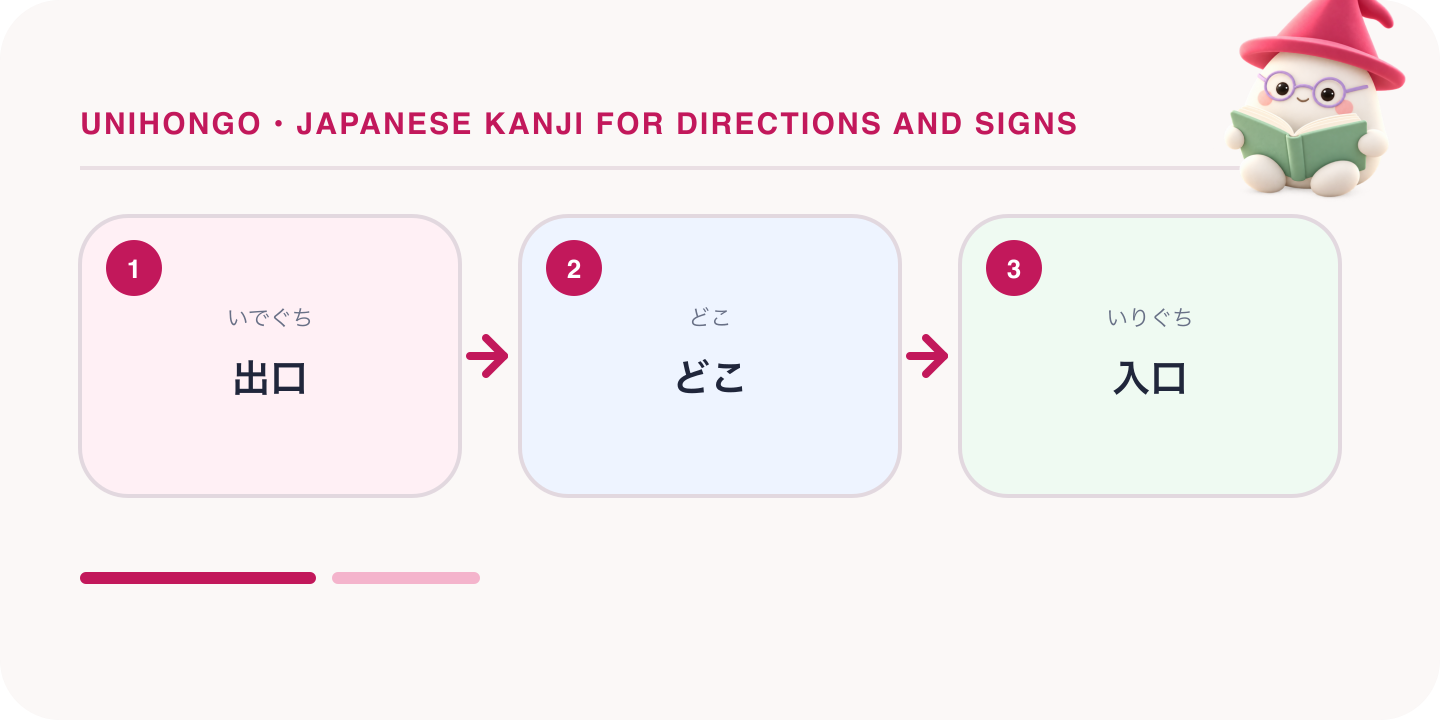
Start with the three kanji above every doorway: 出, 入 and 口. 出 means to go out, read shutsu in compounds and deru or dasu as a verb. 入 means to go in, read nyū in compounds and hairu or ireru as a verb. 口 is a mouth, kō in compounds and kuchi alone, and on signs it means an opening or gate. Together they give 出口, deguchi, exit, and 入口, iriguchi, entrance. These use the kun readings, which is common for native compounds that name physical things.
The same 口 builds many station words: 改札口, kaisatsu-guchi, the ticket gate; 窓口, madoguchi, a service counter; 出入口, deiriguchi, entrance and exit, on shop doors and car parks. As the second half of a compound, 口 usually sounds -guchi rather than -kuchi.
| Japanese | Romaji | Meaning |
|---|---|---|
| 出口はどこですか。 | Deguchi wa doko desu ka. | Where is the exit? |
| 入口は反対側です。 | Iriguchi wa hantaigawa desu. | The entrance is on the opposite side. |
| 東口で待ち合わせしましょう。 | Higashi-guchi de machiawase shimashō. | Let's meet at the east exit. |
| 改札口を出て右です。 | Kaisatsu-guchi o dete migi desu. | Go out of the ticket gate and turn right. |
The four compass points
東西南北, tōzainanboku, is one of the most useful groups in the language. Each kanji has an on reading for place names and a kun reading for when it stands alone or names an exit. 東 is tō or higashi, 西 is sei, sai or nishi, 南 is nan or minami, and 北 is hoku or kita. The kun readings are what station announcements use, so higashi-guchi, nishi-guchi, minami-guchi and kita-guchi are the exits you will be sent to.
The on readings hide inside names you already know: 東京, Tōkyō, the eastern capital; 北海道, Hokkaidō, the northern sea route; 関西, Kansai, west of the barrier. For the shapes, 東 is a sun 日 rising behind a tree 木, 西 looks like a bird settling into a nest, and 北 shows two people sitting back to back, turning away from the cold.
| Japanese | Romaji | Meaning |
|---|---|---|
| 北口から出てください。 | Kita-guchi kara dete kudasai. | Please leave by the north exit. |
| 南に五分歩きます。 | Minami ni go-fun arukimasu. | Walk five minutes south. |
| 西口のバス乗り場はどこですか。 | Nishi-guchi no basu noriba wa doko desu ka. | Where is the bus stop at the west exit? |
| 北海道は日本の北にあります。 | Hokkaidō wa Nihon no kita ni arimasu. | Hokkaido is in the north of Japan. |
Up, down, left, right, front and back
The six position kanji 上下左右前後 appear on lift buttons, platform signs, escalators and every map. They have the most readings of any group here, because they work as nouns, verbs and prefixes, so learn the sign readings first and add the verb readings as you meet them.
| Japanese | Romaji | Meaning |
|---|---|---|
| 左側にお立ちください。 | Hidarigawa ni o-tachi kudasai. | Please stand on the left side. |
| 右に曲がると駅前です。 | Migi ni magaru to ekimae desu. | Turn right and you are in front of the station. |
| 上り電車は二番線です。 | Nobori densha wa niban-sen desu. | The up train is on platform two. |
| 後ろのドアから降りてください。 | Ushiro no doa kara orite kudasai. | Please get off through the rear door. |
| Kanji | Reading | Meaning |
|---|---|---|
| 上 | on: jō; kun: ue, a(garu), nobo(ru) | Up, above; 上り nobori, up train |
| 下 | on: ka, ge; kun: shita, sa(garu), kuda(ru), o(riru) | Down, below; 下り kudari, down train |
| 左 | on: sa; kun: hidari | Left; 左側 hidarigawa, left side |
| 右 | on: u, yū; kun: migi | Right; 右折 usetsu, right turn |
| 前 | on: zen; kun: mae | Front, before; 駅前 ekimae, in front of the station |
| 後 | on: go, kō; kun: ato, ushi(ro) | Back, after; 後方 kōhō, rear |
| 出 | on: shutsu; kun: de(ru), da(su) | Go out; 出口 deguchi, exit |
| 入 | on: nyū; kun: hai(ru), i(ru) | Go in; 入口 iriguchi, entrance |
| 口 | on: kō; kun: kuchi | Mouth, opening; 改札口 kaisatsu-guchi, ticket gate |
| 東 | on: tō; kun: higashi | East; 東口 higashi-guchi, east exit |
| 西 | on: sei, sai; kun: nishi | West; 関西 Kansai |
| 南 | on: nan; kun: minami | South; 南口 minami-guchi, south exit |
| 北 | on: hoku; kun: kita | North; 北海道 Hokkaidō |
On signs you meet the kun readings: ue, shita, hidari, migi, mae and ushiro. The on readings appear when two kanji join, as in 左折, sasetsu, left turn, and 右折, usetsu, right turn, painted on road lanes. In stations, 上り and 下り matter more than north and south: nobori trains head toward the major terminal, usually Tokyo, and kudari trains head away. 駅前, ekimae, the area in front of the station, is on bus stops and shop names everywhere.
Station, road and floor words
Four more kanji turn directions into places. 駅, eki, is a station and has only an on reading in daily use, so every station name ends in the same sound. 道 is a road, michi alone and dō in compounds, the same dō as in jūdō and Hokkaidō, where it means a way. 通 means to pass through, tsū in compounds and tōru as a verb, and it names streets: 通り, tōri, is a street, as in 中央通り, Chūō-dōri. 階, kai, is a floor of a building and is the counter on every lift panel.
Floor readings shift with the number: ikkai, nikai, sangai, yonkai, gokai, rokkai, nanakai, hakkai, kyūkai, jukkai. The ground floor is 一階, because Japan counts from one. Basements use 地下, chika, so 地下一階 is B1. 階段, kaidan, is a staircase. On the road, 歩道, hodō, is a pavement, 横断歩道, ōdan hodō, a pedestrian crossing, and 通行, tsūkō, passage, gives 通行止め, tsūkō-dome, road closed, and 一方通行, ippō tsūkō, one way.
| Japanese | Romaji | Meaning |
|---|---|---|
| 三階でお降りください。 | Sangai de o-ori kudasai. | Please get off on the third floor. |
| この道をまっすぐ行ってください。 | Kono michi o massugu itte kudasai. | Go straight along this road. |
| 中央通りは一方通行です。 | Chūō-dōri wa ippō tsūkō desu. | Chuo Street is one way. |
| 駅から歩いて十分です。 | Eki kara aruite juppun desu. | It is a ten-minute walk from the station. |
Warning and prohibition kanji
The last group is the vocabulary of red and yellow signs. 禁止, kinshi, is prohibited: 禁 is a ban and 止 is stop. 注意, chūi, is caution: 注 means to pour and 意 is mind, so you pour your attention onto something. 非常, hijō, is emergency: 非 means not and 常 means ordinary. These kanji live in fixed phrases, and the phrases are worth learning whole.
| Japanese | Romaji | Meaning |
|---|---|---|
| ここは立入禁止です。 | Koko wa tachiiri kinshi desu. | This area is no entry. |
| 足元にご注意ください。 | Ashimoto ni go-chūi kudasai. | Please watch your step. |
| 非常口は左手にあります。 | Hijō-guchi wa hidarite ni arimasu. | The emergency exit is on your left. |
| 店内は撮影禁止です。 | Tennai wa satsuei kinshi desu. | Photography is prohibited inside the shop. |
| Kanji | Reading | Meaning |
|---|---|---|
| 駅 | on: eki | Station; 駅員 ekiin, station staff |
| 道 | on: dō; kun: michi | Road, way; 歩道 hodō, pavement |
| 通 | on: tsū; kun: tō(ru), kayo(u) | Pass through; 通り tōri, street |
| 階 | on: kai | Floor, storey; 階段 kaidan, stairs |
| 禁 | on: kin | Forbid; 禁煙 kin'en, no smoking |
| 止 | on: shi; kun: to(maru), to(meru) | Stop; 立入禁止 tachiiri kinshi, no entry |
| 注 | on: chū; kun: soso(gu) | Pour, focus; 注意 chūi, caution |
| 意 | on: i | Mind, intention; 意味 imi, meaning |
| 非 | on: hi | Not, wrong; 非常 hijō, emergency |
| 常 | on: jō; kun: tsune | Ordinary, always; 非常口 hijō-guchi, emergency exit |
Common 禁止 signs: 立入禁止, tachiiri kinshi, no entry; 駐車禁止, chūsha kinshi, no parking; 撮影禁止, satsuei kinshi, no photography. 禁煙, kin'en, no smoking, keeps the 禁 and drops the 止. 注意 phrases put the danger first: 足元注意, ashimoto chūi, watch your step; 頭上注意, zujō chūi, mind your head. 非常 marks anything for emergencies: 非常口, 非常階段 and 非常時, hijōji, in an emergency.
Where you meet these kanji every day
Review happens by itself with sign kanji: every station trip, lift ride and shopping street shows you the same characters again. Here is where each group turns up.
- Station exits: 東口, 西口, 南口, 北口, 中央口 and 改札口 on the yellow signs above the gates
- Platform signs: 上り and 下り, 番線 with the platform number, 前 and 後 for front and rear cars
- Lift panels and floor directories: 階 with a number, 地下 for basements, 上 and 下 on the call buttons
- Escalators: 左側 and 右側 for where to stand, 注意 stickers on the handrail
- Road signs: 止まれ stop, 左折 and 右折 lane arrows, 一方通行 and 通行止め
- Shop and office doors: 出入口, 営業中 open, and 関係者以外立入禁止 staff only
Pick one location a day and read every sign in it; reading while you walk builds a speed that flashcards cannot.
Look-alike kanji to watch
Sign kanji are simple, which means several differ by a single stroke. The most dangerous pair is 入 and 人. In 入, to enter, the left stroke starts lower and tucks under the right stroke; in 人, person, the two strokes meet at the top. 入口 is an entrance and 人口, jinkō, is population, which never appears on a door, so context saves you, but know which shape is which.
東 and 車 differ at the top: 東 has an extra horizontal above the box and 車 does not, and both appear on station signs. 北 and 比 are another pair: 北 has its right half rising, while 比, to compare, has two matching halves. 右 and 左 share the same top but 右 has a 口 mouth below and 左 has a 工; you eat with your right hand. 上 and 下 are mirror images, and 止 adds a vertical stroke to 上.
| Japanese | Romaji | Meaning |
|---|---|---|
| 入口と人口は違う字です。 | Iriguchi to jinkō wa chigau ji desu. | Iriguchi and jinkō use different characters. |
| 右には口があります。 | Migi ni wa kuchi ga arimasu. | The character for right has a mouth in it. |
| この字は東ですか、車ですか。 | Kono ji wa higashi desu ka, kuruma desu ka. | Is this character east or car? |
A one-week study plan for sign kanji
Twenty-three kanji fit into one week if you tie each day to a real place. Write each character by hand once, say the sign reading aloud, and photograph a sign that uses it.
- Day 1: 出, 入, 口 and the pair 出口 and 入口. Find both above a shop door.
- Day 2: 東西南北 with both readings. Name the exits at your nearest station.
- Day 3: 上, 下, 左, 右. Ride an escalator and a lift and read the signs.
- Day 4: 前, 後, 駅, 道, 通. Read a bus stop with 駅前 and a street ending in 通り.
- Day 5: 階 with numbers one to ten and 地下. Read a department store directory.
- Day 6: 禁止, 注意, 非常 and their fixed phrases. Count the 禁止 signs on one walk.
- Day 7: Review all 23 with the look-alike pairs, then test yourself with Unihongo's free learning games.
After the week, keep reading every sign you pass. The related post on kanji in daily life covers packaging, receipts and menus, and the post on kanji that look alike goes deeper into confusable pairs.