
願 and 祈 at a glance
The four cards show the heart of the topic. 願い is a wish, 祈る is to pray, お願い is the everyday request you will say many times a day, and 願い事 is the wish you make on a star or at a shrine.
A simple way to separate the two kanji: 願 points at something you want, and you may ask someone for it. 祈 points upward, at something you hope for but cannot control.
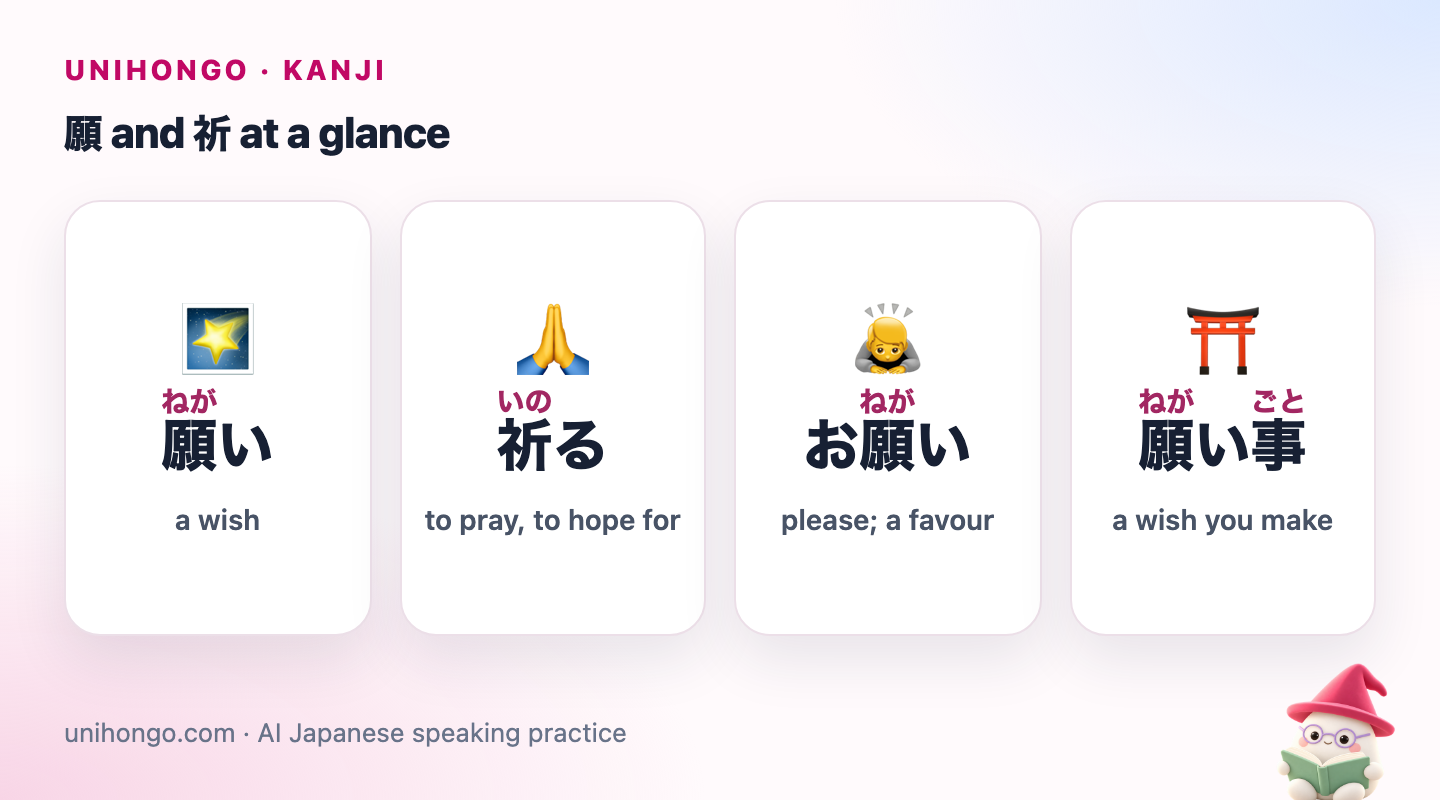
| Japanese | Romaji | Meaning |
|---|---|---|
| 願い | negai | a wish |
| 祈る | inoru | to pray, to hope for |
| お願い | onegai | please; a favour |
| 願い事 | negaigoto | a wish you make |
Readings, stroke counts and parts
| Kanji | Strokes | On'yomi | Kun'yomi | Core meaning |
|---|---|---|---|---|
| 願 | 19 | gan | negau | to wish, to request |
| 祈 | 8 | ki | inoru | to pray |
| 叶 | 5 | kyō (rare) | kanau, kanaeru | to come true, to grant |
願 has 19 strokes, which makes it one of the heavier everyday kanji. On the left is 原 (origin, field), read gen, which is usually explained as the part that gives 願 its similar sound, gan. On the right is 頁, a component meaning head, found in kanji such as 顔 (face) and 頭 (head). A memory picture: a wish that starts deep in your head.
祈 has only eight strokes. On the left is 礻, the altar radical, a squeezed form of 示, which appears in many kanji connected with gods and ceremonies: 神 (god), 社 (shrine), 祝 (to celebrate) and 礼 (bow, thanks). On the right is 斤, originally an axe. When you see 礻, think of a shrine.
叶 is not a wish kanji itself, but you need it: 叶う (kanau) is what a wish does when it comes true, and 叶える (kanaeru) is to make it come true. You will see it in songs, ads and New Year messages.
Words built on 願
願 covers a wide range, from the most ordinary request to a lifelong dream and official applications. The reading gan appears in the formal compounds.
| Japanese | Romaji | Meaning |
|---|---|---|
| 願う | negau | to wish for, to hope |
| 願いが叶う | negai ga kanau | a wish comes true |
| 念願 | nengan | a long-cherished wish |
| 願望 | ganbō | desire, wish |
| 志願 | shigan | volunteering, applying |
| 願書 | gansho | application form (school) |
| 念願のマイホームを買いました。 | Nengan no maihōmu o kaimashita. | We finally bought the home we'd dreamed of. |
| 一生のお願い! | Isshō no onegai! | Please, just this once! (casual, playful) |
念願 is the word for a wish you have held for years, and 念願の is a common way to introduce it: 念願の日本旅行, the trip to Japan I'd always wanted. 願書 is the form you submit to apply for a school or a university, and 出願 (shutsugan) is the act of applying.
一生のお願い, literally the favour of a lifetime, is what children and friends say when they want something badly, often for something small. It is playful and casual, never for work.
Words built on 祈 and polite wishes for others
祈 words are about hoping for something good, often for another person, and they are common in formal messages. In business Japanese, a sentence ending in お祈りしております is a standard, warm way to close a letter.
| Japanese | Romaji | Meaning |
|---|---|---|
| 祈り | inori | a prayer |
| 祈願 | kigan | a prayer for something specific |
| 合格祈願 | gōkaku kigan | praying to pass an exam |
| ご成功をお祈りしています。 | Goseikō o oinori shite imasu. | I wish you every success. (polite) |
| ご冥福をお祈りいたします。 | Gomeifuku o oinori itashimasu. | May they rest in peace. (condolence) |
| 無事を祈ってるよ。 | Buji o inotteru yo. | I'm praying you'll be safe. (casual) |
Job hunters in Japan joke about お祈りメール, prayer emails. Rejection letters often end with 今後のご活躍をお祈り申し上げます, we pray for your future success, so receiving a prayer from a company has come to mean you did not get the job. The phrase itself is sincere and polite, and you can use it in your own formal messages.
ご冥福をお祈りいたします is used for someone who has died, in messages to the family or at a funeral. It is Buddhist in origin, so some families of other faiths may prefer a different phrase, such as 心よりお悔やみ申し上げます, my heartfelt condolences.
願う or 祈る: which verb to use
The two verbs overlap, but a few clear tendencies help you choose. Think about who controls the outcome and who you are hoping for.
| Japanese | Romaji | Meaning |
|---|---|---|
| 世界の平和を願っています。 | Sekai no heiwa o negatte imasu. | I wish for world peace. |
| 早く良くなるように祈ってるね。 | Hayaku yoku naru yō ni inotteru ne. | I'm praying you get better soon. (casual) |
| 合格しますように。 | Gōkaku shimasu yō ni. | May I pass the exam. |
| 願いが叶いますように。 | Negai ga kanaimasu yō ni. | May my wish come true. |
| Point | 願う (negau) | 祈る (inoru) |
|---|---|---|
| Basic idea | To want, to wish for, to request | To pray, to hope beyond your control |
| Directed at | A person or the world in general | Gods, the universe, fate |
| Typical object | Your own dream, a request to someone | Someone else's safety, success or recovery |
| Everyday form | お願いします, 願い事 | 祈ってる, お祈りしています |
The pattern ますように, may it be that, is how wishes are phrased at shrines and on wish strips. It uses the polite verb form, even when you are wishing alone, and it sounds gentle and hopeful. You can also say it for someone else: 素敵な一年になりますように, may it be a wonderful year.
Mini dialogue: making a wish at a shrine
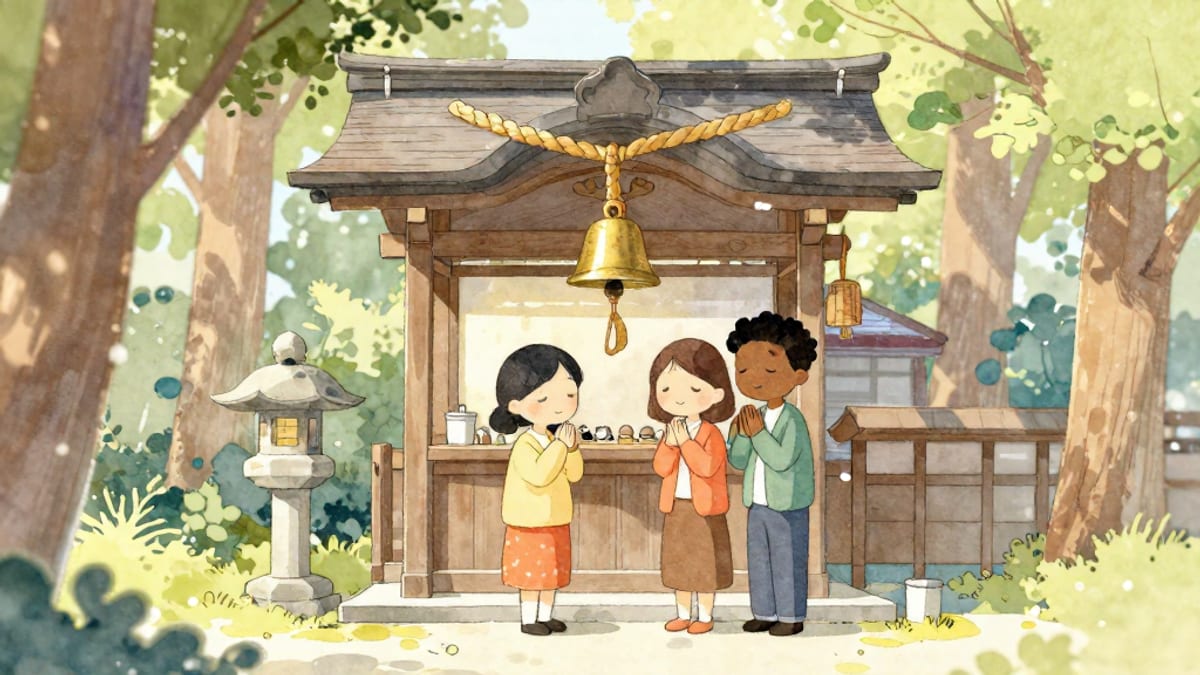
At most shrines, people throw a coin into the offering box, bow twice, clap twice, make their wish silently and bow once more. Some shrines have their own customs and show them on a board, so follow what you see. Here two friends talk before praying. The speech is casual.
| Japanese | Romaji | Meaning |
|---|---|---|
| 何をお願いするの? | Nani o onegai suru no? | Friend: What are you going to wish for? |
| 日本語の試験に合格しますように、かな。 | Nihongo no shiken ni gōkaku shimasu yō ni, kana. | You: To pass my Japanese exam, I think. |
| じゃあ、ここは合格祈願で有名だから、ちょうどいいね。 | Jā, koko wa gōkaku kigan de yūmei da kara, chōdo ii ne. | Friend: This shrine's known for exam prayers, perfect. |
| お守りも買おうかな。 | Omamori mo kaō kana. | You: Maybe I'll buy a charm too. |
| うん。願い事は人に言わないほうが叶うって言うよ。 | Un. Negaigoto wa hito ni iwanai hō ga kanau tte iu yo. | Friend: People say a wish comes true if you keep it secret. |
Notice that at a shrine, the verb is often お願いする, not 祈る: people speak of asking the gods for something. The idea that a wish works better if you keep it secret is a popular belief rather than a rule, and many people happily share theirs.
Wishes also have their seasons. On Tanabata, the star festival held on 7 July in many places and in August in some regions, people write wishes on colourful paper strips called 短冊 (tanzaku) and hang them on bamboo. At shrines, many visitors write wishes on wooden plaques called 絵馬 (ema). And anyone who sees a 流れ星 (nagareboshi), a shooting star, may try to make a wish before it disappears.
願 or 祈 as a tattoo or design
A single 願 or 祈 can look unfinished to Japanese eyes, because in daily writing both are almost always part of a word: 願い, お願い, 祈る, 祈り. Alone, 願 may read as request or application as much as dream, and 祈 as pray rather than prayer. That is not wrong, but a word usually feels more complete.
Good choices include 願い (a wish), 祈り (a prayer) and 念願 (a long-held wish). Avoid お願い unless you want the design to say please. Check the form, too: simplified Chinese writes 願 as 愿, and a design copied from a Chinese source may use that character, while 祈 is the same in both languages.
In given names, both kanji are uncommon, though 祈 occasionally appears in girls' names such as Inori. Before you ink or print anything, ask a native speaker to check the exact characters, the stroke shapes and the font. 願 has 19 strokes, and small slips in the 原 or 頁 parts are common in hand-drawn designs.
| Japanese | Romaji | Meaning |
|---|---|---|
| 祈りを込めて | inori o komete | with a prayer, wishing you well |
| 夢が叶う | yume ga kanau | a dream comes true |
Turn your own wishes into Japanese with Mocchi
Type /grammar ますように and Mocchi explains the wish pattern with examples at your level, then asks you to write three wishes of your own. It corrects them, tells you whether 願う or 祈る fits each one and keeps the forms you struggled with for a later /review.
Before your next shrine visit, rehearse out loud. In AI Sensei, ask Sakura-sensei to play a friend at the shrine: explain how to pray, share what you wish for and buy a charm, then check the session report for any phrase that came out wrong.
Common mistakes and how to write 願
- Confusing 願 with 顔 (kao, face). Both have 頁 on the right; 願 has 原 on the left and 顔 has 彦.
- Confusing 祈 with 析 (seki, analysis, as in 分析) or 折 (oru, to fold). 祈 has the altar radical 礻; 析 has 木 (tree) and 折 has the hand radical 扌.
- Writing 礻 as 衤. The clothing radical 衤 has one extra short stroke; it appears in 初 and 複, not in 祈.
- Saying 試験に合格したいように. The wish pattern uses the polite form: 合格しますように.
- Using 祈る for a simple request. You お願いする a colleague for help; you 祈る for their success.