

Joy and love: 楽 喜 幸 愛 恋 笑
Start with the pleasant ones. 楽 is the most versatile: tanoshii, fun, is what you say about a party or a trip; tanoshimu is to enjoy, and tanoshimi ni shite imasu, I am looking forward to it, is one of the most useful sentences in the language. Read raku it means easy or comfortable, and read gaku it means music. 喜 yorokobu, to be glad, and its noun yorokobi, joy, are a step more formal than ureshii, and 喜んで, yorokonde, means gladly when you accept an invitation.
幸 is shiawase, happiness as a state of life, and kō in 幸運 kōun, good luck, and 幸福 kōfuku, well-being. 愛 ai is love, and aisuru is to love; the character has a heart in the middle. 恋 koi is romantic love, with the heart at the bottom, and koi o suru means to fall in love. 笑 warau is to laugh or smile, with the bamboo radical on top, and egao, a smiling face, is written with it.
| Japanese | Romaji | Meaning |
|---|---|---|
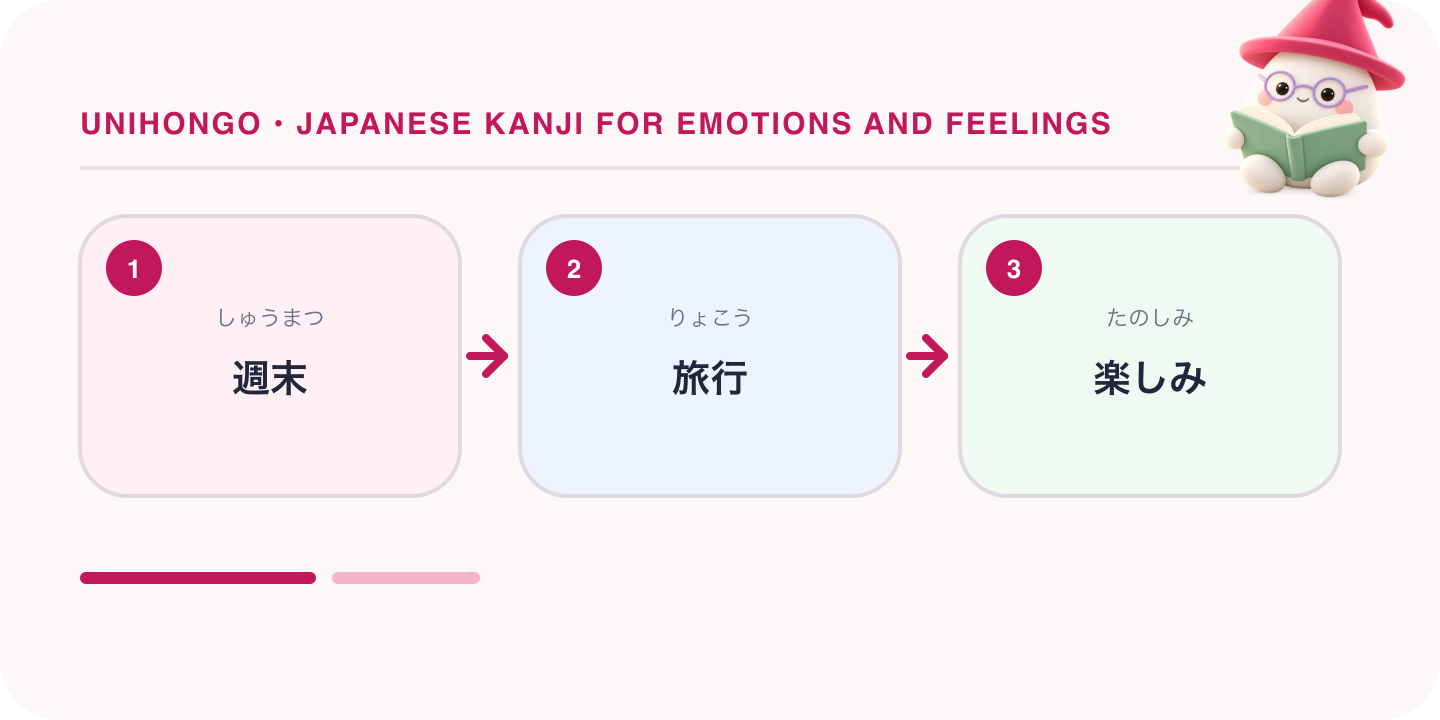
| 週末の旅行を楽しみにしています。 | Shūmatsu no ryokō o tanoshimi ni shite imasu. | I am looking forward to the weekend trip. |
| 合格して、本当に嬉しいです。 | Gōkaku shite, hontō ni ureshii desu. | I passed, and I am really happy. |
| 喜んで参加します。 | Yorokonde sanka shimasu. | I will gladly take part. |
| 家族といると幸せです。 | Kazoku to iru to shiawase desu. | I am happy when I am with my family. |
| 彼女の笑顔が好きです。 | Kanojo no egao ga suki desu. | I like her smile. |
| Kanji | Reading | Meaning |
|---|---|---|
| 楽 | gaku, raku, tano(shii) | fun, easy, music; tanoshii, raku, ongaku |
| 喜 | ki, yoroko(bu) | joy; yorokobu (be glad), yorokobi (delight) |
| 幸 | kō, shiawa(se), saiwa(i) | happiness; shiawase, kōun (good luck) |
| 愛 | ai | love; ai, aisuru, aijō (affection) |
| 恋 | ren, koi | romantic love; koi, koibito (partner), ren'ai (romance) |
| 笑 | shō, wara(u), e(mu) | laugh, smile; warau, egao (smile), bishō (faint smile) |
| 安 | an, yasu(i) | peace, cheap; anshin (relief), fuan (anxiety), yasui |
| 心 | shin, kokoro | heart, mind; kokoro, anshin, shinpai (worry) |
Sadness and anger: 悲 泣 怒 苦
悲 kanashii is sad, with the heart at the bottom under a shape meaning not or wrong: the heart going wrong. The verb kanashimu is to grieve, and 悲しみ kanashimi is sorrow. 泣 naku is to cry, with the water radical for tears, and it is a different word from the 鳴く naku that animals do. 泣き虫 nakimushi is a crybaby, and 泣ける nakeru describes a film that makes you cry.
怒 okoru is to get angry, and the polite way to say it is okotte imasu, they are angry, rather than the blunt adjective. Ikari is the noun anger, and 怒鳴る donaru is to shout in anger. 苦 has two lives: kurushii is painful or hard to bear, nigai is bitter to the taste, and the on reading ku appears in 苦労 kurō, hardship, and 苦手 nigate, something you are bad at or dislike. Nigate is the polite way to say you dislike something without saying kirai.
| Japanese | Romaji | Meaning |
|---|---|---|
| 映画の最後で泣いてしまいました。 | Eiga no saigo de naite shimaimashita. | I ended up crying at the end of the film. |
| 猫が死んで、とても悲しいです。 | Neko ga shinde, totemo kanashii desu. | My cat died and I am very sad. |
| 部長は今、怒っています。 | Buchō wa ima, okotte imasu. | The department head is angry right now. |
| 朝早く起きるのは苦手です。 | Asa hayaku okiru no wa nigate desu. | I am not good at getting up early. |
| このコーヒーは苦いです。 | Kono kōhī wa nigai desu. | This coffee is bitter. |
Fear, worry and calm: 怖 安 心
怖 kowai is scary, with the squeezed heart on the left. It is also used for I am scared, so kowai desu can mean either the ghost is scary or I am frightened, and context decides. Kowagaru is to be afraid, the -garu form you use about other people, and 恐怖 kyōfu is terror in the formal sense.
安 is peace and ease, and its everyday adjective yasui means cheap, but in feeling words it keeps its older sense: 安心 anshin is relief or peace of mind, 不安 fuan is anxiety, and 安全 anzen is safety. 心 kokoro is the heart and mind, and it anchors the feeling compounds: 心配 shinpai, worry; 安心 anshin; 心から kokoro kara, from the heart. Shinpai shinaide, do not worry, is a sentence you will hear often.
| Japanese | Romaji | Meaning |
|---|---|---|
| 夜の道は少し怖いです。 | Yoru no michi wa sukoshi kowai desu. | The road at night is a bit scary. |
| 連絡がなくて心配しました。 | Renraku ga nakute shinpai shimashita. | I was worried because there was no contact. |
| 無事に着いて安心しました。 | Buji ni tsuite anshin shimashita. | I was relieved to arrive safely. |
| 初めての仕事で不安です。 | Hajimete no shigoto de fuan desu. | I am anxious because it is my first job. |
| 心配しないでください。 | Shinpai shinaide kudasai. | Please do not worry. |
Feeling in the abstract: 感 情
感 kanjiru is to feel, and it builds the nouns for sensation: 感じ kanji, a feeling or impression, which sounds the same as the word for kanji characters; 感動 kandō, being moved; 感謝 kansha, gratitude; and 感想 kansō, impressions, which is what a teacher asks for after a film. Ii kanji, nice feeling, is everyday praise for a place, a person or a design.
情 jō is emotion or the state of things, and it appears in 感情 kanjō, emotion, 愛情 aijō, affection, and 情報 jōhō, information, where the meaning has drifted to news of the situation. The kun reading nasake is compassion, and nasakenai, literally without compassion, is the word for pathetic or shameful, usually said about yourself.
| Japanese | Romaji | Meaning |
|---|---|---|
| この映画にとても感動しました。 | Kono eiga ni totemo kandō shimashita. | I was very moved by this film. |
| 感想を聞かせてください。 | Kansō o kikasete kudasai. | Please tell me your impressions. |
| 感情を言葉にするのは難しいです。 | Kanjō o kotoba ni suru no wa muzukashii desu. | It is hard to put emotions into words. |
| 皆さんに心から感謝しています。 | Minasan ni kokoro kara kansha shite imasu. | I am grateful to everyone from the bottom of my heart. |
| Kanji | Reading | Meaning |
|---|---|---|
| 悲 | hi, kana(shii) | sad; kanashii, kanashimu (grieve), higeki (tragedy) |
| 泣 | kyū, na(ku) | cry; naku, nakimushi (crybaby) |
| 怒 | do, oko(ru), ika(ru) | anger; okoru (get angry), ikari (anger) |
| 苦 | ku, kuru(shii), niga(i) | suffering, bitter; kurushii, nigai, nigate |
| 怖 | fu, kowa(i) | scary; kowai, kowagaru, kyōfu (terror) |
| 感 | kan, kan(jiru) | feel; kanjiru, kandō (moved), kansha (thanks) |
| 情 | jō, nasa(ke) | emotion; kanjō (feeling), jōhō (information) |
Adjective, verb and noun from one kanji
The payoff of learning feeling kanji is that one character gives you a whole family. The okurigana tells you the part of speech, and the -sō and -garu endings let you talk about other people without claiming to read their minds.
- 楽: tanoshii (adjective), tanoshimu (verb), tanoshimi (noun), tanoshisō (looks fun)
- 悲: kanashii, kanashimu, kanashimi, kanashisō and kanashigaru (shows sadness)
- 喜: yorokobu (verb), yorokobi (noun), yorokobashii (adjective, formal)
- 怒: okoru (verb), ikari (noun), okorippoi (quick-tempered)
- 苦: kurushii and nigai (adjectives), kurushimu (verb), kurushimi (noun)
- 怖: kowai (adjective), kowagaru (verb for others), kowasa (noun, scariness)
- 愛: aisuru (verb), aijō (noun), itoshii (adjective, beloved, literary)
- 笑: warau (verb), warai (noun), egao (smiling face), okashii (funny, different kanji)
The politeness rule is simple: plain adjectives for your own feelings, -sō or -garu for other people's. Watashi wa kanashii desu, I am sad; kare wa kanashisō desu, he looks sad. Stating another adult's feelings as fact sounds presumptuous.
Where you meet these kanji
Feeling kanji are the language of song titles, adverts and messages, so you meet them far more often outside the classroom than inside it.
- Song and film titles: 愛, 恋, 涙 and 笑顔 appear constantly; 恋人 and 愛してる are lyric staples
- Adverts and packaging: 安心 for safety and reliability, 楽しい for family products, 幸せ for food and weddings
- Messages and cards: 感謝 on thank-you notes, お幸せに on wedding cards, 楽しみにしています at the end of an email
- Health questionnaires: 不安 anxiety, 心配 worry, 苦しい pain, 悲しい low mood
- Signs and manners posters: 安全 safety, 怒鳴らない no shouting, 笑顔で with a smile
- Emoji labels and stickers: 嬉しい, 悲しい, 怒り and 泣き on sticker packs teach the set for free
Look-alike kanji and reading traps
Several feeling kanji share a heart or a top with an unrelated character, and a few readings change meaning entirely. Check these pairs.
| Japanese | Romaji | Meaning |
|---|---|---|
| 楽は、楽しいと楽と音楽で読み方が違います。 | Raku wa, tanoshii to raku to ongaku de yomikata ga chigaimasu. | The kanji raku is read differently in fun, easy and music. |
| 泣くと鳴くは同じ音ですが、漢字が違います。 | Naku to naku wa onaji oto desu ga, kanji ga chigaimasu. | Cry and an animal's cry sound the same but use different kanji. |
- 喜 joy and 嬉 glad: 嬉 is 喜 with the woman radical; ureshii uses 嬉, yorokobu uses 喜
- 悲 sad and 非 not: 悲 adds the heart; 非 alone is the negative prefix, as in 非常口, emergency exit
- 怒 anger and 努 effort: same top; heart below for anger, strength below for effort, as in 努力
- 苦 bitter and 若 young: same grass radical; 苦 has 古 old below, 若 has 右 right below
- 怖 scary and 布 cloth: 怖 is the squeezed heart plus 布, so fear is cloth over the heart
- 泣 cry and 立 stand: 泣 is 立 with the water radical; tears standing in the eyes
- 楽 raku and gaku, 苦 kurushii and nigai, 幸 shiawase and saiwai: one kanji, different words
A three-week study plan
Fifteen feeling kanji become a working vocabulary when you use them about your own life. Ten to fifteen minutes a day, with speaking every day, is enough.
- Week 1: joy and love. Learn 楽 喜 幸 愛 恋 笑, then write three sentences about what made you happy this week using tanoshii, ureshii and shiawase correctly
- Week 2: sadness, anger and fear. Learn 悲 泣 怒 苦 怖 安 心, and write a short diary entry for a bad day using kanashii, okotte, kowai and fuan
- Week 3: abstract words and other people. Learn 感 情, then describe a friend or a character in a drama using -sō and -garu forms
- Every day: five minutes in Unihongo's free learning games on this set, then say aloud how you feel today and why
By the end of the third week you should be able to answer genki desu ka with something better than genki desu. That is the real test: a feeling, a reason and the right level of politeness.