
Child, mood, hat and a lost kid: 子 in four words
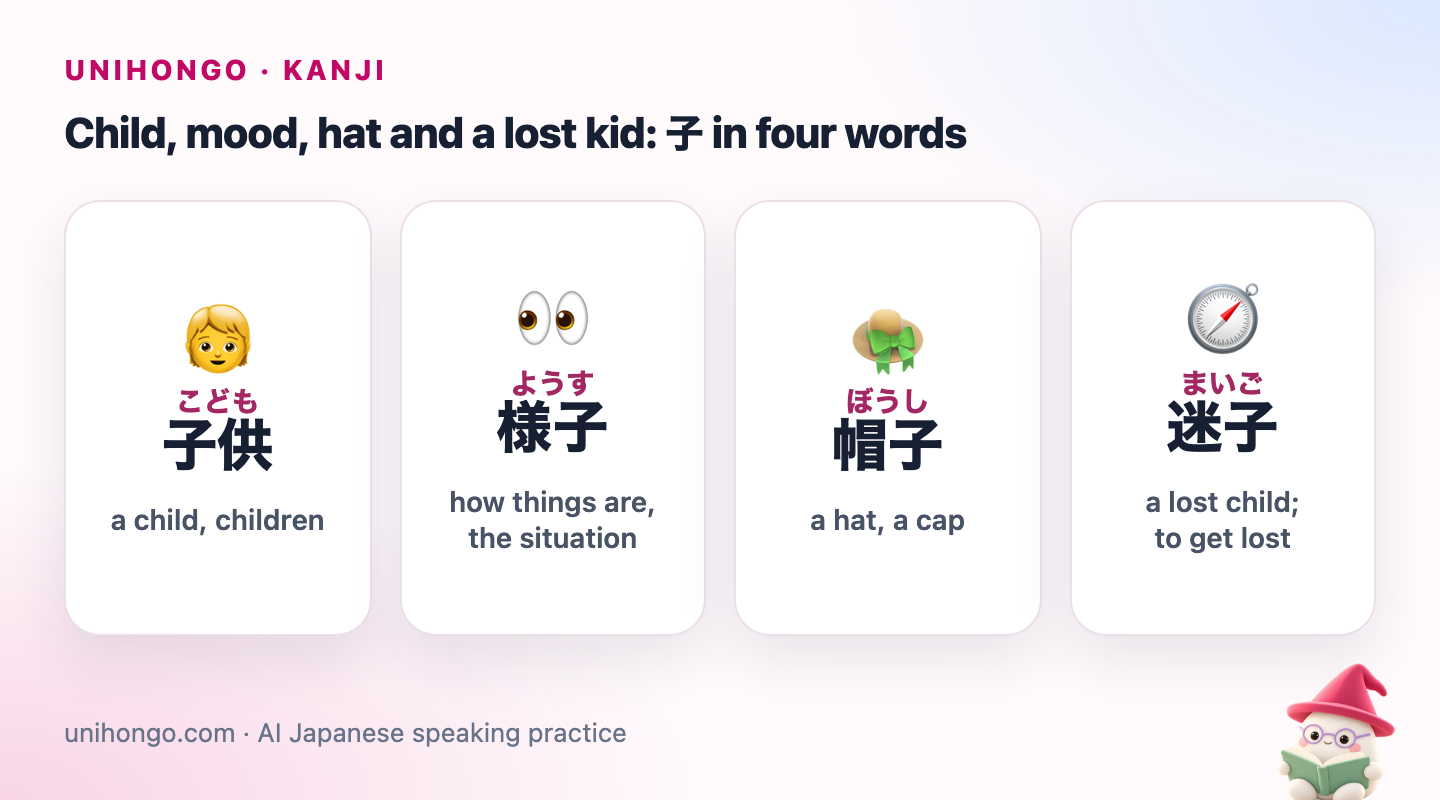
子 means child, but these four words show its two personalities. In the first and last, it really is a child. In the middle two, it is a suffix that turns up in everyday objects and ideas, which is why so many learners are surprised to see it in the word for a hat.
| Japanese | Romaji | Meaning |
|---|---|---|
| 子供 | kodomo | a child, children |
| 様子 | yōsu | how things are, the situation |
| 帽子 | bōshi | a hat, a cap |
| 迷子 | maigo | a lost child; to get lost |
Readings and stroke order of 子
子 has three strokes and is a pictograph, usually described as a baby wrapped in swaddling, with a large head on top and arms stretched out. It is not built from smaller parts, but it appears inside many other kanji, such as 字 (character), 学 (study) and 好 (to like).
The readings are ko, the native word for child, and two on'yomi, shi and su. Shi is common in compounds; su appears in a handful of very common words that you simply have to learn.
| Reading type | Reading | When it is used | Example |
|---|---|---|---|
| kun'yomi | ko | child, and native words | 子供, kodomo; 息子, musuko, son |
| kun'yomi (after another word) | go | with a sound change | 双子, futago; 迷子, maigo |
| on'yomi | shi | most compounds | 帽子, bōshi; 女子, joshi, girls, women |
| on'yomi | su | a few fixed words | 様子, yōsu; 椅子, isu, chair |
| zodiac reading | ne | the traditional zodiac | 子年, nedoshi, Year of the Rat |
Family words and things with 子
These fifteen words are split into two groups. The first is about children and family. The second contains words where 子 has nothing to do with children, but which you will use every week.
| Japanese | Romaji | Meaning |
|---|---|---|
| 息子 | musuko | a son |
| 双子 | futago | twins |
| 親子 | oyako | parent and child |
| 子育て | kosodate | raising children |
| 弟子 | deshi | an apprentice, a disciple |
| 女の子 | onna no ko | a girl |
| 男の子 | otoko no ko | a boy |
| お菓子 | okashi | sweets, snacks |
| 椅子 | isu | a chair |
| 調子 | chōshi | condition, how something is going |
| 扇子 | sensu | a folding fan |
| 餃子 | gyōza | dumplings |
| 電子レンジ | denshi renji | a microwave oven |
| 調子はどう? | Chōshi wa dō? | How's it going? (casual) |
| 親子丼をください。 | Oyakodon o kudasai. | The chicken and egg bowl, please. |
Oyakodon, parent-and-child bowl, is chicken and egg simmered together on rice; the name is a gentle joke about the chicken and its egg sharing a bowl. Chōshi, condition, is everywhere: chōshi ga ii (going well), chōshi ga warui (not working well, or not feeling well), and chōshi ni noru (to get carried away). Gyōza has a special reading, za, that you will not find in other words.
子供, 子ども, お子さん or 児?
Japanese has several ways to say child, and choosing the right one is mostly about politeness and whose child you mean. Kodomo is the general word, and it works for one child or many; add tachi for clearly plural children. For your own children, say kodomo or the warm uchi no ko, our kid. For someone else's children, say okosan, or the very polite okosama in shops and formal settings. Asking anata no kodomo sounds blunt.
児 (ji) is a more formal kanji for child that appears in official and medical words. You see it in 児童 (jidō, schoolchildren), 育児 (ikuji, childcare) and 小児科 (shōnika, paediatrics), where it is read ni.
| Japanese | Romaji | Meaning |
|---|---|---|
| お子さんは何歳ですか? | Okosan wa nan-sai desu ka? | How old are your children? (polite) |
| うちの子は五歳です。 | Uchi no ko wa go-sai desu. | Our kid is five. |
| 育児休暇 | ikuji kyūka | parental leave |
| Word | Use | Example |
|---|---|---|
| 子供・子ども (kodomo) | child in general, your own | kodomo ga futari imasu, I have two children |
| うちの子 (uchi no ko) | your own, warm and casual | uchi no ko, mada go-sai nan desu |
| お子さん (okosan) | someone else's, polite | okosan wa nan-sai desu ka? |
| お子様 (okosama) | very polite, shops and services | okosama ranchi, a kids' meal |
| 児 (ji, ni) | formal and official words | 児童, jidō; 小児科, shōnika |
Kodomo also covers adult children. A parent of a 30-year-old can still say kodomo wa Tōkyō de hataraite imasu, my child works in Tokyo. And children's meals in family restaurants are often called okosama ranchi, the polite customer's child lunch.
At nursery pick-up: a polite dialogue
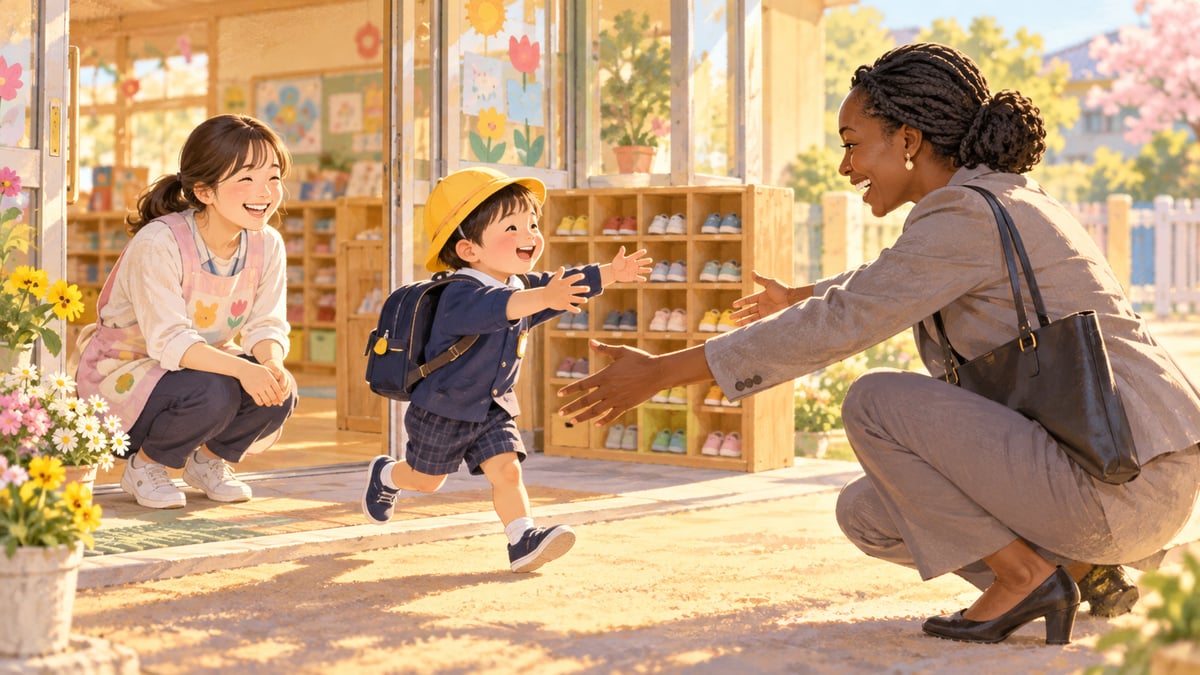
If you have a child at a Japanese nursery, hoikuen, the pick-up is a daily conversation with the teacher. It is short, polite and friendly, and yōsu, how things went, is the key word. Teachers often use gentle polite speech with parents and casual speech with the children.
| Japanese | Romaji | Meaning |
|---|---|---|
| お迎えに来ました。 | Omukae ni kimashita. | Parent: I've come to pick him up. |
| ケンくん、お迎えが来たよ! | Ken-kun, omukae ga kita yo! | Teacher: Ken, someone's here for you! |
| 今日の様子はどうでしたか? | Kyō no yōsu wa dō deshita ka? | Parent: How was he today? |
| 元気に外で遊んでいましたよ。 | Genki ni soto de asonde imashita yo. | Teacher: He played happily outside. |
| よかったです。少し咳が出ていたので。 | Yokatta desu. Sukoshi seki ga dete ita node. | Parent: Good. He had a bit of a cough. |
| 今日は大丈夫そうでしたよ。 | Kyō wa daijōbu sō deshita yo. | Teacher: He seemed fine today. |
| 帽子、忘れないでくださいね。 | Bōshi, wasurenaide kudasai ne. | Teacher: Don't forget his hat. |
| 先生、さようなら! | Sensei, sayōnara! | Child: Bye-bye, teacher! |
Names ending in -ko, idioms and the zodiac Rat
For much of the twentieth century, a huge number of Japanese girls' names ended in 子 (ko): Hanako, the classic textbook name, Yōko, Keiko, Michiko. Many parents today choose other endings, but -ko names are still given and remain very familiar. In these names, 子 simply means child and adds a gentle, traditional feel.
In the traditional Chinese zodiac used in Japan, 子 is also the first sign, the Rat, read ne. You see it in 子年 (nedoshi, Year of the Rat), on New Year cards in those years and in old ways of telling time.
| Japanese | Romaji | Meaning |
|---|---|---|
| 花子 | Hanako | Hanako (a classic girl's name) |
| 蛙の子は蛙 | kaeru no ko wa kaeru | like parent, like child |
| 三つ子の魂百まで | mitsugo no tamashii hyaku made | character formed early lasts for life |
| 寝る子は育つ | neru ko wa sodatsu | children who sleep well grow well |
| 子供っぽい | kodomoppoi | childish |
Kaeru no ko wa kaeru, a frog's child is a frog, means children turn out like their parents, sometimes as a compliment and sometimes as a sigh. Mitsugo no tamashii hyaku made, the soul of a three-year-old lasts until a hundred, says early character stays for life; here mitsugo means a three-year-old, not triplets. Kodomoppoi, childish, is usually a mild criticism, so be careful using it about adults.
子 in tattoos and designs
Many parents want a tattoo or design that honours their children. A single 子 is rarely the best way to do it.
- A lone 子 reads as child, but many Japanese readers will also think of the end of a woman's name, or the Rat of the zodiac.
- Your children's names, written in katakana or in kanji chosen with a native speaker, are usually more personal and meaningful.
- 親子 (oyako, parent and child) or 家族 (kazoku, family) express the bond clearly.
- Chinese and Japanese use 子 a little differently. In Chinese, 子 also means son and appears in honorific names for ancient thinkers, and the everyday word for child is 孩子, so a Chinese reader may read a lone 子 differently.
- Ask a native speaker to check the characters and stroke order, especially the hook on the vertical stroke.
Look-alikes: 了, 予, 字 and 好
子 is small and simple, so it has close cousins. 了 (ryō, finished) is 子 without the horizontal line. 予 (yo, in advance) adds a small shape on top. Under a roof, 子 becomes 字 (ji, a character), and beside 女 it becomes 好 (to like).
| Japanese | Romaji | Meaning |
|---|---|---|
| 終了 | shūryō | finished, closed |
| 予約 | yoyaku | a reservation |
| 漢字 | kanji | kanji, Chinese characters |
| 好き | suki | liked, to like |
- Reading 様子 as yōshi. It is yōsu.
- Saying anata no kodomo to a stranger. Say okosan.
- Thinking 帽子 or 椅子 have something to do with children. Here 子 is only a suffix.
- Writing the horizontal stroke of 子 before the vertical. The horizontal comes last.
Practise the nursery pick-up chat, step by step
Start with Mocchi. Sign in and ask: Explain kodomo, uchi no ko, okosan and okosama, then quiz me on which one to use. Mocchi gives you short situations to answer, notes the ones you get wrong and folds them into your study plan, so they come back in a later review.
Then rehearse the real moment. Open AI Sensei, choose Haru-sensei and ask for a nursery teacher roleplay at pick-up time. Ask how the day went, mention a cough or a missing hat, and say goodbye. You can ask the Sensei to speak more slowly, and the session report shows which polite phrases you used well.