
A separate system
Name readings are not a subset of ordinary kanji readings. Characters take readings in names that appear nowhere else in the language, and the choice among possible readings belongs to the family rather than to a rule.
This is why the problem cannot be solved by learning more kanji. A reader who knows every character in a name still may not know how it is said, and that is the normal condition rather than a gap in knowledge.
The common family names
A relatively small set of family names accounts for a large share of people, which means learning a few dozen covers most of the names you meet.
These are worth knowing on sight, since they recur constantly in workplaces, on forms and in the news.
| Japanese | Romaji | Meaning |
|---|---|---|
| 佐藤 | Satō | Among the most common |
| 鈴木 | Suzuki | Very common |
| 高橋 | Takahashi | Very common |
| 田中 | Tanaka | Very common |
| 渡辺 | Watanabe | Common, several spellings exist |
| 伊藤 | Itō | Common |
Several of these contain long vowels that learners shorten. Getting the length right matters more with names than with ordinary words.
Asking, and recording
Asking how a name is read is routine and is best done at the first meeting, when it is entirely unremarkable. The awkward version is asking after several months of guessing.
The step people skip is recording the answer. Writing the characters without the reading leaves you unable to say the name later, which is the actual problem.
| Japanese | Romaji | Meaning |
|---|---|---|
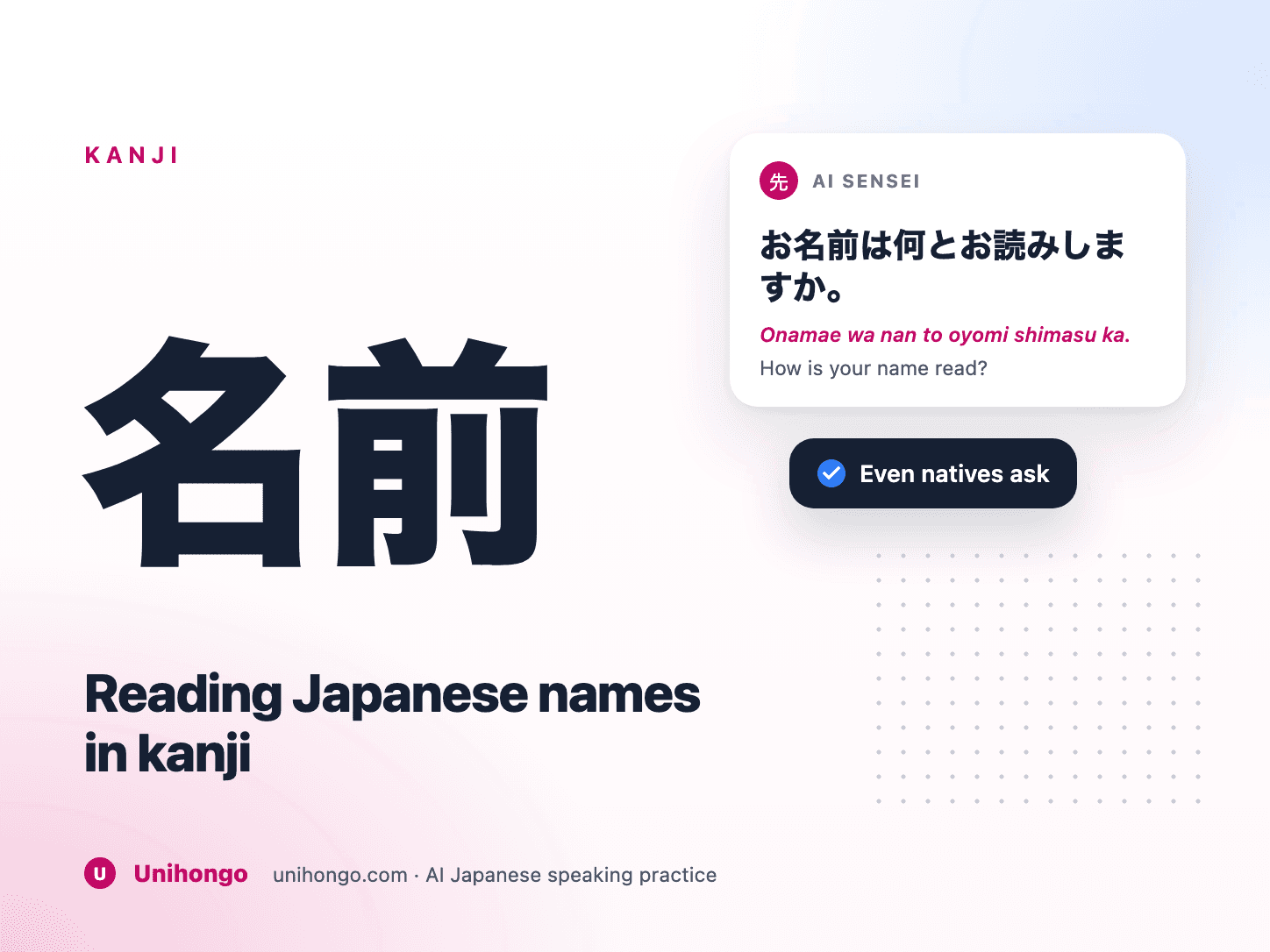
| お名前は何とお読みしますか。 | Onamae wa nan to oyomi shimasu ka. | How is your name read? |
| 失礼ですが、読み方を教えてください。 | Shitsurei desu ga, yomikata o oshiete kudasai. | Excuse me, please tell me the reading. |
| たなかさんでよろしいですか。 | Tanaka-san de yoroshii desu ka. | Is it Tanaka? |
| 珍しいお名前ですね。 | Mezurashii onamae desu ne. | That is an unusual name. |
| ふりがなをお願いできますか。 | Furigana o onegai dekimasu ka. | Could I have the reading in kana? |
| 間違えていたら、すみません。 | Machigaete itara, sumimasen. | I am sorry if I had it wrong. |
Given names are harder
Family names are constrained by convention and repetition; given names are not. Parents choose readings with considerable freedom, and the same characters may be read in ways that appear in no dictionary.
In practice this matters less than it sounds, because you will usually use family names at work and will learn given names from people directly.
- Family names repeat and can be learned; given names often cannot.
- Use the family name plus san unless invited otherwise.
- Ask for the reading of a given name rather than guessing.
- Business cards print the reading; keep the card.
- Email signatures often include it too.
Names on forms and documents
Japanese forms almost always have a field for the reading of a name, written above or beside the field for the characters. It exists because the characters alone are insufficient, and filling it in is required rather than optional.
For a foreign resident the same applies in reverse: your name in katakana is the reading, and it needs to be consistent across every document.
| Japanese | Romaji | Meaning |
|---|---|---|
| ふりがな | furigana | The reading field, in hiragana |
| フリガナ | furigana | The reading field, in katakana |
| 氏名 | shimei | Full name |
| 姓 | sei | Family name |
| 名 | mei | Given name |
| 旧姓 | kyūsei | Former surname |
Which script the reading field wants is shown by the script the label itself is written in. That is the convention and it is easy to miss.
What to actually do
The practical approach is to stop treating name reading as a knowledge problem and treat it as an information-gathering one. Learn the common family names so most cases are covered, and ask about the rest.
Record every reading you are given, next to the characters, in whatever system you use for contacts. That single habit resolves the problem permanently, whereas studying more kanji does not.
For the common names, the length matters. Several contain long vowels that learners shorten, and a shortened name is more noticeable than a shortened ordinary word.
Getting someone's name right is worth more socially than most of the Japanese you will study this month. It is a small effort with a disproportionate return.