
The kanji for courage at a glance
The single kanji is 勇. It means brave, courageous, in high spirits. In modern Japanese it rarely stands alone; it lives inside words. The four cards below show the most useful ones: the noun 勇気, the phrase 勇気を出す, the adjective 勇ましい, and 度胸, the earthy word for nerve.
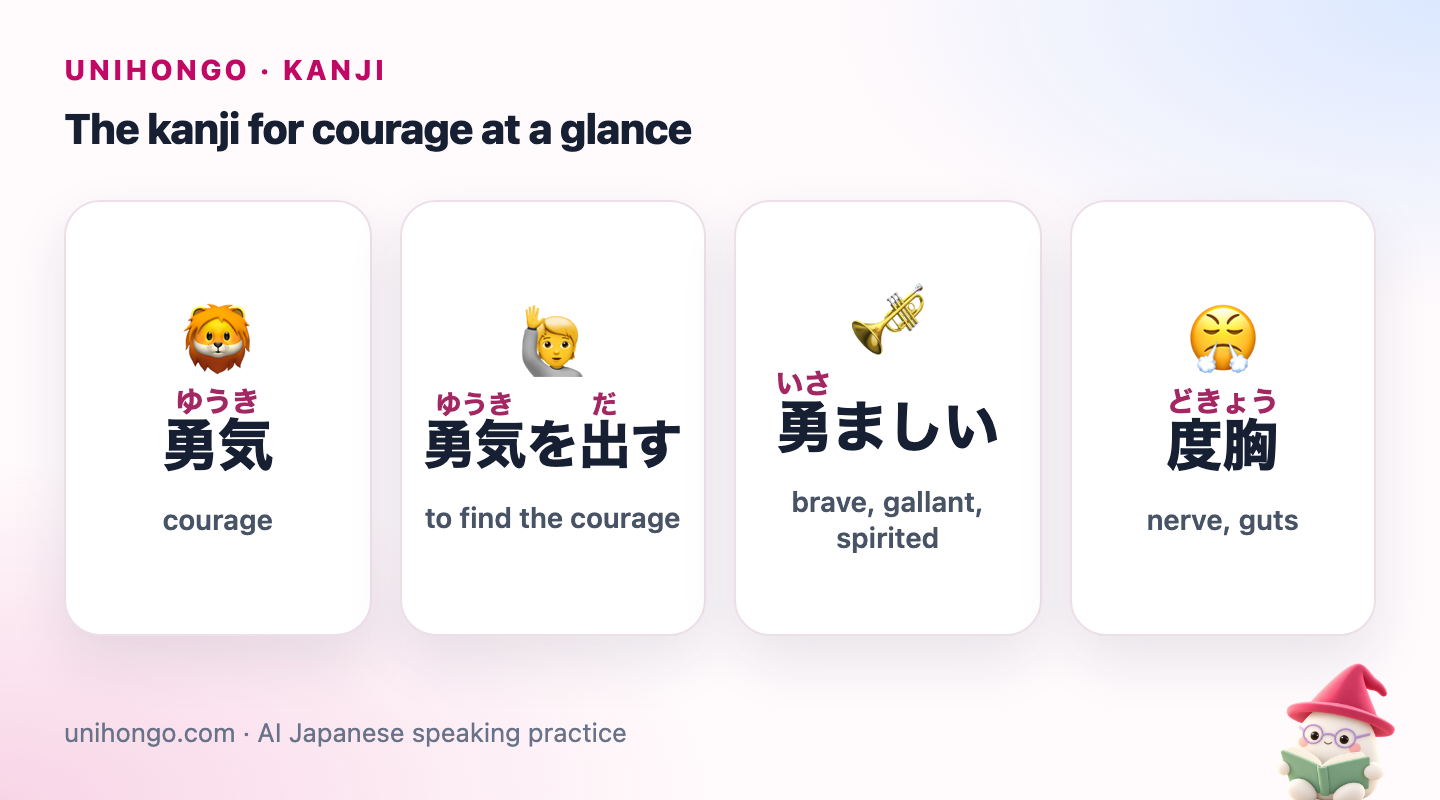
| Japanese | Romaji | Meaning |
|---|---|---|
| 勇気 | yūki | courage |
| 勇気を出す | yūki o dasu | to find the courage |
| 勇ましい | isamashii | brave, gallant, spirited |
| 度胸 | dokyō | nerve, guts |
Readings, strokes and parts of 勇
| Kanji | Strokes | On'yomi | Kun'yomi | Core meaning |
|---|---|---|---|---|
| 勇 | 9 | yū | isamu (isamashii) | brave, courage, spirited |
| 気 | 6 | ki, ke | none in common use | spirit, mind, air, energy |
勇 has nine strokes. Its bottom part is 力, power or effort, which is easy to spot and a good memory hook: courage is a kind of strength. The top part looks like マ over 田 in many fonts. In everyday words the reading is almost always yū; the kun reading isamu survives in the adjective 勇ましい and in the verb 勇む, to be in high spirits, which is literary.
気 is the kanji of spirit and energy, found in 元気 (healthy, lively) and 天気 (weather). 勇気 is literally brave spirit, which is a neat summary of what courage is.
Everyday words with 勇
| Japanese | Romaji | Meaning |
|---|---|---|
| 勇気がある | yūki ga aru | to be brave, to have courage |
| 勇気がない | yūki ga nai | to lack the courage |
| 勇気づける | yūkizukeru | to encourage, to give courage |
| 勇気をもらう | yūki o morau | to be encouraged by someone |
| 勇者 | yūsha | a hero, a brave one (common in games) |
| 勇敢 | yūkan | brave, heroic (formal, news) |
| 勇姿 | yūshi | a gallant figure, a proud sight |
| 武勇伝 | buyūden | tales of past exploits, often joking |
| 思い切って | omoikitte | plucking up courage, boldly |
| 度胸がある | dokyō ga aru | to have nerve |
勇気をもらう is very common and very Japanese: people say they received courage from a song, a team or a friend's words. 勇者 is the word for the hero in many role-playing games, so younger speakers may smile when they hear it. 武勇伝 is often used with a grin, for stories of wild nights or bold things done when young.
思い切って deserves special attention, because it is how Japanese people describe most everyday courage. 思い切って聞いてみた (I plucked up the courage and asked) and 思い切って髪を切った (I took the plunge and cut my hair short) both sound natural; 勇気 would sound too dramatic for a haircut.
勇気, 度胸 and 勇ましい: different kinds of brave
| Japanese | Romaji | Meaning |
|---|---|---|
| 勇気を出して告白した。 | Yūki o dashite kokuhaku shita. | I found the courage to confess my feelings. |
| 人前で話すには度胸がいる。 | Hitomae de hanasu ni wa dokyō ga iru. | Speaking in public takes nerve. |
| 勇ましい音楽ですね。 | Isamashii ongaku desu ne. | That's stirring, heroic music. |
| その言葉に勇気をもらいました。 | Sono kotoba ni yūki o moraimashita. | Those words gave me courage. |
| Word | Feeling | Typical situation | Register |
|---|---|---|---|
| 勇気 | Courage, moral bravery | Apologising first, speaking up, confessing feelings | Neutral, everyday |
| 度胸 | Nerve, cool under pressure | A stage, an exam, a risky business decision | Casual, sometimes teasing |
| 勇ましい | Gallant, bold, spirited | A marching band, warriors, a brave look | Slightly literary |
| 勇敢 | Heroic | A rescue reported in the news | Formal, written |
When not to use them: 勇ましい sounds odd for a quiet act such as apologising; use 勇気がある. 勇敢 is too grand for daily life and sounds like a newspaper. 度胸がある said to a superior can sound cheeky, so keep it for friends.
勇 in names, and a look-alike to avoid
勇 is popular in boys' names because of its meaning. Isamu can be written 勇 alone, and 勇 appears in names such as Yūta (勇太), Yūto (勇人) and Yūki (勇気). Remember that names can be read many ways: some families read 勇人 as Hayato, and Yūki has many other spellings with different kanji.
The classic look-alike is 男 (otoko, man). Both kanji end in 力, and 男 has 田 above it. 勇 has an extra piece on top, so it is taller. If you read 男気 (otokogi, chivalry, manly spirit) and 勇気 side by side, look at the top first.
| Japanese | Romaji | Meaning |
|---|---|---|
| 勇 | Isamu | brave · boy |
| 勇太 | Yūta | brave and big · boy |
| 男気 | otokogi | chivalrous spirit |
Mini dialogue: courage before a speech
Courage words come up most before something scary: a speech, a presentation, a first date. Here a nervous learner talks to a Japanese friend before giving a short speech at a community event.

| Japanese | Romaji | Meaning |
|---|---|---|
| 緊張してきた…。 | Kinchō shite kita… | You: I'm getting nervous… |
| 大丈夫、勇気を出して! | Daijōbu, yūki o dashite! | Friend: You'll be fine, be brave! |
| 日本語でスピーチなんて、度胸がいるよ。 | Nihongo de supīchi nante, dokyō ga iru yo. | You: A speech in Japanese takes real nerve. |
| その勇気がすごいよ。 | Sono yūki ga sugoi yo. | Friend: That courage is amazing. |
| ありがとう。勇気をもらった。 | Arigatō. Yūki o moratta. | You: Thanks. That gave me courage. |
Notice that the friend praises the courage itself, その勇気がすごい, rather than the speech. Praising effort and nerve before the result is a natural, kind move in Japanese, and you can use it whenever a friend tries something new.
勇 or 勇気 as a tattoo or design
勇 often appears in lists of samurai virtues, many of which trace back to Nitobe Inazō's book Bushido, written in English in 1900. That is why it is popular in Western designs. To Japanese readers, 勇 alone reads as brave, but it can also look like a name (Isamu) or a word lifted from such a list.
勇気 is clearer: it is the everyday word for courage and reads naturally on a print or a tattoo. The meaning is the same in Chinese, where courage is written 勇气 with a simplified second character, so check which form your design uses. Decide on Japanese or Chinese on purpose, and have a native speaker check the characters before you ink anything.
A five-minute courage routine with Mocchi
- Ask Mocchi: Explain the difference between yūki, dokyō and isamashii, with a situation for each. Mocchi explains, then checks your answers.
- Write one sentence about a brave moment in your life and send it with /correct. Mocchi corrects it, explains why, and remembers the pattern you got wrong.
- Type /kaiwa and ask for a speaking topic about facing a fear; Mocchi sends you to AI Sensei, where Hana-sensei can play a friend you tell the story to.
Common mistakes and how to write 勇
- Saying 勇気な人. 勇気 is a noun, so say 勇気がある人, a brave person.
- Using 勇ましい for a shy friend who spoke up. It means gallant and bold in a showy way; say 勇気があるね instead.
- Confusing 勇 with 男, which shares the 力 at the bottom.
- Using 勇敢 in casual chat, where it sounds like a news report.