
The dragon kanji at a glance: 竜, 龍 and 辰
Japanese has one dragon character written in two ways, plus a zodiac sign. 竜 is the form on the official list of kanji for general use, so it is the one you see in textbooks, newspapers and science books. 龍 is the traditional form. It has sixteen strokes instead of ten and looks more dramatic, which is exactly why families, temples, restaurants and artists often choose it.
The third character, 辰, is not really a picture of a dragon at all. It is one of the twelve earthly branches used for the zodiac, and it only means dragon in that system. Keep these three apart and most dragon questions answer themselves.
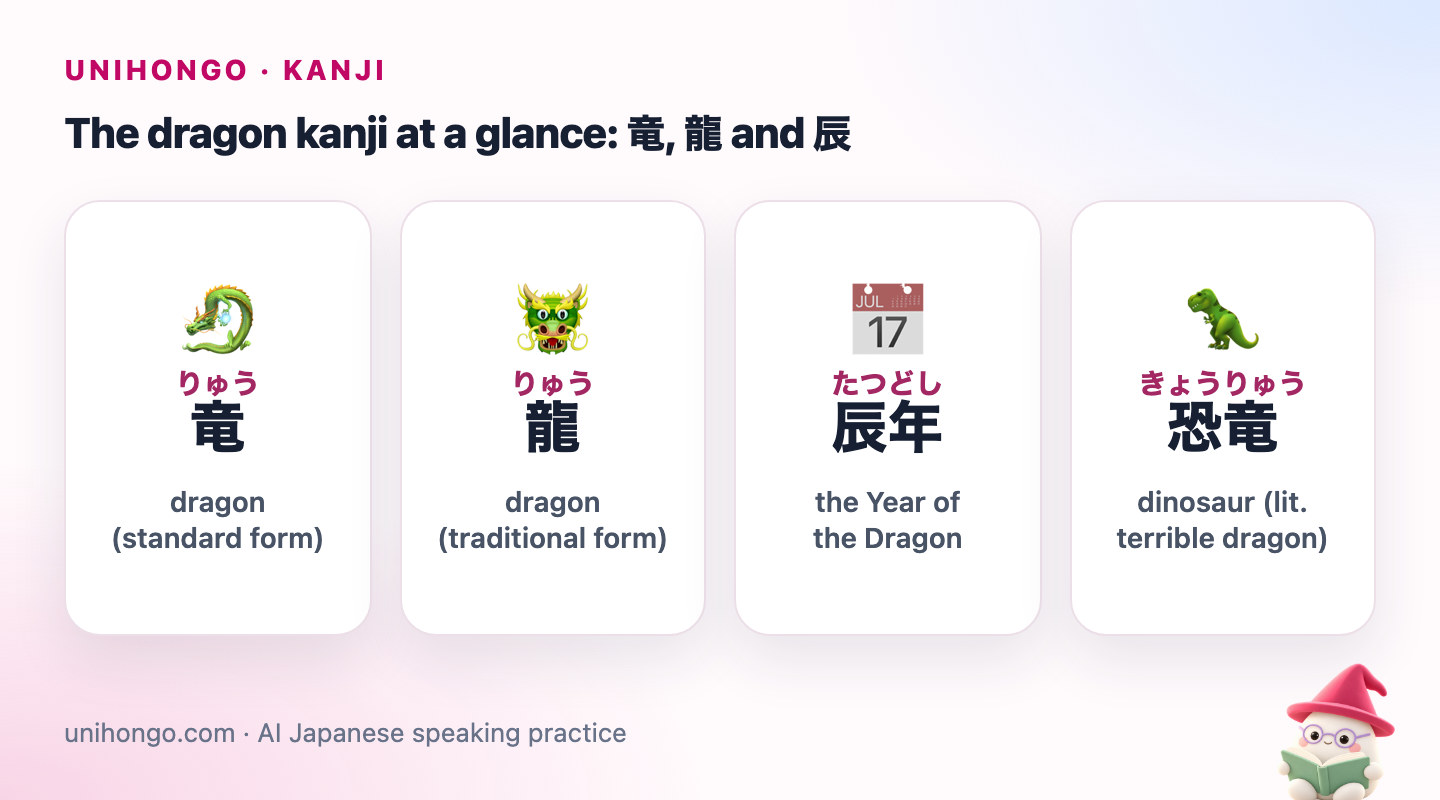
| Japanese | Romaji | Meaning |
|---|---|---|
| 竜 | ryū | dragon (standard form) |
| 龍 | ryū | dragon (traditional form) |
| 辰年 | tatsudoshi | the Year of the Dragon |
| 恐竜 | kyōryū | dinosaur (lit. terrible dragon) |
Readings, stroke counts and how 竜 is built
The two dragon forms share their readings. The on'yomi, borrowed from Chinese, is ryū; it appears in nearly all compound words. The kun'yomi, the native Japanese word, is tatsu. A rarer on'yomi, ryō, survives in a few set phrases such as 画竜点睛, which you will meet below.
| Kanji | On'yomi | Kun'yomi | Strokes | Typical use |
|---|---|---|---|---|
| 竜 | ryū (rarely ryō) | tatsu | 10 | Standard writing, science, everyday words |
| 龍 | ryū (rarely ryō) | tatsu | 16 | Names, temples, art, shop names |
| 辰 | shin | tatsu | 7 | Zodiac sign, some names |
竜 is not a modern shortcut invented in Japan. Dictionaries record it as an old variant of 龍, and Japan adopted it as the standard form. It is made of 立 on top, the same shape as in 立つ, to stand, and a lower part that ends in a long hooked tail. Do not read too much into the parts: in this character they are better treated as shapes than as a story.
Chinese uses yet another form. Traditional Chinese writes 龍, the same as the Japanese traditional form, while simplified Chinese, used in mainland China, writes 龙. If you see 龙 on a design, it was made with Chinese in mind; a Japanese reader will recognise it but it does not look Japanese.
Everyday Japanese words with the dragon kanji
Most people meet the dragon kanji long before they meet a dragon story. Children learn 恐竜 from picture books, weather reports mention 竜巻, and aquariums label seahorses with a dragon name. Notice how compounds take ryū and native words take tatsu.
| Japanese | Romaji | Meaning |
|---|---|---|
| 竜巻 | tatsumaki | tornado (lit. dragon roll) |
| 竜宮城 | Ryūgūjō | the Dragon Palace under the sea, from a folk tale |
| 竜神 | ryūjin | dragon god, often linked to water and rain |
| 竜の落とし子 | tatsu no otoshigo | seahorse (lit. the dragon's lost child) |
| 青竜 | seiryū | the Azure Dragon, guardian of the east |
| 昇り竜 | noboriryū | a dragon rising to the sky |
| 竜骨 | ryūkotsu | the keel of a ship |
| 恐竜が好きです。 | Kyōryū ga suki desu. | I like dinosaurs. |
| 竜巻注意情報が出ています。 | Tatsumaki chūi jōhō ga dete imasu. | A tornado warning has been issued. |
Dragon idioms, set phrases and names
Several four-character idioms use the dragon, and they show up in speeches, school essays and business writing. 登竜門 is by far the most common: a contest or job that opens the door to a career is called the 登竜門 of that field. 画竜点睛 is the classic way to say the finishing touch, and it is famously misread; the dragon here is ryō, not ryū. 竜頭蛇尾 describes a plan that starts with a bang and ends with a whimper.
In names, 龍 and 竜 are popular for boys because they suggest strength and good fortune. You will meet names such as Ryūnosuke and Tatsuya, and the same sound can be written either way, so always check how a person spells their own name.
| Japanese | Romaji | Meaning |
|---|---|---|
| 登竜門 | tōryūmon | a gateway to success |
| 画竜点睛 | garyō tensei | the finishing touch |
| 竜頭蛇尾 | ryūtō dabi | a strong start and a weak finish |
| 竜虎 | ryūko | dragon and tiger: two equal rivals |
| 龍之介 | Ryūnosuke | boy's name with the traditional dragon |
| 竜也 | Tatsuya | boy's name read with tatsu |
| この賞は若手作家の登竜門です。 | Kono shō wa wakate sakka no tōryūmon desu. | This prize is the gateway for young writers. |
画竜点睛 is often used in the negative: 画竜点睛を欠く, garyō tensei o kaku, means missing the one detail that would have completed the work. It is formal and slightly literary, so use it in writing or a speech rather than with friends at a café.
Where you meet dragons in Japan
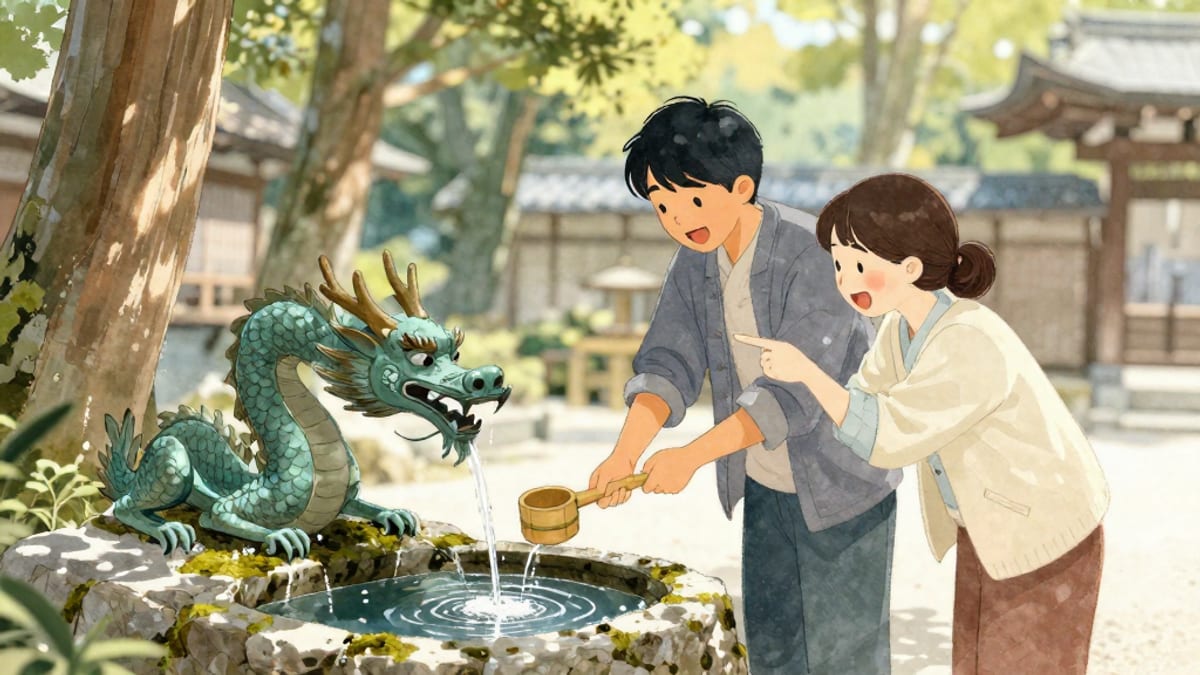
At many shrines and temples, water for rinsing your hands pours from the mouth of a bronze or stone dragon. Dragons are linked with water and rain, so they guard springs, rivers and basins. Some Zen temples have a large dragon painted on the ceiling of the lecture hall, and visitors often stand underneath and look up. Festivals in some regions also feature dragon dances or long dragon figures carried through the streets.
These are perfect places to use the vocabulary. Asking a friend or a guide about the dragon is a natural conversation opener, and people are usually happy to explain the local story.
| Japanese | Romaji | Meaning |
|---|---|---|
| あの竜は何ですか。 | Ano ryū wa nan desu ka. | You: What is that dragon? |
| 水の神様の使いだと言われています。 | Mizu no kamisama no tsukai da to iwarete imasu. | Friend: People say it is a messenger of the water god. |
| 天井の龍、すごい迫力ですね。 | Tenjō no ryū, sugoi hakuryoku desu ne. | You: The ceiling dragon is really powerful. |
| 私、実は辰年生まれなんです。 | Watashi, jitsu wa tatsudoshi umare nan desu. | You: Actually, I was born in the Year of the Dragon. |
| じゃあ、縁起がいいですね。 | Jā, engi ga ii desu ne. | Friend: Then that's a lucky sign. |
Look-alikes, common mistakes and how to write 竜
The dragon hides inside other kanji. 滝, taki, waterfall, is 竜 with the water radical on the left, which fits the old link between dragons and water. 龍 sits inside 襲, the kanji of 襲う, osou, to attack. If you see the dragon shape in a word, check the rest of the character before you decide the word is about dragons.
| Japanese | Romaji | Meaning |
|---|---|---|
| 滝 | taki | waterfall (water radical + 竜) |
| 襲う | osou | to attack (龍 on top of 衣) |
| 電 | den | electricity (its lower part looks like 竜's) |
- Writing 辰 when you mean the animal. 辰 belongs to the zodiac; for a dragon in a story, use 竜 or 龍.
- Reading 画竜点睛 as ga ryū ten sei. The accepted reading is garyō tensei.
- Mixing forms in one word, such as half traditional, half standard. Pick one form and keep it.
- Using simplified Chinese 龙 on something meant to look Japanese.
To write 竜, start with 立: a dot, a short horizontal line, two short strokes that lean inwards, and a long horizontal base. Then write the box-like shape below, and finish with the vertical stroke that bends right at the bottom and flicks up. That last stroke is one continuous line; draw it slowly and keep the tail level.
竜 or 龍 for a tattoo or design
A single dragon kanji is a popular design, and 龍 is usually the stronger choice visually: it fills a square beautifully and reads as dragon in Japanese, traditional Chinese, Korean hanja and older texts. 竜 looks more like ordinary print, a little like using a plain typeface. Neither is wrong.
A word often says more. 昇り竜, a rising dragon, carries the image of ambition and success. 龍神, dragon god, has a spiritual feel. 登竜門 is a phrase, not a personal symbol, so it reads oddly as a tattoo. A lone 辰 means the zodiac sign and nothing more, which is fine if you were born in a dragon year and want exactly that.
Calligraphy fonts change the details of each stroke, and machine-made designs sometimes merge or mirror parts. Show the final artwork to a native speaker, ideally one who writes with a brush, before you book the appointment.
Make the dragon kanji stick with Mocchi
Start by typing /kanji 龍 and then /kanji 竜 to Mocchi. You get the meaning, the readings and common words for each, and you can ask a follow-up such as which one would look right on a festival banner. Mocchi notes which readings you mix up and folds them into your plan, so ryū versus tatsu keeps returning until it is easy.
Then ask Mocchi to make flashcards for the dragon words in this guide with /create-flashcards. Pick a photo for each card, a tornado for 竜巻, a seahorse for 竜の落とし子, and review them with /review-flashcards; the cards you hesitate on come back sooner.