
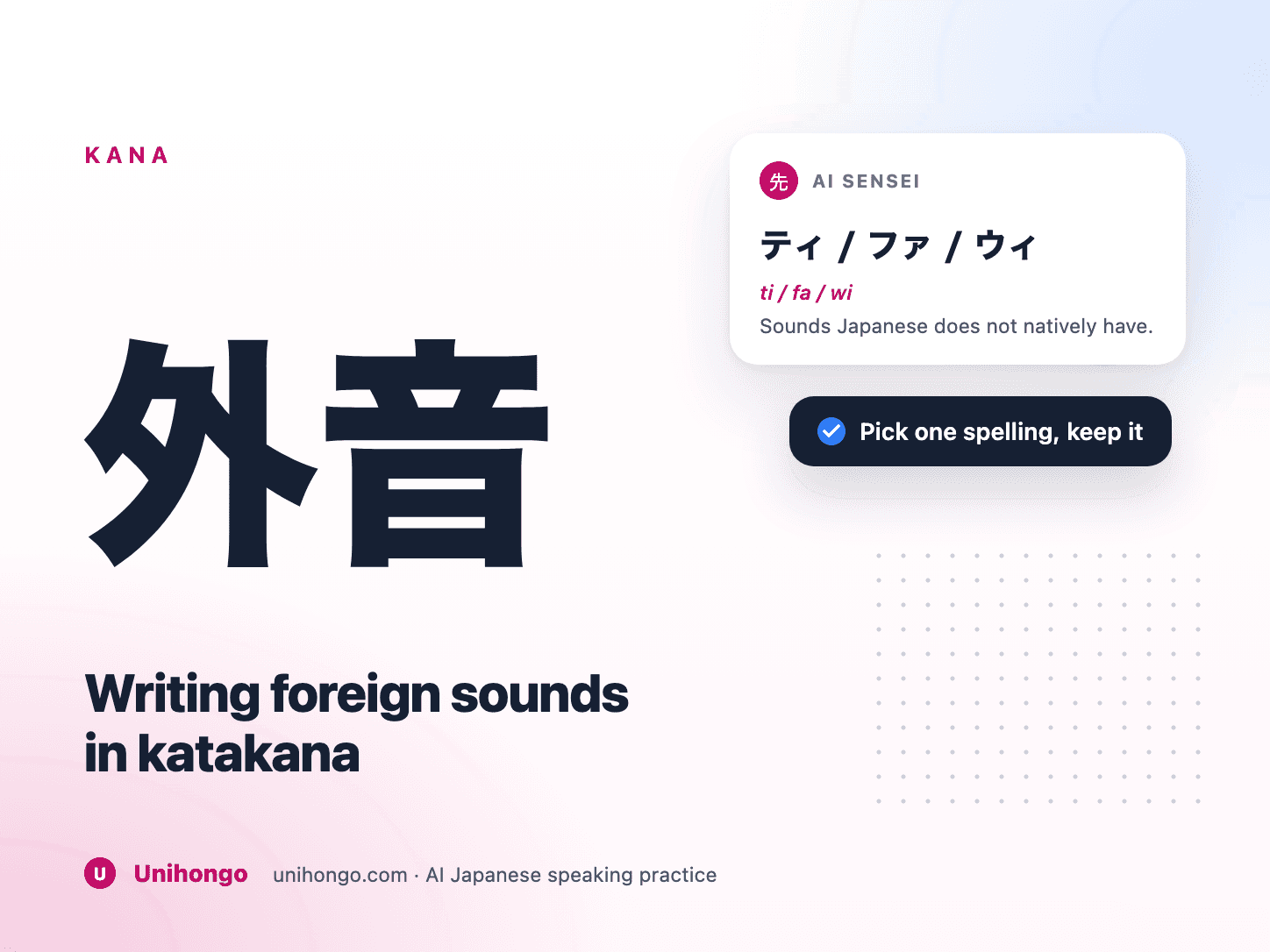
The extended combinations
These are formed the same way as the native combinations, by following a base character with a small vowel, but they use bases and pairings that hiragana does not.
They exist to write sounds Japanese lacks, and they appear constantly in loanwords, brand names and foreign personal names.
| Japanese | Romaji | Meaning |
|---|---|---|
| ティ | ti | As in party |
| ディ | di | As in disc |
| トゥ | tu | As in two |
| ファ | fa | As in fan |
| ウィ | wi | As in week |
| シェ | she | As in shell |
Each of these is one beat despite being written with two characters, which follows the same rule as the native combinations.
Sounds with no equivalent
Where no combination has been devised, a conventional substitution is used, and the substitutions are consistent enough to be predictable.
Knowing them lets you guess how an unfamiliar foreign word will be written, which is genuinely useful when reading brand names and technical terms.
| Foreign sound | Usually becomes | Note |
|---|---|---|
| th, unvoiced | s | Three, think |
| th, voiced | z | This, that |
| v | b | Or a dedicated character |
| l | r | No l exists in Japanese |
| si | shi | The si sound does not occur |
| Final consonant | Consonant plus u or o | Adds a beat |
The last row is why loanwords are longer than their originals. Every consonant that cannot end a syllable gets a vowel, and every added vowel is a beat.
The v question
Japanese has a dedicated way of writing v, using a character with a voicing mark, but in practice the b row is used far more often, particularly in words that entered the language earlier.
Both are correct and you will meet both. For your own name, pick one and stay with it.
| Japanese | Romaji | Meaning |
|---|---|---|
| バイオリン | baiorin | Violin, with b |
| ヴァイオリン | vaiorin | Violin, with the v character |
| ビデオ | bideo | Video, with b |
| ベトナム | Betonamu | Vietnam, with b |
| ヴィクトリア | Vikutoria | Victoria, with the v character |
| バン | ban | Van, with b |
The b spellings dominate in established words. The v character appears more in newer borrowings and in names where the writer wants to signal the original sound.
Rendering your own name
This matters practically, because your name in katakana will go on contracts, bank accounts, residence records and delivery labels, and those records are matched against each other.
Consistency is therefore more important than accuracy. Choose the closest reasonable approximation, write it down, and use exactly that spelling everywhere.
- Approximate each sound with the closest available kana or combination.
- Add a vowel after any consonant that cannot end a syllable.
- Use the middle dot between a given name and a surname.
- Write it down and photograph it, so you can show it at counters.
- Never vary it, even if a later spelling seems more accurate.
Saying it so it can be written
A foreign name pronounced in its original way is frequently not parseable to a Japanese listener, because the sounds and rhythm do not map onto Japanese moras. The version that gets recorded correctly is the katakana one, said in Japanese rhythm.
This feels like mispronouncing your own name and it is not. You are giving the listener a version they can hear and write.
| Japanese | Romaji | Meaning |
|---|---|---|
| カタカナで言いますね。 | Katakana de iimasu ne. | I will say it in katakana. |
| ゆっくり言います。 | Yukkuri iimasu. | I will say it slowly. |
| 書いたものをお見せします。 | Kaita mono o omise shimasu. | Let me show you it written down. |
| パスポートと同じつづりです。 | Pasupōto to onaji tsuzuri desu. | It is the same spelling as on my passport. |
| 中黒で区切ってください。 | Nakaguro de kugitte kudasai. | Please separate it with the middle dot. |
| 長いので、下の名前だけで大丈夫です。 | Nagai node, shita no namae dake de daijōbu desu. | It is long, so just my first name is fine. |
Reading unfamiliar loanwords
Once the substitutions are familiar, unfamiliar katakana becomes far more readable, because you can work backwards from the Japanese sounds to the original word.
The technique is to read the beats, drop the inserted vowels, and reverse the substitutions. Most loanwords resolve in a second or two with practice.
- Read the whole word by beats first, without guessing.
- Drop the vowels that were inserted after consonants.
- Reverse the substitutions: r may be l, b may be v, s may be th.
- Check whether the result is a word you know.
- If not, the word may be from another language or made in Japan.