
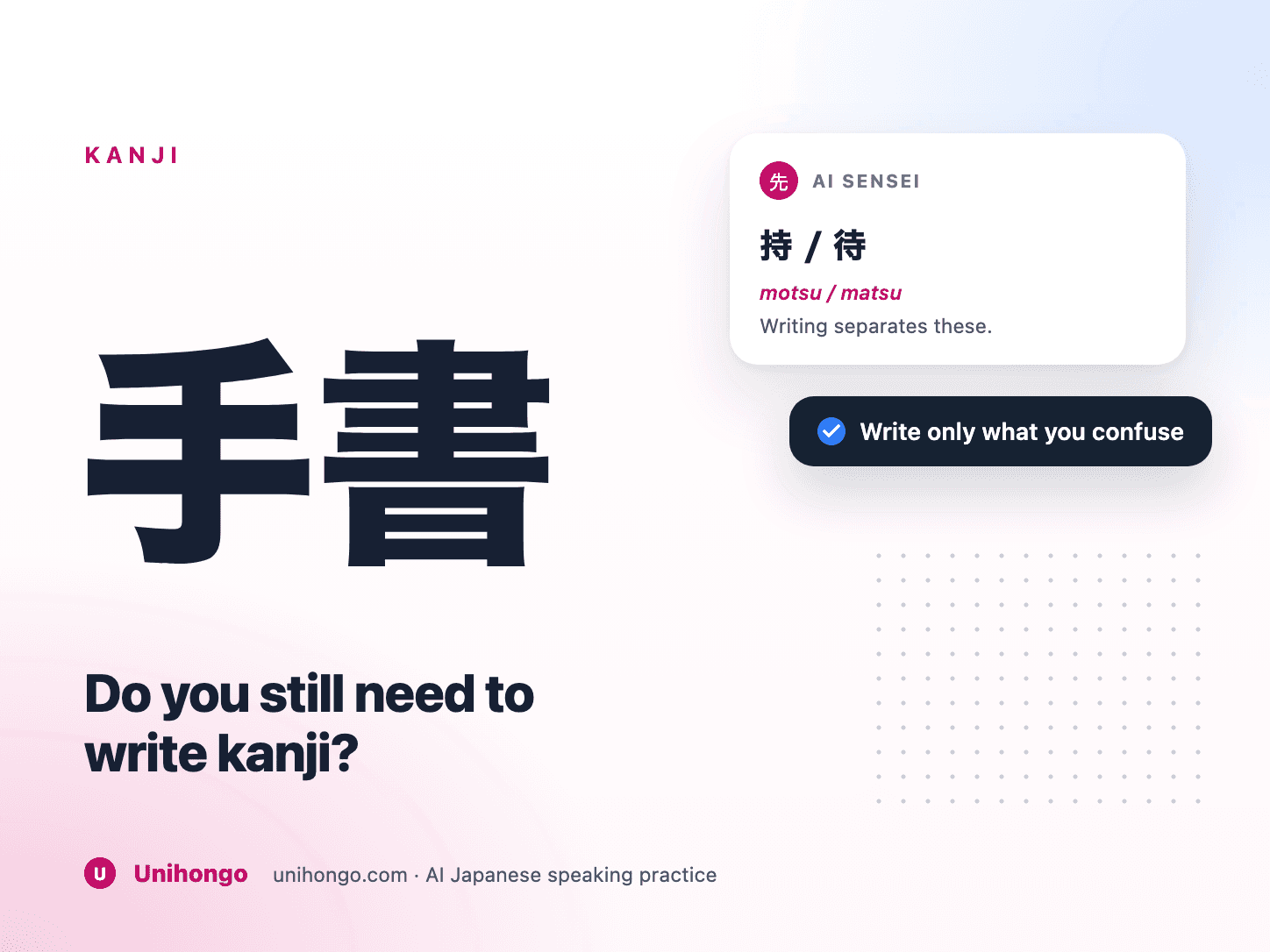
Recognition and recall are different
Typing Japanese requires recognising the right character from a list of candidates. Writing requires producing it from nothing. The second is a considerably stronger form of knowledge and considerably more expensive to build.
That gap is why a learner can read comfortably and be unable to write the same characters, which is an entirely normal state and not evidence of a gap in reading ability.
What writing is genuinely good for
The strongest argument for handwriting is not tradition; it is that writing forces you to attend to structure. Two characters that look similar are written differently, and producing them makes the difference explicit in a way that looking does not.
It also makes components visible, which feeds back into memory and lookup.
| Purpose | Writing helps? | Alternative |
|---|---|---|
| Separating similar characters | Strongly | None as effective |
| Learning components | Yes | Component study |
| Reading speed | Indirectly | Reading volume |
| Handwriting input accuracy | Yes | None |
| Passing forms and notes | Required | None |
| Producing any character on demand | Yes | Rarely needed |
The first and last rows are the extremes. The first is high value for modest effort; the last is high effort for a need that rarely arises.
What you will actually write
For most residents the handwriting that arises is narrow and predictable: your name, your address, dates and numbers, and a small number of set phrases on notes and envelopes.
Practising exactly those is a far smaller task than learning to write generally and covers the overwhelming majority of real situations.
- Your name, in katakana or kanji as appropriate.
- Your address, which appears on nearly every form.
- Numbers and dates, including formal numerals for amounts.
- Set phrases for thank-you notes and envelopes.
- Your employer's name, if forms ask for it often.
A middle path
The practical compromise most learners land on is to write selectively rather than systematically: characters that keep being confused, characters in words used daily, and the fixed list above.
This captures the disambiguation benefit without the enormous cost of full production, and it can be done in a few minutes at a time rather than as a separate study block.
- Write any pair you confuse, alternately, for a week.
- Write new characters once or twice when you learn them.
- Do not maintain writing for characters you only read.
- Use squared paper; it keeps proportions even without effort.
- Stop when the confusion is resolved rather than continuing indefinitely.
Stroke order matters more than beauty
Where you do write, the order matters more than the appearance. Handwriting input depends on it, components are built on it, and characters written in an invented order tend to come out unbalanced.
Nobody expects a learner's handwriting to be attractive. Legible and correctly ordered is the whole target.
- Top to bottom, left to right.
- Horizontal before vertical when strokes cross.
- Outside before inside; the enclosure closes last.
- Centre before symmetrical sides in some characters.
- Learn the order with the character rather than afterwards.
Deciding for yourself
The question is not whether handwriting is valuable but whether it is the best use of the hours it takes, and the answer depends on what you need Japanese for.
A learner whose goal is reading and conversation can reasonably skip systematic writing and do the selective version. A learner who works with paper forms, studies calligraphy or intends to take handwritten exams cannot.
For everyone, the selective version is worth doing, because separating confusable characters is a real benefit for a small cost and nothing else achieves it as quickly.
If you write nothing else by hand, write the pairs you confuse. That single habit resolves in a week what months of reading leaves unresolved.