
Fate in Japanese: four key words
Japanese does not have one word that covers all of fate. Instead, you choose by the kind of fate you mean. Is it a romantic destiny, a heavy burden, or a connection between people? The cards below show the four words to start with.
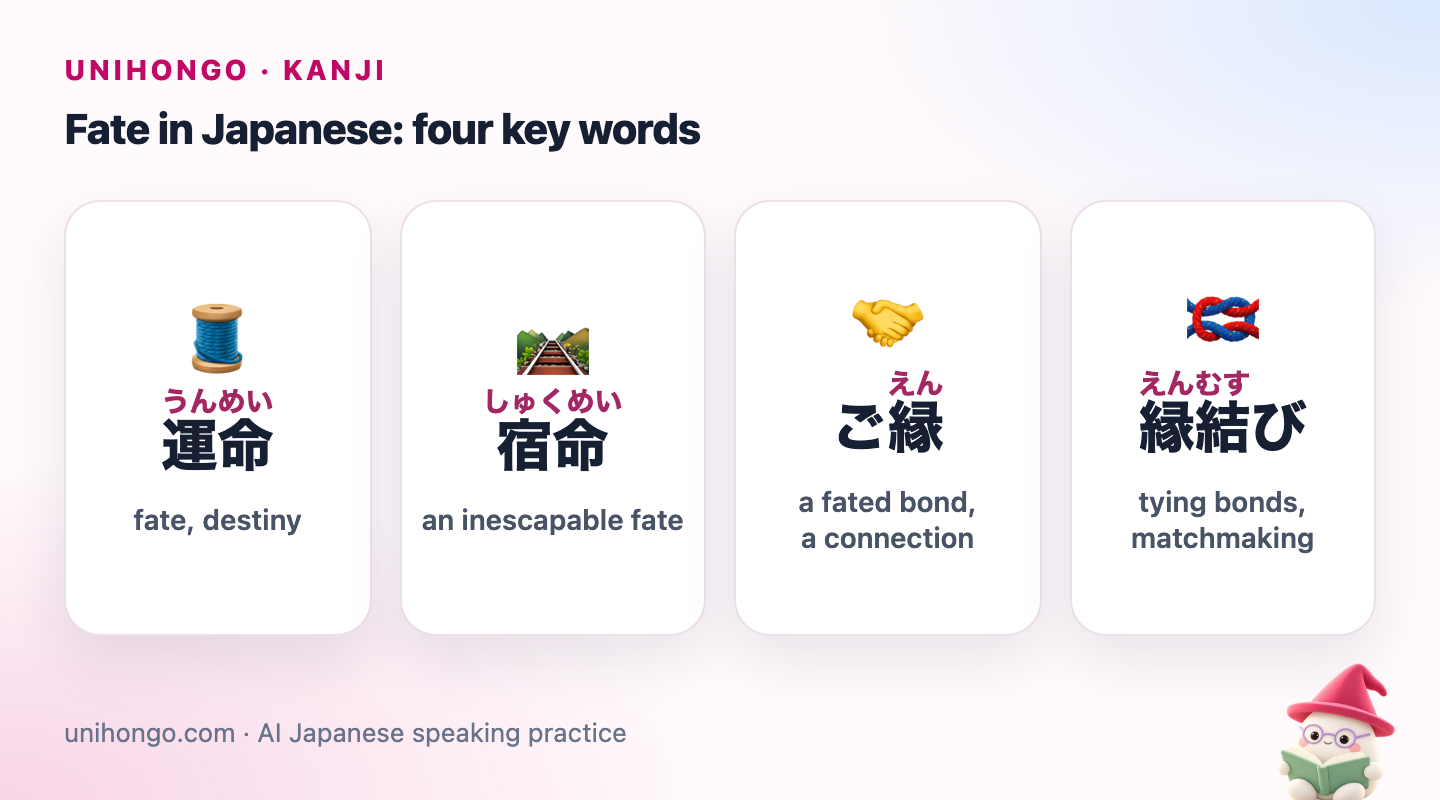
| Japanese | Romaji | Meaning |
|---|---|---|
| 運命 | unmei | fate, destiny |
| 宿命 | shukumei | an inescapable fate |
| ご縁 | goen | a fated bond, a connection |
| 縁結び | enmusubi | tying bonds, matchmaking |
In everyday conversation, 運命 and ご縁 are the two you will use. 宿命 belongs to dramatic stories, sports commentary and serious writing. Notice also that none of these words is a single kanji: Japanese builds the idea of fate from pairs, and 縁 is the only one that is often used alone, as en or goen.
The kanji behind fate: 運, 命, 宿 and 縁
運 combines 辶, the movement radical, with 軍. It means both luck (運がいい, lucky) and to carry (運ぶ, hakobu). 運命 can be read as the life that carries you along. 命 means life and also a command from above, so the word suggests a life course that is given.
宿 means an inn or lodging (宿, yado) and also to dwell inside something. 宿命 is the fate that lives in you from birth. 縁 has 糸, the thread radical, on the left, and its basic meaning is an edge or border, as in 縁 read fuchi, the rim of a cup. The thread radical fits its other meaning, a bond: connections are often imagined as threads in Japanese.
| Japanese | Romaji | Meaning |
|---|---|---|
| 運がいい | un ga ii | lucky |
| 運ぶ | hakobu | to carry |
| 縁 | fuchi | edge, rim |
| Kanji | Readings | Strokes | Core idea |
|---|---|---|---|
| 運 | un; hako(bu) | 12 | Luck; to carry |
| 命 | mei, myō; inochi | 8 | Life; a command |
| 宿 | shuku; yado | 11 | Lodging; to dwell in |
| 縁 | en; fuchi | 15 | Edge; a bond, a connection |
Everyday words and phrases about fate
These are the fate words that come up in conversation, dramas, songs and polite speech.
| Japanese | Romaji | Meaning |
|---|---|---|
| 運命の人 | unmei no hito | the one, your destined partner |
| 運命の出会い | unmei no deai | a fated meeting |
| 運命的 | unmeiteki | fateful, meant to be |
| 運命の赤い糸 | unmei no akai ito | the red thread of fate |
| 宿命のライバル | shukumei no raibaru | a destined rival |
| 縁起 | engi | an omen; luck |
| 縁起がいい | engi ga ii | lucky, a good omen |
| 腐れ縁 | kusareen | a bond you can't shake off (joking) |
| 縁側 | engawa | a wooden veranda (the edge of a house) |
| 一期一会 | ichigo ichie | a once-in-a-lifetime meeting |
運命の赤い糸, the red thread of fate, is the idea that an invisible red thread ties you to the person you are destined to meet. The image is shared with other East Asian cultures and appears constantly in Japanese romance stories.
腐れ縁 literally means a rotten bond. People use it fondly about an old friend they have known forever: 彼とは腐れ縁でね, he and I go way back, we can't get rid of each other. Do not use it about someone you have just met.
縁側 shows the other meaning of 縁, an edge: it is the wooden strip along the outside of a traditional house. 縁起 is luck as in omens: a daruma doll or a beckoning cat is 縁起がいい.
ご縁 in polite and business Japanese
ご縁 is used in situations where English would talk about chance, opportunity or a relationship. It softens news, thanks people for a connection and closes conversations gracefully.
| Japanese | Romaji | Meaning |
|---|---|---|
| これも何かのご縁ですね。 | Kore mo nanika no goen desu ne. | This must be fate. (on a chance meeting) |
| ご縁に感謝します。 | Goen ni kansha shimasu. | I'm grateful for this connection. |
| またご縁がありましたら、よろしくお願いします。 | Mata goen ga arimashitara, yoroshiku onegai shimasu. | Should our paths cross again, I hope we can work together. |
| 今回はご縁がありませんでした。 | Konkai wa goen ga arimasen deshita. | It wasn't meant to be this time. (polite rejection) |
The last line is worth knowing for job hunting. Some Japanese companies write that there was no ご縁 this time in a rejection letter, as a gentle way to say they will not hire you. It is a fixed, polite formula, not a comment on you personally.
Many people offer a five-yen coin at shrines because 五円 (five yen) is also read goen. It is a popular custom rather than a rule, and any amount, or simply a prayer, is fine.
Mini dialogue: buying a charm at a shrine
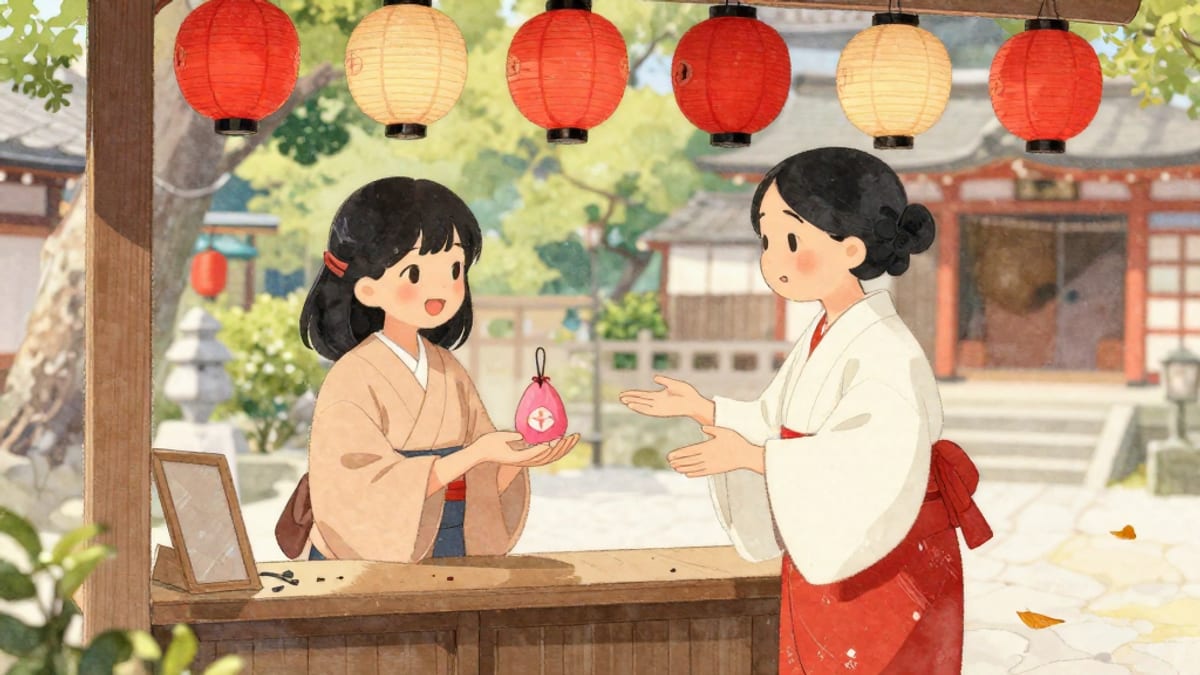
Many shrines are known for 縁結び, tying good bonds, and sell charms for love and good relationships. This is a short exchange at the charm counter.
| Japanese | Romaji | Meaning |
|---|---|---|
| すみません、縁結びのお守りはありますか。 | Sumimasen, enmusubi no omamori wa arimasu ka. | Nok: Excuse me, do you have charms for good bonds? |
| はい、こちらでございます。 | Hai, kochira de gozaimasu. | Attendant: Yes, these ones here. |
| 恋愛だけですか。 | Ren'ai dake desu ka. | Nok: Is it only for love? |
| いいえ、人とのご縁全般ですよ。 | Iie, hito to no goen zenpan desu yo. | Attendant: No, it's for all kinds of connections with people. |
| じゃあ、一つお願いします。 | Jā, hitotsu onegai shimasu. | Nok: Then one, please. |
Look-alike kanji, writing tips and common mistakes
縁 and 緑 (midori, green) are a classic pair. Both have the thread radical 糸 on the left, and their right sides look similar at a glance. Look at the bottom right: 緑 ends in a shape like 水, water, while 縁 ends in the shape of 豕, with more sweeping strokes. Also watch 運 and 連 (ren, connect): both have 辶, but 運 contains 軍 and 連 contains 車.
How to write 縁: first the thread radical 糸 on the left (six strokes), narrow and tall. Then build the right side from the top down, finishing with the sweeping strokes at the bottom. Fifteen strokes in all; give the right side most of the width.
| Japanese | Romaji | Meaning |
|---|---|---|
| 縁 | en | bond, connection |
| 緑 | midori | green (look-alike) |
| 連 | ren | connect (look-alike of 運) |
- Calling an ordinary coincidence 運命. Bumping into a coworker at the supermarket is 偶然 (gūzen, a coincidence), unless you are joking.
- Using 宿命 for something light. It sounds tragic; 運命 is enough.
- Taking ご縁がありませんでした literally. It is a polite rejection formula.
- Using 腐れ縁 with someone you barely know. It is affectionate only between old friends.
Fate kanji as a tattoo or design
運命 is a real, clear word that Japanese readers understand as destiny. It has a romantic and slightly dramatic feel, a little like song lyrics, which some people love. 宿命 is heavier and can suggest a tragic or unchosen fate, so think about whether that is your message.
縁 is a beautiful choice for a bond between people, such as family members, partners or close friends getting matching designs, but a single kanji can be ambiguous: 縁 also means edge. A word such as ご縁 or 縁結び is clearer, though ご adds a polite prefix that some people find odd in a design. Chinese uses 缘 in simplified script and 緣 in traditional script for this character; the Japanese form 縁 differs slightly.
Because 縁 and 緑 are so close, ask a native speaker to check the characters, the meaning and the design before inking, and give the artist a clean, checked image.
| Japanese | Romaji | Meaning |
|---|---|---|
| 運命 | unmei | destiny |
Ask Mocchi about 縁, then use it out loud
Paste the business line またご縁がありましたら、よろしくお願いします into Mocchi with /explain. Mocchi, Unihongo's study assistant, breaks it down word by word, explains the conditional ありましたら and tells you when the phrase is used. Ask for three more situations where ご縁 sounds natural, and Mocchi keeps a note of the ones you find tricky for your next quiz.
Then open AI Sensei, choose Ibuki-sensei and ask her to play the attendant at a shrine charm counter. Ask about 縁結び, choose a charm, and read your session report for corrections.