
桜 at a glance: four spring words
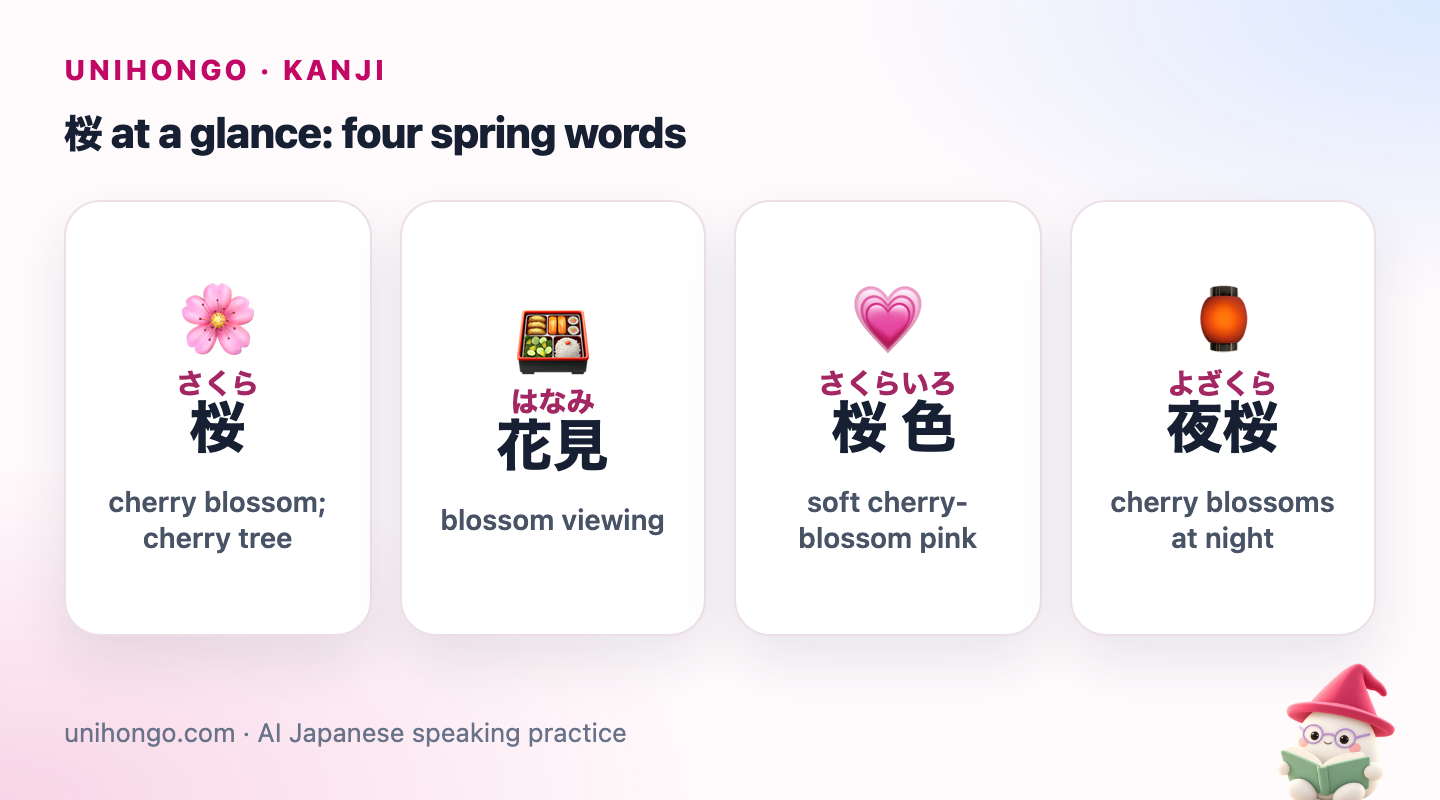
桜 means cherry, both the tree and the blossom. When people say sakura in spring, they usually mean the flowers. Around it is a whole season of words, and these four are the ones you will hear most: the blossom itself, blossom viewing, cherry-blossom pink, and cherry blossoms lit up at night.
| Japanese | Romaji | Meaning |
|---|---|---|
| 桜 | sakura | cherry blossom; cherry tree |
| 花見 | hanami | blossom viewing |
| 桜色 | sakurairo | soft cherry-blossom pink |
| 夜桜 | yozakura | cherry blossoms at night |
Readings, parts and the old form of 桜
桜 has ten strokes: the tree radical 木 on the left, and on the right three short strokes over 女 (woman). This is a post-war simplified Japanese form. The older form, 櫻, has 木 on the left and 嬰 on the right, which gives the sound. You still see 櫻 in some family names, shop signs and traditional designs.
| Reading | Type | When you use it | Examples |
|---|---|---|---|
| sakura | kun'yomi | alone and at the start of words | 桜, sakura; 桜色, sakurairo; 桜餅, sakuramochi |
| zakura | kun'yomi (sound change) | after another word | 夜桜, yozakura; 山桜, yamazakura; 葉桜, hazakura |
| ō | on'yomi | a few formal words | 桜花, ōka, cherry blossoms (literary) |
How to write it: write 木 first, narrow, with its last stroke shortened into a small dot-like stroke so it makes room on the right. Then write the three short strokes on top of the right side, left to right. Finish with 女: the stroke that bends down and to the right, the stroke falling to the left, and the long horizontal line. Let the horizontal line of 女 reach slightly further than the strokes above it.
桜, さくら or サクラ: which spelling and why
Japanese can write the same word in three scripts, and each choice changes the feeling. For sakura the difference is clear enough to learn as a rule.
| Japanese | Romaji | Meaning |
|---|---|---|
| さくら | Sakura | a girl's name, soft spelling |
| ソメイヨシノ | someiyoshino | the most common cherry variety |
| あの行列、サクラじゃない? | Ano gyōretsu, sakura janai? | Isn't that queue just fake customers? |
| Spelling | Feeling | Where you see it |
|---|---|---|
| 桜 (kanji) | standard, neutral | news, forecasts, place names, most writing |
| さくら (hiragana) | soft, gentle, friendly | names, songs, children's books, product names |
| サクラ (katakana) | technical or slang | botany and science; a shill or fake customer |
The slang meaning surprises many learners. A sakura in katakana is a person hired to pretend to be a customer, to queue outside a shop, clap at a show or post a fake review, so the place looks popular. You will hear it in conversations like ano gyōretsu, sakura janai?, isn't that queue just plants? It has nothing to do with flowers in this sense.
Blossom words from first bloom to falling petals
The blossom season is short, often only a week or two at full bloom in any one place, and Japanese has a word for every stage. Forecasts talk about kaika, the first flowers opening, and mankai, full bloom. When the petals fall in the wind, it is a sakura fubuki, a blizzard of blossoms, and when the trees turn green, they become hazakura, leaf cherries.
| Japanese | Romaji | Meaning |
|---|---|---|
| もう満開ですね。 | Mō mankai desu ne. | They're already in full bloom. |
| 雨で散っちゃうかな。 | Ame de chitchau kana. | I wonder if the rain will knock them off. |
In classical Japanese poetry, the word hana, flower, on its own very often meant cherry blossoms, which shows how central they became in Japanese culture. That is why the picnic is hanami, flower viewing, not sakura-mi.
Spring is also the start of the Japanese school and business year in April, so the blossoms are tied to entrance ceremonies, new jobs and goodbyes. A photo of a new pupil under the cherry trees at the school gate is a classic family picture, and many songs about graduation and new beginnings mention sakura.
Hanami: how a blossom picnic works
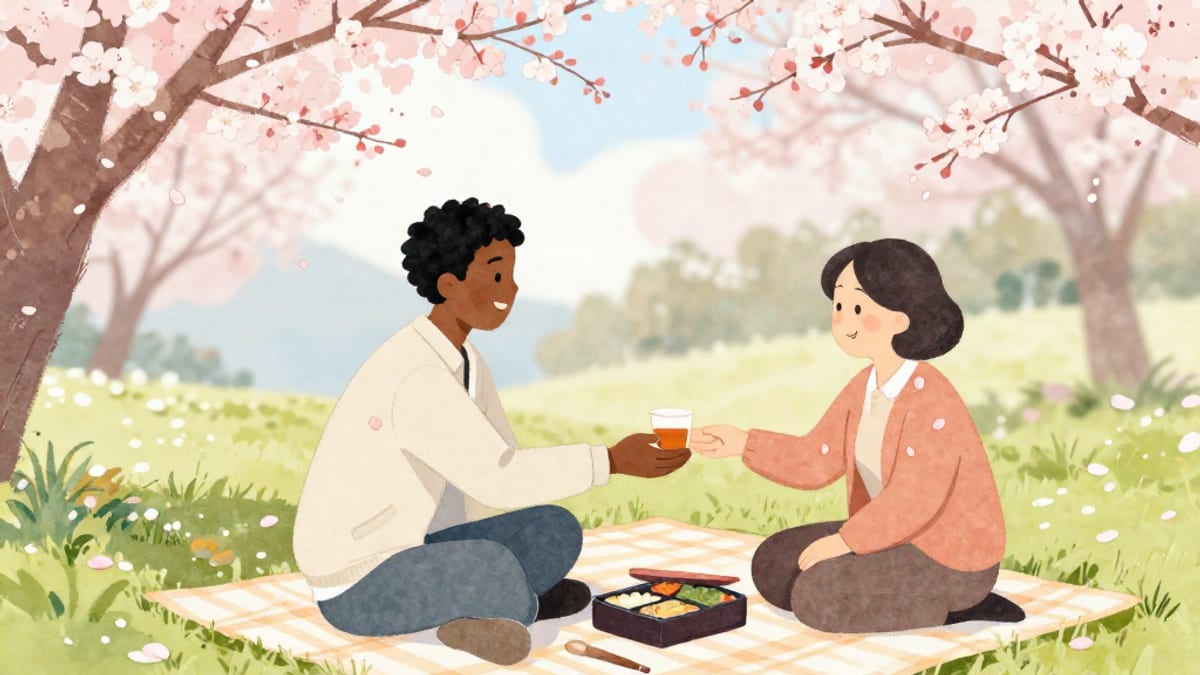
Hanami can be as simple as walking under the trees on the way to the station, or as big as a company picnic with a blue sheet, food and drinks. At busy parks, someone, often the newest member of a team, may go early to claim a spot, basho tori. Many people enjoy yozakura, the trees lit up at night, too.
Manners matter, and rules differ by park. Many parks ban barbecues, loud music or alcohol, or close at night, so check the local rules. Common courtesy includes not shaking branches or picking flowers, taking all rubbish home or to the right bins, and not taking more space than your group needs.
| Japanese | Romaji | Meaning |
|---|---|---|
| 来週、お花見に行きませんか。 | Raishū, ohanami ni ikimasen ka. | Coworker: Would you like to go blossom viewing next week? |
| いいですね。ぜひ行きたいです。 | Ii desu ne. Zehi ikitai desu. | You: That sounds great. I'd love to. |
| 土曜日は空いていますか。 | Doyōbi wa aite imasu ka. | Coworker: Are you free on Saturday? |
| はい、空いています。何か持っていきましょうか。 | Hai, aite imasu. Nanika motte ikimashō ka. | You: Yes. Shall I bring something? |
| じゃあ、飲み物をお願いします。 | Jā, nomimono o onegai shimasu. | Coworker: Then could you bring drinks? |
| わかりました。楽しみにしています。 | Wakarimashita. Tanoshimi ni shite imasu. | You: Sure. I'm looking forward to it. |
Names and sayings with 桜
Sakura is a well-loved girl's name, and the kanji 桜 also appears inside other names. The same name can be written many ways: 桜, さくら or 咲良, which uses bloom and good, are all read Sakura. Families choose kanji for meaning, sound and look.
Hana yori dango, dumplings rather than flowers, is the classic teasing line for someone at a hanami who is more interested in the food than the blossoms. A gardening saying, sakura kiru baka, ume kiranu baka, a fool cuts a cherry and a fool fails to cut a plum, reflects the traditional advice that cherry trees should not be pruned heavily, while plum trees need pruning.
| Japanese | Romaji | Meaning |
|---|---|---|
| 美桜 | Mio | beautiful cherry · girl |
| 桜子 | Sakurako | cherry blossom child · girl |
| 咲良 | Sakura | bloom and good · girl |
| 花より団子 | hana yori dango | food over flowers |
| 桜切る馬鹿、梅切らぬ馬鹿 | sakura kiru baka, ume kiranu baka | prune plums, not cherries |
Cherry blossom tattoos, designs and look-alikes
The cherry blossom is one of the most recognisable Japanese images, linked with spring, new beginnings and the beauty of things that do not last. In the twentieth century it was also used in wartime imagery, but for most people today it is simply the flower of spring, school entrance ceremonies and fresh starts.
| Japanese | Romaji | Meaning |
|---|---|---|
| 楼 | rō | a tower, a tall building |
| 桃 | momo | a peach |
| 梅 | ume | a Japanese plum |
- 桜 alone is clear and natural, and it is one of the better single-kanji choices. Some readers may also read it as a name.
- A word can add a scene: 夜桜 (yozakura, night blossoms), 桜吹雪 (sakura fubuki, falling petals) or 八重桜 (yaezakura, lush double blossoms).
- Use the Japanese form 桜 if you want a Japanese look. Chinese uses 樱 or 櫻, so a design copied from a Chinese source may differ.
- Ask a native speaker to check the characters, the stroke shapes and the style before you get inked.
When reading, do not confuse 桜 with 楼 (rō, a tall building), which has 米 instead of the three short strokes. 桃 (momo, peach) and 梅 (ume, plum) are other tree kanji with 木 on the left, and plum blossoms come a few weeks before the cherries.
Polish your hanami invitation with Mocchi
Write a short message inviting a coworker to hanami, then send it to Mocchi with /correct. Mocchi fixes the Japanese, explains each change and shows a polite and a casual version. Mocchi remembers the points you keep missing, such as ikimasen ka versus ikimashō, and quizzes you on them later.
Then make a spring deck: ask Mocchi to create flashcards for kaika, mankai, hazakura and sakura fubuki with /create-flashcards, choosing a photo for each stage of the blossom, and review them with spaced repetition before the season arrives.