
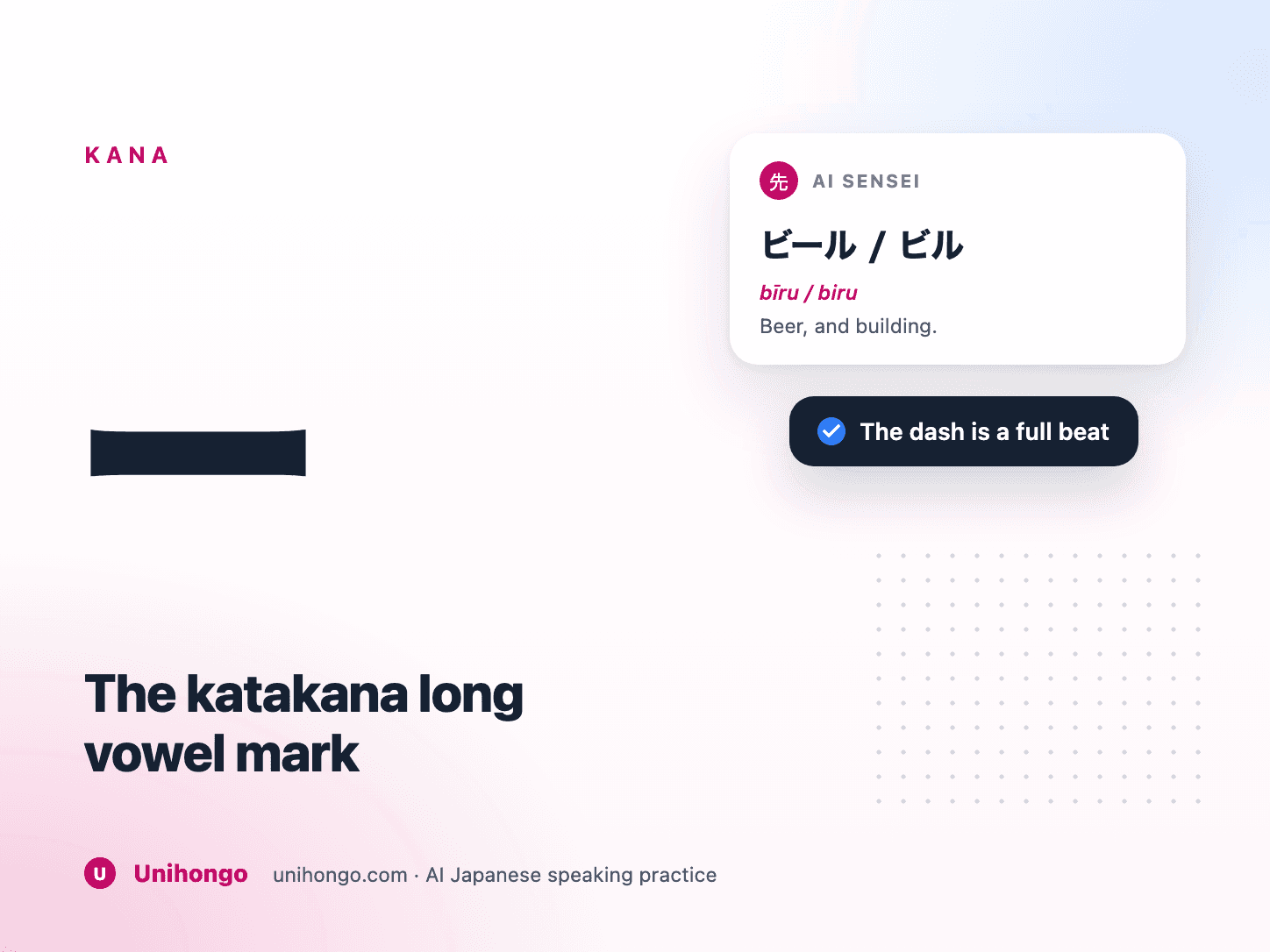
A beat, not a hyphen
The mark looks like a dash and behaves like a vowel. It extends the preceding vowel by one full mora, which means the word takes longer to say and is counted longer.
This matters because Japanese distinguishes words by length. A loanword with the mark dropped is not a casual version of the same word; it is a different sequence of beats and frequently not recognisable.
| Japanese | Romaji | Meaning |
|---|---|---|
| ビール | bi-i-ru | Three beats: beer |
| ビル | bi-ru | Two beats: building |
| カード | ka-a-do | Three beats: card |
| カド | ka-do | Two beats |
| コーヒー | ko-o-hi-i | Four beats: coffee |
| スーパー | su-u-pa-a | Four beats: supermarket |
Where it appears
The mark appears overwhelmingly in katakana, which means in loanwords, foreign names, onomatopoeia and words written in katakana for emphasis.
Because English words frequently contain long vowels and Japanese renders them with this mark, most loanwords you meet will contain at least one.
| Japanese | Romaji | Meaning |
|---|---|---|
| テーブル | te-e-bu-ru | Four beats: table |
| ケーキ | ke-e-ki | Three beats: cake |
| メール | me-e-ru | Three beats: email |
| ゲーム | ge-e-mu | Three beats: game |
| ノート | no-o-to | Three beats: notebook |
| スポーツ | su-po-o-tsu | Four beats: sport |
Every one of these is a beat longer than the English word suggests. Counting the beats is the reliable way to say them recognisably.
How hiragana does the same job
Hiragana does not normally use the dash. It writes a long vowel by adding a vowel character, and which character is added depends on the vowel being extended.
This is worth knowing because it explains why the same sound looks so different in the two scripts.
| Vowel | Hiragana adds | Katakana uses |
|---|---|---|
| a | あ | ー |
| i | い | ー |
| u | う | ー |
| e | え or い | ー |
| o | お or う | ー |
The e and o rows have two options in hiragana, and which one a word takes is fixed by spelling convention rather than by pronunciation.
In vertical writing
Japanese is written both horizontally and vertically, and the long vowel mark follows the direction of the text. In vertical writing it is a vertical stroke rather than a horizontal one.
This catches learners who have only read horizontally, because a vertical line inside a word looks like something else entirely at first.
- Horizontal text: the mark is a horizontal stroke.
- Vertical text: the mark is a vertical stroke.
- It occupies the same space as a full character either way.
- Signs, book spines and menus frequently use vertical text.
- The sound and the beat count are identical in both directions.
Casual and expressive uses
Outside standard spelling, the mark is used expressively to show a drawn-out sound: in advertising, in manga, in casual messages and to represent speech that trails or stretches.
In these uses it can appear with hiragana too, and it can be repeated for effect. That is stylistic rather than standard spelling.
| Japanese | Romaji | Meaning |
|---|---|---|
| えー | ē | A hesitation sound, drawn out |
| すごーい | sugōi | Great, said with emphasis |
| おいしー | oishī | Delicious, casual spelling |
| やったー | yattā | A cheer |
| ええー | eē | Surprise |
| どうぞー | dōzō | Go ahead, said warmly |
These are casual spellings and are common in messages and advertising. They are not appropriate in formal writing.
Counting the beats
The practical skill is counting, and loanwords are the ideal material because you already know what they mean, so all of your attention can go to the length.
Take twenty loanwords from your own life, count the beats including every dash, and say each one at that length. Most learners find they have been saying nearly all of them a beat or two short.
The pronunciation lab is useful here because the beat count is unambiguous: a shortened long vowel is not a matter of opinion, and the score reflects it.
If a loanword is not being understood, it is usually a beat short rather than mispronounced. Lengthen the marked vowel and try again.