
狐 at a glance: the fox, its food and its shrine
Most learners meet the fox in three places: on a noodle menu, at a shrine and in a story. The first two are written in kana or with other kanji far more often than with 狐 itself, so it helps to connect them. Here are the four forms you are most likely to see.
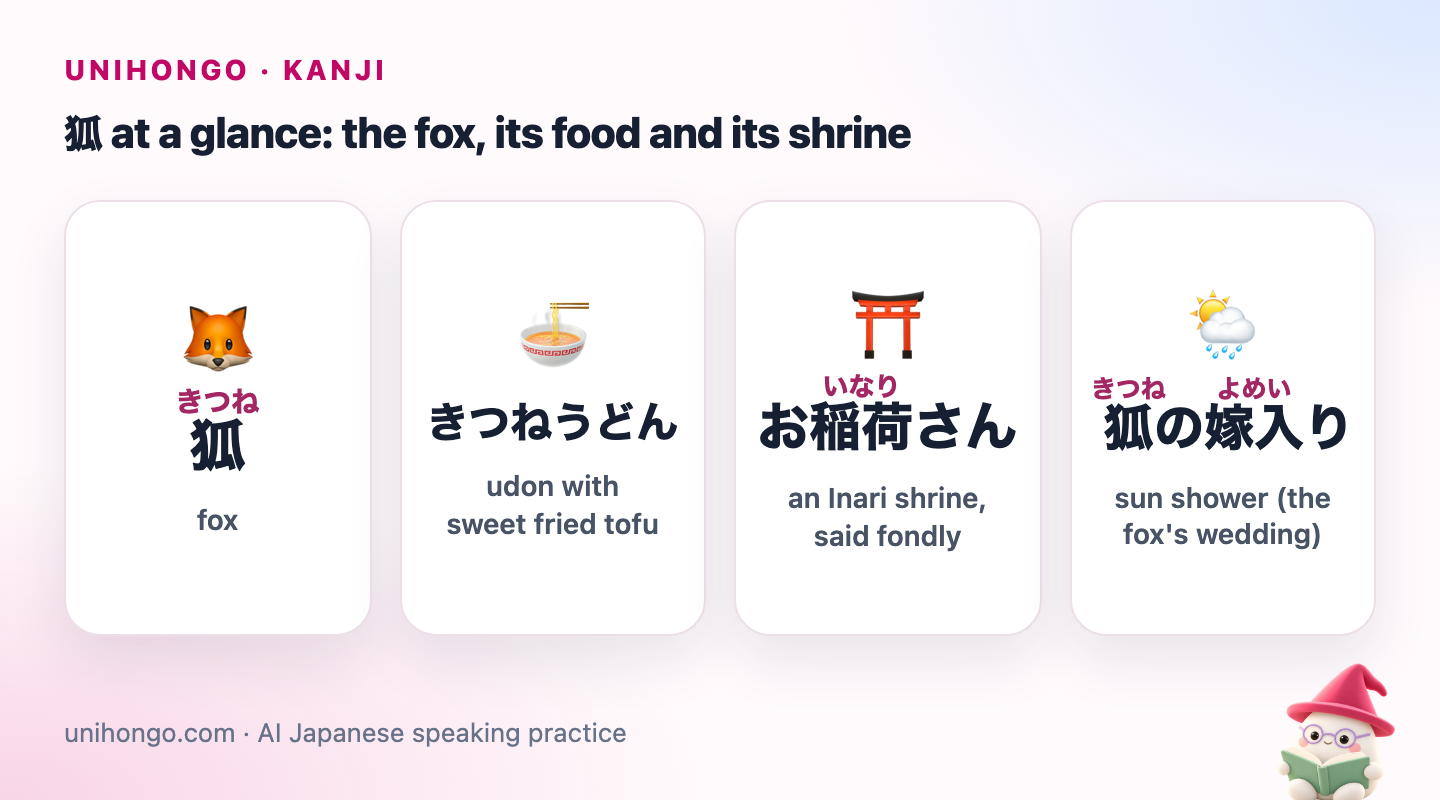
| Japanese | Romaji | Meaning |
|---|---|---|
| 狐 | kitsune | fox |
| きつねうどん | kitsune udon | udon with sweet fried tofu |
| お稲荷さん | oinarisan | an Inari shrine, said fondly |
| 狐の嫁入り | kitsune no yomeiri | sun shower (the fox's wedding) |
Readings and parts: 犭 and 瓜
Japanese dictionaries usually count 狐 as nine strokes, though some count eight, because the 瓜 part is counted as six strokes in Japan and five in older Chinese dictionaries. On the left is 犭, the animal radical you also see in 狼, wolf, and 猫, cat. On the right is 瓜, the kanji for melon or gourd, which here works as a sound part: in Chinese it sounded close to the word for fox. It does not mean that foxes have anything to do with melons.
| Reading | Type | Where it appears |
|---|---|---|
| kitsune | Kun'yomi | The animal, most fox words and idioms |
| ko | On'yomi | A few compounds such as 白狐 and 狐狸 |
| kitsune (kana) | Everyday spelling | Menus, children's books, signs at shrines |
Compound words with the on'yomi are rare in daily life. 白狐, a white fox, is read byakko, and 狐狸, foxes and raccoon dogs together, is kori, a word for sly people that you will mainly see in writing. The kun'yomi kitsune covers almost everything else, so if you are unsure, kitsune is almost always the right guess.
The 瓜 part is fiddly: it has a small hooked stroke inside that learners often forget. If your handwritten 狐 looks thin, check that the inner hook and the final dot are both there.
Fox words on the menu and in the sky
The fox's food words are the most useful ones for a visitor. In noodle shops, きつね always means the sweet fried tofu topping. In parts of western Japan, ordering by name can work a little differently; for example, in some areas around Osaka たぬき may mean something different from Tokyo, and in Kyoto there are local fox dishes too. If the menu has pictures, point and confirm.
| Japanese | Romaji | Meaning |
|---|---|---|
| きつねそば | kitsune soba | soba with sweet fried tofu |
| いなり寿司 | inarizushi | sushi rice in a fried tofu pouch |
| 油揚げ | aburaage | thin fried tofu |
| きつね色 | kitsune iro | golden brown, as in cooking |
| きつね色になるまで焼きます。 | Kitsune iro ni naru made yakimasu. | Fry it until golden brown. |
| 狐火 | kitsunebi | fox fire: mysterious lights in folk tales |
| 狐の面 | kitsune no men | a fox mask, often seen at festivals |
| きつねうどんを一つお願いします。 | Kitsune udon o hitotsu onegai shimasu. | One kitsune udon, please. |
Fox idioms: bewitched, borrowed power and rivals
Folk tales say foxes can take human form and play tricks, so fox idioms are about confusion and cunning. 狐につままれる means being completely baffled, as if a fox had bewitched you; it is common and friendly. The tiger and fox proverb, 虎の威を借る狐, describes someone who shows off using another person's power. 狐と狸の化かし合い is a battle of wits between two schemers.
Not every fox word is kind. 女狐, megitsune, is an old insult for a woman seen as sly and seductive. Recognise it in dramas and novels, but do not use it.
| Japanese | Romaji | Meaning |
|---|---|---|
| 狐につままれたような顔 | kitsune ni tsumamareta yō na kao | a baffled look, as if bewitched |
| 虎の威を借る狐 | tora no i o karu kitsune | a fox borrowing the tiger's power |
| 狐と狸の化かし合い | kitsune to tanuki no bakashiai | a battle of wits between two tricksters |
| 九尾の狐 | kyūbi no kitsune | the nine-tailed fox of legend |
| 何が起きたのか、狐につままれた気分です。 | Nani ga okita no ka, kitsune ni tsumamareta kibun desu. | I feel completely baffled about what happened. |
Talking about foxes at an Inari shrine
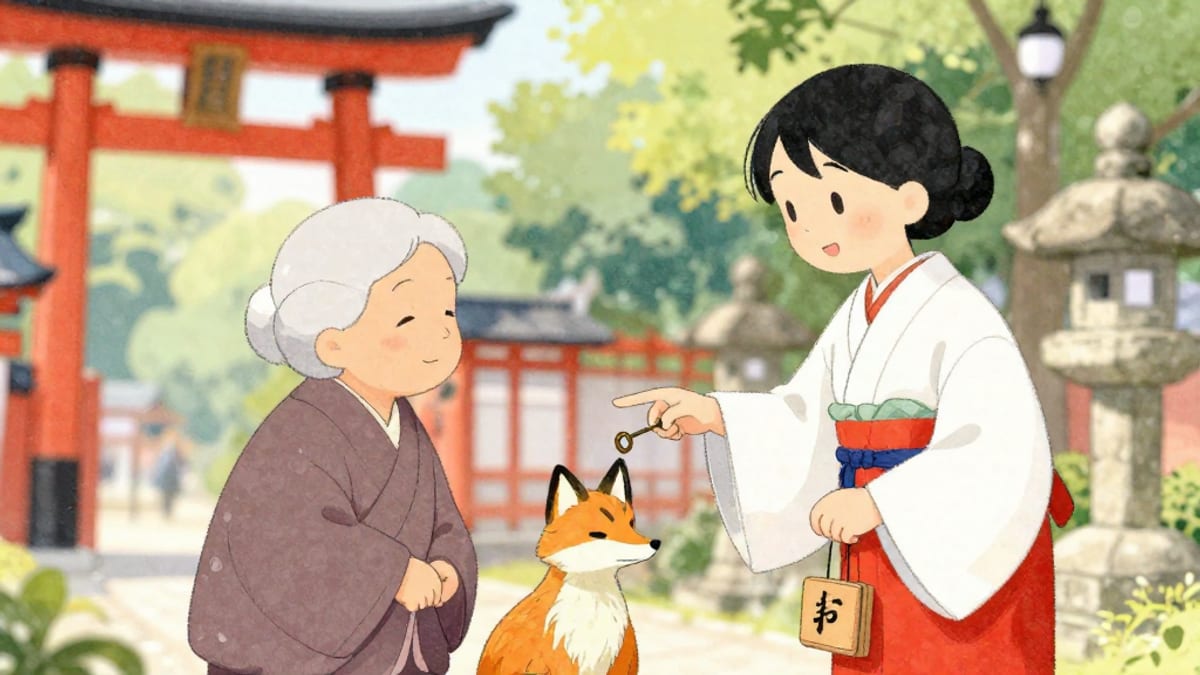
Inari shrines are easy to spot by their red torii gates and pairs of stone foxes. The foxes often hold something in their mouths, such as a key, a jewel, a scroll or a sheaf of rice, and what they hold differs from shrine to shrine. People affectionately call these shrines おいなりさん. Offerings of fried tofu or inari sushi are a traditional custom at some of them, and many sell fox-shaped votive plaques you can draw a face on.
Speak politely and ask rather than explain. Local stories differ, and staff and regular visitors enjoy sharing theirs. Remember too that a shrine is a place of worship: take photos quietly, do not climb on the statues, and follow any signs about where photography is allowed.
| Japanese | Romaji | Meaning |
|---|---|---|
| このキツネは何をくわえているんですか。 | Kono kitsune wa nani o kuwaete iru n desu ka. | You: What is this fox holding in its mouth? |
| 蔵の鍵だと言われています。 | Kura no kagi da to iwarete imasu. | Staff: It's said to be the key to a storehouse. |
| キツネは神様なんですか。 | Kitsune wa kamisama nan desu ka. | You: Is the fox a god? |
| いいえ、お稲荷様のお使いなんですよ。 | Iie, oinarisama no otsukai nan desu yo. | Staff: No, it's the messenger of Inari. |
| このキツネの絵馬、かわいいですね。 | Kono kitsune no ema, kawaii desu ne. | You: This fox votive plaque is so cute. |
狐 vs 孤 vs 弧, and how to write the fox
Three kanji share the 瓜 part and the reading ko. Only the left side changes: the animal radical for the fox, the child radical 子 for loneliness, and the bow radical 弓 for an arc. 孤 is the one learners mix up most, because 孤独, loneliness, is a common word.
| Japanese | Romaji | Meaning |
|---|---|---|
| 孤独 | kodoku | loneliness, solitude |
| 孤立 | koritsu | isolation |
| 円弧 | enko | an arc of a circle |
- Writing 孤 when you mean the fox. Check the left side: 犭 for the animal, 子 for alone.
- Ordering 狐うどん in kanji on a note to a shop. Menus use きつね, and so should you.
- Calling the shrine fox a god. Say otsukai, messenger.
- Using 女狐 as a joke. It is an insult, not a cute word.
To write 狐, start with the animal radical: a short left-falling stroke, the long curved stroke that hooks up at the bottom, and a final left-falling stroke. Then write 瓜 from the top down, starting with the short left-falling stroke and ending with the dot and the long sweep to the bottom right. Give 瓜 room to spread at the bottom, and check a stroke-order chart for its middle strokes, which are easy to get wrong.
Fox designs: 狐, 白狐 or a picture
A single 狐 is graceful on paper and reads as fox in Japanese and Chinese. The associations are mixed, though: cleverness and Inari on one side, trickery and seduction on the other, and in Chinese the fox can strongly suggest a seductress. If you want the protective, shrine-related feeling, 白狐, white fox, or 稲荷 with a fox drawing, carries it more clearly. If you love the fox mask style, consider a design with no text at all.
Whichever you choose, the details of 瓜 are easy to get wrong in calligraphy fonts. Ask a native speaker, ideally someone who knows brush writing, to look at the final stencil before you go ahead.
Follow the fox with Mocchi and AI Sensei
Ask Mocchi to /explain 狐につままれたような顔をしていた and it breaks the sentence into chunks, names the passive form and the yō na pattern, and gives the meaning. Mocchi remembers which of 狐, 孤 and 弧 you keep mixing up and folds a short check into your plan.
Then go to AI Sensei, pick Sakura-sensei and ask her to play a guide at an Inari shrine. Ask about the foxes, the red gates and the fried tofu out loud. The session report afterwards lists your corrections and the new words you used.