
What kotoshi no kanji is
Kotoshi (今年) is this year, and kotoshi no kanji is this year's kanji. The event is organised by the Japan Kanji Aptitude Testing Foundation, the body behind the kanji examination that people call Kanken. The foundation invites the public to send in one character with a reason, counts the votes, and announces the winner in mid-December, on or near 12 December, which it promotes as Kanji Day.
The announcement is the famous part. On the stage of Kiyomizu-dera in Kyoto, the head priest writes the character in a single performance with a very large brush, and the image leads the evening news.
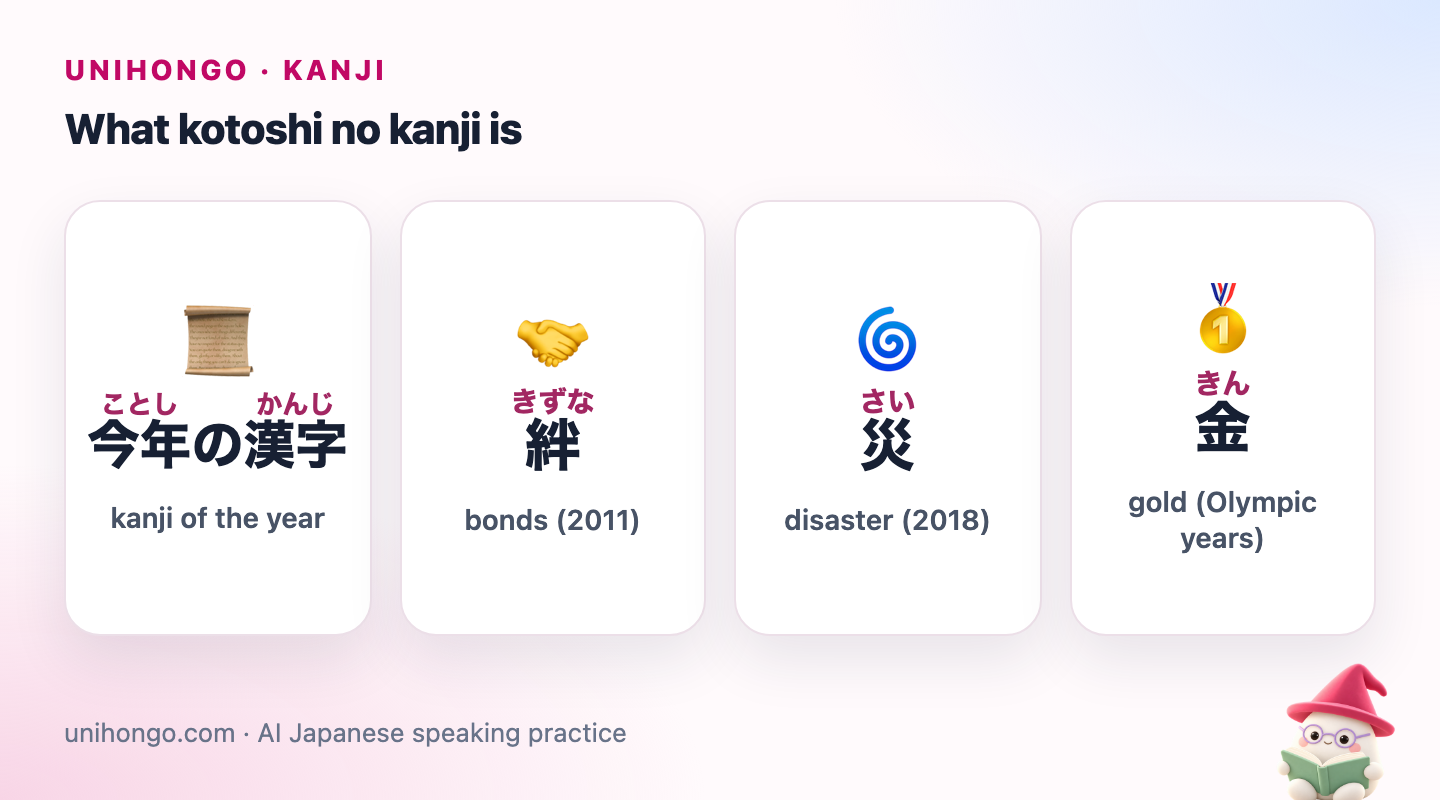
| Japanese | Romaji | Meaning |
|---|---|---|
| 今年の漢字 | kotoshi no kanji | kanji of the year |
| 絆 | kizuna | bonds (2011) |
| 災 | sai | disaster (2018) |
| 金 | kin | gold (Olympic years) |
| 清水寺 | Kiyomizu-dera | Kiyomizu temple in Kyoto |
| 漢字の日 | kanji no hi | Kanji Day, 12 December |
Past choices and what was behind them
| Japanese | Romaji | Meaning |
|---|---|---|
| 震 | shin | quake, 1995 |
| 絆 | kizuna | bonds, 2011 |
| 災 | sai | disaster, 2018 |
| 令 | rei | the rei of the Reiwa era, 2019 |
| 密 | mitsu | close and crowded, 2020 |
| 戦 | sen | war, battle, 2022 |
| 税 | zei | tax, 2023 |
The first kanji of the year, in 1995, followed the great earthquake in Kobe. In 2011, after the earthquake and tsunami in northeastern Japan, people chose kizuna, the ties between family, neighbours and strangers who helped. The year 2018 brought earthquakes, floods, typhoons and extreme heat.
In 2019 a new imperial era, Reiwa (令和), began. In 2020 the public was asked to avoid closed, crowded and close-contact settings, summed up with the kanji 密. The year 2022 was marked by the war in Ukraine, and 2023 by arguments about taxes. Notice the readings: most winners are read in their short Chinese-style form, but 絆 is read as the full word kizuna.
How people talk about it in December
In the weeks before the announcement, television hosts and co-workers trade guesses. Afterwards, politicians, athletes and companies are asked for their own kanji of the year, and so are you. The grammar is simple: a topic with wa, the kanji, and desu or the past deshita. For a guess, add da to omoimasu, I think it is.
| Japanese | Romaji | Meaning |
|---|---|---|
| 今年の漢字が発表されました。 | Kotoshi no kanji ga happyō saremashita. | The kanji of the year has been announced. |
| 今年の漢字は「税」でした。 | Kotoshi no kanji wa zei deshita. | The kanji of the year was tax. |
| 今年の漢字は何だと思いますか。 | Kotoshi no kanji wa nan da to omoimasu ka. | What do you think this year's kanji will be? |
| 「金」だと思います。 | Kin da to omoimasu. | I think it will be gold. |
| どうしてですか。 | Dōshite desu ka. | Why is that? |
Saying which kanji you mean
Many kanji share a reading, so saying chō on its own tells nobody which character you have in mind. Japanese speakers solve this by naming a common word that contains the kanji: chōsen no chō, the chō of chōsen. The same trick is used to spell names over the phone. It is worth practising, because you will hear it every time people discuss kanji aloud.
| Japanese | Romaji | Meaning |
|---|---|---|
| 「挑戦」の「挑」です。 | Chōsen no chō desu. | It's the chō in chōsen, challenge. |
| 「旅行」の「旅」です。 | Ryokō no ryo desu. | It's the ryo in ryokō, travel. |
| どんな字ですか。 | Donna ji desu ka. | What character is it? |
| どう書きますか。 | Dō kakimasu ka. | How do you write it? |
Pick your own kanji of the year
| Japanese | Romaji | Meaning |
|---|---|---|
| 挑 | chō | challenge |
| 学 | gaku | learning |
| 旅 | tabi | journey |
| 変 | hen | change |
| 忙 | bō | busy |
| 楽 | raku | ease, enjoyment |
| 新 | shin | new |
| 会 | kai | meeting people |
- Sum up your year in one word in your own language: change, travel, study, busy.
- Find a kanji you already know that carries that idea. A simple, common kanji is better than a rare one.
- Check how to say it: a reading on its own, or a word that contains it.
- Prepare one sentence that gives the reason.
Explain your choice with kara desu
The speech has two sentences. First state the kanji. Then give the reason as a plain-form sentence followed by kara desu, it is because. Polite endings such as mashita change to the plain past: chōsen shimashita becomes chōsen shita.
| Japanese | Romaji | Meaning |
|---|---|---|
| 私の今年の漢字は「挑」です。 | Watashi no kotoshi no kanji wa chō desu. | My kanji of the year is challenge. |
| 新しいことに挑戦したからです。 | Atarashii koto ni chōsen shita kara desu. | It's because I took on new things. |
| 私の今年の漢字は「旅」です。 | Watashi no kotoshi no kanji wa tabi desu. | My kanji of the year is journey. |
| 初めて日本に行ったからです。 | Hajimete Nihon ni itta kara desu. | It's because I went to Japan for the first time. |
| 仕事が忙しかったからです。 | Shigoto ga isogashikatta kara desu. | It's because work was busy. |
| 来年の漢字は「楽」にしたいです。 | Rainen no kanji wa raku ni shitai desu. | I want next year's kanji to be ease. |
The last line uses ni shitai, I want to make it. It is a neat way to state a hope for the coming year, and a good closing line.
Words for the brush and the board
When the news shows the announcement, a few calligraphy words come up again and again. Calligraphy is shodō (書道), the way of writing. People comment on the strength of the strokes as much as on the choice of character.
| Japanese | Romaji | Meaning |
|---|---|---|
| 筆 | fude | writing brush |
| 墨 | sumi | black ink |
| 書道 | shodō | calligraphy |
| 一文字 | hitomoji | a single character |
| 一文字で表します。 | Hitomoji de arawashimasu. | It is expressed in one character. |