
火 at a glance: four words to start with
火 means fire. It started as a picture of flames rising, and you can still see it: a tall central shape with a small spark on each side. On its own it is read hi, and that is the word you use for any ordinary fire, the flame on a gas stove, a candle or a cigarette lighter.
Most of the time, though, you meet 火 inside a longer word. These four are the ones that come up first in real life: the kanji itself, a house fire, summer fireworks and the modern word for a blaze, which also describes an angry storm on social media.
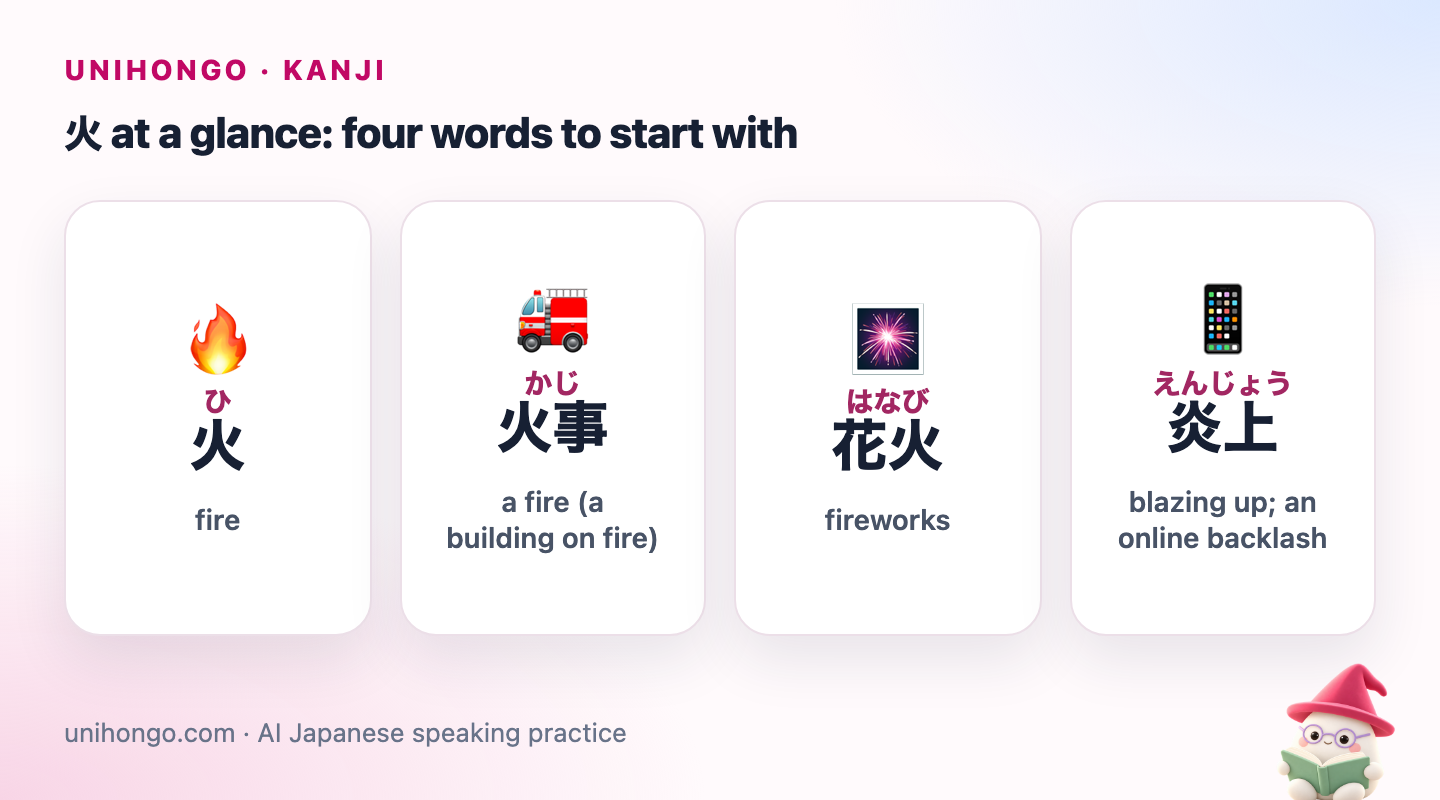
| Japanese | Romaji | Meaning |
|---|---|---|
| 火 | hi | fire |
| 火事 | kaji | a fire (a building on fire) |
| 花火 | hanabi | fireworks |
| 炎上 | enjō | blazing up; an online backlash |
Readings, stroke count and the parts of 火
火 has four strokes. It is a pictograph, a simplified drawing of flames, so it is not built from smaller parts. Instead, it becomes a part of many other kanji, which is useful to know when you are guessing meanings.
Like most kanji, 火 has a native Japanese reading (kun'yomi) and a reading borrowed from Chinese (on'yomi). The rule of thumb: when 火 stands alone or joins native words, say hi; in two-kanji compounds borrowed from Chinese, say ka. 炎 follows the same pattern.
| Japanese | Romaji | Meaning |
|---|---|---|
| 焼く | yaku | to grill, to bake, to burn |
| 燃える | moeru | to burn, to be on fire |
| 熱い | atsui | hot (to the touch) |
| 畑 | hatake | a vegetable field |
| Kanji | Reading type | Reading | Example |
|---|---|---|---|
| 火 | kun'yomi | hi (bi after another word) | 火をつける, hi o tsukeru, to light a fire; 花火, hanabi |
| 火 | kun'yomi (rare) | ho | 火照る, hoteru, to feel flushed and hot |
| 火 | on'yomi | ka | 火事, kaji; 火山, kazan; 火曜日, kayōbi |
| 炎 | kun'yomi | honoo | 炎, honoo, a flame |
| 炎 | on'yomi | en | 炎上, enjō; 肺炎, haien |
As a building block, fire takes two shapes. On the left side of a kanji it is written as a narrow 火, called hihen, in characters such as 焼 (burn, grill), 燃 (burn) and 灯 (lamp). At the bottom of a kanji it often becomes four dots, called rekka or renga, in 熱 (hot), 点 (point, dot), 照 (shine) and 煮 (simmer). When you see four dots along the bottom, think heat or fire. One famous kanji made in Japan, 畑 (hatake, a dry field), combines fire with rice field, and is usually explained by the old practice of clearing land by burning.
Fourteen everyday words with 火
These are the 火 words you will hear in a kitchen, on the news and in ordinary conversation. Notice the cooking group: Japanese recipes describe heat with 火, so tsuyobi, chūbi and yowabi are worth learning as a set if you ever cook from a Japanese video or cookbook.
| Japanese | Romaji | Meaning |
|---|---|---|
| 指をやけどしちゃった。 | Yubi o yakedo shichatta. | I burnt my finger. (casual) |
| 火事だ! | Kaji da! | Fire! (shouted warning) |
| 弱火で十分煮てください。 | Yowabi de jūbun nite kudasai. | Simmer well over low heat. |
Two of these deserve a note. 火傷 is read yakedo, a special reading that you have to learn as a whole word; it is also often written in hiragana as やけど. And a burn on your hand is yakedo, never kaji: kaji is only for a fire that damages a building, a car or a forest. If you burnt your finger on a pan, say yakedo shichatta, I burnt myself.
火 or 炎? Choosing the right fire
Japanese has two main kanji for fire, and they are not interchangeable. 火 is the neutral, practical word. 炎 is the flame, the bright moving tongue of fire, and it carries more emotion and drama. Think of the difference between fire and flames in English: you put out a fire, but flames roar.
Because 炎 is visual and intense, it appears in poems, song lyrics, anime titles and in phrases about passion, anger and jealousy. In medicine, 炎 is the kanji for inflammation, so many illness names end in it: 肺炎 for pneumonia, 胃炎 for gastritis. This is worth knowing so you are not surprised when a pharmacy leaflet is full of flames.
| Japanese | Romaji | Meaning |
|---|---|---|
| 炎 | honoo | a flame |
| 炎が上がる | honoo ga agaru | flames shoot up |
| 炎天下 | entenka | under the blazing sun |
| 肺炎 | haien | pneumonia |
| 炎症 | enshō | inflammation |
| 情熱の炎 | jōnetsu no honoo | the flame of passion |
| ネットで炎上した。 | Netto de enjō shita. | It blew up online. |
| Point | 火 (hi, ka) | 炎 (honoo, en) |
|---|---|---|
| Basic meaning | fire in general | a flame, a blaze |
| Feeling | neutral, practical | vivid, dramatic, emotional |
| Typical use | cooking, safety, daily life | big fires, passion, poems, inflammation |
| Strokes | 4 | 8 (two 火 stacked) |
| Online meaning | none | 炎上: a post blows up with criticism |
A note on honoo: it has three vowel sounds, ho-no-o, and the last o is pronounced separately rather than merged into a long ō. Learners often shorten it to hono. Say it slowly at first.
Sayings and set phrases with fire
Fire appears in several sayings that native speakers use in ordinary conversation, not only in textbooks. They are good to recognise, and two or three are safe to use yourself once you are comfortable with them. 火の用心 (hi no yōjin, beware of fire) is the classic call of neighbourhood fire-watch patrols in winter; in some areas volunteers still walk the streets clapping wooden blocks and calling it out, although this varies a lot by town.
| Japanese | Romaji | Meaning |
|---|---|---|
| 火に油を注ぐ | hi ni abura o sosogu | to pour oil on the fire |
| 火の車 | hi no kuruma | in financial trouble |
| 対岸の火事 | taigan no kaji | someone else's problem |
| 火の用心 | hi no yōjin | beware of fire |
| 火のない所に煙は立たない。 | Hi no nai tokoro ni kemuri wa tatanai. | There's no smoke without fire. |
| 飛んで火に入る夏の虫 | tonde hi ni iru natsu no mushi | walking straight into trouble |
Hi no kuruma, literally a cart of fire, describes a household or business that is struggling to pay its bills: uchi no kakei wa hi no kuruma da, our family finances are a mess. Taigan no kaji, a fire on the far bank of the river, is a problem that does not affect you, and it is often used in the negative: kore wa taigan no kaji de wa nai, this is not just someone else's problem. The last saying, a summer insect flying into the fire, describes someone who walks straight into danger of their own accord, and it is often said with a teasing smile.
Mini dialogue: a summer night with hand-held fireworks
Big fireworks displays are a summer highlight in Japan, but many people also buy packs of small hand-held fireworks, temochi hanabi, and light them with friends on a beach, a riverbank or in a garden. Rules differ a lot: many parks and beaches ban them, and others allow them only in marked areas, so check before you go. Always bring a bucket of water. The evening traditionally ends with senkō hanabi, tiny sparklers that drip a glowing ball, and the game of seeing whose lasts longest.
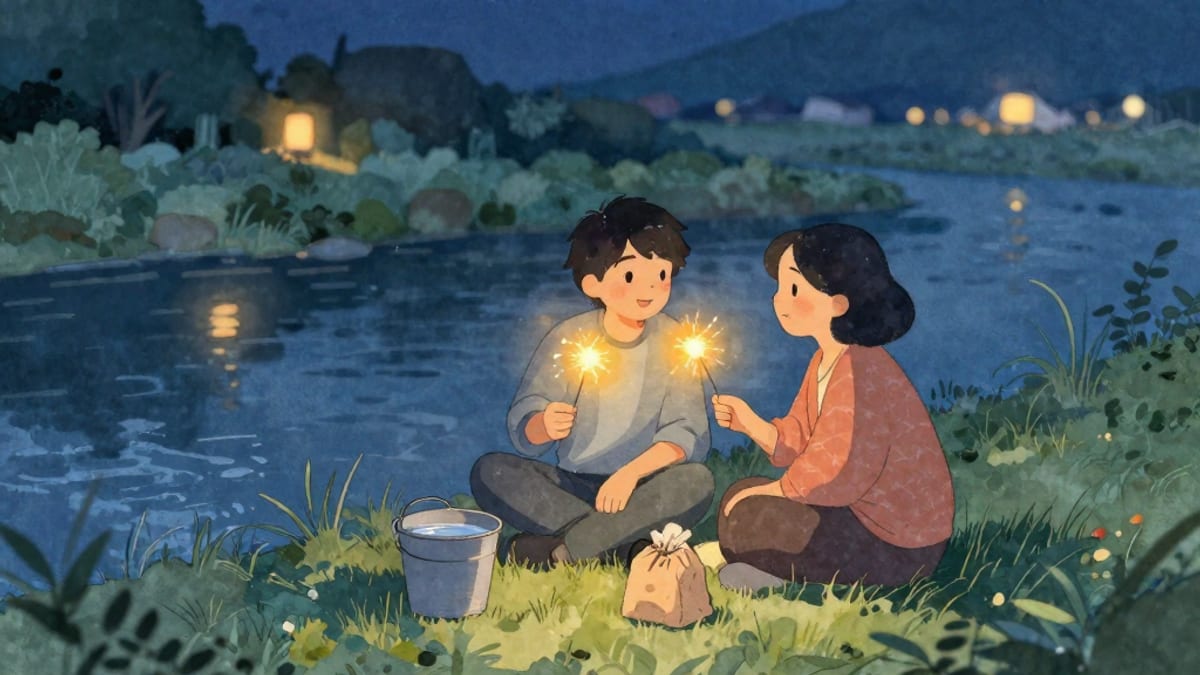
| Japanese | Romaji | Meaning |
|---|---|---|
| 今夜、花火やろうよ! | Kon'ya, hanabi yarō yo! | Friend: Let's do fireworks tonight! |
| いいね。ライター持ってる? | Ii ne. Raitā motteru? | You: Great. Do you have a lighter? |
| うん。じゃあ、火をつけるね。 | Un. Jā, hi o tsukeru ne. | Friend: Yeah. OK, I'll light it. |
| わあ、きれい! | Wā, kirei! | You: Wow, beautiful! |
| バケツに水、入ってる? | Baketsu ni mizu, haitteru? | Friend: Is there water in the bucket? |
| 入ってるよ。最後は線香花火ね。 | Haitteru yo. Saigo wa senkō hanabi ne. | You: Yes. Let's end with the little sparklers. |
| どっちが長く持つか勝負しよう。 | Dotchi ga nagaku motsu ka shōbu shiyō. | Friend: Let's see whose lasts longer. |
Fire tattoos and designs: 火, 炎 or a word?
Fire is a popular theme for tattoos, logos and T-shirts, and the kanji is easy to draw. Before you commit, it helps to know how Japanese readers will see each option.
- A single 火 is clear but very plain. To many Japanese readers it looks like a label, the way the English word FIRE alone on an arm might look. It is also the kanji on the Tuesday line of every calendar.
- 炎 feels more dramatic and artistic, and it is a common choice in designs about energy, passion or a fighting spirit. Many people find it a better single character than 火.
- A word often says more than one kanji. 情熱 (jōnetsu, passion), 闘志 (tōshi, fighting spirit) or 不屈 (fukutsu, unyielding) express a clear idea, while one character can feel incomplete.
- Chinese and Japanese both use 火 and 炎 with the same basic meaning, so here there is no trap between the two languages. The risk is in longer phrases, which can be natural in one language and odd in the other.
- Ask a native speaker to check the exact characters, the direction and the font or brush style before you get inked. Mirrored or merged characters are a common and permanent mistake.
If you plan to visit Japanese hot springs, remember that many onsen and public baths have rules about tattoos. Rules vary by place, so check and respect each one rather than trying to hide a tattoo where it is not allowed.
Look-alike kanji and common learner mistakes
火 is small and simple, which makes it easy to confuse with a few cousins. The most common mix-up is with 灰, ash, which has 火 sitting under a roof-like stroke. 炭, charcoal, has the same shape with a mountain on top. And 秋, autumn, hides 火 on its right side, which surprises many learners.
| Japanese | Romaji | Meaning |
|---|---|---|
| 灰 | hai | ash |
| 炭 | sumi | charcoal |
| 秋 | aki | autumn |
| 人 | hito | person |
- Reading 花火 as hanahi. The sound changes: hanabi.
- Using kaji for a skin burn. A burn is yakedo; kaji is a fire that damages a building.
- Writing 火 like 人 with two extra dots added at the end. The dots come first.
- Using 炎 for a cooking flame. The gas ring on a stove is hi: hi o tsuyoku shite, turn the heat up.
- Saying enjō only about the internet. In the news it still means a building going up in flames too.
Make 火 stick with a five-minute Mocchi review
Sign in, open Mocchi and type /kanji 火. Mocchi gives you the meaning, the readings and common words, and you can follow up with: Explain when 火 is read hi, bi or ka, with examples. Then ask for a short quiz on this post's words with /quiz. Mocchi keeps track of which ones you miss, such as yakedo or hikagen, and picks up where you left off the next time you open the chat.
To make the cooking words automatic, ask Mocchi to make flashcards for tsuyobi, chūbi, yowabi and hi o kesu with /create-flashcards. You choose a photo for each card, so a picture of a blue gas flame can stand for chūbi, and /review-flashcards brings the hard ones back sooner. Those same cards can feed Kotoba Tank in the games, where you hear a word and hit the right one.