
光 at a glance: four bright words
光 means light. As a noun it is hikari, and as a verb, with the okurigana る, it is hikaru, to shine. In compounds it switches to kō, which is how it appears in two of the most useful words for visitors: sunlight and sightseeing.
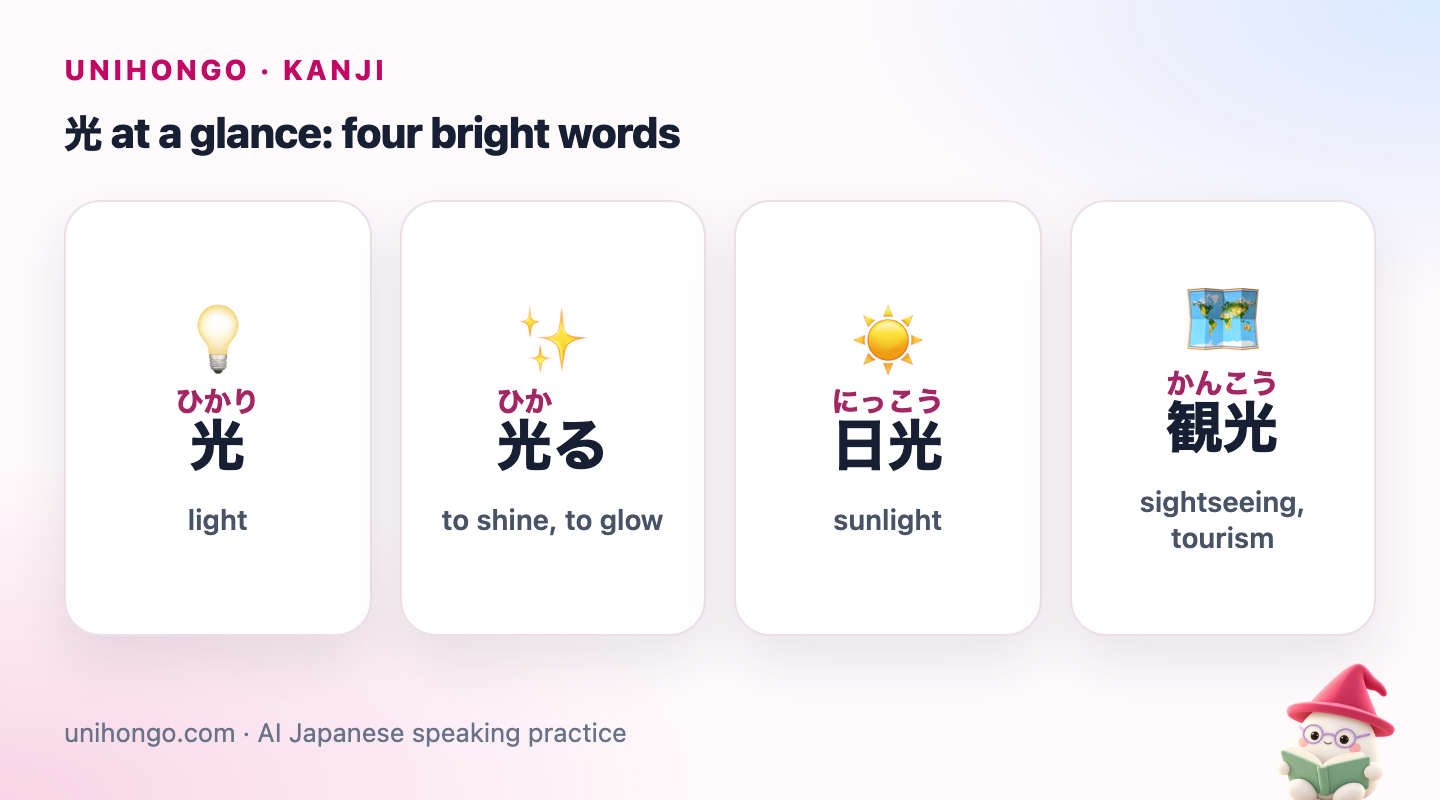
| Japanese | Romaji | Meaning |
|---|---|---|
| 光 | hikari | light |
| 光る | hikaru | to shine, to glow |
| 日光 | nikkō | sunlight |
| 観光 | kankō | sightseeing, tourism |
Readings, parts and stroke order of 光
光 has six strokes. The top part is usually explained as fire and the bottom part, 儿, as a person, so the kanji shows fire carried above a person, shining light around them. It is a helpful picture to remember even if you do not know the history.
| Japanese | Romaji | Meaning |
|---|---|---|
| 今、何か光った! | Ima, nanika hikatta! | Something just flashed! |
| 光が見える。 | Hikari ga mieru. | I can see a light. |
| Reading | Type | When you use it | Examples |
|---|---|---|---|
| hikari | kun'yomi (noun) | light as a thing | 光, hikari; 稲光, inabikari |
| hika(ru) | kun'yomi (verb) | to shine | 光る, hikaru; 光った, hikatta |
| kō | on'yomi | compounds | 日光, nikkō; 観光, kankō; 光景, kōkei |
How to write it: start with the short vertical stroke in the centre, then the dot on the left, then the short stroke falling to the left on the right side. Next write the long horizontal line. Below it, write the stroke that falls to the left, and finish with the last stroke, which goes down, turns right along the bottom and ends with a small upward hook. Keep the two legs apart so the kanji stands steadily.
Watch the change in the past tense: hikaru becomes hikatta, it shone or it flashed. Ima nanika hikatta, something just flashed, is a common reaction to lightning or a camera flash.
Everyday words with 光
These are the 光 words you will meet at home, at work and on a trip. A few are very practical: hikari kaisen is the standard term for fibre-optic internet, and kōnetsuhi, light and heat costs, is the word for utility bills in a monthly budget.
| Japanese | Romaji | Meaning |
|---|---|---|
| 逆光で顔が暗い。 | Gyakkō de kao ga kurai. | My face is dark because of the backlight. |
| 光回線を申し込みたいです。 | Hikari kaisen o mōshikomitai desu. | I'd like to sign up for fibre internet. |
Kōei desu is a formal, humble way to say you are honoured, for example when a client praises your work or you are invited to give a speech. With friends it can sound playful or exaggerated. Gyakkō, backlight, is a word photographers and anyone taking a selfie by a window will hear: gyakkō de kao ga kurai, my face is dark because of the backlight.
Sparkle, glitter and flash: shine sounds
Japanese describes how something shines with sound-and-feeling words, and they are so common that you will hear them every day. They usually come with the verb hikaru or with suru. Choosing the right one tells your listener exactly what kind of light you mean.
| Japanese | Romaji | Meaning |
|---|---|---|
| 星がきらきら光っている。 | Hoshi ga kira kira hikatte iru. | The stars are twinkling. |
| 靴がぴかぴかだ。 | Kutsu ga pika pika da. | My shoes are spotless and shiny. |
| 電気がちかちかしている。 | Denki ga chika chika shite iru. | The light is flickering. |
| 目がきらきらしている。 | Me ga kira kira shite iru. | Their eyes are sparkling. |
| Sound word | Kind of light | Typical use |
|---|---|---|
| kira kira | twinkling, sparkling | stars, jewels, eyes full of hope |
| pika pika | flashing; also polished and brand new | lightning, clean shoes, a new car |
| chika chika | flickering, tiring to look at | a failing light, a screen |
| giragira | glaring, harsh | a fierce summer sun |
Pika pika has two senses: a flash of light, and something so clean or new that it gleams. A child starting school is sometimes called pika pika no ichinensei, a shiny new first-year pupil, because of their new school bag and uniform.
Mini dialogue: at a tourist information desk
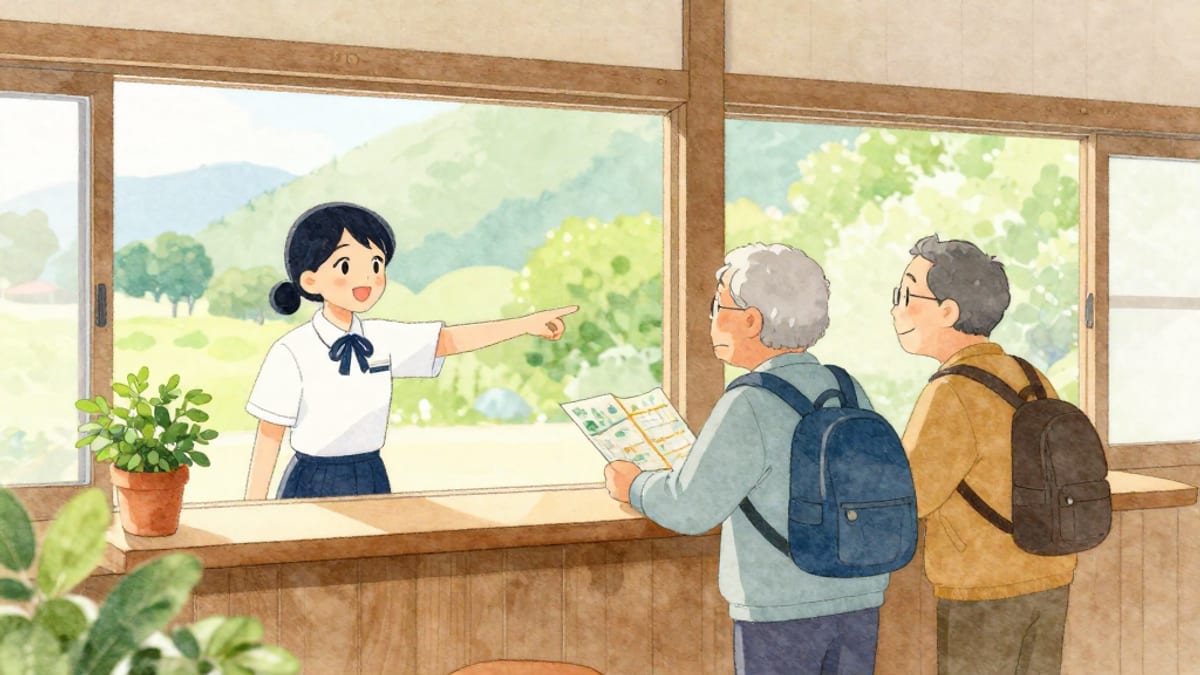
Most Japanese cities and many towns have a tourist information centre, a kankō annaijo, at the main station or in the town centre. Staff can give you a map, suggest places to visit and explain how to get there, often in simple Japanese if you ask. It is a perfect place to practise, because the conversation follows a clear pattern.
| Japanese | Romaji | Meaning |
|---|---|---|
| すみません、観光マップはありますか。 | Sumimasen, kankō mappu wa arimasu ka. | You: Excuse me, do you have a sightseeing map? |
| はい、こちらです。どちらへ行かれますか。 | Hai, kochira desu. Dochira e ikaremasu ka. | Staff: Yes, here. Where are you heading? |
| この近くで、おすすめの所はありますか。 | Kono chikaku de, osusume no tokoro wa arimasu ka. | You: Is there anywhere you recommend nearby? |
| 夕方なら、川沿いの夜景がきれいですよ。 | Yūgata nara, kawazoi no yakei ga kirei desu yo. | Staff: In the evening, the night view by the river is lovely. |
| そこまでどのくらいかかりますか。 | Soko made dono kurai kakarimasu ka. | You: How long does it take to get there? |
| 歩いて十五分ぐらいです。 | Aruite jūgofun gurai desu. | Staff: About fifteen minutes on foot. |
Sayings and names with 光
Light appears in a few well-known expressions. Kōin ya no gotoshi, light and shade pass like an arrow, is a formal saying for how fast time flies, often quoted in school speeches. Oya no nanahikari, the seven lights of a parent, describes someone who benefits from a famous or powerful parent's reputation, and it is usually critical. Me o hikaraseru, to make your eyes shine, means to keep a sharp watch on something.
光 is also a popular kanji in given names, chosen for brightness and hope. It can be read Hikari or Hikaru on its own, and kō or mitsu inside longer names. As with all names, the same name can be written with other kanji, and the same kanji can be read in other ways.
| Japanese | Romaji | Meaning |
|---|---|---|
| 光陰矢のごとし | kōin ya no gotoshi | time flies like an arrow |
| 親の七光り | oya no nanahikari | riding on a parent's fame |
| 目を光らせる | me o hikaraseru | to keep a sharp eye on |
| 光 | Hikari | light · girl or unisex |
| 光 | Hikaru | to shine · unisex |
Light tattoos and designs
Light suggests hope, guidance and goodness, and 光 is short, balanced and easy to recognise. It is one of the more natural single-kanji choices, but a few points are still worth checking.
- 光 alone reads clearly as light and has a positive feeling. Some readers may also read it as a name, Hikari or Hikaru.
- A word can add a story: 希望の光 (kibō no hikari, a light of hope) or 光明 (kōmyō, a ray of hope, a light in the darkness).
- In Chinese, 光 also means light, but in some compounds it means bare or used up, such as a shaved head or food all eaten. On its own it is fine; just check longer phrases.
- Ask a native speaker to check the characters, especially the last stroke with its hook, before you get inked.
Look-alikes and common mistakes
光 shares its legs, 儿, with 先 (sen, ahead), 元 (gen, origin) and 兄 (ani, older brother). Its top shape is shared with 当 (tō, to hit, correct). Look at the top half to tell them apart.
| Japanese | Romaji | Meaning |
|---|---|---|
| 先生 | sensei | a teacher |
| 元気 | genki | well, healthy |
| 兄 | ani | my older brother |
- Saying hikari for the verb. Light is hikari; to shine is hikaru.
- Thinking 観光 is about light shows. It means sightseeing; a light show or illumination is iruminēshon.
- Using kōei desu with close friends. It sounds very formal and can come across as a joke.
- Reading 日光 as hikari. It is nikkō.
Plan a sightseeing chat with Mocchi and Ibuki-sensei
Ask Mocchi: Give me ten sentences I would need at a tourist information desk, then quiz me on them. Mocchi explains each phrase, keeps track of the ones you hesitate on and brings them back in your next review. If you are travelling soon, ask Mocchi to add a short daily travel-phrase task to your study plan until your trip.
When you are ready to speak, open AI Sensei, pick Ibuki-sensei and ask him to play the staff member at a kankō annaijo. Ask for a map, a recommendation and the way there, then read the corrections in the session report.