
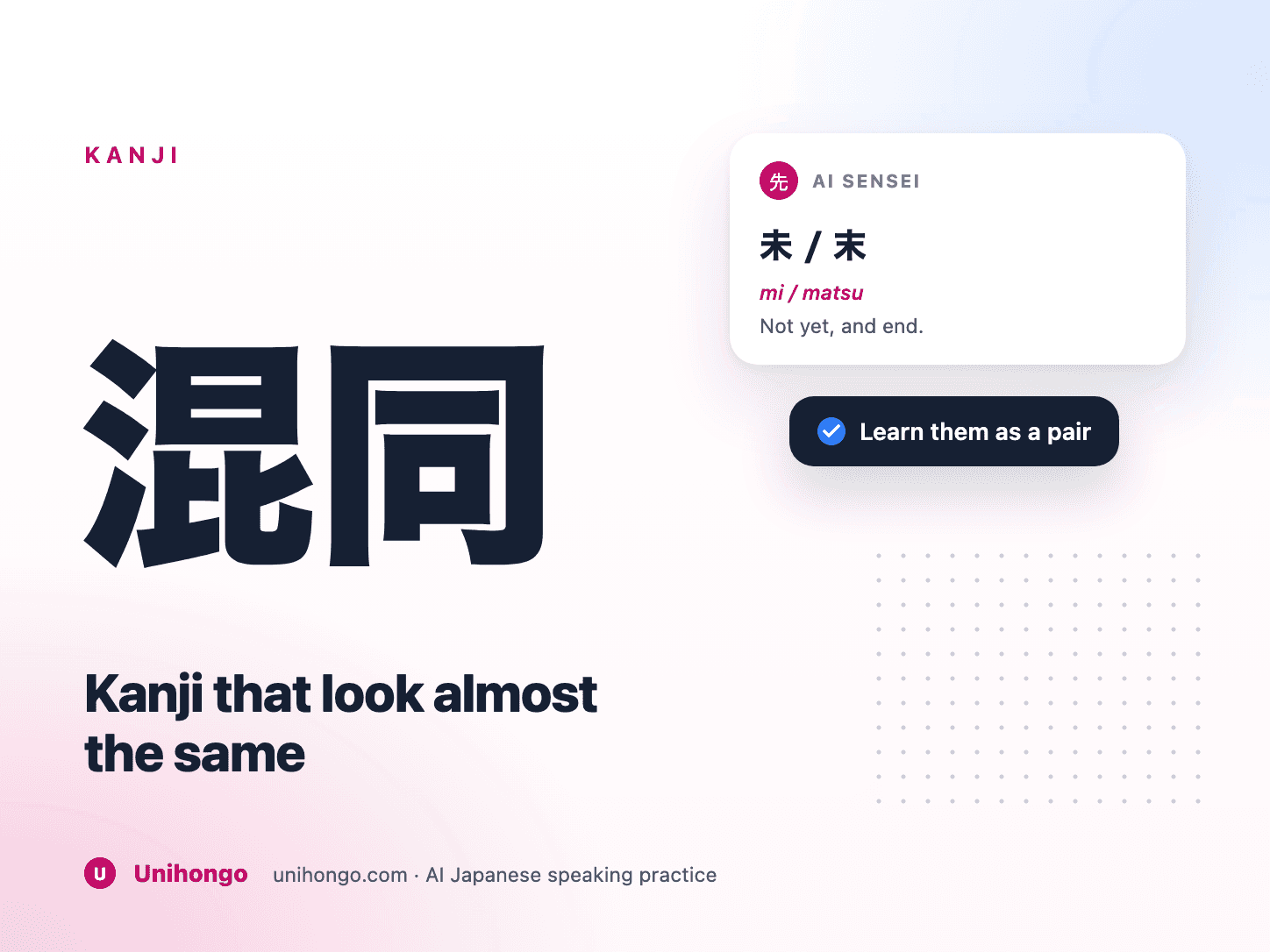
One stroke apart
The commonest kind of confusion is a pair differing by a single stroke. The characters are otherwise identical, and the difference is easy to overlook when reading and easy to omit when writing.
These are worth learning as pairs from the start rather than meeting the second one months later and discovering it collides with something you already know.
| Japanese | Romaji | Meaning |
|---|---|---|
| 土 / 士 | tsuchi / shi | Earth, and a gentleman or scholar |
| 未 / 末 | mi / matsu | Not yet, and end |
| 大 / 犬 | dai / inu | Large, and dog: one dot |
| 日 / 曰 | hi / etsu | Sun, and to say |
| 千 / 干 | sen / kan | Thousand, and dry |
| 矢 / 失 | ya / shitsu | Arrow, and to lose |
Same component, different position
A second family of confusions comes from characters built from the same components arranged differently. Here the parts are familiar and the arrangement is what distinguishes them.
Recognising the components is what makes these separable, which is one of the practical arguments for learning radicals rather than treating characters as pictures.
| Japanese | Romaji | Meaning |
|---|---|---|
| 休 / 体 | yasumu / karada | Rest, and body |
| 招 / 紹 | maneku / shō | To invite, and to introduce |
| 持 / 待 | motsu / matsu | To hold, and to wait |
| 特 / 侍 | toku / samurai | Special, and retainer |
| 緑 / 縁 | midori / en | Green, and connection |
Each of these pairs differs only in one component. Learning what each component means makes the pair separable rather than arbitrary.
Why learning them apart fuses them
Memory for visually similar items works by contrast. If two characters are learned separately, each is stored against a vague impression rather than against its partner, and when they finally meet they collapse.
Learning them together does the opposite: the memory is stored as a difference, which is far more stable than a shape.
- Introduce the pair together, even if one is more common.
- State the difference in words, out loud.
- Write them alternately rather than in blocks.
- Attach each to a concrete word you use.
- Test them against each other rather than in a mixed deck.
Attach each to a word
A character attached to an abstract meaning is easy to confuse; a character attached to a word you actually say is not. This is the single most effective technique for separating a stubborn pair.
Choose words you already use rather than the first dictionary example, because the point is to connect the character to something already stable in memory.
| Japanese | Romaji | Meaning |
|---|---|---|
| 休む | yasumu | To rest: fixes the first character |
| 体調 | taichō | Physical condition: fixes the second |
| 持つ | motsu | To hold |
| 待つ | matsu | To wait |
| 特別 | tokubetsu | Special |
| 緑茶 | ryokucha | Green tea |
Each of these is a word you will meet weekly. That frequency is what keeps the character attached rather than drifting back towards its partner.
Writing as the disambiguator
Two characters that look similar are often written quite differently, with different stroke orders and different numbers of strokes. Writing them encodes that difference in a way that reading does not.
This is the reason handwriting practice keeps being recommended even in an era when almost nothing is handwritten: it is the most reliable way to separate confusable characters.
- Write the pair alternately, five times each.
- Follow correct stroke order; it differs more than the shape does.
- Count the strokes; the number often differs.
- Say the reading aloud as you write.
- Do it for a week, then stop; this does not need months.
When context is enough
For reading, context resolves most confusions without any effort. A character in a familiar word is identified by the word rather than by the character, which is why fluent readers rarely notice these pairs at all.
For writing, context does not help, which is where the confusion produces real errors. That asymmetry is worth knowing: if you only ever read, these pairs may never trouble you, and the moment you write they will.
Prioritise the pairs that appear in words you write. The ones you only read will be resolved by context indefinitely.