
From shaved ice to glaciers: 氷 in four words
氷 means ice, and its words range from the sweetest summer snack to the slowest-moving things on the planet. These four give you both readings and both ends of that range: shaved ice, ice itself, a glacier and the drift ice that arrives on Hokkaido's northern coast in winter.
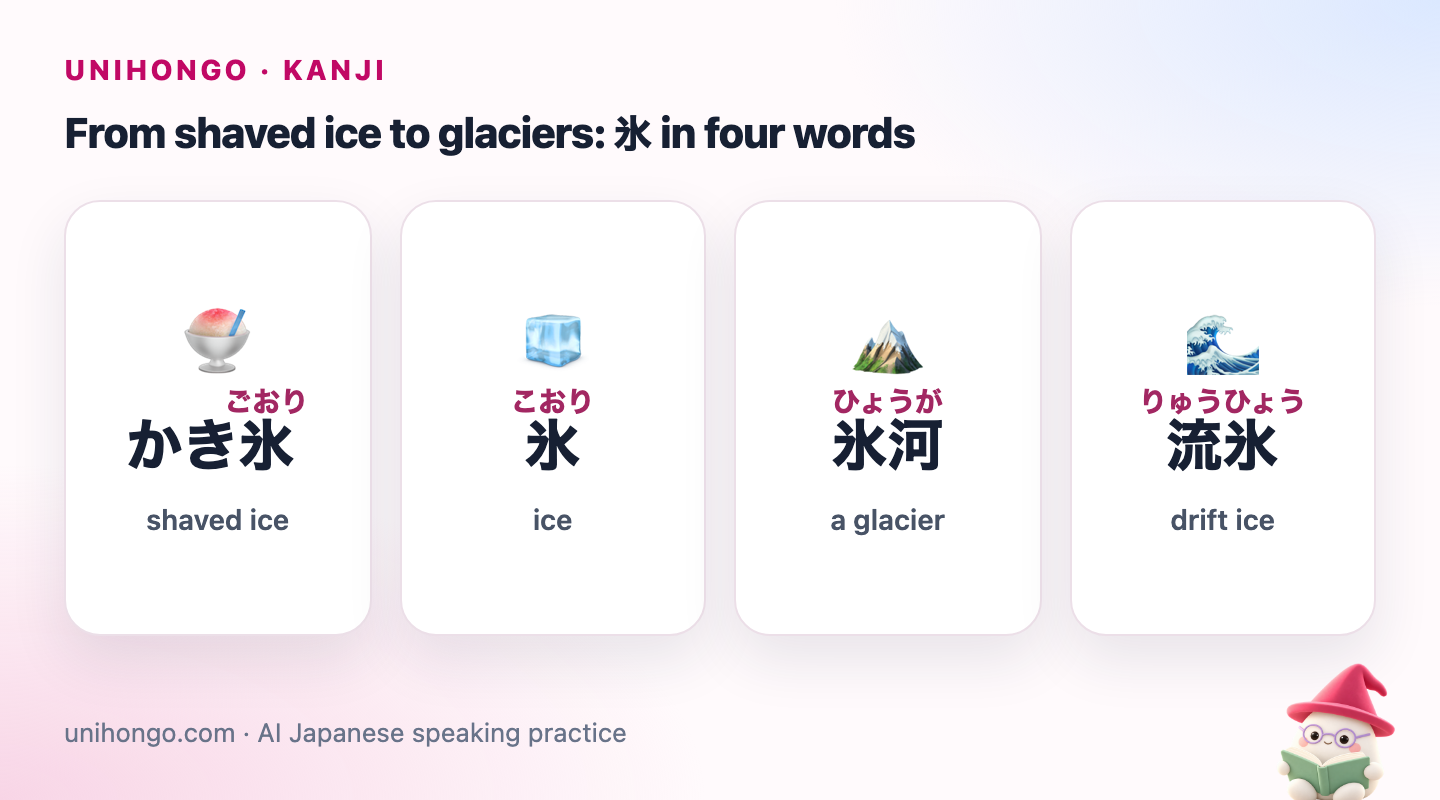
| Japanese | Romaji | Meaning |
|---|---|---|
| かき氷 | kakigōri | shaved ice |
| 氷 | kōri | ice |
| 氷河 | hyōga | a glacier |
| 流氷 | ryūhyō | drift ice |
Readings, the extra dot and stroke order
氷 has five strokes. It is usually explained as water, 水, with a dot added to show it has frozen. In older writing, the dot was a separate ice radical, 冫, which still appears on the left of kanji such as 冷 (cold) and 凍 (freeze). When you see those two short strokes on the left, think cold.
The readings follow the usual split. Alone, it is kōri, a native Japanese word that is related to the verb kōru, to freeze. In compounds borrowed from Chinese, it is hyō.
| Japanese | Romaji | Meaning |
|---|---|---|
| 冷たい | tsumetai | cold (to the touch) |
| 凍る | kōru | to freeze |
| Reading type | Reading | When it is used | Example |
|---|---|---|---|
| kun'yomi | kōri | alone and in native words | 氷, kōri; 氷水, kōrimizu, ice water |
| kun'yomi (after another word) | gōri | with a sound change | かき氷, kakigōri |
| on'yomi | hyō | in most compounds | 氷河, hyōga; 流氷, ryūhyō |
| kun'yomi (rare) | hi | a few literary words | 氷雨, hisame, a cold winter rain |
Fourteen ice words for cafés, winter and the news
These are the words with 氷 you are most likely to meet. The first group belongs to daily life, the second to weather and nature. Notice how long vowels appear in almost every one; dropping them is the most common pronunciation mistake.
| Japanese | Romaji | Meaning |
|---|---|---|
| 氷水 | kōrimizu | ice water |
| 氷砂糖 | kōrizatō | rock sugar |
| 氷枕 | kōrimakura | an ice pillow (for a fever) |
| 製氷機 | seihyōki | an ice maker |
| 氷点下 | hyōtenka | below freezing |
| 氷山 | hyōzan | an iceberg |
| 薄氷 | hakuhyō | thin ice |
| つらら | tsurara | an icicle |
| 池が凍った。 | Ike ga kōtta. | The pond froze over. |
| 今朝は氷点下だった。 | Kesa wa hyōtenka datta. | It was below freezing this morning. |
Kōrimakura, an ice pillow, is a classic Japanese way to cool a fever: a soft pack of ice or gel wrapped in a towel under the head. Tsurara is usually written in hiragana, although it can also be written 氷柱. And hyōtenka is a word you will hear in winter weather forecasts: ashita no asa wa hyōtenka ni naru deshō, tomorrow morning will probably drop below freezing.
Drift ice, ryūhyō, arrives on the Sea of Okhotsk coast of Hokkaido in winter, usually around February, and towns such as Abashiri run sightseeing boats through it. Exact timing varies from year to year.
Kōri or aisu? Ordering ice without getting ice cream
English uses ice for frozen water and puts ice cream in its own word. Japanese borrowed the English word ice as アイス (aisu), but in everyday speech aisu means ice cream. So if you ask a friend aisu aru? at home, they will open the freezer and look for a tub of ice cream, not ice cubes.
Aisu also appears at the start of iced drinks: aisu kōhī, aisu tī. For the cubes themselves, use kōri. Restaurants in Japan usually serve water, called ohiya, with ice already in it, and drinks often come with plenty of ice, so these phrases are handy.
| Japanese | Romaji | Meaning |
|---|---|---|
| 氷なしでお願いします。 | Kōri nashi de onegai shimasu. | No ice, please. (polite) |
| 氷少なめでお願いします。 | Kōri sukuname de onegai shimasu. | Less ice, please. (polite) |
| アイスコーヒーをください。 | Aisu kōhī o kudasai. | An iced coffee, please. |
| 冷凍庫にアイスあるよ。 | Reitōko ni aisu aru yo. | There's ice cream in the freezer. |
| Word | Meaning | Example |
|---|---|---|
| 氷 (kōri) | ice, ice cubes | kōri o irete, put ice in it |
| アイス (aisu) | ice cream | aisu o tabeyō, let's have ice cream |
| アイス + drink | iced (drink) | aisu kōhī, iced coffee |
| お冷 (ohiya) | cold water at a restaurant | ohiya o kudasai, water, please |
At the shaved-ice stall: a festival dialogue
Kakigōri is a summer favourite at festivals, beaches and cafés. In summer you may see shops hang a cloth flag with one large 氷 on it, the traditional sign that shaved ice is sold inside. At a festival, a stall keeper usually speaks casually and warmly; it is fine to answer politely. Here is a typical exchange, with your friend joining in at the end.

| Japanese | Romaji | Meaning |
|---|---|---|
| いらっしゃい!何味にする? | Irasshai! Nani aji ni suru? | Stall keeper: Welcome! Which flavour? |
| イチゴをひとつください。 | Ichigo o hitotsu kudasai. | You: One strawberry, please. |
| 練乳もかける? | Rennyū mo kakeru? | Stall keeper: Condensed milk on top too? |
| はい、お願いします。 | Hai, onegai shimasu. | You: Yes, please. |
| はい、どうぞ。冷たいから気をつけてね。 | Hai, dōzo. Tsumetai kara ki o tsukete ne. | Stall keeper: Here you go. Careful, it's cold. |
| 頭がキーンとする! | Atama ga kīn to suru! | Friend: Ow, brain freeze! |
| 急いで食べるからだよ。 | Isoide taberu kara da yo. | You: That's because you're eating too fast. |
| でも、早く食べないと溶けちゃう。 | Demo, hayaku tabenai to tokechau. | Friend: But if I don't hurry, it'll melt. |
Sayings and set phrases with ice
Ice appears in a few expressions that are common in news reports, business talk and conversation. Two of them are straight equivalents of English expressions, which makes them easy to remember.
| Japanese | Romaji | Meaning |
|---|---|---|
| 氷山の一角 | hyōzan no ikkaku | the tip of the iceberg |
| 薄氷を踏む思い | hakuhyō o fumu omoi | like walking on thin ice |
| 氷のように冷たい | kōri no yō ni tsumetai | ice-cold |
| 氷が溶ける | kōri ga tokeru | the ice melts |
Hyōzan no ikkaku is common in the news, usually about problems: kore wa hyōzan no ikkaku ni suginai, this is only the tip of the iceberg. Hakuhyō o fumu omoi describes the tense feeling of a situation that could go wrong at any moment, such as a close match or a delicate negotiation. Kōri no yō ni tsumetai can describe a drink, a hand in winter, or a person's cold attitude, just as in English.
Ice in tattoos and designs: 氷, 冰 or a word?
Ice suggests calm, clarity and coolness, which makes it attractive for tattoos, game characters and logos. A few points are worth knowing first.
- A lone 氷 is the character on the traditional shaved-ice flag. Many Japanese readers will think of a summer snack shop, which may not be the mood you want.
- Chinese and Japanese write ice differently. Chinese uses 冰, with the two-stroke ice radical on the left; Japanese uses 氷. They look similar, but a Japanese reader will see 冰 as foreign.
- A word often works better than one kanji. 氷雪 (hyōsetsu, ice and snow) has a literary, wintry feel, and 雪 (yuki, snow) alone is a popular, softer choice.
- Watch the dot. Put it on top instead of at the side and you have written 永, eternity, a completely different tattoo.
- Ask a native speaker to check the characters and the brush style before you book the appointment.
Look-alikes: 水, 氷 and 永
These three are the classic trio that catches learners out. 水 (water) has no dot. 氷 (ice) has a dot on the upper left. 永 (eternity) has a dot on top. Say it as a story: water freezes when a dot of cold lands beside it, and lasts forever when the dot crowns it.
| Japanese | Romaji | Meaning |
|---|---|---|
| 水 | mizu | water |
| 永遠 | eien | eternity |
| 泳ぐ | oyogu | to swim |
- Saying kori with a short o. It needs the long vowel: kōri.
- Asking for aisu when you want ice cubes. Ask for kōri.
- Reading 氷河 as kōriga. In compounds, 氷 is hyō: hyōga.
- Using kōru (to freeze) for food in a freezer. For freezing food on purpose, say reitō suru.
Order kakigōri in your head first: a Mocchi warm-up
Before your next summer festival, sign in and ask Mocchi to walk you through it: Teach me the Japanese for ordering shaved ice and cold drinks, then quiz me. Mocchi explains kōri versus aisu, checks your answers and remembers the ones you hesitate on, so the next quiz starts there.
Then make the words stick visually. Ask Mocchi to /create-flashcards for kakigōri, rennyū, kōri nashi and hyōtenka, and pick a photo for each card. Those cards can go straight into Mocchi Flight, where you guide Mocchi through the gate with the right word.