
The kanji for trust at a glance
The four cards below show the trust words you need most. 信頼 is the core word for trust between people. 信じる is to believe. 信用 is trust earned by a record, and 自信, literally trust in yourself, is self-confidence.
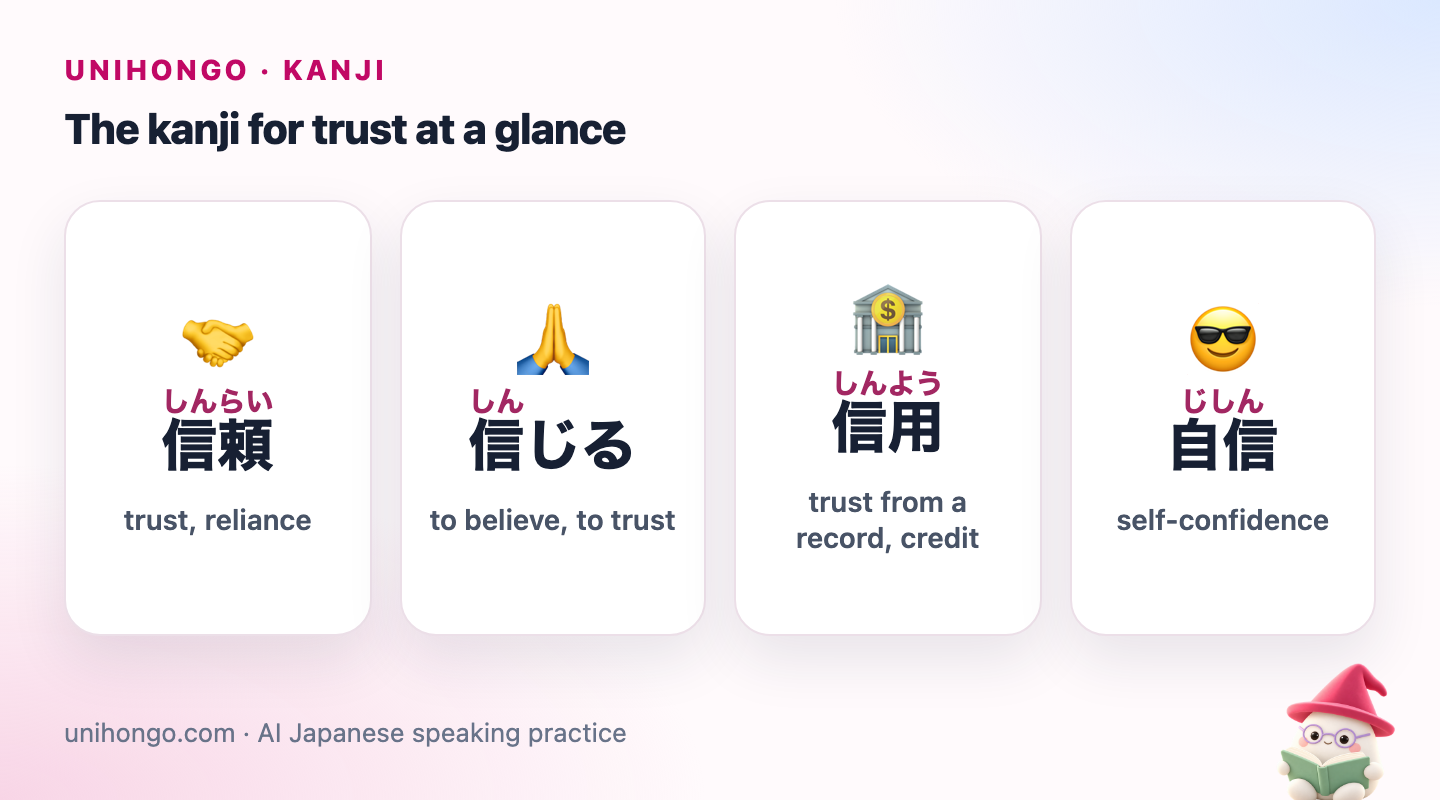
| Japanese | Romaji | Meaning |
|---|---|---|
| 信頼 | shinrai | trust, reliance |
| 信じる | shinjiru | to believe, to trust |
| 信用 | shin'yō | trust from a record, credit |
| 自信 | jishin | self-confidence |
Readings, strokes and parts
| Kanji | Strokes | On'yomi | Kun'yomi | Core meaning |
|---|---|---|---|---|
| 信 | 9 | shin | none in common use | trust, believe, message |
| 頼 | 16 | rai | tanomu, tanomoshii, tayoru | rely on, request |
| 用 | 5 | yō | mochiiru | use, business |
信 has nine strokes: the person radical 亻 on the left and 言 (word, speech) on the right. A person standing by their word is a popular way to remember it, and it fits the meaning well, but treat it as a memory aid rather than a proven origin.
信 has no kun reading in common use, so 信じる is made from the on reading shin plus じる. 頼 has 16 strokes and gives you three useful verbs: 頼む (to ask a favour), 頼る (to rely on) and the adjective 頼もしい (dependable).
Everyday words with 信
Many 信 words have nothing to do with trust and everything to do with messages, because 信 also means a communication. You will see them on your phone and in emails every day.
| Japanese | Romaji | Meaning |
|---|---|---|
| 信号 | shingō | traffic light, signal |
| 返信 | henshin | reply |
| 送信 | sōshin | sending, transmission |
| 受信 | jushin | receiving |
| 着信 | chakushin | incoming call or message |
| 通信 | tsūshin | communication, connection |
| 信念 | shinnen | belief, conviction |
| 確信 | kakushin | certainty, firm belief |
| 迷信 | meishin | superstition |
| 頼もしい | tanomoshii | dependable, reassuring |
| 頼る | tayoru | to rely on |
| 信じられない! | Shinjirarenai! | Unbelievable! |
信頼, 信用, 信じる or 頼る: which trust is which
| Japanese | Romaji | Meaning |
|---|---|---|
| 彼女は信頼できる人です。 | Kanojo wa shinrai dekiru hito desu. | She's someone you can trust. |
| あの店は信用があります。 | Ano mise wa shin'yō ga arimasu. | That shop has a good reputation. |
| 信用を失うのは一瞬です。 | Shin'yō o ushinau no wa isshun desu. | You can lose people's trust in an instant. |
| 自分を信じて。 | Jibun o shinjite. | Believe in yourself. (casual) |
| 困ったときは家族に頼ります。 | Komatta toki wa kazoku ni tayorimasu. | When I'm in trouble, I rely on my family. |
| Word | Meaning | Typical use | Register |
|---|---|---|---|
| 信頼 | Deep trust in character | A teammate, a doctor, a partner | Neutral to formal |
| 信用 | Trust from a record; credit | A company, a bank, a document, a reputation | Neutral, business |
| 信じる | To believe | A person, a story, yourself, a religion | Everyday |
| 頼る | To rely on, depend on | Family, a friend, a map app | Everyday |
| 任せる | To leave to someone | A task at work, a decision | Everyday |
When not to use them: 信用しています said to a friend can sound like you have checked their record, which is cold. 信じているよ is warm but heavy, a line from a film or a big moment. In daily life, people show trust by handing things over: 任せるね, I'll leave it to you.
信用 is also the business word behind credit. A local credit union is a 信用金庫 (shin'yō kinko), often shortened to 信金, and 信用調査 is a credit check. A credit card, though, is simply クレジットカード.
Names and a look-alike
信 appears in boys' names, usually read shin or nobu, as in Shin'ya (信也) and Shinsuke (信介). Makoto, meaning sincerity, can also be written 信, though 誠 is the more common spelling. As with every name, the same sound can be written with other kanji.
| Japanese | Romaji | Meaning |
|---|---|---|
| 信也 | Shin'ya | trust · boy |
| 信介 | Shinsuke | trust and help · boy |
| 頭 | atama | head |
The look-alike problem is on the right side of 頼. It ends in 頁, the same part as 頭 (head) and 顔 (face). If you read 頼 as 頭, look at the left side: 頼 has 束 (a bundle), 頭 has 豆 (bean).
Mini dialogue: being trusted with a task at work
Trust at work is usually shown by handing over a task. Here a manager gives a project to a team member, and the replies show how to accept with confidence and modesty.

| Japanese | Romaji | Meaning |
|---|---|---|
| この件、任せてもいいですか。 | Kono ken, makasete mo ii desu ka. | Manager: Can I leave this matter to you? |
| はい、任せてください。 | Hai, makasete kudasai. | You: Yes, leave it to me. |
| 頼りにしていますよ。 | Tayori ni shite imasu yo. | Manager: I'm counting on you. |
| 信頼していただいて、ありがとうございます。 | Shinrai shite itadaite, arigatō gozaimasu. | You: Thank you for trusting me. |
| 何かあったら、すぐ相談してくださいね。 | Nanika attara, sugu sōdan shite kudasai ne. | Manager: If anything comes up, talk to me right away. |
The manager never says 信頼しています. Handing over the task and saying 頼りにしています does the work, and your reply, thanking them for their trust, shows that you noticed. This indirect style is common in Japanese workplaces, though every team has its own culture.
信 or 信頼 as a tattoo or design
On its own, 信 reads as trust, belief or faith. Japanese readers may take it as religious faith, as in 信仰 (shinkō), or simply as one half of a word. In Chinese, 信 is also the everyday word for a letter, so a Chinese reader may see a different meaning. Japanese writes letter as 手紙, which in Chinese means toilet paper, a classic example of how the same kanji can drift apart between languages.
信頼 is the clearest choice for trust. 信じる心 (shinjiru kokoro, a believing heart) is a natural, gentle phrase, and 自信 suits a design about self-confidence. Ask a native speaker to check the characters and the design before inking.
| Japanese | Romaji | Meaning |
|---|---|---|
| 信じる心 | shinjiru kokoro | a heart that believes |
Build a trust-word deck with Mocchi
Ask Mocchi: Make flashcards for henshin, sōshin, chakushin, shingō, shinrai and shin'yō with a short example for each. With /create-flashcards, Mocchi adds them to your Flash Card list and lets you pick a photo per card, such as a traffic light for 信号. It then reviews them with you using spaced repetition, so the message words you keep forgetting come back sooner.
Once the deck feels comfortable, run it in Vocabulary Dash, the 3D word runner, using your own flashcards. Then ask Mocchi to /explain 頼りにしていますよ and notice how much trust sits in a sentence with no trust word in it.
Common mistakes and how to write 信
- Saying 信用しています to a friend when you mean I trust you. It sounds like a credit check; use 信じているよ or show it with 任せるね.
- Writing 信じます with a kun reading in mind. There is none in common use; it is always shinjiru.
- Forgetting the apostrophe in shin'yō. It shows that n and yō are separate sounds, not nyo.
- Reading 自信 as believing in yourself only. It is the everyday word for confidence: 自信がない, I'm not confident.