
What to study for academic vocabulary, argument structure, and abstract meaning
N1 reading asks you to follow abstract claims at speed. This guide focuses on academic and editorial kanji such as 前提, 根拠, 顕著, and 論理, using component stories and sentence roles to make them easier to retrieve.
The useful unit is not a character or sound by itself. It is a Japanese word inside a situation. Read the examples aloud, notice the repeated patterns, and connect each new item to a task you would ask an AI Japanese teacher to practise with you.
Work in small, repeatable sets. Five focused items are enough for one session if you can retrieve them without looking, recognise them in a new sentence, and explain the difference between a correct answer and a tempting wrong one. That kind of practice is especially valuable for JLPT preparation because the test changes the surrounding vocabulary while keeping the underlying skill constant.
Memory tricks and core examples
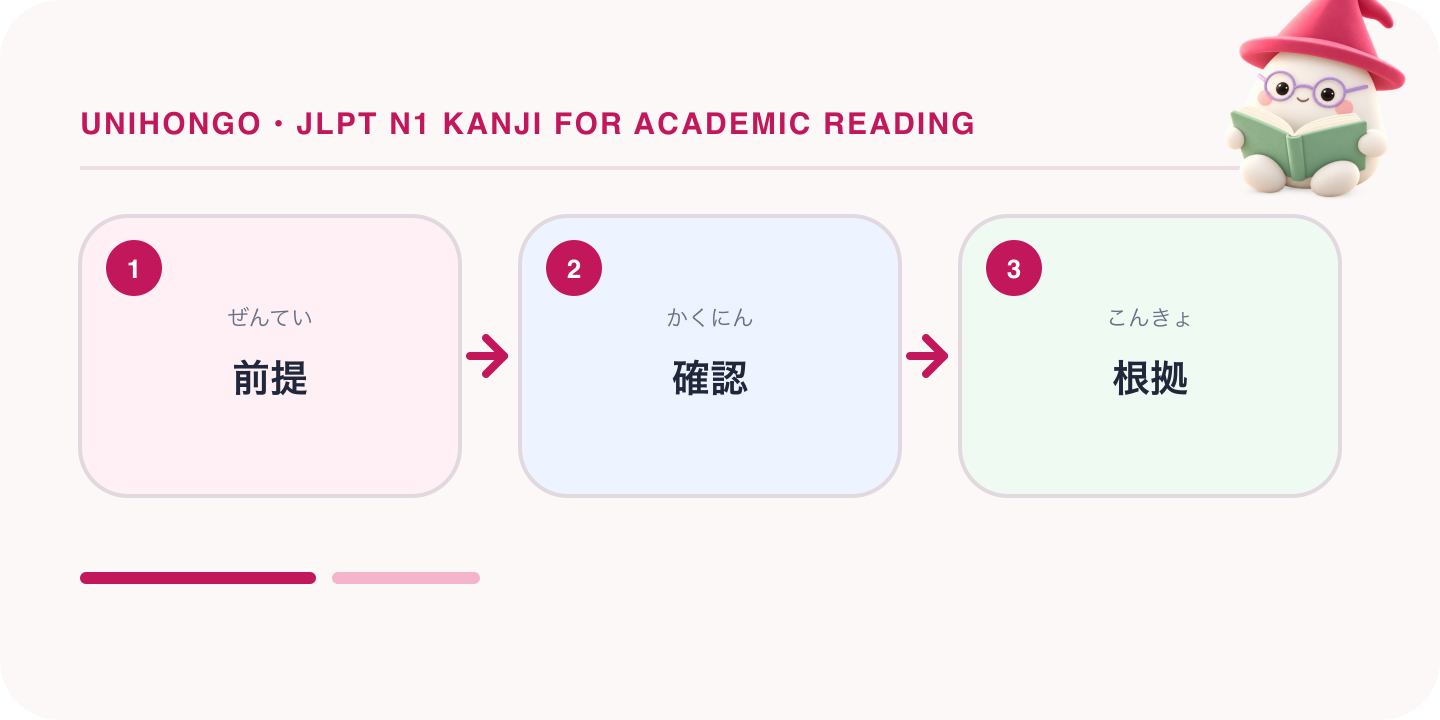
前提 is the idea placed before the argument. 根拠 is the root that supports a claim. 顕著 is a point that shows clearly, and 論理 is the thread of reasoning. Turn each compound into a role in a courtroom or classroom discussion.
| Japanese | Romaji | Meaning |
|---|---|---|
| 前提を確認する | ぜんていを かくにんする / zentei o kakunin suru | confirm the premise |
| 根拠を示す | こんきょを しめす / konkyo o shimesu | show evidence |
| 顕著な差がある | けんちょな さが ある / kencho na sa ga aru | there is a marked difference |
| 論理的に説明する | ろんりてきに せつめいする / ronriteki ni setsumei suru | explain logically |
| 問題を本質的に考える | もんだいを ほんしつてきに かんがえる / mondai o honshitsuteki ni kangaeru | consider a problem fundamentally |
Read the word, not only the character
| Study move | Why it helps | AI Sensei prompt |
|---|---|---|
| See the shape | Creates a visual anchor | Give me a five-second image clue |
| Read the word | Selects the correct reading | Quiz me in a sentence |
| Contrast a pair | Prevents look-alike errors | Test two similar compounds |
| Use it personally | Builds retrieval | Ask me a real-life question |
How to make the trick stick
- Review the character in three different words, not three copies of one word.
- Say the reading before looking at the answer.
- Keep a contrast pair beside every character you often confuse.
- Write a one-line memory story in the language you think in most naturally.
- Return to the word after one day, three days, and one week.
A review plan for this JLPT level
Use a three-stage Kanji review. On day one, learn the shape, reading, and one concrete word. On day three, retrieve the word from its meaning and write a second compound. At the end of the week, read a short passage and mark every target character you can recognise in context. For the higher levels, add a paraphrase because advanced kanji often have several close English translations.
Keep a mistake log with three columns: what I expected, what the Japanese actually did, and what clue I missed. This turns an incorrect answer into a future prediction. It also gives your AI Sensei useful material for personalised drills instead of sending you back to a generic exercise.
The next JLPT level
N1 reading also reuses N2 roots in longer compounds and nominal phrases. Review 前, 根, 顕, 論, and 質 as families, then practise identifying whether the sentence is defining, contrasting, qualifying, or concluding.
Use this article as a level checkpoint, not a finish line. When the core items feel automatic, raise the challenge one step: longer compounds for Kanji, or less transcript support and longer turns for Listening. Unihongo's AI Sensei can keep the practice at the edge of your level and turn mistakes into the next personalised exercise.