
風 at a glance: four words with wind
風 means wind. On its own it is kaze, and you hear it in every weather forecast. In compounds it usually becomes fū, and once in a while fu.
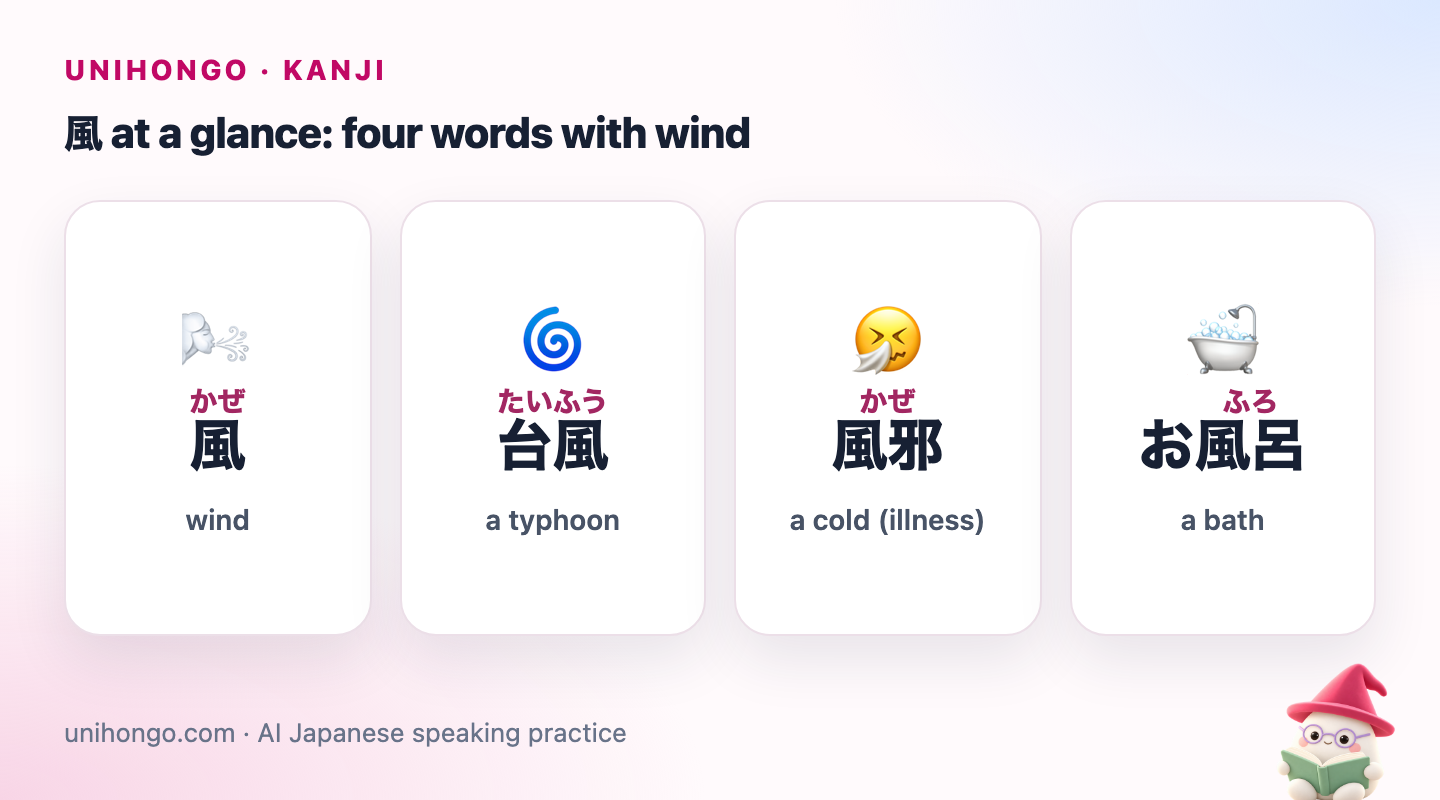
These four words show its range, from the sky to the bathroom: the wind, a typhoon, a cold that sounds the same as wind, and the bath.
| Japanese | Romaji | Meaning |
|---|---|---|
| 風 | kaze | wind |
| 台風 | taifū | a typhoon |
| 風邪 | kaze | a cold (illness) |
| お風呂 | ofuro | a bath |
Readings, parts and stroke order of 風
風 has nine strokes. In its modern form it is an outer frame shaped like 几, with a short stroke and 虫 (insect) inside. Scholars explain the ancient form in different ways, so the safest approach is to treat the parts as a memory aid: a frame, and a little bug blown about inside it.
| Reading | Type | When you use it | Examples |
|---|---|---|---|
| kaze | kun'yomi | alone and in native words | 風, kaze; 北風, kitakaze; そよ風, soyokaze |
| kaza | kun'yomi | at the start of some native words | 風上, kazakami, upwind; 風車, kazaguruma, pinwheel |
| fū | on'yomi | most compounds and the style suffix | 台風, taifū; 風景, fūkei; 和風, wafū |
| fu | on'yomi (short) | a few words | 風呂, furo; 風情, fuzei, charm, atmosphere |
How to write it: start with the left side of the frame, a stroke falling down and slightly to the left. Then write the top and right side as one stroke that runs across, down and curves out with a hook at the bottom right. Inside, write a short stroke falling to the left, then 虫 in its usual order: the small box, the vertical line, the bottom stroke rising to the right, and the final dot. Leave the frame open at the bottom.
Note that 風車 has two readings with different meanings: fūsha is a windmill, while kazaguruma is a child's pinwheel. It is a good example of why you should learn readings word by word.
A dozen everyday words with 風
These 風 words come up at home, in the weather report and in shops. Several are summer words, because a breeze matters so much in a hot, humid Japanese summer.
| Japanese | Romaji | Meaning |
|---|---|---|
| 扇風機 | senpūki | an electric fan |
| 風鈴 | fūrin | a wind chime |
| 風景 | fūkei | scenery, a view |
| 風船 | fūsen | a balloon |
| 強風 | kyōfū | a strong wind, a gale |
| そよ風 | soyokaze | a gentle breeze |
| 北風 | kitakaze | the north wind |
| 春一番 | haru ichiban | the first strong spring wind |
| 風向き | kazamuki | wind direction |
| 風が強い | kaze ga tsuyoi | the wind is strong |
| 和風 | wafū | Japanese style |
| 洋風 | yōfū | Western style |
Haru ichiban is the name for the first strong, warm southerly wind of late winter or early spring, announced on the news in many regions. It does not contain 風, but it is the wind word everyone in Japan knows. Fūrin, glass or metal wind chimes, are hung under the eaves in summer because their sound is felt to make the heat easier to bear.
風 or 風邪? Wind and a cold
The word for a cold, kaze, is written 風邪, wind plus a kanji meaning evil or harmful, an old idea of illness carried in on a bad wind. Today the two words are pronounced the same, and both have a flat pitch in standard Tokyo speech, so the difference lives entirely in the context and the verb. In handwriting and messages, many people write the illness in hiragana, かぜ, and you will see both 風邪 and かぜ on pharmacy shelves.
Because a cold is so often the reason for missing work or school, this is one of the most useful sentences in daily life. Pair it with a polite apology when you message your manager.
| Japanese | Romaji | Meaning |
|---|---|---|
| 風が吹いている。 | Kaze ga fuite iru. | The wind is blowing. |
| 風邪をひきました。 | Kaze o hikimashita. | I've caught a cold. |
| 風邪薬 | kazegusuri | cold medicine |
| 風邪をひいたので、今日は休みます。 | Kaze o hiita node, kyō wa yasumimasu. | I've caught a cold, so I'll take today off. |
| お大事にしてください。 | Odaiji ni shite kudasai. | Please take care of yourself. |
| Meaning | Kanji | Typical verb | Example in English |
|---|---|---|---|
| wind | 風 | 吹く, fuku, to blow | The wind is blowing hard. |
| a cold | 風邪 | ひく, hiku, to catch | I caught a cold. |
| cold medicine | 風邪薬 | 飲む, nomu, to take | I took some cold medicine. |
-fū: wind as style
風 also means a manner, a way or a style, and as a suffix -fū it attaches to places, eras and nouns. It is extremely common on menus, in interior design and in recipes. In the same sense, sonna fū ni means in that way, like that.
| Japanese | Romaji | Meaning |
|---|---|---|
| 関西風 | Kansai fū | Kansai style |
| 和風の部屋 | wafū no heya | a Japanese-style room |
| 洋風の朝ご飯 | yōfū no asagohan | a Western-style breakfast |
| そんな風に言わないで。 | Sonna fū ni iwanaide. | Don't say it like that. |
Wafū dressing on a salad menu is a soy-based dressing; wafū pasta is pasta with Japanese flavours such as soy sauce, mushrooms or seaweed. When you see -fū after a place name, read it as in the style of rather than from.
Mini dialogue: a typhoon is coming
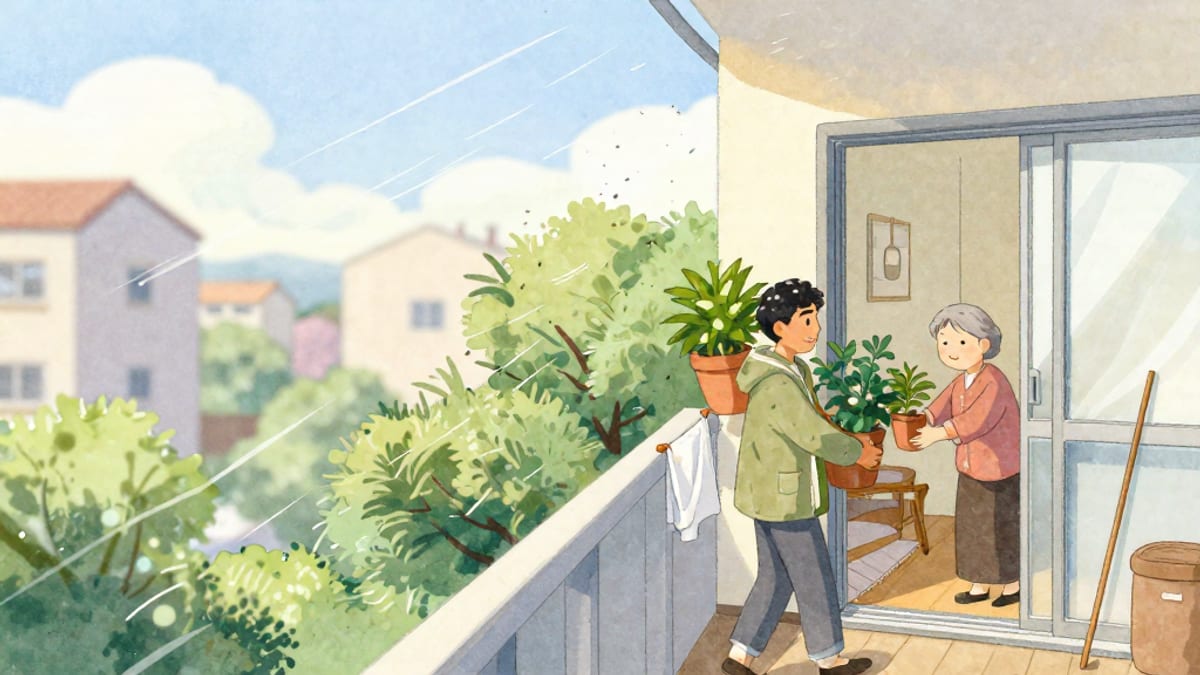
From late summer into autumn, typhoons are part of life in much of Japan. Before a strong one arrives, people bring in plants and laundry from balconies, check torches and water, and coworkers trade warnings about trains that may stop. The news gives each typhoon a number, not a name, such as taifū jūgō, typhoon number fifteen.
| Japanese | Romaji | Meaning |
|---|---|---|
| 明日、台風が来るらしいですよ。 | Ashita, taifū ga kuru rashii desu yo. | Neighbour: Apparently a typhoon is coming tomorrow. |
| 本当ですか。風、強くなりますか。 | Hontō desu ka. Kaze, tsuyoku narimasu ka. | You: Really? Will the wind get strong? |
| かなり強いみたいです。 | Kanari tsuyoi mitai desu. | Neighbour: It looks like it'll be quite strong. |
| じゃあ、植木を中に入れます。 | Jā, ueki o naka ni iremasu. | You: Then I'll bring my plants inside. |
| それがいいですね。電車も止まるかも。 | Sore ga ii desu ne. Densha mo tomaru kamo. | Neighbour: Good idea. The trains might stop too. |
| 気をつけましょうね。 | Ki o tsukemashō ne. | You: Let's both be careful. |
Sayings, names and designs with 風
Wind appears in several expressions about luck, criticism and news. Oikaze, a tailwind, is a favourable trend; mukaikaze, a headwind, is the opposite. Kazeatari ga tsuyoi, the wind hits hard, means someone is facing a lot of criticism. Kaze no tayori, news on the wind, is hearing something indirectly, like through the grapevine. 風 also appears in poetic words such as 風情 (fuzei), the charm or atmosphere of a place, and in some given names, where families choose it for a sense of freedom.
| Japanese | Romaji | Meaning |
|---|---|---|
| 追い風 | oikaze | a tailwind; a favourable trend |
| 向かい風 | mukaikaze | a headwind |
| 風の便り | kaze no tayori | news heard indirectly |
| 風当たりが強い | kazeatari ga tsuyoi | to face strong criticism |
- For a tattoo or design, 風 alone looks strong and graceful but can read like a label. Words such as 追い風 (tailwind, support) or 疾風 (shippū, a swift, gusty wind) say more.
- 風林火山 (fūrinkazan), swift as the wind, quiet as the forest, fierce as fire, immovable as the mountain, is a famous four-character phrase from Chinese military writing, also well known in Japan. Make sure you are happy with its martial feeling.
- Chinese and Japanese both use 風 for wind, but the simplified Chinese form is 风. If you want a Japanese look, use 風.
- Ask a native speaker to check the exact characters before you get inked.
Look-alikes and common mistakes
Two kanji share parts with 風 and are worth recognising. 凪 (nagi), with the same open frame, means a calm, when the wind drops at sea, and is used in some given names. 嵐 (arashi), a storm, puts 風 under a mountain. And remember 虫, insect, which sits inside 風.
| Japanese | Romaji | Meaning |
|---|---|---|
| 凪 | nagi | a calm, still sea |
| 嵐 | arashi | a storm |
| 虫 | mushi | an insect |
- Saying kaze o totta for I caught a cold. The verb is hiku: kaze o hiita.
- Saying ofūro. The bath is ofuro, with a short u.
- Reading 台風 as daifū. It is taifū.
- Reading 風車 always as fūsha. A child's pinwheel is kazaguruma.
Ask Mocchi to untangle the two kaze
Paste a sentence like 台風で風が強いので、風邪をひかないように気をつけて into Mocchi with /explain. Mocchi splits it into parts, names each particle and pattern, and shows which kaze is which. Then ask for five fill-in-the-gap questions on kaze, taifū and furo; Mocchi keeps track of the ones you miss and brings them back next time.
To train your ear, play Listen & Pick in the games: hearing kaze in a full sentence and choosing the right meaning is exactly the skill that separates the wind from a cold.